A surprising and beautiful meditation on the color blue—and its fascinating role in Black history and culture—from National Book Award winner Imani Perry
Throughout history, the concept of Blackness has been remarkably intertwined with another blue. In daily life, it is evoked in countless ways. Blue skies and blue water offer hope for that which lies beyond the current conditions. But blue is also the color of deep melancholy and heartache, echoing Louis Armstrong’s question, “What did I do to be so Black and blue?” In this book, celebrated author Imani Perry uses the world’s favorite color as a springboard for a riveting emotional, cultural, and spiritual journey—an examination of race and Blackness that transcends politics or ideology.
Perry traces both blue and Blackness from their earliest roots to their many embodiments of contemporary culture, drawing deeply from her own life as well as art and The dyed indigo cloths of West Africa that were traded for human life in the 16th century. The mixture of awe and aversion in the old-fashioned characterization of dark-skinned people as “Blue Black.” The fundamentally American art form of blues music, sitting at the crossroads of pain and pleasure. The blue flowers Perry plants to honor a loved one gone too soon.
Poignant, spellbinding, and utterly original, Black in Blues is a brilliant new work that could only have come from the mind of one of our greatest writers and thinkers. Attuned to the harrowing and the sublime aspects of the human experience, it is every bit as vivid, rich, and striking as blue itself.
Imani Perry, a professor of African American studies at Princeton, first appeared in print at age 3 in the Birmingham (Alabama) News in a photo of her and her parents at a protest against police brutality. She has published widely on topics ranging from racial inequality to hip-hop and is active across various media. She earned a Ph.D. from Harvard University, a J.D. from Harvard Law School and a bachelor's degree from Yale University.
it's a bonus that this book was packed beyond belief with emotion, knowledge, interesting facts and gut=punching scenes, poetic moments and factual connections. each chapter follows an example of the tie between blue and Black, and each one is astonishingly interesting and well-researched.
although i do wish they built on each other more. this could feel segmented, and i didn't always think i knew what the throughline or overall argument was. sometimes connections were grouped chronologically, or thematically, but not always, which felt discombobulating as a reading experience.
all in all, though, needing to slow down and appreciate this book was not a bad thing.
bottom line: i've read 2 books about blue, and both have lived up to the best color.
I am officially inducting the amazing Imani Perry into my prosey posse. What is the prosey posse you ask? The posse is those group of writers whose prose is often beyond description. When you just can’t find the right adjective, in a word(perhaps I need to copyright it), just prosey! She is the first nonfiction author to join the posse. Ok, I’m making a way to early prediction,(book not out until Jan. 28, 2025) but this one will land on book of the year lists and compete for awards.
In Blacks in Blue Ms. Perry sets out to “…I wanted to write toward the mystery of blue and its alchemy in the lives of Black folk.” So right there the intention is set and you are immediately invited and inspired to go on this wonderful scholarly, yet always accessible journey through the color blue. Naturally, the first thing that comes to mind, is the Blues, musically speaking. And of course that is a prominent, powerful, and a prime part of this book. Not just the music, but the message and meaning of being blue or ‘having the blues’. Her prosey way with the page makes reading ANYTHING she pens very enjoyable. You’ll find yourself reading with a smile on your face as she consistently drops morsels of history, that will activate your want for further details.
She includes, not just the facts of these historical tidbits but the ‘blue notes’ if you will. “People, especially elders, repeat stories over and over again with purpose. In the arrogance of youth, we often think they do it because they are absentminded. Now I know they repeat themselves because they’ve whittled life down into observations that should not be forgotten. They are authoring scriptures of their own.”
Although this is a relatively short book, she covers a vast array of ground with blue as center. How many have heard the term blue-black in description of a person’s shade of black, how dark one is. A great discourse on that is peppered( no pun intended) through these pages. Did we always embrace being Black? Was it an easy transition from Negro? Here she is speaking of African people, including of course African-Americans “Its people and their descendants call themselves and are called by enough names to fill ten books, and we have held onto our specificity despite the pervasiveness of single signifiers like ’African’ and ‘Black’“
Over the course of 256 pages she deals with the blues of Blackness in art, music, dance, literature and just the being and perception of it. And she does it all so blissfully, boundlessly, breathlessly, beautifully, and brilliantly. You would be an absolute fool if you fail to add this to your library. A great big thanks to Ecco press and Edelweiss for trusting me with an advanced DRC. I am humbled to be an early reader and add my thoughts with humility. Book drops Jan. 28, 2025. Don’t be a fool!
Imani Perry is a brave and loving writer who is experimenting on the page as to what it means to write a history of a people. This book is so unique and something only she could write. I loved it and was moved deeply by certain sections, passages, and pages. Some parts were so dense I know I need to return to them again and again. Other parts felt like a reach of connection. The ambition and complexity of this one is to be applauded. I never had really considered blue and Blackness but now I will never be able to see them apart.
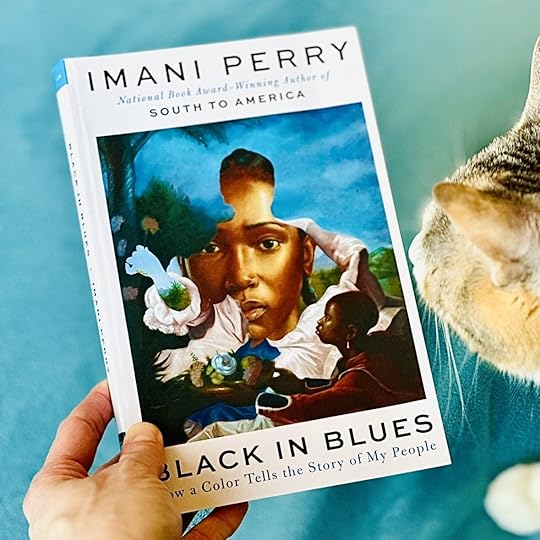
I definitely fell for the judging-a-book-by-its-cover. It's gorgeous! I was right 😍
This is a beautifully, sorrowfully, inspiring book full of names and places centered around the color blue and its presence in Black people's lives around the world. Some of the content was familiar to me. Much of it was new to me.
This was an interesting thesis - to highlight one color in its many forms and how it's been presented and represented Black lives, including birds, music, movies, politics, people, works of literature, skin tones and eye colors, jewelry, spirituality, and so much more.
The book goes fast, so write down, highlight, look up, etc. anything else you want to deeper dive into. I can't believe how much information is in here. It starts even before colonial days in the US and goes as current as Bobbi Kristina Brown's death in 2015.
💙 An eloquent tapestry of historical facts and personal anecdotes. Insightful and meditative.
"Still I wondered, why so much blue? And what makes it matter? What makes it mournful and hopeful and Black?"*
Imani Perry's treatise on how Blackness is historically intertwined with the color blue covers a vast array of topics: enslaved men who became masters themselves, West African cloth dyers, the folklore of blue jays in the American south, use of bluestone for hoodoo, ceramics and pottery, jazz music, Black people with blue eyes, and more, as well as many notable figures such as W. E. B. Du Bois, Zora Neale Hurston, Andrée Blouin, and others.
Perry journeys across the globe, charting the color blue like a time traveler, leaping forward and a back to all of the strange and surprising instances when blue and Blackness merged significantly.
Most chapters are only a few pages long. Some are steadfast and focused, while others meander like the blue waters Perry writes about. Occasionally Perry inserts personal anecdotes and wisdom, sharing her own experience as a Black woman.
What I found most enjoyable about this book is how Perry lets the color blue lead her on a curiosity voyage, allowing its presence to draw her from one person, time, or place, to a related object, incident, or observation.
Take, for example, the chapter titled "Lonely Blue", which traces the color blue as follows:
Billy Blue, a freed enslaved man, who married a white woman (a fellow ex-convict) ⬇️ the dispersal of Africans across the globe brought varied Black people together ⬇️ Black people slowly ventured into white spaces ⬇️ Phillis Wheatley, the 1st published Black poet in the US ⬇️ the Black people Henry Thoreau found living around Walden Pond ⬇️ water, and how maritime life became a way for Black men to strike out on their own ⬇️ Crispus Attucks escaped slavery in the south and made an itinerant living on whaling ships ⬇️ Moby Dick and the Black cabin boy named Pip ⬇️ the Inner Passage through South Carolina Sea Islands lead to Mexico and freedom ⬇️ Daniel Blue, enslaved but emancipated, then became a minister and adopted an enslaved girl ⬇️ the Civil War, enslaved men donned a blue uniform and joined the Union Army ⬇️ Black soldiers in the Union Army were known as the "boys in blue" ⬇️ after the Civil War, the blue uniforms went to cops.
And she concludes with this devastating point: "In the twenty-first century, the retaliatory response to the slogan "Black Lives Matter" was "Blue Lives Matter." Think about it. The quip contrasts Black life with police survival—one must choose, it implies. And that is a blues song indeed."*
All of that ☝️ is just NINE PAGES in the book.
At times, it seemed the book might benefit from being structured into themed sections like Art, Literature, Abolitionists, etc. But with some chapters encompassing a little of everything, I'm not sure this would be possible. Overall, it's an arresting exploration of history and a stunning ode to the beauty and strength of Blackness.
To say that this book hits hard is an understatement.
To say that it's beautifully written falls short.
To say that it will make prize lists this year is a given.
*Note: All quotes taken from an advanced reading copy and are subject to change upon publication.
My heartfelt thanks to Ecco books for generously sending me an ARC of this book. 🩵
--
ORIGINAL POST 👇
This book sounds amazing. 👀
UPDATE: I got an ARC in the mail! 🩵
Not only does this book encompass an emotional, cultural, and spiritual exploration of Black history, but it does so in tandem with the color blue, examining how the color has been intertwined with Blackness throughout history.
Honing in on the historical significance of a color is such an interesting way to approach a subject. And the color blue is so intriguing because its symbolic meaning can vary greatly (i.e., blue skies and waters can symbolize hope whereas having the blues symbolize heartache and melancholy).
And the author is Imani Perry, who won the National Book Award for South to America. All signs point to this book being a potential prize winner.
Black in Blues covers everything from dyed indigo cloths of West Africa and dark-skinned people characterized as "Blue Black" to blues music and blue flowers planted at a loved one's grave.
This is a beautifully written book about the color blue and how it parallels with the history of black folks (the blue of the water bringing the slave ships to America, signs, symbols and feelings) in the African Diaspora.
Blue Indigo was a commodity and was harvested before cotton replaced it. It was also a recompense for greed in the Trans-Atlantic slave trade.
Blue affects balance and harmony but this soon becomes imbalance. True Blue was not only the name of a slave ship but, the definition and its origin. The introduction of the indigo trade in South Carolina and was a different form of slavery (not a good one, just different).
Blue burial beads were a way of adornment, and blue took on several contexts and spiritual meanings throughout history for blacks in Jamaica, Haiti, Africa, South Carolina, the Caribbean and throughout the world.
There is so much more that I can say about this great book!
I listened to it via Libby (the author narrated and she was great!), but I will patronize my local bookstore and buy a physical copy to read.
I will never look at the color blue the same again!
The narrator of this audiobook is the author, Imani Perry. Her voice is soft, genteel, and cultured. It's an advantage to hear the author read her own words. Most especially in this book, which is almost laid out like poetry but broken up by historical essays.
This is somewhat a history of Black Americans and the Diaspora, as seen through our connection to the color blue. My favorite colors are Black & purple. However, I'm well aware that blue is the most common favorite color alongside green.
Blue is special to Black Americans who created a musical genre, literally called 'the blues'. It also holds significance in African Traditional Religions (ATR) in the Americas. All over the South are 'haint' blue porches. Haint blue is my favorite shade of blue. It's not widely available in Detroit, where I grew up.
This also covers the history of Indigo and its ties to the Transatlantic Slave Trade. I don't really know how to describe this. A love letter to Black folks works. This is beautifully done and not to be missed. In fact, I pre-ordered this on audiobook because I can already tell this will be a top reread of mine during the shenanigans of the coming 4 years. This is like chicken soup for the Black Soul. I think readers across the Diaspora will appreciate this. It's simple, historically accurate, and weirdly comforting. Something I don't often say about nonfiction that deals directly with chattel slavery and the Middle Passage.
For those interested in the spiritual meaning and representation of blue, I offer Grandma Baby Apothecary's: Grandma Baby's 52 Blues playing cards. They are round and gorgeous, my Ancestors love them. If you don't understand this reference, no worries🥰 This is primarily for folks interested in ATR's. https://grandmababyapothecary.com/pro...
Thank you to Imani Perry, HarperAudio Adult, and NetGalley for the opportunity to listen to and review this audiobook. All opinions and viewpoints expressed in this review are my own.
This is a collection of essays, some personal to the author and others rooted in Black history. Each was interesting and beautifully written. The underlying premise of the collection is that there is some connection between Black history and the color blue. I found that gimmicky, although the author insists that it is not. The author did an excellent job narrating her own audiobook.
I received a free copy of this audiobook from the publisher.
Imani Perry's mind is astounding. I had no idea just how many connections she would find between the color blue and Black history and culture. This is a dense read but a thought-provoking one.
Content notes: sexual violence, child sexual abuse, incest, physical abuse, substance abuse and overdoses, medical abuse, industrial abuse (e.g. diamond mining), genocide, suicide, death of babies and children, death of author's cousin (after heart and lung transplant surgery due to sarcoidosis), enslavement, segregation, racism, racial slurs, branding, limb amputation, diphtheria, malaria, syphilis, forced family separation, colonialism, incarceration, mob violence, police violence, political assassinations, indigo trade, pregnancy, menthol cigarettes
Magnificent read. Blue is truly the expression of what it means to be black across the diaspora, whether describing indigo's significance, hoodoo practices, blues music which expressed the pain of Black American's pain, etc. My first read of 2025 is amazing.
Imani Perry is one of our beacons in the Black community. She has written a book that is timeless and classic. Imani has become a staple in the households of many. This book will remain a classic because of its depth and weight Imani Perry does this so well in this novel. She has given us a beauty that examines not only a theme worth talking about, but that is relevant and that will be reread for generations and generations to come.
I loved every minute I spent with this book and re-listened to the many bookmarks I had made in the Libby App along the way. It was truly a profound experience. I have included quotes here from several of the stories or essays that were particularly poignant.
Writing in Color:
Imani Perry states, “I wanted to write toward the mystery of blue and its alchemy in the lives of Black folk.”
“I wanted to offer truth with a heartbeat and so I steadily collected Black stories of blue and the Blues, both literal and figurative.”
The stories truly flow seamlessly. Truly they are “bound together in a tight weave.” Perry writes that as she was deciding on the order of the stories, “I was revealing and witnessing, quilting something present.”
She continues - “Along the way, I learned much more than I already knew about what it means to be a blues people, events, artifacts, sound, color, breath, death and depth spoke to me and through me and that is this book."
"In it, loose threads and frayed patches are as important as seamless compositions and straight stitched stories, perhaps more so because life is neither tidy nor done, it is doing.”
The Blue Note:
“You can see the blue note isn’t one thing, it is a flexible relation to the scale in the most African of interventions into Western music. That kind of sound is in fact a window into the entire tradition."
"A blued note is so distinctive that someone who knows nothing about music formally speaking can hear it is special.”
Lonely Blue:
“Part of the story of Blackness must focus on those who ventured into white spaces, largely or completely alone like Billy Blue. Singularly marked or one of a few without the cushion of a common culture with an active font or the prospect of revolt, a lonely Blackness could make a soul blue.”
I learned that the poet Phyllis Wheatley – “The first published Black woman poet in the United States who is famous to this day died without a marker.” She lies buried in the Copp’s Hill Burying Ground in Boston “where the gravestones look bluish in morning light but there is nothing that reads, ‘here lies Phyllis Wheately’ as exists for the people that owned her, the ones for whom there is far less historic significance.”
“When you are one of the lonely people misfitted in the Nation’s self-image you can look like threat even when you’re the one with the foot on your neck. That is not intended to be poetic, it is just a way to name the raw consequence of a long history in which Black yearning to be free was verboten for longer than it has been accepted."
"Sure things have changed, we are not slaves, but what is is still not good enough.”
Blue-Eyed Negroes:
“As much as I delight in all the colors of Blackness from blue-eyed and blue-veined to blue-black from the comfortable position of being brown, the short-hand term for being in the middle critical mass of color, I know this isn’t a happy motley.”
“Grief can be carried in color. For some, it is the grief of being close to but not quite white or of carrying a strangeness within Blackness that makes other Black people skeptical or resentful.”
“For others, it is the grief of being considered too Black even for Black people and having a body that is marked as a kind of shame as though blue-Black flesh is a disaster.”
Blue-Black Speller:
“Before the war reading was a dangerous activity for bondspeople, you could be maimed or killed – certainly sold away from loved ones as punishment for an activity that was believed to make slaves unsuitable for servitude.”
“People sneaked learning. Enslaved children hovered around the lessons for white children to get a little bit of book knowledge.”
“In a time and place where people caught hell quicker than a cold, a country harder than iron if you were born Black, books became an anchor.”
Egyptian Blue in Alabama:
I learned that “As a child [George Washington Carver] loved plants, crafts, music and learning. A motherless child, he cherished a few inherited possessions from his mother including her old spinning wheel and polar lamp. He carried them with him whenever he traveled to acquire more education.” I loved that he honored his mother in this way.
I didn't know that “Carver introduced the practice of crop rotation, that’s where his famous peanuts came in. He instructed the people to grow cotton one year, then peanuts the next and so on.”
I learned about the beautiful blue morning glories that I love – “There are fourteen hundred different kinds of morning glories, they are perennials, some travel along roadsides and some gather in thickets, some are invasive and are called appropriate names like witch’s shoelaces and strangle weed, they line fences and make tracks on sandy beaches.”
“Decorative gardening of the sort [former slave Tildy Collins] did, and Carver painted did not originate in West Africa, rather it was something that Black people took on in the Americas having learned it from Europeans, but it was no less theirs. Who you are is what you stand in.”
“Gardening was especially precious as a pleasure that flourished despite captivity and cruelty. It is a delicate thing to say. Every time you allow for joy it seems to invite those who would say it wasn’t that bad. It was horrific and still there was joy. Telling the whole truth including delight cannot, should not absolve the nation of its shame. It should make the indecency all the more apparent.”
Bentonia:
“So much of what is held dear will necessarily be forgotten or left behind and our past is only available to us through the artifacts and imaginations of those who came before and only as long as somebody lives to tell us what was told and why.”
Perry writes that “the most important preservation is not perhaps a particular place or thing, but the sensibility that lies in blues, that of living as a protest. It can remain even when recordings degrade and buildings crumble.”
“Spiritual sustainability is a natural condition for those on the underside of empire.”
From Indigo Child to Whitney’s Blues:
“I think it is true that art is that thing we bring into our life in order to transform it. Art has an immediate force, it feels so good to dance, to sing, to play but it also has environmental power – we can retell and rearrange who we are to one another.”
Seeing the Seventh Son:
“The people who encounter the beauty of an artist’s work are also experiencing labor, process and memory. We are part of their transformation and transposing of our relationship to the past.”
“Frequently, Black people speak of being haunted by the past – slavery, conquest, Jim Crow, colonialism, but the artists teach us that people of today to haunt the past, to whisper to the ancestors and rearrange the materiality of their lives with our care, to show them that they’re respected and loved.”
“We haunt the past to refuse to let it lie comfortably as it was. We give back to them in return for the inheritances they have bestowed upon us. That’s what I see in Adebunmi Gbadebo’s artwork.”
What a beautiful tribute to color blue among the African diaspora! Imani Perry does not miss. I had the pleasure of seeing her at an author event in 2024 where she told us about this book. I knew then I immediately had to read it. She went over many things that I knew she would, others that I didn't think of the connection, and some things that were new to me. There were a few times where I did wish she went more depth on a few of them. For instance, in the chapter Janie's Blues (named after Zora Neale Hurston's female main character in Their Eyes Were Watching God,) I wanted a little more information of voodoo and hoodoo. I think this book will definitely serve as an introduction for some subjects to do a deep dive on later. Hoodoo Blue, Blue-eyed Negroes, The Blue Note, Afro Blue, and the boys in Blue were some of my favorite chapters but honestly really enjoyed this book. When Perry closed the book out talking about her friendship with artist Delita Martin, I was so satisfied. Martin's work is amazing and the emotion in her paintings are palpable. I will definitely high recommend this book and I plan on re-reading in the future.
I was reading my advanced copy when I was approved for the ALC. I pressed play and instead of picking back up where I left off, I ended up starting the book over because I enjoyed listening to Perry so much.
Halfway through this book, I had to wave the white flag and surrender. I suppose it probably should’ve been a blue flag.
I was very excited to read this book the moment I heard the premise. In fact, I was talking to people about the book before I even read it - that’s how excited I was.
Then I started reading.
Listen, I’m not an idiot. I’m well educated, I’ve been a published author for decades, I’m very well read. I’m not a genius by any means, but I’m smarter than your average bear.
Every once in a long while, I read a book that uses words in such a purposely complex way, that it makes me feel like an idiot. Sometimes, like with Ta-Nehisi Coates, I get through the book and think “wow, that author is brilliant.” More often than not, I get part of the way through the book and realize the author is making reading so difficult because they’re really saying nothing.
Unfortunately, I’m going to go against the trend of reviews and say that Imani Perry is in the latter category.
The premise of this book is that Black peoples history is intertwined with the color blue. Imani then tells stories about how the history of black people is all about fighting for survival in a world that wants to beat them down. Amidst these stories are references to blue, some obvious (Blues music), some interesting (farming Indigo) and many ridiculous and forced (a horse with “Blue” in its name that a black person once rode, a guy with the last name Blue who got arrested and deported to Australia, a cocktail named Blue N****).
All in all, I’m no more convinced that the color is attached to the history of black people than I was before I read the book.
But that’s not even my main point in this review.
As Steve Martin said to John Candy in “Planes, Trains and Automobiles”:
“Let me give you a tip: when you tell a story, have a point.”
Each chapter is like a stream of consciousness for somebody who wants to write like Malcolm X can speak. The average simple sentence is made into such a muddle of intellectual blather that after a chapter or two your just begging for her to say something like a normal person would speak in todays day and age.
What’s even worse is that Imani continually goes into excruciating detail into topics that simply don’t matter for her story. In fact, most of the chapters ramble from intricate and mundane details from one random thought into another and another.
It’s no wonder she refers to Moby Dick a few times, as the writing reminded me of that book: pages and pages of excruciating detail into minuscule topics that are irrelevant to the readers understanding of what’s going on. (If you haven’t read Moby Dick, it’s a really hard read. I never could finish it).
I read a bunch of other reviews of this book down below. Everybody talks about the writing, and almost everybody is praising it while still saying they didn’t understand it.
I’m not going to give it praise (obviously), we are supposed to understand writing. Using big words and complex sentences just for the sake of trying to sound smart is a waste of our time.
I’m sure Imani is an incredibly smart person, but this book is a big swing and a miss. It bums me out because I was so very much looking forward to it.
Black In Blues by Imani Perry is a profound and moving journey into the color blue’s deep-rooted meaning within Black History. The author beautifully weaves together the threads of blue, culture, and identity, tracing their connection to Blackness from the harrowing days of the slave trade to the vibrant realms of our music and literature. This heartfelt exploration is presented in a way that captivates and enriches, leaving me with a profound sense of understanding and appreciation for the significance of my people and the color blue.
Audiobook (9 hours) narrated by the author, Imani Perry Publisher: HarperAudio
Unsurprisingly, Imani Perry executes a flawless narration of her novel. Her lectures at Princeton, where she is a professor of African American studies, must be overflowing on the regular, if this novel is any example of her melody of skill sets; researching, writing and teaching through stories being among them. The audio is flawless.
When I saw that this book was coming out this year, I was drawn in by the title. Black in Blues. My curiosity was further peaked by what I anticipated the book would be about:
A surprising and beautiful meditation on the color blue—and its fascinating role in Black history and culture—from National Book Award winner Imani Perry
.
While reading the synopsis my mind went to the train cars between the US and Mexico, back before World War II, which were died a beautiful blue. The blue came from the fumigation that the US would use to spray Mexicans who were entering the country, as they were seen as dirty and needed delousing before being allowed entrance. The chemicals used were not meant for humans and the idea of them was used by Hitler when forming the gas that was used to slaughter countless innocent men, women and children... In the horrific places where these beautiful Jewish individuals took their final breaths was left this amazing shade of blue. Prussian blue.
Prussian blue was discovered accidentally way back in 1704 in Berlin from experiments with iron oxidation, specifically iron cyanide. Iron cyanide isn't the same as free cyanide, which we think of when speaking of cyanide poisoning, however, the cyanide within it can be released as free cyanide. I cannot recall the exact way in which this happened but if I remember correctly this story is outlined in When We Cease to Understand the World. (I reviewed it here: https://www.goodreads.com/book/show/6... but do not mention it's contents.)
The story of Prussian blue lead me down a rabbit hole, where I read and watched videos for hours and hours, thought about it for days. Clothing, art, the painting inside homes, on the outside of buildings, the pigments in makeup, paper, and just... the popularity of a color that is now all around us, originating from the racist fumigation of migrant Mexicans and viciously murdered Jewish. Few people know the origins of what is all around us every day. That people looked at the colors of the walls of these places of dishonor and thought, wow... That's a beautiful color, how can we replicate that to paint murals as vibrant as those in the Sistine Chapel?
And yes, while the color was discovered well before the war, it was during and after the war that the color went viral, let's say. Of course my version here is from memory and the details may be a bit off here or there, as it is from my personal thoughts and memories. If it's interesting to you, I encourage you to poke around a little bit, maybe consider the book I mention above.
As I often do not go into detail of the book, as I feel the inside is the journey that you choose to take or not and is yours alone, I will not spoil much, but there is a detail that I cannot help but share and it really brought this nearly full circle to me in a roundabout way from the time I first learned of Prussian blue to seeing the synopsis of this book:
If you missed the spoiler as you did not want to spoil anything in the book, I also include some of my own thoughts that you may want to read after. The short of it is that things that surround us, that we don't often even give a second thought as they are so ingrained into our lives, have deep back stories and are, were, or may become potential game changers.
Great read and I do recommend the audio book, although if you like to have things on hand to refer too, you may want both as there are a lot of great stories and details that you may want to refer back to again and again.
Black in Blues opens with Imani Perry talking about how she's been studying colors lately and how besides black, the color blue has been closely associated with Black people. For the past couple of months, I've also been paying more attention to color and how it appears in art, photography, and culture. Besides red, the color that I associate with humanity because of blood, blue is often studied alongside red. My studies have shown me that blue is synthetic or unnatural. There are very few, if any, naturally blue things in our world. The sky isn't actually blue and water was historically described as "wine red" or black. The color blue had to be created and with blue came so much struggle and triumph. From colonialism to the way the color is perceived as holiness, the color blue can be symbolic of Blackness.
Immediately, Moonlight (2016) comes to mind because of the quote: "In moonlight, Black boys look blue." Blue is used in this film for tranquility, peace, and finding one's true self. I also think of the paintings of Amy Sherland, particularly her portrait of Michelle Obama. The blue backdrop of that piece about the outgoing First Lady stands out to me along with the Blackness of her skin. In Imani Perry's book, she talks about occurrences like this in Black art along with what I mentioned earlier about how blue has been associated with religion or "holiness."
Some of my favorite chapters focused on arts and folklore. From hoodoo to blues music and the painted homes and doorways of the Deep South and Caribbean stand out to me. To Nina Simone, a classically gifted pianist who is associated with soul, jazz, and blues. Black people are people of water. Our relationship with water is complicated. The Trans-Atlantic Slave Trade is widely considered one of the worst human atrocities in history. Any time I think of what those people endured on those trips, I feel tears forming in my eyes. For Black Christians, water is associated with Baptism and renewal. The idea of cleaning the "unclean" body and soul is a strong theme in Black culture.
This book touches on slavery about two-thirds of this book. This did not bother me and it doesn't go into the grim details. What Perry manages to do is talk about how blue is perceived as innocent. The chapter that stands out the most here are the blue eyed Black children created out of institutional sexual abuse between an enslaved Black woman and wealthy white enslavers. Those children reminded the wives of these plantation owners what their husbands were up to and it also served as a point of marketing in abolitionist pamphlets in the North. It was easier to attract white people to a cause by showing light skinned biracial slaves due the the perceived innocence.
As someone who reads Toni Morrison closely, particularly her first novel The Bluest Eye, I had to try not to shout when Imani Perry mentioned this book and how it went against the Black Arts Movement of the time. She (and Toni Morrison) raised the question: what happens when Black isn't perceived as beautiful? What do we do then?
While this book isn't a full picture of Black cultural history in the United States and the Americas, it does a great job of introducing ideas and points of reference to the readers. I was able to keep up with this with no problem and it was very readable. I read it in one sitting and I found it to be calming and deeply interesting. This is such a treat for people who want to study arts, culture, and history.
Amazing, fascinating and highly readable book. Just full of 'stuff.' History, philosphy, art and music, religious beliefs, and all centering around the color 'blue' and what it means to those who were forceably caught, sold and sent around the world as property. Yep, just like you own a knife and fork, or a book and a house or a horse, you can own a person. Do what you want to them, actually, truly, yes and I mean that. And we all know it, though many of us want to look the other way and say, get over it! Nah, this is NOT something anyone gets over...
I had to re-read some sections - there is a lot of densely-compacted material here. Names and dates. Places - a lot of geography. Helps to have an atlas nearby - or wikipedia or similar. The focus, on the color, might seem a little odd at first - it did to me. But then I saw it as a backdrop, kind of like the scenery which shifts now and then as a play moves on. (You aren't supposed to see the crew who rushes onstage all dressed in black to move a prop or replace a landscape in the background.) But it's always there, the color blue - as in indigo, as in the blues (music), as in the colors in people's clothing, or as in a mood. Blue is vibrant and bold, but it can also be confining and cold. It heats you up with a blue flame, or can be the color of wind-swept ice. It was a fantastic idea, to write a book about African-Amerians - which is kind of misnomer as the Africans who were enslaved, mistreated, ignored, imprisoned, sold like butter or bread at a grocery store all come from so many many different nations, regions and cultures across the African continent - based on a single color, but it works.
At any rate, Ms. Perry hits all the targets here. From politics to art and history and how Black people - which can be any range from pale beige or white, btw, to ebony-dark - have fared in the US and a few other places - over the last few centuries. It's not a pitying read - as oh, goodness, just look at poor us! No indeed. It's bold and bracing and terrifically honest.
I took a course almost fifty years ago - anthropology of all things - and I'll never forget the professor, now long gone, who told us students there really is no such thing, biologically, as race. There's variety, yes, born of geographical differences, migration, the way we inherit and pass on traits to the next generations, etc. etc. But we are all Homo sapiens, like it or not. (He was a fabulous teacher, btw.) For me, at eighteen or so, it was a fascinating idea - and a truth.
Back to the book: My favorite sections were on music, on the origin and history of the blues. Also, on the significance of indigo, the plant, and how African peoples (is that a correct turn of phrase?) prepared and used indigo, but then later how the plant itself and the dye it produced made so many white folks in the US so wealthy. Also, how so much of US history - and the wealth of thousands of families, institutions, companies and so on - rests on the backs of a large, enslaved population. So very much contributed, so very little acknowledged.
(Sorry for the overuse of the word 'so,' but it fits. So much.)
A great book, I plan to own it. (The one I read was borrowed.)
This is a very interesting book. Love the history behind it. The more I listened to the audiobook, the more it made sense. Even though my favorite color is pink, I’ve always been attracted to blue. The darker the blue, the more I love it.
The way this book is formatted reminds me so much of the survey courses I took in college and it scratched an itch in my brain that I haven’t been able to reach since I graduated😂 I didn’t even mind that it wasn’t strictly chronological either even though that’s usually a big issues for me! I found the material and history super interesting, especially considering a lot of the foundational knowledge I had on some of these topics was from romance books😭 So if anyone ever tells you that you don’t learn anything reading romance, think again😌 I also listened to the audiobook and having the author narrate was truly a brilliant move because it felt so much more engaging and interesting because you could tell not just from the words being spoken, but the emphasis and emotion behind the words that the author put so much energy and care into their research👏
3.5 stars // a beautifully written, innovative, poetic & informative book on blue throughout the history of Black america/americans. i love, love, love the concept & theme but felt the content itself was so jam-packed with information that it was overwhelming. you definitely need to read this book slowly because so many different topics are addressed, & each chapter contains condensed biographies of a handful of people. overall, i learned so much (although i feel like i will lose a lot of the information bc my brain capacity is small😔). goodness, if i ever wrote anything like this, or ever completed such a grand & meaningful project, i wouldn’t know what to do with myself…very inspiring <3
This book's beauty cannot be exaggerated. So much history with its joy, sadness, tragedy, and agility in overcoming is found on each page. Honestly, I never knew how much we could relate to the color blue. Now I do, and my eyes are opened to signs I have unintentionally ignored or knew little of.
such an interesting analysis and subject to research and write about ! I learnt so much, the writing style was clear and poignant. My only issue with this book is how discombobulated the chapters were, I get that the main theme throughout was the color blue and it’s relation to black folks, however each chapter felt a bit too isolated and made the reading experience slightly unsatisfactory.
this is an incredible text. a history book that narrates facts emotionally and through this, teaches it‘s ethics easily. although much of what is relayed was hard to confront, Imani Perry‘s poetic voice guided me strongly across the globe. as someone who‘s been interested in decolonialist theory for a while, this opened up a whole new level of perspectives. truly, I invite every white person to consult this text in order to understand the depth of racism and the century-long tradition of suppression and exploitation. I‘m very impressed by the author‘s ability to convey so much in relatively few pages. the concept of this project drew me in right away and I think it was perfectly executed.






![Profile Image for laurel [the suspected bibliophile].](/_next/image?url=https%3A%2F%2Fi.gr-assets.com%2Fimages%2FS%2Fcompressed.photo.goodreads.com%2Fusers%2F1645808644i%2F7494844._UX200_CR0%2C6%2C200%2C200_.jpg&w=128&q=75)


