

What do you think?

Life in Hell #11
Will and Abe's Guide to the Universe
Why do skeletons dance?
Is there a Queen Kong?
Are zombies ever happy?These are just a few of the many perplexing questions asked, and sometimes answered, in . . . Will and Abe's Guide to the Universe
This is the very latest in the ever-expanding series of mini-jumbo cartoon compendia by that rabbit-drawing rabble-rouser Matt Groening, author of Love Is Hell™, Childhood Is Hell™, and many, many more hell-bound books.
Unlike other collections gathered from Matt's provocative Life in Hell® comic strip, Will and Abe's Guide to the Universe shows a different side of the politically charged TV-cartoon guy—that of dazed but proud dad. All the words in these comic strips are taken from Matt's feisty and funny sons Will and Abe: their actual conversations, stories, songs, arguments, theories, explanations, excuses, snappy retorts, and flights of fancy.
If you have kids, know kids, have been a kid, or remain a kid at heart, you know that kids say the most hellish things!*
*Any similarity between "hellish" and "darndest," implied or otherwise, is impossible, because darndest isn't really a word, is it?
Contains the following wildness:
And much, much more!
Collect all 73 comic strips! Better yet, we did it for you! So buy this book!
Includes the classic comic strips
"Interview with a 3-Year-Old Vampire,"
"I'm Going to Tell God to Kick You," and
"The Girls at School Drive Us Crazy!"
84 pages, Paperback
First published September 17, 2007
About the author
Matt Groening
1,062 books447 followersMatthew Abram Groening is an American cartoonist, television producer and writer from Portland, Oregon.
Groening is best known as the creator of The Simpsons. He is also the creator of Futurama and the author of the weekly comic strip Life in Hell. Groening distributed Life in Hell in the book corner of Licorice Pizza, a record store in which he worked.
He made his first professional cartoon sale to the avant-garde Wet magazine in 1978. The cartoon is still carried in 250 weekly newspapers.
Groening is best known as the creator of The Simpsons. He is also the creator of Futurama and the author of the weekly comic strip Life in Hell. Groening distributed Life in Hell in the book corner of Licorice Pizza, a record store in which he worked.
He made his first professional cartoon sale to the avant-garde Wet magazine in 1978. The cartoon is still carried in 250 weekly newspapers.
Ratings & Reviews
Friends & Following
Create a free account to discover what your friends think of this book!
Community Reviews
Displaying 1 - 15 of 15 reviews

January 4, 2008
You couldn't ask for a better comic duo than Will and Abe. When the overly dramatic, death-obsessed spinner of improvised monster stories is the straight man, you know your comedy team is something special, and imagine Matt Groening's pride at having played an integral role in bringing this comedy team into the world, and imagine his relief at the discovery that all he had to do from now on was eavesdrop on his kids fighting in the next room in order to produce hilarious, effort-free comic strips.
It's unfair to label Will the straight man, as his penchant for creating hilariously unwieldy titles for horror films provides some of the book's biggest belly laughs, but unfairness is what being the older sibling is all about. Take it from one who knows. The eldest was here first, and by rights ought to be able to claim dibs and superior knowledge in every aspect of life, while the youngest is just happy to be invited to the party. The youngest's refusal to heed, properly appreciate, or even attempt to comprehend the magnitude or value of the eldest's position or wishes ignites within the eldest intense feelings of confusion, depression, and rage. A child cannot be expected to deal properly with even one of those powerful emotions, let alone an unexpected and immediate Molotov cocktail of all three. The result is an uncontrollable and unattractive outburst, or temper tantrum, emanating loudly and often from the eldest, a phenemenon that is, unfortunately, hugely entertaining for the youngest, who hasn't a care in the world, barring a desire to repeatedly experience things that are loud and make them laugh. You now have the makings of one of the most vital, enduring, bizarre, recognizable, and (in hindsight) hilarious relationships the human race has to offer, and Groening's simple but ever-expressive childlike doodles have rarely if ever been put to better use than in documenting the brother-to-brother dynamic of these kids he so clearly loves to pieces.
If Will is the proud bearer of his dad's boundless and overactive imagination, than little cape-wearing Abe is the lucky recipient of Pop's sly, out-of-left-field wit and whimsical disinterest in adhering to the average human mentality that has marked Groening's irreverent guides to life and made Homer Simpson a character we continue to cheer for in spite of his many unseemly qualities. A toddler throughout most of the book, Abe's lack of vocabulary prevents him from adding much to the conversation, but when he does talk, it's either cute, insane, or hilarious, and generally all three at once. If and when his piped-up comments are at all related to the topic at hand, they rarely direct the discussion down a road that Will had intended to explore, and Abe's refusal to play by the rules never fails to infuriate his brother, who can't see how improvising an exuberant song about kicking people in the penis could possibly enhance a conversation about the perils of going to the mall at Christmastime.
My favorite strips, however, contain the moments when Will cracks up at Abe's antics in spite of himself, when he drops, or loses his death-grip on, the inherited burden of older-brother entitlement and sense of propriety, and finds himself naturally reacting to this ridiculous and maybe even brilliant creature flopping around like a madman for the benefit of him alone and for the approval of no one, for the sheer joy of acting out. There are beautiful panels of Will and Abe simply laughing at their own obnoxiousness, little boys with goofy smiles surrounded by "ha"s, suitable for framing. Sure I screamed at my own little brother for ruining the watertight plots of every one of my meticulously thought-out G.I. Joe battles, but later that night at the dinner table when he responded to one of our dad's angry scoldings by turning to our mother and innocently inquiring, "Mom, why is Dad so cross?", no amount of parental disapproval could have contained my giggles of appreciation.
For me, the moment that best captures what this perfectly viable Guide to the Universe is all about comes when the brothers are discussing Abe's omnipresent cape, with which he periodically assumes the identities of Batman or Dracula, depending on where the day has taken him. After somewhat testily asking Abe why he wears a cape all the time, Abe offers a simple response (something like "I like it" or "I'm Batman", I forget exactly), and rather than mocking him further, Will matter-of-factly replies "A cape looks good on you, Abe". It's a throwaway moment that retains a quiet power, a nice compliment for Abe but a statement that belies an essential, lovely, and impressively early epiphany for Will, whether he realized it at the time or not.
Apart from being the funniest 45 minutes you'll spend with a book this year, "Will and Abe's Guide to Universe" is the most accurate and loving portrayal of early brotherhood you'll ever read. Those who were forced to contend with younger siblings of either sex in childhood may find more food for thought than others, but I can't think of anyone who wouldn't enjoy spending time with these hilarious kids.
It's unfair to label Will the straight man, as his penchant for creating hilariously unwieldy titles for horror films provides some of the book's biggest belly laughs, but unfairness is what being the older sibling is all about. Take it from one who knows. The eldest was here first, and by rights ought to be able to claim dibs and superior knowledge in every aspect of life, while the youngest is just happy to be invited to the party. The youngest's refusal to heed, properly appreciate, or even attempt to comprehend the magnitude or value of the eldest's position or wishes ignites within the eldest intense feelings of confusion, depression, and rage. A child cannot be expected to deal properly with even one of those powerful emotions, let alone an unexpected and immediate Molotov cocktail of all three. The result is an uncontrollable and unattractive outburst, or temper tantrum, emanating loudly and often from the eldest, a phenemenon that is, unfortunately, hugely entertaining for the youngest, who hasn't a care in the world, barring a desire to repeatedly experience things that are loud and make them laugh. You now have the makings of one of the most vital, enduring, bizarre, recognizable, and (in hindsight) hilarious relationships the human race has to offer, and Groening's simple but ever-expressive childlike doodles have rarely if ever been put to better use than in documenting the brother-to-brother dynamic of these kids he so clearly loves to pieces.
If Will is the proud bearer of his dad's boundless and overactive imagination, than little cape-wearing Abe is the lucky recipient of Pop's sly, out-of-left-field wit and whimsical disinterest in adhering to the average human mentality that has marked Groening's irreverent guides to life and made Homer Simpson a character we continue to cheer for in spite of his many unseemly qualities. A toddler throughout most of the book, Abe's lack of vocabulary prevents him from adding much to the conversation, but when he does talk, it's either cute, insane, or hilarious, and generally all three at once. If and when his piped-up comments are at all related to the topic at hand, they rarely direct the discussion down a road that Will had intended to explore, and Abe's refusal to play by the rules never fails to infuriate his brother, who can't see how improvising an exuberant song about kicking people in the penis could possibly enhance a conversation about the perils of going to the mall at Christmastime.
My favorite strips, however, contain the moments when Will cracks up at Abe's antics in spite of himself, when he drops, or loses his death-grip on, the inherited burden of older-brother entitlement and sense of propriety, and finds himself naturally reacting to this ridiculous and maybe even brilliant creature flopping around like a madman for the benefit of him alone and for the approval of no one, for the sheer joy of acting out. There are beautiful panels of Will and Abe simply laughing at their own obnoxiousness, little boys with goofy smiles surrounded by "ha"s, suitable for framing. Sure I screamed at my own little brother for ruining the watertight plots of every one of my meticulously thought-out G.I. Joe battles, but later that night at the dinner table when he responded to one of our dad's angry scoldings by turning to our mother and innocently inquiring, "Mom, why is Dad so cross?", no amount of parental disapproval could have contained my giggles of appreciation.
For me, the moment that best captures what this perfectly viable Guide to the Universe is all about comes when the brothers are discussing Abe's omnipresent cape, with which he periodically assumes the identities of Batman or Dracula, depending on where the day has taken him. After somewhat testily asking Abe why he wears a cape all the time, Abe offers a simple response (something like "I like it" or "I'm Batman", I forget exactly), and rather than mocking him further, Will matter-of-factly replies "A cape looks good on you, Abe". It's a throwaway moment that retains a quiet power, a nice compliment for Abe but a statement that belies an essential, lovely, and impressively early epiphany for Will, whether he realized it at the time or not.
Apart from being the funniest 45 minutes you'll spend with a book this year, "Will and Abe's Guide to Universe" is the most accurate and loving portrayal of early brotherhood you'll ever read. Those who were forced to contend with younger siblings of either sex in childhood may find more food for thought than others, but I can't think of anyone who wouldn't enjoy spending time with these hilarious kids.
December 15, 2017
Back in 4th grade, this was my shit.
August 30, 2019
I had a hard time deciding between 2 or 3 stars for this review. I finally chose 3 because I am a huge Matt Groening fan. However, this book is not nearly as funny as his Life in Hell books.
The premise of Will and Abe's Guide to the Universe is really intriguing and has huge potential. Basically Groening would overhear his two sons' conversations and stories, and recognizing their unique humor, made them into a comic strip.
As I was reading page after page of the book, though, I was reminded of a saying from America's Funniest Home Videos. The producers said they had to sift through video after video of OFTTF. Only Funny To The Family. I could see that a lot in this book.
I think Will and Abe's, etc, would be most enjoyed by someone with kids of their own. Since I have a daughter, a few of the strips reminded me of the hilarious things she would say, just as I was mindful that they were probably only funny at the time, and to me and my husband.
On the other hand, Will and Abe's, etc, has made ME want to write the stories I remember of our family.
The premise of Will and Abe's Guide to the Universe is really intriguing and has huge potential. Basically Groening would overhear his two sons' conversations and stories, and recognizing their unique humor, made them into a comic strip.
As I was reading page after page of the book, though, I was reminded of a saying from America's Funniest Home Videos. The producers said they had to sift through video after video of OFTTF. Only Funny To The Family. I could see that a lot in this book.
I think Will and Abe's, etc, would be most enjoyed by someone with kids of their own. Since I have a daughter, a few of the strips reminded me of the hilarious things she would say, just as I was mindful that they were probably only funny at the time, and to me and my husband.
On the other hand, Will and Abe's, etc, has made ME want to write the stories I remember of our family.

January 26, 2009
This book is goddamned hilarious. Groening formerly drew on his own memories of childhood and brought out those observations with his hapless kid character Bongo, and now he has his own kids, Will and Abe, to provide new fodder.
He also seems to be raising them right with the classics of monster cinema so well-remembered from our own youths. I can't imagine a childhood without Mothra, etc. and these kids apparently know their stuff - not that they don't have questions.
"Why do people go to Dracula's castle?"
"Because he invited them"
"But he's a vampire!"
"They don't know that"
"But his name is DRACULA!"
Bonus fun fact: he didn't like them watching The Simpsons (too old for them?) and they razz him about it.
He also seems to be raising them right with the classics of monster cinema so well-remembered from our own youths. I can't imagine a childhood without Mothra, etc. and these kids apparently know their stuff - not that they don't have questions.
"Why do people go to Dracula's castle?"
"Because he invited them"
"But he's a vampire!"
"They don't know that"
"But his name is DRACULA!"
Bonus fun fact: he didn't like them watching The Simpsons (too old for them?) and they razz him about it.

December 31, 2012
When I was little, my parents would sometimes take a pen and a notebook and fill pages with the words that came out of my mouth. That notebook is still around, and it's amazing to go back sometimes and read over my childish inventiveness (which hit its peak, I think, with an elegiac poem called "The Boy Cries in the Peanut Butter Water"). Like my parents, Matt Groening kept a record of his children's monologues and conversations; unlike my parents, he chose to use his artistic talents to publish it. I'm not sure how his two sons have felt about that through the years, but I'm glad he did, because, as you might expect, Groening's kids are very funny and very, very strange.

June 22, 2012
With Matt Groening ending Life Is Hell, there's no better time to read up on the old editions of the strip and remember how good it was at its best. While a lot of people feel it peaked early, back in the 80s, some of my all-time favorite strips are the ones collected in this book, where his two young, imaginative, monster-obsessed, not-always-coherent sons interact with him and with each other. I fy away now, beardface!

October 23, 2008
I was obsessed with Groening's "Life Is Hell" strip growing up. I remember when he first announced that he'd be doing animated shorts for the Tracy Ullman Show which later became "The Simpsons". Anyway, this book is hilarious...it's actual conversations between his two kids. Kinda like "Kids Say The Darnedest Things" in comic form?

January 7, 2008
A collection of Groening's weekly comic that focuses on his transcription of things said by his two young sons. Features their descriptions of a trip to Bali and their interest in monsters and violence.

May 18, 2008
The Return of the Dinosaur Pop-up Book installment necessitates a five star review and that's as far as I got in the book before the authorities had to escort me out of the store for having too much fun with a book.

May 11, 2009
This is so cute and funny and had me laughing out loud many many times. I love the Simpsons but have never been that huge a fan of Akbar & Jeff or Life in Hell. But these: too much. I think mainly because they're verbatim (as much as possible) dialogue from Groening's kids.

June 13, 2010
The humor can be summed up in two quotes:
Will: Do clouds die??
Matt Groening: No, clouds don't die.
Will: Yayyyy!!
And...
Will: If I die, who will get all my toys??
Abe: Me.
Will: NOOOOOO!
Abe: Yes.
Will: Do clouds die??
Matt Groening: No, clouds don't die.
Will: Yayyyy!!
And...
Will: If I die, who will get all my toys??
Abe: Me.
Will: NOOOOOO!
Abe: Yes.
September 12, 2010
These comics are adorable and hilarious. What -- you need more than that?
February 1, 2011
I love the cartoons in this book; however, the thing I love the most is that the rabbit boys on the cover bear an uncanny resemblance to my sons when they were younger.

November 2, 2014
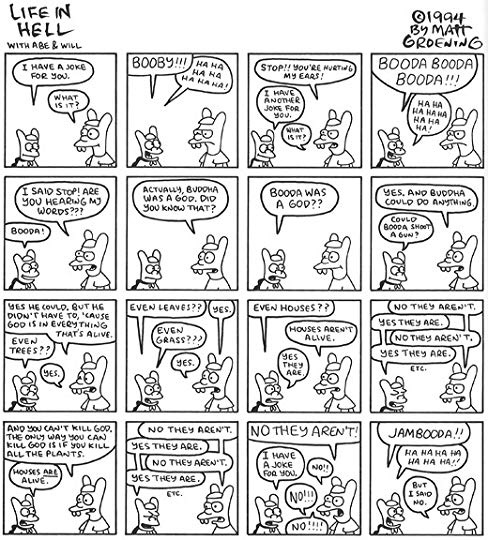
My favorite part is how sad Will looks in the last panel. "But I said no."
January 19, 2025
Hilariously funny and every cartoon rings true to life. My favorite Groening stuff (and I say that as a fan).
Displaying 1 - 15 of 15 reviews