"A tall man in the crowd lifted the little boy in his arms till the child’s face was nearly on a level with Tweedledee’s. The dwarf glowered at it, and clenched his hands. Surely the spring was giving way at last. All the wires began to tremble at once. How he hated this thing that was pushed at him! – this stupid little beast with sticky hands and dirty face, with staring eyes and drooping lips – this disgusting caricature of himself."
A gripping tale of desire, deception, and murder, from the pen of Tod Robbins, the author of the short story "Spurs," which was the original inspiration for Tod Browning's cult film FREAKS.
PLEASE NOTE: This is a newly formated edition of the text, proofread by a real live human being in an attempt to eradicate the typographical errors common to many available print and online editions. If you do find any mistakes, blame Br. Marcus (and please let us know so we can correct him – er – the mistakes).
Clarence Aaron Robbins, billed as C.A Robbins and better known as Tod Robbins, was an American author of horror and mystery fiction, particularly novels and short story collections.
Robbins authored two short story collections and several novels. His work often contains bizarre and frightening plots. His novel The Unholy Three (1917) was twice adapted for the screen, a silent version in 1925 and a sound version in 1930; both adaptations starred Lon Chaney. Robbins was also the author of the short story "Spurs", which was used as the basis for Freaks (1932), a film which later developed a cult following. Some of Robbins's work was later reprinted in the "Creeps" series of horror anthologies edited by Charles Birkin.
In the early 30s he moved to French Riviera and refused to leave during the Nazi occupation of France. He spent the war in a concentration camp and died in Saint-Jean-Cap-Ferrat in 1949 due to the consequences.
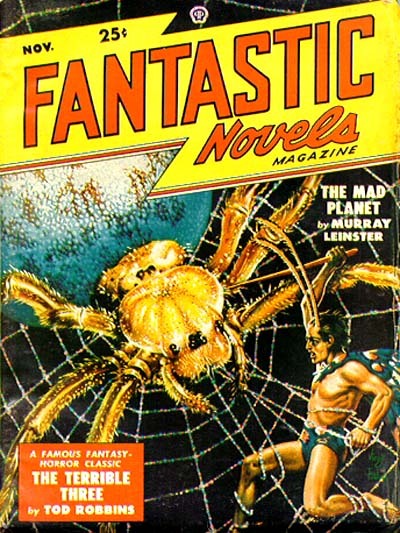
Will be reading from this Nov. 1948 issue of Fantastic Novels Magazine, titled The Terrible Three here. I've always loved the 1932 Tod Browning film Freaks, based on a story by the same author, and this seems to be in a similar vein.
I have seen the two Lon Chaney versions of THE UNHOLY THREE (silent and sound) on several occasions. Although both versions had their fun moments, the story of the unusual crime gang never really hooked me, and the ending seemed contrived. So, it took me a while to decide to read Tod Robbins’ original novel.
I absolutely loved it.
Robbins is mostly known for his novella, SPURS, which was made into the notorious film, FREAKS. Yet, THE UNHOLY THREE is much the better work and considerably darker. And I should probably clarify my rating. I am fully aware that THE UNHOLY THREE is never going to be seen as a great work of Art, nor is it going to make anyone’s “Greatest Novels” list. However, I was fascinated by it and couldn’t wait to feast myself on the next reading session ... which is undoubtedly why I finished it so quickly. The writing style effortlessly carried me along and I very much wanted to know what was going to happen next.
If you’ve seen one of the cinematic versions of THE UNHOLY THREE, the book is significantly different. The writer provides three highly disturbed characters who see themselves as forming one very dangerous human being. Tweedledee is the dwarf and the most seriously disturbed of all of them. He rages with hatred for all people because of the disrespect they show him. He is the Brain, and comes up with the criminal schemes. As a bonus, he insists on causing bodily injury to his victims as a way of leaving his “mark.”
The Body is Hercules, a circus strong man who idolizes Tweedledee and is his protector. At a complete loss when he needs to think for himself, his loyalty provides Tweedledee with the physical power he has always desired.
Finally, there is Echo, a very sensitive and disturbed ventriloquist. Echo is the Voice, and has the grace and gentle manners that suggest complete subservience. Echo also has a small wooden figure that perches on the shoulder and, while called Echo’s Brain, is more of a conscience. What the wooden figure whispers to the gentle Echo can be most unsettling.
These characters are introduced in the early chapters, and I don’t want to mention much more about them. It is not a worry so much of divulging Spoilers as it is allowing the Reader to discover the story as it unfolds.
Published in 1917, there are “period moments” that were popular in the crime novels of the day which might elicit groans of being “too obvious” for the modern Reader. At the same time, the writer shares great insight as to the inner workings of his characters. He also uses a lyrical style at many key points that give a feeling of otherworldliness. The best example I can give would be for those who have seen the classic film, THE NIGHT OF THE HUNTER, from 1955. When the children are being stalked in that film through the swamp by the murderous preacher, the setting almost seems like a dream world with both beauty and terror throughout. That is the feeling I had while reading THE UNHOLY THREE.
Perhaps I’m too credulous, but I wasn’t expecting the ending at all. It did make sense, and the lyrical writing style enhanced the imagery. And depending on the Reader’s interpretation, it either brings everything to a satisfactory close, or it leaves a possible opening to a story that hasn’t quite finished.
In the movie versions, Lon Chaney portrayed Echo and was the Brain of the criminal trio. However, the Echo of the novel is very different, much more colorful, and considerably more intriguing.
I thoroughly enjoyed THE UNHOLY THREE and wouldn’t hesitate to recommend it to anyone who enjoys classic psychological crime thrillers.
So. Weird. Truly weird, not just hyper-aware intentional GEEK LOVE weird. At times it drags, but then you take a step back and think: how did this guy come up with this? In 1917? In America? I mean...The parrots? What was that all about? Reading it is like having a fever dream. Read it.
This book is so amazing! Poetic and demonic and artsy! Brilliant. It's a *must* read. Hard to imagine it was written almost a century ago! A true rarity.
"The germ of ego grows in the garden of solitude till sometimes a man goes mad. It is only by encountering others that we can gauge our strength."
I was expecting a macabre novel. Having just read Todd Robbins’ short story “Spurs,” I had high hopes. “Spurs” is a masterpiece in miniature of the conte cruel, of forsaken hopes and the death drive that unites both the beautiful and the damned.
The Unholy Three (1917) is a strong work of strange fiction. Its use of coincidence, initially frustrating for the reader, quickly turns into a fever dream of daemonic inspiration.
The trio hardly make an appearance in the middle third of the novel; most of our attention is directed to a young man ostracized by a rich uncle because he refused a big business job. His goal is writing grand guignol murder stories. This section is all very time consuming, maneuvering our arrogant aesthetic butterfly into arrest for murdering the rich uncle. Ultimately declining precipitously toward courtroom melodrama, this section of the novel finishes at the end of chapter twenty-nine.
The final three chapters are the novel's masterpiece section. The villains are given a chapter to slingshot them from death row to the afterlife. The ventriloquist named Echo is given a chapter where he reaches from a beatific insanity into a grove of childlike oblivion.
The novel's final chapter gives us the happily-ever-after of hero and heroine.
Each of these final three chapters is a vignette linking villains and heroes—in their beginnings and endings—to something more than just a heritage of psychological or sociological maladjustment.
It is the whisper of black wings in empty spaces; it is cosmic horror.
This entire review has been hidden because of spoilers.
Not good. A germ of an idea here, and when we are in the mind of Tweedledee there is a memorably nasty atmosphere. Otherwise this is second or third rate stuff: who cares if a character is murdered if you didn't care about them while alive? The "Hero" is the worst... a flaccid cypher not even realized enough to be a good Twit.
Tod Robbins seemed have had an affinity for sideshow performers. Most people are familiar with Tod Browning's film "Freaks" which was an adaptation of Robbin's short story "Spurs". Before "Spurs" Robbins wrote the bizarre, not quite good but yet not wholly awful "The Unholy Three".
"The Unholy Three" tells the tale of three sideshow runaways who go on a crime/murder spree. The leader of the gang is an angry hateful dwarf named Tweedledee who's tired of not being taken seriously by society, a mad ventriloquist named Echo and a 7ft dimwitted strongman named Hercules.
The three set up a parrot shop in which Tweedledee plays an infant, Echo an old lady who owns the shop and Hercules as Cousin Harry. The shop is a front to find rich victims to kill and rob.
Robbins writing goes from the angsty journal entries of a 15 year old goth kid, to the endless drivel of a writer hoping to pass their drivel off as some sort of poetic verse to the melodramatic narration of a 1920s radio show emcee with a dash of bigotry thrown into the mix.
I personally would have preferred the story to focus more on the said unholy three of the novels title instead of young scapegoat Hector McDonald.
This book is amazing. At times it will drag a little, but not long enough to lose your attention. The build up is perfect and this little book is full of philosophies that make one look in the mirror a little harder.
"The Unholy Three is definitely an imperfect book. It's a pulp, so I'd expect no different. But if you are a pulp fan and/or an enthusiast for extremely unusual crime thrillers, this will not let you down. Plus, you can probably get a kick out of the movies, as well, which differ substantially from the book. I'll return to this book somewhat when I finally get to Todd Browning's movie The Devil-Doll, as you'll see an echo of Professor Echo in that film's lead. This book once left powerful ripples in pop culture--maybe it's due for rediscovery."
A very good piece of pulp literature with a trio of bizarre sideshow performer villains that feel like the prototype for the rouges gallery of both Batman and Dick Tracy! I will admit that I'm not as crazy about this book when said sideshow trio are off screen but the fact that something this bizarre was written in 1917 cannot be understated!
A fun book that was turned into a Lon Chaney senior movie twice, once as a silent film, and once as Chaney senior's only sound film!
Read via the new LibriVox audio-book recording which can be found here:
Like many others, I was aware of this book because of the silent film classic directed by Tod Browning (there is also a sound version made a few years later , which I haven't seen). It is interesting to see the differences between the film and book version. While the film follows the book closely, there are some major differences such as the addition of the female character Rosie. But back to the book - it is quite readable, brisk and entertaining. At times, the writing style can be a bit ornate and dated but there are undeniably quite a number of lyrical passages that are quite beautiful. The book is dark and psychologically astute with well-drawn and developed characters. Although written to achieve a big reveal in the last chapters that exposes the major characters deceptions, if you've seen the film, you know what is going on all the time but that doesn't diminish the enjoyment of the book.
This was pretty bad. The Unholy Three never really built a dynamic of horror, much less tension, so it died on arrival. This hapless novel spent far too much time exploring the trails and tribulations of dullard Hector McDonald. Tod Robbins' plotting was extremely clumsy and plodding in places, making the pace of the book almost painful to follow.
The old saw about bad books making good movies continues with The Unholy Three, which was a terrific film. Kudos to Todd Browning and Lon Chaney for making such a crummy book rock.
This was made into a film twice and was the subject of a Warner Bros cartoon as well. A good story and could be remade as a sort of retro horror movie. It is about three circus performers that engage in crime.