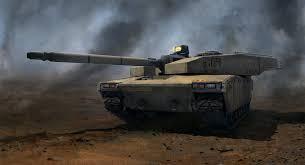
Big Boys Don't Cry is a novella from military science fiction author Tom Kratman, known for A Desert Called Peace and his Carrera series. The novella follows the life cycle of a Ratha, a sentient future supertank that dutifully fights Man's battles on dozens of alien worlds. But will the massive creature still be grateful to its creators when it discovers it has a conscience? And how long will an intelligent war machine with enough firepower to flatten a city be content to remain Man's obedient slave?
Tom Kratman, a retired military officer, first published Big Boys Don’t Cry in 2014 and this short work has been nominated for the 2015 Hugo Award for Best Novella.
Kratman describes a far future where sentient tanks are the main war machines of human defense – and offense. Big Boys Don’t Cry illustrates a situation where one such tank has come to understand all too well its place in our society.
In the summer of 2016 (Lord willing and the creek don’t rise) I will reach 20 years of combined active/reserve military service – meaning that I will be eligible for a military retirement. So not only do I have more military time than most people, I have more military time than most veterans. That said, I am not a big fan of military history or fiction, or military science fiction. It seems that these writers are too concerned about protocol or technology, or both, or they cannot tell a story or are just not good writers, or whatever. And some writers are just full of ****. Anyway (let me step down from my soapbox) I don’t read a lot of books in this collective genre.
That said, there is some damn fine literature in this genre (expanded to include science fiction). Heinlein’s Starship Troopers comes to mind, Joe Haldeman’s The Forever War, and Matterhorn by Karl Marlantes to name just a few. This is another very well written and thought out fiction. Told with attention to detail and with compassion and empathy for an animate, thinking being, Kratman has delivered an exceptional story.
I don't read a lot of military scifi, but if Tom Kratman's Big Boys Don't Cry is any indication of what I'm missing, I may start reading more.
Nominated for the 2015 Hugo Award for Best Novella (a story with a word count between 17,500 words and 40,000 words), Big Boys Don't Cry held me from the first page. This review is part of my effort to read and evaluate the 2015 Hugo nominees prior to the final vote later this year. I’ve previously reviewed “Totaled” by Kary English, Flow by Arlan Andrews Sr., and I’ll post other reviews as I write them.
Although there's been a bit of controversy around the Hugo Awards this year (okay, a lot more than just a bit), I've decided to plow ahead and evaluate as many of the nominees as possible. Much of what has been written and said seems driven by emotion and a scarcity mentality bent on controlling and manipulating the award, where little seems to address the quality of the nominees. With some exception in the novel category (I've already finished Annie Leckie's Ancillary Sword, many of the nominees appear to be new (to me), which presents an opportunity to meet some new authors, expand my regular reading, and perhaps add to the conversation. Once I've been able to get a better grasp of the quality of writing, perhaps I can examine it against the larger conversation (or, if you will, screaming match) happening in science fiction right now over the politics, future, and fandom around the Hugo Award.
But I digress. Where was I?
Oh, yes. Tom Kratman. Big Boys Don't Cry. Novella. Hugo nominee A thought provoking read.
In the far future, man has expanded throughout to the universe, overcoming the light barrier. In an imperialistic surge, we have designed autonomous tanks with artificial intelligence. Initially designed to work hand in hand with soldiers, they eventually replace them, becoming the main line of an imperial ground force. Intelligent beyond our own capacity, but tempered by very human like emotions, they are more human than we realize.
Prior to becoming a full time author, Kratman was a career military officer, and it shows in his writing. Big Boys Don't Cry is written by a mind steeped in the culture and history of a trained soldier and officer. That said, Kratman is no conformist, but portrays a critical awareness of the dark side of war and military culture. Underlying his story about an artificial intelligence that becoming self-aware and developing a conscience is a cautionary tale about the dangers of hubris, of becoming to distanced from the violence and pain of war, and of allowing machines to do for us what we are unwilling to do ourselves.
I loved Kratman's description of how the hardware for the artificial intelligence is grown, as well as how the AI is trained to become a warrior. He gives special attention to explaining--in mostly comprehensible technojargon--how the gigantic tanks are mobile and powered under their immense weight. He interweaves his story with requisite back story, almost in the form of a chiasmus (poetic, not genetic), coming to the end of his story just as the denouement arrives.
If I were to lodge a sole complaint, it would be that Kratman's humans are superficially all of one breed, a selfish and greedy race, consumed with domination and control. It does, however, serve to put the protagonist tank, Maggie, in high relief as a more sympathetic character.
Big Boys Don't Cry got me thinking, and that's one of my main criteria for a competitive nominee for the Hugo. I hope all the best for Kratman as the voters start to tally their ballots. At the very least, I'm glad to discover a new author, and I look forward to reading more by Kratman in the future.
Magnolia, a.k.a. Maggie, is a Ratha, an armored war machine in the military forces of a starfaring and aggressive Earth culture. It is gradually revealed to us that pretty much everything about this Earth culture is bad. When first attacked by aggressive aliens, Earth takes a while to gear up to fight effectively because the government is so corrupt and bureaucratic. We meet Maggie when she's been irrecoverably damaged and will be dismantled for parts, and we learn her story, and Earth's, as she sorts through her memories. This includes memories that had been locked from her conscious awareness for security reasons, but which are somehow freed up by the damage to her machinery.
And Maggie is pretty much the only decent being in the story.
Maggie is brave, loyal, resourceful, and as far as she's able resists orders to kill civilians. While she carried human soldiers, she cared for them with affection. Other Rathas are implied to be decent also, but we don't really get to know them.
The humans around her that have authority are at best pathetic, and typically far worse. Corrupt, incompetent, cruel, indifferent not only to the welfare of the Ratha (who are enabled to feel both emotion, and pain), but other humans. On one planet, women and children without political connections are abandoned in favor of getting out the rich merchants and the high-ranking political officials. On another, a rebellion is caused by a woman governor who is clearly what the Puppies call an SJW: she's sure the only reason she hasn't had all the advancement she wants is because there's a wicked conspiracy to hold women back. When she takes up her new assignment as governor of a planet inhabited by people who settled there to peaceably practice their own religion, she causes totally unnecessary trouble and touches off a rebellion by deciding that it's a bad thing the women are kept in seclusion and required to cover their faces. Obviously, only an SJW fanatic feminazi could possibly hold such views!
We also have such odd features as the fact that a story written in 2014 consistently uses Man as the collective term for humans, apparently all the military are male, with women in only secretarial positions, and although it's implied the Rathas gender-identify about equally as male or female, Maggie is the only female one we encounter. It feels like it was written in the 1950s.
And with all that, the writing itself is at best adequate.
This novella by former military officer Tom Kratman is obviously inspired by and throwing a twist into the worlds of Keith Laumer's Bolo series. Bolos, if you have never read those books (and you really should if you are any kind of military SF fan), are sentient war machines, futuristic tanks with minds and even souls, figuratively speaking. Laumer's stories were not just war stories, but stories about the relationships between fighting men and their machines, and they're genuine classics of the genre.
Kratman has a big legacy to live up to here, and I felt this story did a serviceable job. His Ratha are massive sentient tanks with enough firepower to level cities, and capable of taking near-direct hits from nuclear weapons. Like Laumer's Bolos, the Ratha have been programmed not just as intelligent war machines, but machines with feelings, capable of feeling pain and grief, pride and, in the case of MGD aka "Magnolia" aka "Maggie," betrayal.
Maggie, heavily damaged in her last battle and waiting to be scrapped, questions why she's been given the capacity to feel, and makes us question why you would want to create a sentient weapon of mass destruction with emotions, as we walk back through her "life."
Kratman's political metaphors are not subtle, and he is clearly exercising some venom he feels about the current state of the U.S. military and global politics. But whether or not you care to try to identify the intended real-world analogs of Maggie and her masters, this is military SF with heart. The ending is not much of a surprise, but Big Boys Don't Cry is certainly more than just a war story about a giant machine, though if you like copious details about weaponry and armor and extended descriptions of shit getting blown up, there is plenty of that.
I rarely attempt reading sci-fi because each time it is a failure. This time was no exception. I haven’t read sci-fi in years so I told myself why not give a chance to Big Boys Don’t Cry. One changes. Tastes change; and I wanted to ascertain that mine could (with regards to sci-fi), but so far it is not the case. Therefore, I will neither review nor rating Big Boys Don’t Cry as I don’t believe that I have the necessary experience or skill to do so.
The first third of the book was great. After that it faltered into a series of dry partial "memories" of the Ratha (Sentient Battle Vehicle). A good read over all, but nowhere near as good as all of Tom's other books to date.
I will preface this by saying that I don't usually read military sci-fi, and that I am only reading this because it was part of the Hugo voter's packet. Lots of people seem to have loved this book, so clearly Kratman is doing something right, it just didn't appeal to me.
First off, I want to discuss the combat sequences. In contrast to what most people have said, these seemed quite boring to me. There was a lot of description, but no cleverness in what the characters were doing. They targeted the enemy and blew them up or were blown up, end of story. To me, the appeal of a fight scene is not the size of the explosion, but getting to watch the metaphorical gears in the protagonist's head spin. Here the mechanical nature of the protagonist meant that there were no mad scrambles, only methodical slaughter.
The social commentary in a nutshell? Humanity is corrupt, incompetent, and generally just bad. If the dust jacket blurb is to be believed, "Kratman delights in offending left-wing sensibilities". Here, aside from a cardboard characterization of modern women, the opposite seems to be true. It's the military officials, the government bureaucrats, and the capitalists who are immoral. Even the oft-hated literati are spared the sword. What historical reports we get are written in a decidedly nonacademic style - more propaganda than formal report - suggesting that this is a world where education in the humanities is seriously devalued and liberal voices have been silenced. I suppose I should be pleased by a book that so reinforces my values, but that's not why I read sci-fi.
Overall impression? I didn't actively hate it.
This is one of those books that makes me wish Goodreads used 3-stars as a neutral rating rather than a positive one. I didn't like it, yet I feel like it deserves more than one star.
The biggest surprise of the Puppy dominated Hugo novella nominees of 2015 is that Tom Kratman, the writer of the execrable 'A Desert Called Peace' could produce such a searing anti-war, anti-militarism polemic as he achieves with 'Big Boys Don't Cry'.
The reader is introduced to 'Maggie' a sentient tank, fighting never-ending meaningless, cruel and barbaric battles on behalf of her corrupt human masters. Kratman is masterful in his use of paragraph upon paragraph of dull and jargon laden weapons porn to signify the banality of evil perpetrated in these futile and destructive battle interludes. In a nod to 'Born on the Fourth of July', after her final battle, 'Maggie' is reduced to a pile of rubble, fit only to be sold for scrap, not worthy of repair despite her loyal servitude. Her fate though, unlocks repressed memories, meant to be locked away for ever. We see how the killer was moulded.
Assembled as a blank slate, 'newbie' Maggie is thrust through a vile 'Boot Camp' experience, which manipulates and transforms her from an innocent lover of flowers, to a pitiless, immoral killer, always following orders, no matter how reprehensible her actions may be. The sequence recalls the Paris Island Act of 'Full Metal Jacket', as Kratman tells how soldiers are broken as humans and remoulded into unquestioning killers and followers of orders in that age old practice of brutalisation, intended to strip away the sense of self, and replace it with the sense of the machine. The final 'Full Metal Jacket' reference is saved for the final act, where the scrap metal dealer, the general and the politician (deliberately generic, one-dimensional characters, in contrast to the betrayed heroine) receive, like the brutal drill sergeant, their just reward. Bravo Sir.
This entire review has been hidden because of spoilers.
Haven't finished it yet but I'm loving it so far. If I were to try and get someone hooked on Tom Kratman this would be my opening gambit. Takes influence from both Heinlein and Ian M Banks. Always thought it was really novel and cool when Ian wrote from the point of view of the AI's controlling mankind's spaceships, and Kratman does a great job of making this idea his own. By writing an entire book that way. It's very interesting how much I am already empathising with 'Maggie' the battle tank. She's loyal, compassionate, self sacrificing. And she can cook. OK so she might weigh more than a Boing747, but nobody's perfect right? I feel like we could still make it work.
Hugo-nominated novella Big Boys Don't Cry by Tom Kratman is in essence an exploration of a concept - a sentient war machine that has a conscience but lacks the autonomy to live by it. Magnolia, MLN90456SS06150212 - "Maggie" to her comrades in arms, both human and machine - is a Ratha, an AI-controlled superheavy tank that carries both massive weaponry and a crew, either human or mechanical. (Rathas are Kratman's version of Keith Laumer's Bolos, first inagined in his 1960 short story "Combat Unit.")
Maggie has had a long term of service in a long and deadly war. At first outfitted with a human complement of fighters, she, and the other Ratha, now carry mechanical drone units - but she misses her "boys":
"I used to have a human commander, one who knew me and cared about me. I carried a short platoon of my own infantry, too, once upon a time; twenty-four men in powered battle armor. They were killed, or retired, medically or otherwise, or reached the end of their service. I think the last of them has passed on by now."
Damaged beyond repair in battle, Maggie relives her past as her remaining functional parts are salvaged, back to the harrowing experiences of her early conditioning.
The novella unfolds in sections, alternating between a present-time narrative line, a past-time narrative line, Maggie's memories of past battles, and expository passages framed as excerpts from various texts discussing Rathas and the war. Despite this complexity of viewpoints, Maggie's story, and the worldbuilding needed to understand her, and her actions, come through clearly. I found the battle sequences a bit repetitive, but then I'm not the ideal audience for this style of milsf. What did keep me reading was Maggie and her response to the moral dilemmas of war.
Big Boys Don't Cry tells the story of Maggie, a Ratha - an AI battle machine - as she reminisces her past missions. She forms emotional bonds with her crew, but as the crew dies, injures and finally retires, human contact gets more and more inhuman and Maggie finds herself manned by dumb drones. She ends up being a magnificent harbinger of doom for all her enemies as she moves from battlefield to battlefield to further mankind's greedy quest for power. The world of the novella is very black and white. Maggie is the only one with a conscience, whereas all the humans are greedy, petty, sadistic, corrupt beings. Since it's a relatively short story and it's built of multiple episodes, there's no room for subtlety: people are reduced to caricatures, battle depictions get more and more violent and pretty obviously try to appeal to basic emotions. At least for me, that just doesn't work. The story is too one-sided, people are too obviously "bad", and at the same time some crucial features of the story are left unexplained.
Magnolia, a.k.a, Maggie, is a sentient military supertank created by humans. Her kind, the Ratha, first fought in the Nighean Ruadh War (AD 2289-2402) alongside humans, but the Ratha, with the aid of drones, eventually replaced all humans on the ground. Damaged beyond repair during the last battle, Maggie is inspected by officers who deem her salvageable for parts only. As she awaits dismantlement, she relives painful memories only now available to her conscious mind.
All humans (except for one young female technician who ran Maggie’s training exercises in a virtual environment) are corrupt, without conscience, and justify the ends by any means possible. This is a not-so-subtle juxtaposition of humans abusing and discarding that which they do not recognize, but Maggie herself provides a sympathetic character. She’s intelligent, brave, and honest. She cares for and misses her human soldiers. She objects when her general orders her to kill civilians. She likes flowers and wishes she had olfactory sensors. As Maggie (and the reader) traverse through her memory banks, she recognizes the betrayal of her gods for the first time.
I am still unclear why the Ratha are given emotions, as memories of Maggie’s training suggest all Ratha’s must be broken of their empathy and guilt. However, as a huge fan of AI consciousness narratives, I find Maggie’s story engaging, and her motives justified, if simple.
Recommended for those who love military scifi, as this novella has plenty of explosions and lengthy descriptions of weapons, who are new to the subgenre of artificial intelligence.
I quite enjoyed this story. I have never read the Bolos (or Kratman before this), so I don't have that to compare this story to. The premise is that a sentient war machine (a ratha) named Magnolia is damaged in battle, and we follow her thought processes and memories as she is scrapped.
The back cover of this story promised to tweak my liberal sensibilities, but I was disappointed, as the author simply posits a corrupt military/governmental/industrial complex, which isn't exactly radical or shocking stuff. This is about what I expect in military SF, and I do expect it to be to the right of me, which hasn't really ever damaged my enjoyment of a good story. (I did dig around on his website to see if I found anything that gave me a sense of his political compass, but didn't find much of his political opinion that I found interesting or consequential.)
This was a thought-provoking story that was ably told, and really made me care about the protagonist. It also echoes in some eerie ways the alienation of a few of the military veterans I know, and I think it works to a certain extent as an allegory as well.
But the story was a little too simplistic for me, with the evil military/governmental/industrial complex staffed solely by incompetent/unfeeling/cowardly people, versus the pure and childlike rathas, who devoid of any agency end up as their innocent victims. I was looking for a bit more complexity and didn't find it. But still, an interesting, engaging, and thought-provoking story, even if it is told in too many shades of black and white.
An excellent story, and even though the expression of "makes you think" is very much overused by reviewers, this one actually does. The only reason it does not get 5 stars from me is because it is so unrelentingly dark. I can't say I *enjoyed* it so much as I suffered through the story along with the main character as she recounts her life and realizes some terrible truths in the process. Kratman manages to create an AI who is in fact more human than her human masters. It is a huge scifi trope to feed on our fears of AI taking over the world. Kratman shows us that we should perhaps be more worried about humanity itself trading honor and compassion for power and desire to win at all costs. This is a story that will stay with you and change your perspective, as any good piece of literature should.
I was surprised how much I enjoyed this book. I enjoy Military SF on occasion, but it's never been my number one genre. However, I really enjoyed how this book took it deeper than simply showing strategic battles and fancy technology. Don't get me wrong, there were good battles that shared cool strategies, and there were fun scenes that described the technology that mankind uses to win futuristic wars.
But this story was so much more. It delves into the atrocities of war and the monsters that men can be. It delves into the problem of pain, and whether artificial intelligence has the right to joy.
It was an emotional ride, and definitely worth the read.
My my my. I'm glad I stuck this out, but ended up being very conflicted about how to rate it. I almost stopped about half way through because there didn't seem to be much point to it, but the pay-off at the end was worth reading it for. I thought it was a bit too long. And Magnolia kept thinking she was going to think on happier times, and then she didn't. I was hoping to read a bit more about what life was like with her 'boys'. And people in the future really suck.
This is about the only one of the novella nominees that's actually worth being on the ballot. While it has shades of Ancillary Justice, it's a decent story. You wouldn't normally find yourself sympathizing with an AI war machine, but I found myself feeling very sorry for "Maggie".
A rip off of the Bolo series by Keith Laumer. A have read only a few of those, but there were much more interesting than this story. An intelligent tank has been badly damaged. It is being dismantled for scrap and that opens new connections to the brain of the tank and it remembers past missions and experiences which have been restricted from the active memory. They consist mainly from more or less bloody battles and very detailed descriptions of the turrets of tanks and so on. The writer sure seems to love his guns! On the other hand, his knowledge of physics is really badly lacking. In one place, he describes antimatter mines which are able to harm the tanks described in the story through the thinner armor plating at the bottom. As 50 grams of antimatter corresponds an explosive power worth of 150 Hiroshima bombs it will undoubtedly slightly harm the armor. Or vaporizes everything within a few dozen meters. The writing is fairly clumsy, worse than Laumer’s, but vastly better than Wright’s. What we learn from this story: pacifists should be hanged at the nearest lamppost. And feminists are badly disturbed people who push worlds to civil war just because they want to be as good as men.
There's a truly brief list of stories with mechanical/artificial main characters where enough emotion and soul are written into them that I'll shed tears for them. When I was a kid, that was Disney's Pinocchio (who is more sympathetic than the original version from the book). As an adult, it's the warbot from the Galaxy's Edge novella "Tin Man" (no shame, I ugly cried the first time I read that), and the other is "Maggie" the anti-OGRE / ruined BOLO of this story. Whether Kratman's assessment of the technology behind these beasts is accurate or not is not the relevant part of this story. It's asking different questions about the entire idea and ethics behind general artificial intelligence applied to military purposes. Also, about whose assumptions about how such machines would turn out were more correct: Keith Laumer's BOLO series presents them as "metal paladins" whose chivalry and martial valor equal if not outshine that of humans. Steve Jackson's OGREs are cruel, even amoral monsters, reminiscent of Saberhagen's Berserkers. We all know the Terminator franchise. Kratman's take throws a monkey wrench into these tropes by forcing the viewpoint back on us, because it makes the reader ask, "what kind of creature even MAKES another form of life for no other purpose than to be a disposable killing machine?" It's not a comfortable reflection.
This is a viewpoint essay disguised as a story, one I don't entirely agree with. The main issue is the premise of programming cybertanks. Can it be done? We don't know and there are indications we may never know. I don't agree with the conclusion about Laumer's Bolos being NSM, unless NSM are supposed to display only the Western military virtues. Can and have Bolos been perverted by deception? Yes, but GIGO applies to humans as well.
The premises are important, since Laumer's Retief actually ends up being shown to be what would be a eugenic superhuman wet dream, but he most certainly doesn't act like as such, despite coming from such a culture.
Others have also pointed out that humans, unless firmly placed in the center of a cybertank, require some kind of power armor to survive in that battle environment. One of the better workarounds comes from the 40k universe, where the Marines are genetically, biologically and cybernetically altered superhumans who depend less on the armor and more on the physical alterations. Never mind the extensive psychological indoctrination. Without that, humans would be forced from the field of battle.
If you ever enjoyed the Hammer's Slammers series, then BBDC is a fantastic short title for you. Sentient battle tanks slug it out with alien menaces from beyond the stars. Plenty of action and realistic character development that goes a long way toward revealing the real threats to humankind (and machinekind). In a century when thinking machines are still in their infancy, this work will give you good reason for pause, to consider the consequences of putting machines on the frontlines of tomorrow's battles.
It's been a while since I've read a Bolo story, and I've missed them. Although this was not a Bolo story in the strictest sense of the word it reminded me of the series, in a good way.
After a week and a half, I made it halfway through this story. I couldn't go any farther. It was seriously killing my love of reading.
What happened? First - I couldn't stay awake while reading it. The last thing I read that put me to sleep this consistently was a statistics textbook. Second - I couldn't get a grasp of what was actually happening. There seemed to be several plots running at once, all in different time frames. I got totally confused. Third - I couldn't picture what was happening at all. Kratman said the action was in a valley, so I pictured a narrow area. Then he said there was a 2-mile radius around the character. Sure, valleys can be that big (I live in one) but that would have been nice to know at the beginning. Also, the vehicles seemed to be sized strangely. SciFi and Fantasy writers have a habit of thinking of huge numbers without thinking about what that would be like in reality. This seemed to fall into that category. Fourth - I just didn't care what happened. I was reading words, but they weren't coming together into a coherent whole in my head, so I simply didn't care what happened. Fifth - Once again, we have a story about an AI in a machine and I couldn't help but think that Ancillary Justice did it better.
“‘Big boy here won’t cry.’ Two lies in a single sentence. I am not a boy. And I will cry…”
Big Boys Don’t Cry is a far-future military SF told from the perspective of an AI-tank. A 14,000 ton hover-tank run by a fusion reactor. (By way of comparison, a German Panzer tank of the sort that shows up in the training simulation ran 25 tons. The proposed German Landkreuzer P. 1000 “Ratte” super-heavy tank was only supposed to be 1,000 tons.) The story concerns itself with the tank, Maggie, coming to grips with war and her role in it.
AI of the sort is a popular topic, although it’s usually a spaceship that’s sapient. Kratman introduces a few twists. There is no Asimov’s First Law of Robotics (why would we ever want that?). The tanks are designed as individuals because it makes them more suited to combat. Other programming makes less sense. The tanks can think and question and, most interestingly, feel pain, but can’t disobey.
Maggie is disabled early on in the novella, which robs the many (good) later battle scenes of tension. The military brass is evil to mustache-twirling levels. I see what Kratman is trying to do—raise questions of the implications of replacing an all-volunteer military with (pliant) AI—and he does that effectively, but the narrative doesn’t quite work.
A new imagining of Fritz Lauber's BOLO universe. One story focusing on one exquisite AI tank. The story traces the 'upbringing' of the Tank's AI, a powerful cybernetic organism that is repeatedly 'trained' in its emerging personality, to kill, maneuver, and let NO shred of 'humanity' develop within her interface. She asks"Why" during some brutal scenarios and is tortured for the question. She learns that the easiest way to dodge torture is to perform the 'missions' without fear or questioning her human commanders. They also install a pleasure center to tease the brain (and the tank) to perform better, faster and without remorse. Most soldiers eventually totally DUMP the stupid 'HOOAH, HOOAH' mindset and start to question the WHY of 'Higher'....That's Why they appear to develop this Futuristic implacable RATHA tank. TO Stop the "WHYs".
This is the first thing I've read from Kratman, except for posts on Facebook and various blogs. Many people love his stuff, but I just hadn't gotten around to checking him out until now. Glad I did - this novella was pretty awesome. It hit just the right technical and tactical notes and the action zipped. But the story's real power comes in the second half of the book, when Maggie begins accessing her deeper memories that had been locked away until now. I don't want to give anything away, so I'll just say it'll leave you shocked, a bit sickened, and deep in thought.
I wish I had been reading this somewhere more private because I was working hard to hold back tears, but I couldn't put it down. This has the elegant simplicity of a short story structure though it's novella length and I don't usually prefer short stories. But this one left me with a feeling of catharsis as well as something to think about. Though I would still like a novel length treatment of this would to see some of the complexities and other plots only hinted at here.
An interesting story, although it seems far too short, and in need of a sequel. "Maggie" is a Ratha; a giant tank, commanded by AI. She suffers incredible damage while trying to defend another Ratha, and while being assessed back at a workshop for scrap or salvage, she thinks back to some of her earlier campaigns. Due to the damage, she remembers being "created" in a AI training facility, and the pain they inflicted on her to get her to become an unthinking, unfeeling killing machine.