

What do you think?
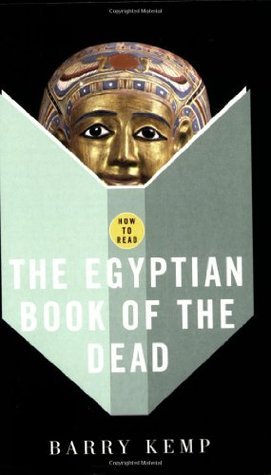
How to Read...
How to Read the "Egyptian Book of the Dead"
The Egyptians created a world of supernatural forces so vivid, powerful and inescapable that controlling one's destiny within it was a constant preoccupation. In life, supernatural forces manifested themselves through misfortune and illness,and after death were faced for eternity in the Otherworld, along with the divine gods who controlled the universe. The Book of the Dead empowered the reader to overcome the dangers lurking in the Otherworld and to become one with the gods who governed. Barry Kemp selects a number of spells to explore who and what the Egyptians feared and the kind of assistance that the Book offered them, revealing a relationship between the human individual and the divine quite unlike that found in the major faiths of the modern world.
125 pages, Paperback
First published January 1, 2007
About the author
Barry J. Kemp
25 books16 followersProfessor Barry Kemp is Emeritus Professor of Egyptology at the McDonald Institute for Archaeological Research, University of Cambridge. He has been Field Director at Tell el-Amarna since 1977, pioneering excavations formerly for the Egypt Exploration Society, and now as The Amarna Project supported by the Amarna Trust. His important publications include Amarna Reports, I-VI (EES, 1984-95) and Ancient Egypt: Anatomy of a Civilisation (Routledge, 2nd ed., 2006).
Ratings & Reviews
Friends & Following
Create a free account to discover what your friends think of this book!
Community Reviews
Displaying 1 - 9 of 9 reviews

May 6, 2023
A concise but beautiful introduction to the Book of the Dead, perhaps the most famous writing in Ancient Egyptian history, very popular from about 1500 BCE and constantly placed in the tombs of the Egyptian kings, notables and lesser folk. In essence, it contained spells to protect and guide the deceased during his journey through the otherworld. Kemp not only deals with the content and evolution of the texts and images, but also sketches the broader framework of Egyptian thinking about death, religion and spirituality in general. What struck me most is that there was not really one Book of the Dead, for almost every version is different and thousands of them have been preserved. And also remarkable is that the standardization process of the text was not completed until about 600 bce. Above all, this booklet (by Kemp I mean) shows how diverse the ancient Egyptians thought about life and death, contrasting with the image of the static society that I previously had. More on that in my History account on Goodreads : https://www.goodreads.com/review/show....

Read
May 7, 2023This book is a small treasure trove of information about the world of Ancient Egypt. Barry Kemp, a respected Egyptologist, apparently only focuses on the cult of the dead, but indirectly he portrays almost the entire Ancient Egyptian culture. What strikes me time and time again is how we should not look at that culture through our own 21st century eyes, because then we are doing it an absolute injustice. To address just one essential issue: the question "what did the Egyptians believe in?" turns out to be flatly wrong, at least if we understand that “believing in” in our Western sense, namely as a well-defined, homogeneous view on an absolute reality, cast in beliefs, coupled with equally precise ethics and expressed in eternally fixed rituals. Kemp constantly emphasizes how the Egyptians saw reality as something fluid, in which the earthly and the super- or subterranean flow together, presented in the most diverse forms, with constant shifts in meaning and in constant evolution. “The Egyptians had created a complex and frightening spiritual world. Over the centuries they added ever more details and variations: caverns and gates, ways of torturing and destroying the enemies of the sun - god, and symbols of how the sun - god continually renewed his existence, a metaphor for personal renewal. Did any of it really exist? In the end they could neither know nor not know. They had not developed a theology: the concepts, the vocabulary and the argumentative skills to argue for or against their spiritual world and so to develop a level of unshakeable belief or absolute doubt. Hence the nervous, constantly shifting perspective of the Book of the Dead. It is an articulation of worry and uncertainty as much as of belief.” Kemp indicates that this view is much more like a very early form of relativism, a view of the world that comes suspiciously close to what we have come to call postmodernism.
There is one characteristic, however, that recurs almost invariably: life after death is an inhospitable journey, in a menacing world, full of dangers. “The Otherworld was not a comforting place, an idyllic world, a paradise. It was full of alarming beings and prospects, all needing to be mastered single-handedly by the reader. There was no kindly savior waiting reassuringly to welcome the dead.” That is why the fear of the underworld dominates almost all iconographic representations of Ancient Egypt, and thus pre-eminently also the Book of the Dead, which is nothing more than a series of spells to get through this perilous journey as best as possible. “The experience of life after death was a continuous dangerous struggle and the Book of the Dead protects spirits of the dead from these dangers. By reading and learning the names and characteristics of the Otherworld and its parts, Egyptians could ward off the evils. Having invented a world of fears, the Egyptians set about creating practical ways to overcome them.” Well, that last thing sure is something that discriminates ancient Egyptians from Mesopotamians: both saw the Otherworld as an unattractive place, but Egyptians sought ways to live (pun intended) with it.
The only suggestion of a somewhat milder fate for the deceased is the judgment, in which the soul of the deceased (the ba) is weighed against the principle of the "ma'at", a complex concept that stands for truth, order and justice. Those who fail this test, await an even grimmer fate of torture and torment by demons. But even the righteous did not have to count on such things as heaven or Elysian fields. Life in Ancient Egypt may have been no fun, but death apparently was even less so.
There is one characteristic, however, that recurs almost invariably: life after death is an inhospitable journey, in a menacing world, full of dangers. “The Otherworld was not a comforting place, an idyllic world, a paradise. It was full of alarming beings and prospects, all needing to be mastered single-handedly by the reader. There was no kindly savior waiting reassuringly to welcome the dead.” That is why the fear of the underworld dominates almost all iconographic representations of Ancient Egypt, and thus pre-eminently also the Book of the Dead, which is nothing more than a series of spells to get through this perilous journey as best as possible. “The experience of life after death was a continuous dangerous struggle and the Book of the Dead protects spirits of the dead from these dangers. By reading and learning the names and characteristics of the Otherworld and its parts, Egyptians could ward off the evils. Having invented a world of fears, the Egyptians set about creating practical ways to overcome them.” Well, that last thing sure is something that discriminates ancient Egyptians from Mesopotamians: both saw the Otherworld as an unattractive place, but Egyptians sought ways to live (pun intended) with it.
The only suggestion of a somewhat milder fate for the deceased is the judgment, in which the soul of the deceased (the ba) is weighed against the principle of the "ma'at", a complex concept that stands for truth, order and justice. Those who fail this test, await an even grimmer fate of torture and torment by demons. But even the righteous did not have to count on such things as heaven or Elysian fields. Life in Ancient Egypt may have been no fun, but death apparently was even less so.

December 9, 2014
This book is a great read, full of quotes and explanations.
It goes beyond one's basic education. I recommend it because it's a quick and easy read, and quite interesting if you don't know much about the Book of the Dead.
It goes beyond one's basic education. I recommend it because it's a quick and easy read, and quite interesting if you don't know much about the Book of the Dead.
January 23, 2016
An interesting if brief essay that attempts to both place the Book of the Dead in a social context, and to extrapolate details of that society from it. Made some very good points and convinced me that I need a better translation.

May 4, 2013
It would seem the authors final words sum the Book of the Dead up as well as their belief .... "It is an articulation of worry and uncertainty as much as of belief." The main things I took away from this book is in the authors opinion the Egyptians required no belief in the gods to be with them. To live a good life was the prime goal. Though there seems to be great fear of the afterlife and the many pitfalls the soul may come upon in it. Many of these problems could be overcome by study of the Book of the Dead while living and when one is dead. The greatest benefit of the BOTD is through the spells you learn the names of the guardians and so forth as well as how to become the god too. By becoming the god you share in his or her power and help to safeguard your soul on its journey.
If you use this in conjunction with reading the BOTD I would suggest a more modern translation rather than the Budge one. His seems to just bounce to much around.
If you use this in conjunction with reading the BOTD I would suggest a more modern translation rather than the Budge one. His seems to just bounce to much around.
October 31, 2025
How to Read the "Egyptian Book of the Dead" is a short, but deeply informative book about key aspects of Ancient Egyptian religious, moralistic, and afterlife views, though the primary lens of the famed ‘Book of the Dead’. If you are looking for an in depth, spell-by-spell review, this isn’t it, but Kemp provides some excellent context for the original material. Even as someone very familiar with the topic, I still gained new insight. Highly recommend.

June 14, 2025
accessibly written, with such an endearing, generous respect for people who lived so long ago. this was a simple and enjoyable read.

Want to Read
September 10, 2012Want to read this because the cover is so cute.

August 22, 2012
Very useful if you are reading the "Book of the Dead".
Displaying 1 - 9 of 9 reviews