

What do you think?

The Sea of Regret: Two Turn-of-the-Century Chinese Romantic Novels
Published within a few months of each other in 1906, Stones in the Sea by Fu Lin and The Sea of Regret by Wu Jianren take opposite sides in the heated turn-of-the-century debate over the place of romantic and sexual love and passion in Chinese life. The Sea of Regret, which came to be the most popular short novel of this period, is a response to the less well-known but equally significant Stones in the Sea. Taken together, this pair of novels provides a fascinating portrait of early twentieth-century China's struggle with its own cultural, ethical, and sexual redefinition.
220 pages, Hardcover
First published June 1, 1995
About the author
Wu Jianren
9 books1 followerWu Jianren (T: 吳趼人, S: 吴趼人, P: Wú Jiǎnrén, W: Wu Chien-jen; 1866–1910), also known as Wu Woyao (T: 吳沃堯, S: 吴沃尧, P: Wú Wòyáo, W: Wu Wo-yao) was a Chinese writer of the late Qing period. A native of Foshan, Guangdong province, he is known for several novels, namely The Strange State of the World Witnessed Over 20 Years and The Sea of Regret.
Wu Jianren wrote novels for an audience who did not receive a classical education, and he used everyday vernacular speech in his works.
Wu Jianren recorded stories from newspapers that he could use as a source in his work within a notebook. Bao Tianxiao, another novelist who wrote an account of Wu Jianren's notebook, used this technique to write Shanghai Chunqiu (上海春秋; Shanghai records).
(from Wikipedia)
Wu Jianren wrote novels for an audience who did not receive a classical education, and he used everyday vernacular speech in his works.
Wu Jianren recorded stories from newspapers that he could use as a source in his work within a notebook. Bao Tianxiao, another novelist who wrote an account of Wu Jianren's notebook, used this technique to write Shanghai Chunqiu (上海春秋; Shanghai records).
(from Wikipedia)
Ratings & Reviews
Friends & Following
Create a free account to discover what your friends think of this book!
Community Reviews
Displaying 1 - 15 of 15 reviews

Read
March 1, 2015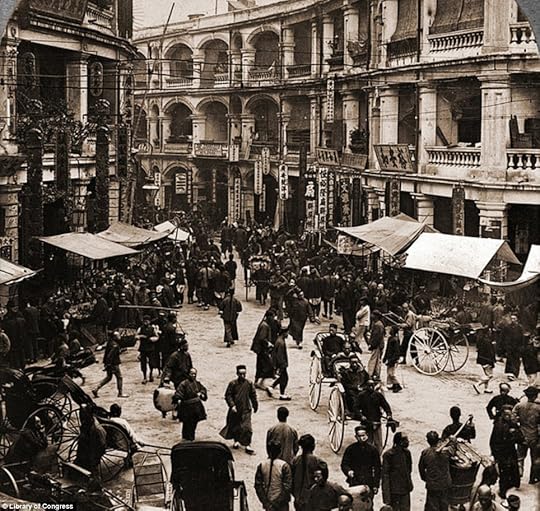
Hong Kong, 1902
At the beginning of the 20th century China underwent a social turmoil the extent of which I do not yet grasp but which seems to have some similarities with the corresponding developments in Meiji Japan. In the face of increasing (and often quite unpleasant) contact with Westerners, some fraction of the Chinese intelligentsia questioned the rigid and paternalistic structure of the family and society in general that had been a characteristic of Chinese culture since at least the 4th century BCE. This expressed itself in a number of ways, among which were: a nascent movement for the rights of women emerged, the notion of marriage for love as opposed to arranged marriage began to find proponents and even some practitioners, and the interest in Western science and literature grew.(*) Of course, this spurred a backlash from the cultural conservatives who decried the concomitant loss of Chinese cultural identity.
In The Sea of Regret (1995) we find two novellas that took part in that debate: Qin hai shi (literally, "bird, stone, sea," translated here as Stones in the Sea) by Fu Lin and Hen hai (translated as The Sea of Regret) by Wu Jianren. Qin hai shi appeared in the Spring of 1906 and Hen hai in the Autumn of the same year; the latter is a conservative response to the former. "Fu Lin" was probably a defensive pseudonym, but Wu Jianren (1866–1910) was a well known author.(**) In fact, Patrick Hanan, the translator here, says in his informative introduction that Hen hai is one of the most famous novels of the period.
The dialogue between these two authors took place on more than one level. According to Hanan, Wu wrote the first Chinese novel told in the first person in 1903-1905 (but the narrator was a disengaged observer). Fu's first person narrator in Qin hai shi is a centrally involved primary character passionately appealing his case, apparently a first in Chinese literature.
In fact, that Fu both treats the somewhat self-deluded and self-absorbed young narrator ironically and satirizes figures of power in Chinese society evidences a level of literary sophistication Wu does not display, though Wu himself does not just repeat received notions. Hanan informs us that Wu wrote his texts in vernacular Chinese, while Fu used a classical literary style; even those of us who cannot read Chinese can recognize that Fu flavors his text with apt classical allusions and quotations (explained by Hanan in footnotes), while Wu does none of that. Nonetheless, it is Fu who is arguing for change and Wu for the status quo, and it is Fu who is arguing by appeal to emotion while Wu is arguing from a philosophical tradition deeply rooted in Chinese culture. This dialogue is not at all stereotypical.(***)
In Fu's story, told with great charm, the narrator is a teenager who fell in love with a girl before he was 12, but her family moved away. A few years later, a coincidence brings them together again and re-kindles his love. But his stupefaction before her unexpected appearance makes a very bad impression on her family. So the drama begins, but it develops in ways one would not expect. There are no stick-in-the-mud fathers resisting their children's wishes; by cleverness and persistence the couple overcome the many obstacles placed in their path by Chinese tradition itself and almost attain their wish - then suddenly the Boxer Rebellion arrives!
Qin hai shi is a romance with melodramatic traits, and Hen hai is a direct rejoinder with even more pronounced melodramatic traits. Fu's narrator insists that his love with Aren was one of passion, not lust. Wu's first person narrator insists (in accordance with neo-Confucian philosophy) that passion (qing) is the energy behind the entire universe (human passion is but one small manifestation of qing) and that only the proper guiding of passion can lead to a good outcome. Passion can lead to evil as readily as it can to good. Needless to say, this proper guidance involves sacrificing one's own wishes to those of one's family (above all, of one's father) and one's society.
Assuming that his audience was already familiar with Fu's text, Wu lifts many elements from Qin hai shi and modifies them to fit his purpose; I found it very entertaining to watch a painting of a tiger be disassembled and pieced together again to reveal an elephant. In this story, after a little flirtation with transgression of social mores and a nearly imperceptible hint of sensuality, all enters into the proper track, and the universe gives a little sigh of relief as the children make their sacrifices (even going well beyond what their parents expected). This combination of the little frisson of stepping off the track for a moment and the reassurance of getting back to the straight and narrow with a vengeance is likely why Hen hai was and still is acclaimed by the Chinese and Qin hai shi was forgotten, even though the latter is a far more engaging read and, in the former, the excruciatingly proper girl Dihua's ability to interpret everything as her fault exceeded my ability to apply the theory of cultural relativity. I was begging for someone to give her a sharp slap...
In general, if one wants to write a tear jerker in Asia, one is sure to play upon the conflict between a personal love and the obligation to one's family, and then is doubly sure to arrange that the offspring renounce their personal happiness to conform with their family's wishes.(4*) In Japan, this often ends with a double suicide; not so often on the mainland, where one moistens one's sleeve with many tears, swallows hard, and then does one's duty.
(*) Apparently, in 1907 over two-thirds of all novels published in China were translations. The most popular: La Dame aux camélias and and H. Rider Haggard's Joan Haste.
(**) Wu was by no means a stereotypical reactionary: among other things, he was an editor at the Central China Post, an American-owned newspaper, but when the Americans extended their exclusion laws against the Chinese (after bringing in thousands of Chinese to build the railroads in America's West, there was a racist backlash) Wu resigned in protest.
(***) No doubt my experience with the sleep-inducing clichés wielded by both sides of the culture wars in contemporary America has led to my pleased surprise here.
(4*) Indeed, the national poem of Vietnam, Kim Vân Kiều, is about the extremes of self-sacrifice a young woman can make for her family...
Rating
http://leopard.booklikes.com/post/111...

January 14, 2025
While I can definitely see that this pair of novels gives a lot of insight into the concerns and values of turn-of-the-century China, they didn’t have any emotion, fun, or intellect that I need from a story to feel a significant impact.

May 20, 2015
250615: this is more interesting as conflict of ideas, of lit as vessel to communicate worldview, in this case opposing the other, than as what passes in the west as novels. the first book, stones in the sea, is apparently an early 'i' novel, and tells or rather summarizes briefly an anguished modern western-type love from childhood to reunited young adults, that covers such time, events, emotions, that a reader might expect to be stretched out to a hundred thousand words. not here. but the sea of regret, the second novel, is told in classical chinese in support of more traditional filial piety, and could certainly be summarized. i do not have much luck in reading chinese novels, this does not change here...
December 10, 2008
Two novels written in the early 1900, the second in response (or inspired by) the first. I really enjoyed Stones in the Sea, narrated in the first person, very entertaining and brilliantly translated. The second novel, The Sea of Regret, was a bit boring, a lot of melodrama not lifted by the occasional cheekiness of the first.

December 5, 2023
Didn’t really like some of the translation choices, such as the use of tete a tete, which broke immersion to me.

September 18, 2024
This book shares two Chinese tales of romance, placed in the setting of the Boxer Rebellion in the early 1900s. Western concepts of love were just starting to take root then in China’s artistic community, and these novels portray the first attempts to integrate these foreign themes in Chinese society. At the time, marital love, based in centuries of Confucian thought, was grounded in families, not individual feelings, so Western concepts stirred the cultural pot. These two stories convey two very different reactions, but enlighten readers about the historical impact of an integrated, globalized world.
The first tale “Stones in the Sea” is told in the first person, an usual trait for Chinese stories of this time. It tells of how a teenage young man fell in love with another young woman who lived nearby. His challenge is not so much to woo her but to persuade both families that their path is noble. The story is more of a simple love tale, but the cultural backdrop of ancient China stimulates readers’ imaginations. The Boxer Rebellion, when nationalistic factions fought against Western interests and their Chinese sympathizers, functions prominently to impact this story’s plot.
The second tale “The Sea of Regret” intertwines the Boxer Rebellion with two arranged marriages in a sophisticated manner. These arranged marriages, however, are not passionless; rather, the engaged couples must suffer deeply for each other as they flee southward as refugees. They, too, have deep elements of romantic love, less resembling Western teenage love in “Stones in the Sea” but more conveying a deep dedication to each other. Clearly, the author is attempting to integrate Western romantic love with traditional Chinese concepts of parental guidance for marriage. The added elements to this drama make it a thought-provoking tale, impressing comparably to present-day dramas.
As an American, I enjoyed reading how romantic love reared itself in another context. Even in China in the early 1900s, love and war seem forever enemies. “The Sea of Regret” is a literary masterpiece while “Stones in the Sea” seems more significant for its historical value as a first-person novel resembling Western romances. These plot structures provided a entertaining way to learn about Chinese society in that era. It shows that, despite traditions relatively isolated from each other, we humans aren’t that different from each other after all.
The first tale “Stones in the Sea” is told in the first person, an usual trait for Chinese stories of this time. It tells of how a teenage young man fell in love with another young woman who lived nearby. His challenge is not so much to woo her but to persuade both families that their path is noble. The story is more of a simple love tale, but the cultural backdrop of ancient China stimulates readers’ imaginations. The Boxer Rebellion, when nationalistic factions fought against Western interests and their Chinese sympathizers, functions prominently to impact this story’s plot.
The second tale “The Sea of Regret” intertwines the Boxer Rebellion with two arranged marriages in a sophisticated manner. These arranged marriages, however, are not passionless; rather, the engaged couples must suffer deeply for each other as they flee southward as refugees. They, too, have deep elements of romantic love, less resembling Western teenage love in “Stones in the Sea” but more conveying a deep dedication to each other. Clearly, the author is attempting to integrate Western romantic love with traditional Chinese concepts of parental guidance for marriage. The added elements to this drama make it a thought-provoking tale, impressing comparably to present-day dramas.
As an American, I enjoyed reading how romantic love reared itself in another context. Even in China in the early 1900s, love and war seem forever enemies. “The Sea of Regret” is a literary masterpiece while “Stones in the Sea” seems more significant for its historical value as a first-person novel resembling Western romances. These plot structures provided a entertaining way to learn about Chinese society in that era. It shows that, despite traditions relatively isolated from each other, we humans aren’t that different from each other after all.

August 6, 2025
Both of these novellas are a fun look into Chinese society at the turn of the 20th century. While the novels both focus in on the narrow issue of marriage, they are really reflecting a nation that is trying to figure out where to go; to keep tradition or to toss it to the wayside in the quest for modernity. "Stones in the Sea" is regarded as the first I-novel in Chinese and was worth reading just for that historical tidbit.
Overall, I enjoyed both of these stories. They gave me a deeper glimpse into the turmoil of the Boxer rebellion and how that upended lives. It was neat to see how they played off one another. I also couldn't help but love the dismal endings. These were true to traditional Chinese romance form with the lovers not actually getting together and probably both dying or heading off to be a monk/nun.
Overall, I enjoyed both of these stories. They gave me a deeper glimpse into the turmoil of the Boxer rebellion and how that upended lives. It was neat to see how they played off one another. I also couldn't help but love the dismal endings. These were true to traditional Chinese romance form with the lovers not actually getting together and probably both dying or heading off to be a monk/nun.
February 21, 2018
The story seems to end on a very anticlimactic note. Although it highlights the hardships of romance during times of war, the ending was a little too bleh for me.

January 20, 2026
interesting on a historical and sociological level, but not on a literary level in really any sense. extremely didactic, slow, tell-y, unfeeling, and plain boring.

February 5, 2026
Very mid book. Sea of Regret was better than Stones in the Sea (two different novellas in one book) but overall it was hard to get attached to the characters (except for Dihua poor girl)

November 7, 2019
Two novels, the first Stones in the Sea is a first-person story about adolescent love: it's cosy, it's charming, but readers should note that Hanan has translated a stronger, more developed work on the same theme, The Money Demon by Chen Diexian, which, taking the form of a confessional memoir has no need to bring about the same sort of hackneyed closure expected in a fictional work, as appears here. Anyway, the good news is that . Confucius breathes a sigh of relief.
Sea of Regret is deservedly a more famous work - fast paced, episodic, more entertaining and possessing more compelling characters* than Stones in the Sea, it delivers an emphatic message about the absolute state of China during the late Qing, a nation so rotten that the good are compelled to withdraw from society - a chaotic cesspool where the youth are either driven into violence gangs or the whorehouse.
*I'm thinking particularly of Heting, the father of the pious Dihua. He has a near-perfect Confucian daughter: dutiful, semi-literate, her only flaw being her inability to go a single page without hysterically sobbing, about which Heting often expresses his frustration. But Heting is not a perfect Confucian patriarch. He's not a scholar or an official nose deep in Confucian texts, but a merchant immersed in the material world. While his wife is dying somewhere out in the country, a displaced refugee victim of the violent upheaval caused by the xenophobic Boxer mob, Heting is shacked up with a concubine. And while he's morally incensed about his daughter's fiancé turning out to be a whoremongering junkie, the only reason he learns of this is through a good friend who happens owns a whorehouse. The rot is everywhere apparent, only the two examples of pious youth - Dihua and Zhongai - the two potential national saviors, are internally exempt from its influences, but it destroys them nonetheless. Wu Jianren's message is clear: a nation that pushes its best out of society is doomed!
Sea of Regret is deservedly a more famous work - fast paced, episodic, more entertaining and possessing more compelling characters* than Stones in the Sea, it delivers an emphatic message about the absolute state of China during the late Qing, a nation so rotten that the good are compelled to withdraw from society - a chaotic cesspool where the youth are either driven into violence gangs or the whorehouse.
*I'm thinking particularly of Heting, the father of the pious Dihua. He has a near-perfect Confucian daughter: dutiful, semi-literate, her only flaw being her inability to go a single page without hysterically sobbing, about which Heting often expresses his frustration. But Heting is not a perfect Confucian patriarch. He's not a scholar or an official nose deep in Confucian texts, but a merchant immersed in the material world. While his wife is dying somewhere out in the country, a displaced refugee victim of the violent upheaval caused by the xenophobic Boxer mob, Heting is shacked up with a concubine. And while he's morally incensed about his daughter's fiancé turning out to be a whoremongering junkie, the only reason he learns of this is through a good friend who happens owns a whorehouse. The rot is everywhere apparent, only the two examples of pious youth - Dihua and Zhongai - the two potential national saviors, are internally exempt from its influences, but it destroys them nonetheless. Wu Jianren's message is clear: a nation that pushes its best out of society is doomed!
August 29, 2012
Awful. The book reads like a 1950's soap opera. I'm trying to figure out whether people in the Qing Dynasty were just accustomed to such poor literary form or if this is just a really bad translation.

October 16, 2007
I read this for the first time in the spring of 2002.

December 27, 2011
2.5 stars

April 5, 2018
Rating: 2.0
Displaying 1 - 15 of 15 reviews