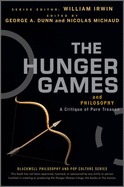
Cometer um assassinato com a finalidade de se autopreservar pode ser considerado moral? É possível que algo tão simples quanto uma música dê início a uma revolução? A filosofia pode ajudar Katniss a escolher entre Peeta e Gale? Tocando em temas profundos, como lealdade e moralidade, Jogos Vorazes e a filosofia nos ajuda a analisar uma das mais famosas distopias de nosso tempo.
I can't decide what is scarier, to think that Susan Collins had all of that philosophical and historical content whizzing about in her head when writing the Hunger Games or to believe that she just wrote it all and stumbled upon the connections! No I'm going with, she's a philosophical and historical genius! No wonder when I got to the third book in a week I started to get a bit overwhelmed and fragile. I thoroughly enjoyed reading this series of critical philosophical essays, they were riveting. Although I would have liked to read more dissection on the final power-play in the capital and why Katniss could never have chosen Gale afterwards. Moreover I'd like to see it examined from Gale's decision making viewpoint. At what point did Gale decide to tip the scales against himself, let go of Katniss forever and become the career soldier? Thinking back it could have been as early as standing in her kitchen with the statement " I knew you'd kiss me, you only see me when I'm in pain". That is probably a misquote but it's the sentiment. A history lesson in human nature!
I read this book as part of the research I am doing for my master thesis, which is about the current popularity of the dystopian genre amongst adolescents.
I liked the essays in this book, some were more useful than others. The essays were interesting but not very special or groundbreaking. Just an ok read I suppose.
My favorite essay in this collection is "She Has No Idea. The Effect She Can Have": Katniss and the Politics of Gender by Jessica Miller. Otherwise, all of these are fascinating. I do wish there was an updated edition that handled the movie adaptations and A Ballad of Songbirds and Snakes along with its adaptation.
By now, I've read a pretty wide selection of the "Philosophy and Pop Culture" series put out by several publishing houses over the last decade or so, and while it's commendable that important scholars and philosophers have finally agreed to descend from their ivory towers to grace us with their ultimate knowledge by starting to use pop culture items to "layman-ize" classic, difficult texts, their efforts do have certain drawbacks.
For instance, after the third "[insert movie, book, show, band here] and Philosophy" book, you do start getting the feeling that they all but run out of books and ideas to present to us humble readers. How many times do I have to read about Utilitarianism and its fundamental differences with Kantian ethics? Or about Plato's analogy of the cave, and how it pertains to the "reality" argument? Truth vs Ignorance? You get my point.
It makes one wonder if sometimes in the act of making philosophy more accessible to the masses, much is not lost in the way of respect for the reader, simply by not trusting him/her to move past the basics into more challenging territory. Ultimately, it is the challenge that makes philosophy so rewarding.
"The Hunger Games and Philosophy" is sadly no different. You have to make it all the way down to the last three chapters to find something truly rewarding and thought provoking, with the power to redeem the preceding essays. It's not that they're bad, it's just that I've feel like I've read them before.
In short, if you're new to philosophy or are just looking for a primer, then you'll thoroughly enjoy this read. However, if you're either familiar with the basics or are simply curious about the depth to which "The Hunger Games" has been probed, then you might be disappointed.
The absolute best thing about the book is that it often feels like a deep conversation about HG with someone more intelligent than me, who's able to both articulate my own thoughts as well as direct my attention to things I had not considered. I'm glad I read it even though I nearly gave up half-way through the introduction as it read more like a high school essay of a student trying too hard to make analogies. "Philosophy is an invention worthy of Beetee. It's as indispensable to anyone who wants to think as Katniss's skill with a bow and arrow is to her survival in the arena"; "We've enlisted a team of allies with minds as sharp as Cloves knives, who weave arguments as strong as Finnick Odair's nets (...)" 🤦♀️🤦♀️
Fortunately, it turned out that such overkill was confined mostly to the introduction and small parts of two or three chapters. Since each chapter is written by a different author, they are a mixed bag, but some really stand out (like chapter 4 introducing, among other concepts, Thomas Nagel's idea of 'moral luck' that I had not heard about).
Am I somewhat reduced to pop-philosophy since being so far removed from more intellectual or serious philosophical studies? Maybe, but there's nothing wrong with enjoying new material.
This was fun analysis of a good trilogy, and it's worth holding onto for future use or reference.
This was really excellent. Although I'd say to ignore the introduction because it's pretty much just a game of how many Hunger Games references can we make. But the essays themselves are super interesting even for someone with a non-existent grasp on philosophy. It did make me sad that this wasn't written after The Ballad of Songbirds and Snakes though because there was so much in there that could have been referred to/explored. This is well worth a read for anyone who likes the Hunger Games and is constantly impressed by Collins' ability to craft perfectly lifelike worlds and characters.
Edit the next day I was looking through some of my highlights from this book and I've highlighted the phrase: "a pacifist in Panem would last about as long as a juicy steak in front of a wolf muttation" and annotated it with: 'example of this thing they do'. I'd forgotten this thing where a lot of the authors make very forced references to the books and yes it was unbearable in the introduction but it did happen a fair amount throughout - just worth noting I guess.
I liked this compilation of essays by philosphers much better than any 'pop culture' book of this kind I've gotten that had to do with psychology. Though, out of pure curiousity in the case of this one series I actually wouldn't mind reading the psychological analaylsis in essays of The Hunger Games Trilogy truth be told. There is plenty of dsyfunction going on that I'd love them to pick to death. In fantasy books, the psychology analysis is sort of pointless. But a philosophical book of essays would be more interesting. I discovered the psychology pop culture books through my love of Harry Potter and wasn't impressed, though found a psychological analysis of The Simpsons (the cartoon that hasn't stopped since it's debut on Fox when I was in Third or Fourth grade!) was entertaining. Now a philosophical rendering of the Hunger Games was really thought provoking in all honesty. I loved this book. I loved the essays.
An in depth analysis of everything that is The Hunger Games. My only complaints are that some of the chapters copied the same pivotal moments in the trilogy, but that is evened out by the different takes on the moments. Also some of the chapters (luck, chimeras, mimetic art) didn't ring especially true to me. Chapters on Schadenfreude, Invisible strings (favors), Just-War tradition, Being versus Seeming to be, Morality and the War of All against All, were very cohesive and interesting. The motives behind why the Hunger Games were accepted in Panem and were accepted in some fashion in our past time were explored. My favorite series was broken down expertly; the authors did a great job not over analyzing Collins' moral questions. The book is always a smart delve into the series and only solidifies my love for the books; this book only makes me want to check out the others in the series of Philosophy.
Some very good essays; some were okay; a couple just didn't jive for me. At times, I felt like the authors didn't explore their topics as deeply as I would have liked- I found myself interested in the essay's argument, but it didn't go far enough for me. I realize, though, that these essays are published for a general interest audience who may not already have a background in critical and philosophical theory, so I can understand some of those editing decisions. At other times, the author seemed to be "trying too hard" to be accessible. (Maybe it's just a picky personal preference that no one else shares, or maybe it's just an occupational hazard when writing for this kind of audience, but I didn't care for the excessively casual tone in one or two of the essays) All in all, an interesting read that brought up some ways of looking at The Hunger Games that I had never considered.
Easily the best of the Pop Culture and Philosophy books I've read. I think the somewhat more simple content of the Hungers Games books, compared to the sprawling world and myriad character of Game of Thrones, actually led to a more complex and comprehensive discussion of the philosophical problems in the series. There are some fantastic entries here, and unlike the two GoT philosophy books I've read, I never felt that I was being talked down to or that all the philosophical aspects were being over explained or overly simplified.
I'm not going to single out my favourite chapters, which are too numerous to count. But the Political Philosophy section in particular stood out as a good blend of philosophy and the world of the Hunger Games which felt organic and unforced.
Overall one of the better collections of Pop Culture and Philosophy books out there.
I have enjoyed a great many of the books in the Blackwell Philosophy and Pop Culture Series. This was the most recent one in the series that I have read, and I have to say that this one was more of a mixed bag than any of the others. Once you hit the 3/4 of the way mark, many of the essays seem redundant, incorporating aspects of the first essays and kind of running them into the ground. While that was seriously obnoxious, the essays before that point were well written and well thought out. All in all, could have been better - definitely had room for better editing, but not terrible.
Of course, in picking this book up, I am a fan of the Hunger Games trilogy, and I studied Philosophy in college. A lot of the points raised are ones I've often considered myself when reading the books or watching the films. I sometimes found myself wanting more, such as character analysis on Johanna Mason, but I understand this book is focused on philosophy, not psychology.
I listened to the audiobook and didn't particularly like the narration, so I ended up listening at 2x speed. I feel in retrospect that it would serve better as some sort of interactive podcast or YouTube thread, because as thorough as some points are, others felt like they only skimmed the surface. Also, as spectators to Suzanne Collins' masterpiece, we as readers can only ever theorise, so certain arguments felt less tangible than others.
I would recommend this to fans of both The Hunger Games and philosophy, but bear in mind the people writing these articles are only analysing the text from their own interpretation. Naturally, this could be said for any book review/analysis, but as a Listener I felt disconnected to some points raised. An example would be the interpretation of Katniss' feelings towards Peeta- I think this part lacked the heart that the text and films show, such as the symbolism of the pearl and what this really meant for their relationship. That said, this comes down to opinion.
I also felt the book ended rather abruptly, without a proper conclusion.
Overall, it's interesting to hear other people's interpretations of the text, but I think it could have been executed better, both in regards to formatting and content. That said, if I can get my hands on a physical copy, I might try reading it again.
This installment of the popular culture and philosophy books felt fresh. It didn't just rehash the same things that the other similar books talked about. It's almost as if someone actually thought about what kind of philosophy is actually suggested by the book and went with that instead of with philosophy 101. I really appreciated a chapter on game theory and when it is worth it to betray your partners in the arena since ultimately only one of you can survive. The author showed that Katniss thought about this a lot, and it was ultimately a major part of the series rather than just philosophy 101 that could be forced into the book.
There was also a chapter on disciplining the body that talked about the body modifications of the people in the Capital as a way of distracting them from the fact that they are killing children for their entertainment.
There was a chapter on Just War that specifically looked at whether the rebellion was "just" which actually concluded that it was not because of the last bomb that killed Prim and the fact that they killed the soldiers in the caves and didn't have to do that. They considered the real world effects of injust wars and how the only reason this turns out good is because it is fiction.
Over and over we see philosophy applied to major parts of the Hunger Games instead of minor details that happen to illustrate a point. It was refreshing, and I hope all of the later installments of this series are as thought provoking.
Liked this book a lot and appreciate that I didn't need to reread the books to understand the philosophical connections they were making. There is some deeper philosophy than what went beyond my intro course in college and would need to research a few concepts for more fuller understanding. The book is as solid as I hoped for.
Each chapter is a different theme, concept or connection to philosophy somehow. Looked like each chapter was written up by a different author and I think that was to the book's advantage.
Book was a little long for me as a lot of the same examples from the books keep getting mentioned for reference. I suppose it was necessary but it also seemed they pulled material mostly from book 1 and 3. Catching Fire was not referenced as much regardless.
Well done book that I was more interested in than the books themselves and went beyond the themes I thought about when reading the books originally. They can more philosophical connections out of the Hunger Games series than I thought possible.
It sure was a challenging reading. The authors' takes on philosophy are not very complex, but their approaches get repetitive at times. I feel I've already read about stoicism 5 times, reviewed in my head the Hobbes v. Kant fight on morality and found many different answers to the "Peeta over Gale" dilema.
Here are TOP 5 essays that have changed my perspective on THG:
1. "So here I am in his debt again": Katniss, Gifts and Invisible Strings (Jennifer Culver)
2. "She has no idea. The effect she can have": Katniss and the Politics of Gender (Jessica Miller)
3. Discipline and the Docile Body: Regulating Hunger in the Capitol (Christina Van Dyke)
4. "The odds have not been very dependable of Late": Morality and Luck in the Hunger Game Trilogy (George A. Dunn)
5. Why Katniss Chooses Peeta: Looking at Love through a Stoic Lens (Abigail E. Myers)
+ Class in Session: Power and Privilege in Panem (Chad William Timm)
This book is the perfect way to cap off a reading of the hunger games trilogy, as it not only serves as a brilliant way to understand more about the themes and hidden meanings of the hunger games, but also serves as a great intro into the world of philosophy. The authors do a brilliant job of connecting the hunger games to many different philosophers and philosophies without leaving a reader who may perhaps not know much about philosophy confused, but still enriching enough where someone who does love and know about philosophy will still have a fantastic time learning about these connections. As someone who loves the hunger games and philosophy, I loved discovering these subtle meanings throughout the various plot points of the hunger games trilogy through philosophy, and I thought it was throughly well done the way the book was structured. Definitely worth a read if you are a fan of the hunger games especially.
i feel like such an intellectual but in reality i was confused by some of the philosophy references. overall, this was super interesting as multiple writers contributed to this book. it breaks down various philosophical and psychological aspects of the series and i really enjoyed most of the chapters. this made me appreciate the series even more and i even feel a little bit smarter, which is always good.
Great book that shows what a great writer Suzanne Collins is. I especially loved the sections on war, resistance, and gender. Furthered my love for the Hunger Games Trilogy. Some sections dragged on a little or just didn't make a whole lot of sense to me, but critical theory is hard to read, so that's probably why. Would love to see a version that incorporates The Ballad of Songbirds and Snakes as well!
I’ve found this book very interesting and instigating. They share a lot of philosophical content in a way that the discussion is always interesting and substantial but not inaccessible, in terms of content density. I think it’s a good book to start questioning some aspects of the original trilogy as well as our lives.
As a fan of the Hunger Games I have high expectations for this book and it didn't disappoint! Whether you're new to Philosophy or not this is easy to read and follow the ideas of chance (odds), being lucky, being true to yourself, rules for society, and self preservation. There are spoilers for the whole Hunger Games trilogy so please read that first. The books not the movies.
O livro é claramente pra adolescentes, então tem que ler com isso em mente! Mas achei muito legal. Revi conceitos que aprendi no ensino medio e primeiro ano da faculdade e que já tinha esquecido, e os autores explicam de um jeito extremamente didático e envolvente, usando a série de pano de fundo. Amei!
This book contains a collection of essays relating to the series of books. I found some essays more agreeable than others, and many of the essays seemed to focus on the same topics. Still, it's a fun way of relating the books to real philosophy.
This entire review has been hidden because of spoilers.
This book helps to conceptualize and clarify some aspects of the original trilogy. Great if you don't like ready stuffy philosophy. I wonder what would be added if this was released after the prequel book.
I'd like to thank whoever decided to assess this book and make it a peer-reviewed source. Bought this for fun a while back but only ended up really using it for a media theory paper. The odds were apparently in my favour
The Hunger Games and Philosophy is another solid entry in the “and Philosophy” series. It goes a little deeper than the other entrants in the series but given the subject matter, that makes sense. It’s still written in accessible language and prompts the reader to think.
As a huge Hunger Games fan I really enjoyed this book. The perfect book for fans of the series who want to know more about the background of the whole story.