

What do you think?
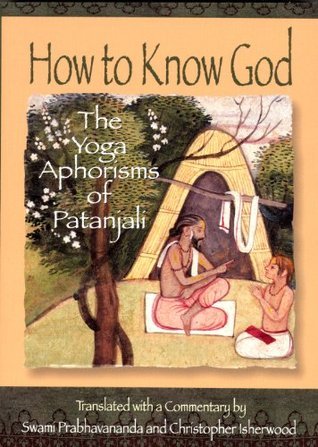
How to Know God: The Yoga Aphorisms of Patanjali
The Yoga Aphorisms of Patanjali is a major work on the practice of yoga and meditation. Through these ancient aphorisms you will learn how to control your mind and achieve inner peace and freedom. Although these methods were taught over 2,000 years ago, they are as alive and effective today as they have ever been. The 2008 edition has been reset and now has an extensive index for reference.
256 pages, Paperback
First published January 1, 400
About the author
Prabhavananda
143 books66 followersSwami Prabhavananda was an Indian philosopher, monk of the Ramakrishna Order, and religious teacher.
Born in India, he joined the Ramakrishna Order after graduating from Calcutta university in 1914. He was initiated by Swami Brahmananda.
In 1923, he was sent to the United States of America. Initially he worked as an assistant minister of the Vedanta Society of San Francisco. After two years, he established the Vedanta Society of Portland. In December 1929, he moved to Los Angeles where he founded the Vedanta Society of Southern California in 1930.
Under his administration the Vedanta Society of Southern California grew over the years to become the largest Vedanta Society in the West, with monasteries in Hollywood and Trabuco Canyon and convents in Hollywood and Santa Barbara.
Swami Prabhavananda was a scholar who authored a number of books on Vedanta and Indian religious scriptures and commentary. He was assisted on several of the projects by Christopher Isherwood or Frederick Manchester. His comprehensive knowledge of philosophy and religion attracted such disciples as Aldous Huxley and Gerald Heard.
Swami Prabhavananda died on the bicentennial of America's independence, July 4, 1976, and on the 74th anniversary of the death, or mahasamadhi, of Swami Vivekananda, the founder of the Ramakrishna Order in India and many of the Vedanta centers in America and Europe.
Christopher Isherwood wrote a book, My guru and his disciple,[3] that described his more than three decades (1939–76) as a student of Swami Prabhavananda
Born in India, he joined the Ramakrishna Order after graduating from Calcutta university in 1914. He was initiated by Swami Brahmananda.
In 1923, he was sent to the United States of America. Initially he worked as an assistant minister of the Vedanta Society of San Francisco. After two years, he established the Vedanta Society of Portland. In December 1929, he moved to Los Angeles where he founded the Vedanta Society of Southern California in 1930.
Under his administration the Vedanta Society of Southern California grew over the years to become the largest Vedanta Society in the West, with monasteries in Hollywood and Trabuco Canyon and convents in Hollywood and Santa Barbara.
Swami Prabhavananda was a scholar who authored a number of books on Vedanta and Indian religious scriptures and commentary. He was assisted on several of the projects by Christopher Isherwood or Frederick Manchester. His comprehensive knowledge of philosophy and religion attracted such disciples as Aldous Huxley and Gerald Heard.
Swami Prabhavananda died on the bicentennial of America's independence, July 4, 1976, and on the 74th anniversary of the death, or mahasamadhi, of Swami Vivekananda, the founder of the Ramakrishna Order in India and many of the Vedanta centers in America and Europe.
Christopher Isherwood wrote a book, My guru and his disciple,[3] that described his more than three decades (1939–76) as a student of Swami Prabhavananda
Ratings & Reviews
Friends & Following
Create a free account to discover what your friends think of this book!
Community Reviews
Displaying 1 - 30 of 82 reviews

August 30, 2007
I read this cover-to-cover while sitting on Mt. Shasta this summer, consuming nothing but water and juice for 7 days. But its brilliance is beyond hallucination. Though I was told this was one of those "dry spiritual texts," I found it funny, accessible, practical, and engaging. The translation of Patanjali's aphorisms must be one of the best, if not the best, out there, and the Sanskrit terminology isn't obtrusive. My only qualm is that by the end, the pragmatic "how-to" approach to yogi-ism felt so discouragingly disciplined that I spent hours lying in my tent bemoaning the impossibility of ever achieving samadhi.
Seriously, though. If this book ever crosses your path, at the right time and in the right space, give it a try.
Seriously, though. If this book ever crosses your path, at the right time and in the right space, give it a try.

December 9, 2022
The Yoga Aphorisms of Patanjali are deservedly influential. From the outset, my disclaimer: I read these Patanjali sutras second hand, yet most likely I have spent more time with them than most other reviewers here at Goodreads. To explain...
As an initiator trained personally by Maharishi Mahesh Yogi, from 1970 until I resigned in 1995, my life involved everything Transcendental Meditation. Of course, I took his special advanced course to learn the TM Sidhi Program.
Then I followed up faithfully, regularly, "Doing program." When traveling I'd even carry around my portable "Flying Cushion" in a yellow bag with a thick black drawstring, a burlap bag that held my precious cushion, made of high-density foam rubber. This I'd sit on; then I'd buckle up as if putting on a car's seatbelt. So important for cutting down on injuries when doing Yogic Flying!
Seems to me...
Everybody Who's Done the TM Sidhi Program Has Reason to Thank Patanjali for His Yoga Aphorisms
Maharishi made no secret of how his Sidhis program was based on The Yoga Aphorisms of Patanjali.
In addition, Maharishi was a master teacher, a meticulous and systematic instructor of techniques that involved consciousness.
Not that I stayed with the TM founder and his organization. I sure didn't.
Nor do I still do Yogic Flying. Or practice the sutra for Great Physical Strength. Or do the Invisibility sutra. Yet I sit here, at my keyboard, so deep down grateful that I had the chance to explore these sacred mysteries.
Why, Exactly, Am I Writing this Book Review, Anyway?
Partly to honor Patanjali. Not that he needs a boost for more good karma, a teensy acknowledgment coming from the likes of me, haha!
More that, as a lover of God, I'm a lover of sacred teachers. In my heart, I honor every legitimate one who has taught knowledge inspired by what I call "High Truth Value."
In addition, I have a bit of a caution to share with any of you Goodreaders who believe that you can read Prabhavananda's book and then turn these sacred aphorism into your latest self-help project.
Might I suggest?
If you Seek God, Don't Expect to Learn on the Cheap.
Find a legitimate teacher, one with the standing to teach about Enlightenment. Choose the best teacher you can find, regarding both skills and honor. Otherwise don't (unintentionally) desecrate a spiritual teaching by assuming that you can figure it out, or "get a taste of it" from a book.
Even though this work by Patanjali has been translated into current English, that doesn't make his teaching accessible to readers.
In case it helps you, as a fellow Goodreader who longs to know God -- and maybe you're also aspiring, to be of service to humanity -- please consider this next part. Because it's one of the many excellent chunks o' wisdom that I learned as one of Maharishi's teachers, back in the day. To paraphrase:
Spiritual teaching that involves consciousness techniques -- this must flow from a human teacher. It goes from the heart of that teacher directly to the heart of the student. Specific instructions are needed, but they only serve to adorn that pristine flow, one-on-one, from the teacher.
Not being a Time Lord like Doctor Who, nor even owning a decent time machine, no, I haven't personally met Patanjali. But if I did, there's one quality that I'm convinced I would find. Patanjali, like any true spiritual teacher, devoted his life to teaching the best that he had.
No exaggeration: He gave his life in order to teach, such as what has been written down and included in this book. Undoubtedly published with great respect by Prabhavananda....
And much as I like books -- heck, I LOVE books -- no paperback can do justice to this sort of teaching about consciousness.
Just my opinion and experience, you know. Rose Rosetree, attempting to give a word to the wise.
As an initiator trained personally by Maharishi Mahesh Yogi, from 1970 until I resigned in 1995, my life involved everything Transcendental Meditation. Of course, I took his special advanced course to learn the TM Sidhi Program.
Then I followed up faithfully, regularly, "Doing program." When traveling I'd even carry around my portable "Flying Cushion" in a yellow bag with a thick black drawstring, a burlap bag that held my precious cushion, made of high-density foam rubber. This I'd sit on; then I'd buckle up as if putting on a car's seatbelt. So important for cutting down on injuries when doing Yogic Flying!
Seems to me...
Everybody Who's Done the TM Sidhi Program Has Reason to Thank Patanjali for His Yoga Aphorisms
Maharishi made no secret of how his Sidhis program was based on The Yoga Aphorisms of Patanjali.
In addition, Maharishi was a master teacher, a meticulous and systematic instructor of techniques that involved consciousness.
Not that I stayed with the TM founder and his organization. I sure didn't.
Nor do I still do Yogic Flying. Or practice the sutra for Great Physical Strength. Or do the Invisibility sutra. Yet I sit here, at my keyboard, so deep down grateful that I had the chance to explore these sacred mysteries.
Why, Exactly, Am I Writing this Book Review, Anyway?
Partly to honor Patanjali. Not that he needs a boost for more good karma, a teensy acknowledgment coming from the likes of me, haha!
More that, as a lover of God, I'm a lover of sacred teachers. In my heart, I honor every legitimate one who has taught knowledge inspired by what I call "High Truth Value."
In addition, I have a bit of a caution to share with any of you Goodreaders who believe that you can read Prabhavananda's book and then turn these sacred aphorism into your latest self-help project.
Might I suggest?
If you Seek God, Don't Expect to Learn on the Cheap.
Find a legitimate teacher, one with the standing to teach about Enlightenment. Choose the best teacher you can find, regarding both skills and honor. Otherwise don't (unintentionally) desecrate a spiritual teaching by assuming that you can figure it out, or "get a taste of it" from a book.
Even though this work by Patanjali has been translated into current English, that doesn't make his teaching accessible to readers.
In case it helps you, as a fellow Goodreader who longs to know God -- and maybe you're also aspiring, to be of service to humanity -- please consider this next part. Because it's one of the many excellent chunks o' wisdom that I learned as one of Maharishi's teachers, back in the day. To paraphrase:
Spiritual teaching that involves consciousness techniques -- this must flow from a human teacher. It goes from the heart of that teacher directly to the heart of the student. Specific instructions are needed, but they only serve to adorn that pristine flow, one-on-one, from the teacher.
Not being a Time Lord like Doctor Who, nor even owning a decent time machine, no, I haven't personally met Patanjali. But if I did, there's one quality that I'm convinced I would find. Patanjali, like any true spiritual teacher, devoted his life to teaching the best that he had.
No exaggeration: He gave his life in order to teach, such as what has been written down and included in this book. Undoubtedly published with great respect by Prabhavananda....
And much as I like books -- heck, I LOVE books -- no paperback can do justice to this sort of teaching about consciousness.
Just my opinion and experience, you know. Rose Rosetree, attempting to give a word to the wise.

September 22, 2011
The Yoga Sutras (thread of aphorisms) of Patanjali are one of the six darshanas of the Hindu or Vedic schools. "How to Know God" is a beautiful translation of those. The book is relatively short (pocket sized with just over 200 pages) and very readable. It offers one of the clearest explanations of the practice of yoga and meditation that I have read. It is surprisingly practical. I value it almost as much as I do "The Art and Science of Raja Yoga: Fourteen Steps to Higher Awareness: Based on the Teachings of Paramhansa Yogananda" and Osho's "The Book of Secrets: 112 Keys to the Mystery Within" as a practical guide to specific meditation techniques. For those who have a Christian background, the book references familiar Christian concepts, making the book all the more readable for the typical Westerner. While one can read the entire book in one sitting (and maybe this is a useful strategy for its first reading), I prefer to digest it slowly, contemplating and savoring each aphorism. I highly recommend this book for anyone who wants to enter into a deeper level of spiritual consciousness.

December 17, 2021
This is a superlative commentary on Patanjali's Yoga Sutras, beautifully written, accessible, and filled with deep wisdom from writers who are manifestly well seasoned in that of which they write.
The only reason I gave it four instead of five stars is some problematic conflation of Advaita Vedanta and Yoga philosophies and practise in which realisation of Brahman is synonymous with the experience of samadhi. This tends to reinforce the common misunderstanding that Advaita Vedanta is a mere philosophy and that we need the methodology of Yoga in order to realise this philosophy experientially. In fact, Advaita Vedanta is a 'pramana' or means to realisation in its own right, via jnana-yoga, albeit that its leading proponents consider the methods of Yoga, i.e. raja-yoga, in particular meditation, to be highly beneficial as preparatory practices, supporting the likelihood of the intuitive leap that Advaita Vedanta teaching aims at provoking.
The idea that realisation of Brahman is attained via nirvikalpa samadhi (deep meditative absorption) is at odds with the reality, taught by Advaita Vedanta, that Brahman is not some special or exotic experience but the very ground of *all* experience, including the most "mundane" experience. Self realisation, or realisation of atman/Brahman, is not a discrete experience, which by the nature of all experience must be transient, but the recognition of the nature of all experience, that is of our own nature, always and already accomplished, but only obscured by ignorance.
Despite this point of confusion, which the Ramakrishna Mission has been criticised for historically propagating, and now unequivocally rectified by current teachers in that organisation, Swami Sarvapriyananda being most prominent, I highly recommend this classic text for anyone wanting to understand and benefit from Patanjali's Yoga Sutras.
The only reason I gave it four instead of five stars is some problematic conflation of Advaita Vedanta and Yoga philosophies and practise in which realisation of Brahman is synonymous with the experience of samadhi. This tends to reinforce the common misunderstanding that Advaita Vedanta is a mere philosophy and that we need the methodology of Yoga in order to realise this philosophy experientially. In fact, Advaita Vedanta is a 'pramana' or means to realisation in its own right, via jnana-yoga, albeit that its leading proponents consider the methods of Yoga, i.e. raja-yoga, in particular meditation, to be highly beneficial as preparatory practices, supporting the likelihood of the intuitive leap that Advaita Vedanta teaching aims at provoking.
The idea that realisation of Brahman is attained via nirvikalpa samadhi (deep meditative absorption) is at odds with the reality, taught by Advaita Vedanta, that Brahman is not some special or exotic experience but the very ground of *all* experience, including the most "mundane" experience. Self realisation, or realisation of atman/Brahman, is not a discrete experience, which by the nature of all experience must be transient, but the recognition of the nature of all experience, that is of our own nature, always and already accomplished, but only obscured by ignorance.
Despite this point of confusion, which the Ramakrishna Mission has been criticised for historically propagating, and now unequivocally rectified by current teachers in that organisation, Swami Sarvapriyananda being most prominent, I highly recommend this classic text for anyone wanting to understand and benefit from Patanjali's Yoga Sutras.

April 22, 2012
My favorite translation of Patanjali.
Trivia: in George Harrison's song "Brainwashed" this translation is quoted, and the book and page number are referenced within the song.
Trivia: in George Harrison's song "Brainwashed" this translation is quoted, and the book and page number are referenced within the song.

March 9, 2011
This book is very intense, but great for people who are curious about the sutras or who are serious yoga practitioners. This translation has a Christian scope on it, which makes it nice for many Westerns when trying to make connections. It is a book that should be read slowly. I marked mine up by underlining it. It is also a book that will reveal itself to you in day-to-day events if you pay attention and if you took the reading to heart. You will most likely reread this book in your life time if staying connected to the sutras is something you seek in life. I know I will be picking this book up again from time to time to remind myself of lessons.

December 18, 2012
A great interpretation of the sutras recommended for the senior student who already has a good grasp of yoga philosophy. Even though this was published in 1953 it still is relevant to the spiritual seeker and examples of real life situations which are given to illustrate themes found in the sutras can still be understood. I found it interesting to research who Isherwood was after seeing a film based on one of his books, 'A Good Man' and realising he was the same Isherwood that had worked with Swami Prabhavanda to commentate on the yoga sutras and the Bhagavad Gita . He also wrote the book that later became the key text for the film 'Caberet'. What an amazing story of all these incredible artists who fled Europe after the First World War and ended up in America and became part of the Vedanta society there. I loved finding this connection between the ancient teachings of yoga and passionate artists seeking to escape the horror of war and open to a different way of being. This is a book that I will go back to time and time again as an important and beautifully written source.

January 14, 2024
This is one of the older translations, one with much simple language and none of the more convoluted esoteric diction seen in some of the newer age, self-help tomes taking inspiration from spiritual texts.
At the beginning of the book, the translators explain how, since Sanskrit followed an oral tradition of passing down knowledge from teacher to student, a lot of the Yoga Aphorism were more of a shorthand that mentors would then expand upon using their own knowledge and sensibilities. This approach appears efficient and contrary to what one might think, helps preserve the pith of the message better.
There are some parts of the book which deal with supposed real-life instances of 'abilities' that the practitioners of Yoga acquire. But to those who're interested in learning a structured approach to Yoga and the Sanatana principles that it represents, are best to stick to the actual interpretations.
A good book, one which I hope to revisit in the future.
At the beginning of the book, the translators explain how, since Sanskrit followed an oral tradition of passing down knowledge from teacher to student, a lot of the Yoga Aphorism were more of a shorthand that mentors would then expand upon using their own knowledge and sensibilities. This approach appears efficient and contrary to what one might think, helps preserve the pith of the message better.
There are some parts of the book which deal with supposed real-life instances of 'abilities' that the practitioners of Yoga acquire. But to those who're interested in learning a structured approach to Yoga and the Sanatana principles that it represents, are best to stick to the actual interpretations.
A good book, one which I hope to revisit in the future.

July 24, 2026
Niet iets dat snel wegleest. Geen meeslepend verhaal maar desalniettemin van genoten en van geleerd. Ook blij dat ‘ie uit is.
Mijn grote held Wayne Dyer haalt veel aan vanuit dit boek. Ik heb hem al een tijdje en ben vaak begonnen en onderweg afgehaakt maar nu voor het eerst helemaal uitgelezen. Voor mij best een pittig boek door de hoeveelheid begrippen uit het Sanskriet met te weinig duiding en beetje moeilijk Engels.
Leuk als je geïnteresseerd bent in yoga filosofie/psychologie, in het hindoeïsme en in God. 🫶🏼
Mijn grote held Wayne Dyer haalt veel aan vanuit dit boek. Ik heb hem al een tijdje en ben vaak begonnen en onderweg afgehaakt maar nu voor het eerst helemaal uitgelezen. Voor mij best een pittig boek door de hoeveelheid begrippen uit het Sanskriet met te weinig duiding en beetje moeilijk Engels.
Leuk als je geïnteresseerd bent in yoga filosofie/psychologie, in het hindoeïsme en in God. 🫶🏼

March 7, 2024
An easy to understand translation of the sutras— which can be v daunting. I loved the parallels he drew to Christianity
September 2, 2024
My mind fell like a hailstone into that vast expanse of Brahman's ocean. Touching one drop of it, I melted away and became one with Brahman. And now, though I return to human consciousness, I abide in the joy of the Atman. Where is this universe? Who took it away? Has it merged into something else? A while ago, I beheld it—now it exists no longer. This is wonderful indeed! Here is the ocean of Brahman, full of endless joy. How can I accept or reject anything? Is there anything apart or distinct from Brahman? Now, finally and clearly, I know that I am the Atman, whose nature is eternal joy. I see nothing, I hear nothing, I know nothing that is separate from me.
- Shankara, Crest-Jewel of Discrimination
One can take issue with the translation, which favors conceptual clarity over literal fidelity, or with the fact that Prabhavananda tends to shoehorn Patañjali—who adhered to the Sāṃkhya philosophy, which is dualistic and conceives of liberation not as the unity of all in Atman-Brahman, as does Vedanta, but as the isolation of each of a plurality of Puruṣas from the oneness of Prakṛti—into his own Vedantic system; even to the point of translating Puruṣa as Atman throughout the text. Nonetheless, even though he covers much of the same territory as Mircea Eliade’s justly-lauded study of Yoga, Prabhavananda offers a much more user-friendly guide to a collection of aphorisms which the uninitiated reader would otherwise find too obscure and minimalistic to be of use. The following is an unthematic jumble of quotes from Prabhavananda’s commentary (and a few from the Yoga Sutras themselves); mostly for my own recollection. But perhaps others might find some interest in them as well.
A yoga is a method—any one of many—by which an individual may become united with the Godhead, the Reality which underlies this apparent, ephemeral universe.
According to Patanjali, the mind (chitta) is made up of three components, manas, buddhi, and ahamkara. Manas is the recording faculty which receives impressions gathered by the senses from the outside world. Buddhi is the discriminative faculty which classifies these impressions and reacts to them. Ahamkara is the ego-sense which claims these impressions for its own and stores them up as individual knowledge.
God-within-the-creature is known in the Sanskrit language as the Atman or Purusha, the real Self. Patanjali speaks always of the Purusha (which means literally "the Godhead that dwells within the body"), but we shall substitute Atman throughout this translation, because Atman is the word used in the Upanishads and the Bhagavad-Gita, and students are therefore likely to be more accustomed to it.
The mind seems to be intelligent and conscious. Yoga philosophy teaches that it is not. It has only a borrowed intelligence. The Atman is intelligence itself, is pure consciousness. The mind merely reflects that consciousness and so appears to be conscious.
Knowledge or perception is a thought-wave (vritti) in the mind. All knowledge is therefore objective. Even what Western psychologists call introspection or self-knowledge is objective knowledge according to Patanjali, since the mind is not the seer, but only an instrument of knowledge, an object of perception like the outside world. The Atman, the real seer, remains unknown.
When an event or object in the external world is recorded by the senses, a thought-wave is raised in the mind. The ego-sense identifies itself with this wave. If the thought-wave is pleasant, the ego-sense feels, "I am happy"; if the wave is unpleasant, "I am unhappy." This false identification is the cause of all our misery—for even the ego's temporary sensation of happiness brings anxiety, a desire to cling to the object of pleasure, and this prepares future possibilities of becoming unhappy. The real Self, the Atman, remains forever outside the power of thought-waves; it is eternally pure, enlightened and free—the only true, unchanging happiness. It follows, therefore, that man can never know his real Self as long as the thought-waves and the ego-sense are being identified. In order to become enlightened we must bring the thought-waves under control, so that this false identification may cease. The Gita teaches us that "Yoga is the breaking of contact with pain."
What does yoga philosophy mean by "character"? To explain this, one may develop the analogy of the lake. Waves do not merely disturb the surface of the water, they also, by their continued action, build up banks of sand or pebbles on the lake bottom. Such sand-banks are, of course, much more permanent and solid than the waves themselves. They may be compared to the tendencies, potentialities and latent states which exist in the subconscious and unconscious areas of the mind. In Sanskrit, they are called samskaras. The samskaras are built up by the continued action of the thought-waves, and they, in their turn, create new thought-waves—the process works both ways. Expose the mind to constant thoughts of anger and resentment, and you will find that these angerwaves build up anger-samskaras, which will predispose you to find occasions for anger throughout your daily life. A man with well-developed anger-samskaras is said to have "a bad temper." The sum total of our samskaras is, in fact, our character—at any given moment. Let us never forget, however, that, just as a sandbank may shift and change its shape if the tide or the current changes, so also the samskaras may be modified by the introduction of other kinds of thought-waves into the mind.
Not all samskaras are acquired during the course of a single human life.
To the thoughts of anger, desire and delusion we must oppose thoughts of love, generosity and truth. Only much later, when the "painful" thought-waves have been completely stilled, can we proceed to the second stage of discipline; the stilling of the "not painful" waves which we have deliberately created.
In the Taoist scriptures we read: "Heaven arms with compassion those whom it would not see destroyed".
Non-attachment is the exercise of discrimination. We gradually gain control of the "painful" or impure thought-waves by asking ourselves: "Why do I really desire that object? What permanent advantage should I gain by possessing it? In what way would its possession help me toward greater knowledge and freedom?" The answers to these questions are always disconcerting. They show us that the desired object is not only useless as a means to liberation but potentially harmful as a means to ignorance and bondage; and, further, that our desire is not really desire for the object-in itself at all, but only a desire to desire something, a mere restlessness in the mind.
Human love is the highest emotion most of us know. It frees us to some extent from our egotism in our relation to one or more individuals. But human love is still possessive and exclusive. Love for the Atman is neither. We readily admit that it is better to love people "for what they really are" than merely for their beauty, their intelligence, their strength, their sense of humour or some other quality—but this is only a vague and relative phrase. What people "really are" is the Atman, nothing less. To love the Atman in ourselves is to love it everywhere. And to love the Atman everywhere is to go beyond any manifestation of Nature to the Reality within Nature.
To love someone, even in the usual human manner, is to get a brief, dim glimpse of something within that person which is tremendous, awe-inspiring, and eternal. In our ignorance, we think that this "something" is unique. He or she, we say, is like nobody else. That is because our perception of the Reality is clouded and obscured by the external manifestations—the character and individual qualities of the person we love—and by the way in which our own ego-sense reacts to them. Nevertheless, this weak flash of perception is a valid spiritual experience and it should encourage us to purify our minds and make them fit for that infinitely greater kind of love which always awaits us. This love is not restless or transient, like our human love. It is secure and eternal and calm. It is absolutely free from desire, because lover and beloved have become one.
What is this cosmos? What is it made of? Vedanta teaches that the cosmos is made of Prakriti, the elemental, undifferentiated stuff of mind and matter. Prakriti is defined as the power or effect of Brahman—in the sense that heat is a power or effect of fire. Just as heat cannot exist apart from the fire which causes it, so Prakriti could not exist apart from Brahman. The two are eternally inseparable. The latter puts forth and causes the former.
[Percy Shelley: “Life, like a dome of many-coloured glass, Stains the white radiance of eternity.”]
If we think of Brahman as "the white radiance," then Prakriti is represented by the colours which disguise the real nature of its beams.
Prakriti remains undifferentiated and the universe exists only in its potential state. As soon as the balance is disturbed, a re-creation of the universe begins. The gunas enter into an enormous variety of combinations—all of them irregular, with one or the other guna predominating over the rest. Hence we have the variety of physical and psychic phenomena which make up our apparent world. Such a world continues to multiply and vary its forms until the gunas find a temporary equilibrium once more, and a new phase of undifferentiated potentiality begins.
Collectively, they may be thought of as a triangle of forces, opposed yet complementary. In the process of evolution, sattwa is the essence of the form which has to be realized, tamas is the inherent obstacle to its realization, and rajas is the power by which that obstacle is removed and the essential form made manifest.
If we wish to describe the gunas individually, we can say that sattwa represents all that is pure, ideal and tranquil, while rajas expresses itself in action, motion and violence, and tamas is the principle of solidity, immobile resistance and inertia. As has been said above, all three gunas are present in everything, but one guna always predominates. Sattwa, for example, predominates in sunlight, rajas in the erupting volcano, and tamas in a block of granite. In the mind of man, the gunas are usually found in a relationship of extreme instability— hence the many moods through which we pass in the course of a single day. Sattwa causes our moments of inspiration, disinterested affection, quiet joy and meditative calm. Rajas brings on our outbursts of rage and fierce desire. It makes us restless and discontented, but it is also responsible for our better phases of constructive activity, energy, enthusiasm and physical courage. Tamas is the mental bog into which we sink whenever sattwa and rajas cease to prevail. In the state of tamas, we exhibit our worst qualities—sloth, stupidity, obstinacy and helpless despair.
In the Hindu system, the first stage of evolution from undifferentiated Prakriti is called mahat, "the great cause." Mahat is the cosmic ego-sense, the first drawing of differentiated consciousness. It may perhaps be compared to the Spirit moving on the face of the waters which is mentioned in the Book of Genesis. From mahat is evolved buddhi, the discriminating faculty which has already been described. From buddhi is evolved ahamkara, the individual ego-sense.
Creation is here described as an evolution outward, from undifferentiated into differentiated consciousness, from mind into matter. Pure consciousness is, as it were, gradually covered by successive layers of ignorance and differentiation, each layer being grosser and thicker than the one below it, until the process ends on the outer physical surface of the visible and tangible world.
The gunas pass through four states—gross, subtle, primal and unevolved. [Yoga Sutras]
When the universe exists only in its potential form, the gunas are in perfect equilibrium and their state is described as unevolved or "signless." When the universe begins to evolve, and the guna-balance is disturbed, we find the dawning of mahat, the cosmic ego-sense. This state is described as primal or "indicated." In the next stage of evolution, when the gunas have entered into the combinations which form the mind and the inner essences of things, their state is described as subtle or "undefined." And finally, when the universe has reached its external, physical manifestation, the state of the gunas is described as gross or "defined."
[Thoughts and subconscious impulses—indeed all the workings of the mind—are objects too, of varying degrees of grossness or “definition.”]
Meditation is evolution in reverse.
When the spiritual aspirant has achieved the highest degree of concentration upon a single object, he is ready to attempt the supreme feat—concentration upon consciousness itself. This is the state of perfect yoga, in which one passes beyond Prakriti, beyond all object knowledge, into union with the Atman—the undifferentiated universal consciousness. The state of perfect yoga can only be entered into when the thought-waves have been stilled and the mind has been cleared of all its samskaras, both the evil and the good—when Patanjali has ceased to believe that he is Patanjali and knows that he is none other than the Atman.
He who achieves yoga is said to be "liberated." When his present life ends, he will be united with the Atman forever. However, the achievement of perfect yoga does not necessarily mean the immediate end of mortal life. Saints have reached the supreme spiritual experience and continued to live on for many years. They have continued to think, speak and act on the plane of external phenomena—but with a difference. The thoughts, words, and actions of a liberated man are said to be like "burnt seeds"—that is to say, they are no longer fertile; they cannot bring forth any more samskaras, they cannot create any new addiction or bondage.
When such concentration is not accompanied by non- attachment, and ignorance therefore remains, the aspirant will reach the state of the disincarnate gods or become merged in the forces of Nature. [Yoga Sutras]
Brahman, the ultimate Reality, cannot properly be said to create, sustain or dissolve, since Brahman is, by definition, without attributes. Ishwara is Brahman seen within Prakriti. He corresponds, more or less, to God the Father in the Christian tradition.
[It’s not a perfect correspondence, since Christian theology holds that one only “sees” the Father in Christ, who is “Lord” (the literal meaning of Ishwara). Christ is the visible image of the invisible God. The Father is probably the closest thing to Nirguna Brahman in Christian thought, but he is still “personal”. Christianity would find a closer affinity with Ramanuja, who simply denied the existence of Nirguna Brahman and identified Brahman with Ishwara.]
"In the beginning was the Word,” says the Gospel according to St. John and "the Word was with God, and the Word was God.” This statement echoes, almost exactly, a verse from the Rig Veda: "In the beginning was Brahman, with whom was the Word; and the Word was truly the supreme Brahman."
Undisturbed calmness of mind is attained by cultivating friendliness toward the happy, compassion for the unhappy, delight in the virtuous, and indifference toward the wicked. [Yoga Sutras]
"The supreme heaven shines in the lotus of the heart," says the Kaivalya Upanishad. "Those who struggle and aspire may enter there. Retire into solitude. Seat yourself on a clean spot in an erect posture, with the head and neck in a straight line. Control all sense-organs. Bow down in devotion to your teacher. Then enter the lotus of the heart and meditate there on the presence of Brahman—the pure, the infinite, the blissful.”
Even so large as the universe outside is the universe within the lotus of the heart. Within it are heaven and earth, the sun, the moon, the lightning and all the stars. Whatever is in the macrocosm is in this microcosm also. [Chandogya Upanishad]
According to Vedanta philosophy, the Atman in man is covered by three layers or "sheaths."
[Psychical (psyche), subtle (pneuma), causal (ego-sense, mind)]
In the waking state, Vedanta tells us, all of these three sheaths come between us and the Atman, but in dreamless sleep the two outer coverings are removed and only the casual sheath, the ego-sense, remains. It follows, therefore, that we are nearer to the Atman in dreamless sleep than in any other phase of our ordinary unspiritual lives; nearer—yet still so far, for what separates us is the toughest covering of the three, the basic layer of our ignorance, the lie of otherness.
Through intense concentration we may become identified with the [object] and yet still retain a mixture of "name," "quality" and "knowledge" in the mind. This is the lowest kind of samadhi, known as savitarka, which means "with deliberation." The term savitarka is only applied when the object of concentration belongs to the order of the gross elements, the most external order of phenomena.
In the samadhi called nirvitarka ("without deliberation") we reach a higher stage. Our achievement of identity with the object of concentration is now unmixed with awareness of name, quality and knowledge. Or, to put it in another way, we are at last able to still the thought-waves which are our reactions to the object, and to know nothing but the object itself, as it truly is: "the thing-in-itself", to use Kant's famous term.
Nirvikalpa samadhi is said to be seedless because it is nothing but pure, undifferentiated consciousness; it contains no phenomenal impressions whatever, no seeds of desire and attachment. Brahman is not "an object of concentration"; in Brahman is neither knower nor known. Brahman, as we have seen, is pure, undifferentiated consciousness; and so, in nirvikalpa samadhi, you are literally one with Brahman, you enter into the real nature of the apparent universe and all its forms and creatures.
[Review continues in comments]
- Shankara, Crest-Jewel of Discrimination
One can take issue with the translation, which favors conceptual clarity over literal fidelity, or with the fact that Prabhavananda tends to shoehorn Patañjali—who adhered to the Sāṃkhya philosophy, which is dualistic and conceives of liberation not as the unity of all in Atman-Brahman, as does Vedanta, but as the isolation of each of a plurality of Puruṣas from the oneness of Prakṛti—into his own Vedantic system; even to the point of translating Puruṣa as Atman throughout the text. Nonetheless, even though he covers much of the same territory as Mircea Eliade’s justly-lauded study of Yoga, Prabhavananda offers a much more user-friendly guide to a collection of aphorisms which the uninitiated reader would otherwise find too obscure and minimalistic to be of use. The following is an unthematic jumble of quotes from Prabhavananda’s commentary (and a few from the Yoga Sutras themselves); mostly for my own recollection. But perhaps others might find some interest in them as well.
A yoga is a method—any one of many—by which an individual may become united with the Godhead, the Reality which underlies this apparent, ephemeral universe.
According to Patanjali, the mind (chitta) is made up of three components, manas, buddhi, and ahamkara. Manas is the recording faculty which receives impressions gathered by the senses from the outside world. Buddhi is the discriminative faculty which classifies these impressions and reacts to them. Ahamkara is the ego-sense which claims these impressions for its own and stores them up as individual knowledge.
God-within-the-creature is known in the Sanskrit language as the Atman or Purusha, the real Self. Patanjali speaks always of the Purusha (which means literally "the Godhead that dwells within the body"), but we shall substitute Atman throughout this translation, because Atman is the word used in the Upanishads and the Bhagavad-Gita, and students are therefore likely to be more accustomed to it.
The mind seems to be intelligent and conscious. Yoga philosophy teaches that it is not. It has only a borrowed intelligence. The Atman is intelligence itself, is pure consciousness. The mind merely reflects that consciousness and so appears to be conscious.
Knowledge or perception is a thought-wave (vritti) in the mind. All knowledge is therefore objective. Even what Western psychologists call introspection or self-knowledge is objective knowledge according to Patanjali, since the mind is not the seer, but only an instrument of knowledge, an object of perception like the outside world. The Atman, the real seer, remains unknown.
When an event or object in the external world is recorded by the senses, a thought-wave is raised in the mind. The ego-sense identifies itself with this wave. If the thought-wave is pleasant, the ego-sense feels, "I am happy"; if the wave is unpleasant, "I am unhappy." This false identification is the cause of all our misery—for even the ego's temporary sensation of happiness brings anxiety, a desire to cling to the object of pleasure, and this prepares future possibilities of becoming unhappy. The real Self, the Atman, remains forever outside the power of thought-waves; it is eternally pure, enlightened and free—the only true, unchanging happiness. It follows, therefore, that man can never know his real Self as long as the thought-waves and the ego-sense are being identified. In order to become enlightened we must bring the thought-waves under control, so that this false identification may cease. The Gita teaches us that "Yoga is the breaking of contact with pain."
What does yoga philosophy mean by "character"? To explain this, one may develop the analogy of the lake. Waves do not merely disturb the surface of the water, they also, by their continued action, build up banks of sand or pebbles on the lake bottom. Such sand-banks are, of course, much more permanent and solid than the waves themselves. They may be compared to the tendencies, potentialities and latent states which exist in the subconscious and unconscious areas of the mind. In Sanskrit, they are called samskaras. The samskaras are built up by the continued action of the thought-waves, and they, in their turn, create new thought-waves—the process works both ways. Expose the mind to constant thoughts of anger and resentment, and you will find that these angerwaves build up anger-samskaras, which will predispose you to find occasions for anger throughout your daily life. A man with well-developed anger-samskaras is said to have "a bad temper." The sum total of our samskaras is, in fact, our character—at any given moment. Let us never forget, however, that, just as a sandbank may shift and change its shape if the tide or the current changes, so also the samskaras may be modified by the introduction of other kinds of thought-waves into the mind.
Not all samskaras are acquired during the course of a single human life.
To the thoughts of anger, desire and delusion we must oppose thoughts of love, generosity and truth. Only much later, when the "painful" thought-waves have been completely stilled, can we proceed to the second stage of discipline; the stilling of the "not painful" waves which we have deliberately created.
In the Taoist scriptures we read: "Heaven arms with compassion those whom it would not see destroyed".
Non-attachment is the exercise of discrimination. We gradually gain control of the "painful" or impure thought-waves by asking ourselves: "Why do I really desire that object? What permanent advantage should I gain by possessing it? In what way would its possession help me toward greater knowledge and freedom?" The answers to these questions are always disconcerting. They show us that the desired object is not only useless as a means to liberation but potentially harmful as a means to ignorance and bondage; and, further, that our desire is not really desire for the object-in itself at all, but only a desire to desire something, a mere restlessness in the mind.
Human love is the highest emotion most of us know. It frees us to some extent from our egotism in our relation to one or more individuals. But human love is still possessive and exclusive. Love for the Atman is neither. We readily admit that it is better to love people "for what they really are" than merely for their beauty, their intelligence, their strength, their sense of humour or some other quality—but this is only a vague and relative phrase. What people "really are" is the Atman, nothing less. To love the Atman in ourselves is to love it everywhere. And to love the Atman everywhere is to go beyond any manifestation of Nature to the Reality within Nature.
To love someone, even in the usual human manner, is to get a brief, dim glimpse of something within that person which is tremendous, awe-inspiring, and eternal. In our ignorance, we think that this "something" is unique. He or she, we say, is like nobody else. That is because our perception of the Reality is clouded and obscured by the external manifestations—the character and individual qualities of the person we love—and by the way in which our own ego-sense reacts to them. Nevertheless, this weak flash of perception is a valid spiritual experience and it should encourage us to purify our minds and make them fit for that infinitely greater kind of love which always awaits us. This love is not restless or transient, like our human love. It is secure and eternal and calm. It is absolutely free from desire, because lover and beloved have become one.
What is this cosmos? What is it made of? Vedanta teaches that the cosmos is made of Prakriti, the elemental, undifferentiated stuff of mind and matter. Prakriti is defined as the power or effect of Brahman—in the sense that heat is a power or effect of fire. Just as heat cannot exist apart from the fire which causes it, so Prakriti could not exist apart from Brahman. The two are eternally inseparable. The latter puts forth and causes the former.
[Percy Shelley: “Life, like a dome of many-coloured glass, Stains the white radiance of eternity.”]
If we think of Brahman as "the white radiance," then Prakriti is represented by the colours which disguise the real nature of its beams.
Prakriti remains undifferentiated and the universe exists only in its potential state. As soon as the balance is disturbed, a re-creation of the universe begins. The gunas enter into an enormous variety of combinations—all of them irregular, with one or the other guna predominating over the rest. Hence we have the variety of physical and psychic phenomena which make up our apparent world. Such a world continues to multiply and vary its forms until the gunas find a temporary equilibrium once more, and a new phase of undifferentiated potentiality begins.
Collectively, they may be thought of as a triangle of forces, opposed yet complementary. In the process of evolution, sattwa is the essence of the form which has to be realized, tamas is the inherent obstacle to its realization, and rajas is the power by which that obstacle is removed and the essential form made manifest.
If we wish to describe the gunas individually, we can say that sattwa represents all that is pure, ideal and tranquil, while rajas expresses itself in action, motion and violence, and tamas is the principle of solidity, immobile resistance and inertia. As has been said above, all three gunas are present in everything, but one guna always predominates. Sattwa, for example, predominates in sunlight, rajas in the erupting volcano, and tamas in a block of granite. In the mind of man, the gunas are usually found in a relationship of extreme instability— hence the many moods through which we pass in the course of a single day. Sattwa causes our moments of inspiration, disinterested affection, quiet joy and meditative calm. Rajas brings on our outbursts of rage and fierce desire. It makes us restless and discontented, but it is also responsible for our better phases of constructive activity, energy, enthusiasm and physical courage. Tamas is the mental bog into which we sink whenever sattwa and rajas cease to prevail. In the state of tamas, we exhibit our worst qualities—sloth, stupidity, obstinacy and helpless despair.
In the Hindu system, the first stage of evolution from undifferentiated Prakriti is called mahat, "the great cause." Mahat is the cosmic ego-sense, the first drawing of differentiated consciousness. It may perhaps be compared to the Spirit moving on the face of the waters which is mentioned in the Book of Genesis. From mahat is evolved buddhi, the discriminating faculty which has already been described. From buddhi is evolved ahamkara, the individual ego-sense.
Creation is here described as an evolution outward, from undifferentiated into differentiated consciousness, from mind into matter. Pure consciousness is, as it were, gradually covered by successive layers of ignorance and differentiation, each layer being grosser and thicker than the one below it, until the process ends on the outer physical surface of the visible and tangible world.
The gunas pass through four states—gross, subtle, primal and unevolved. [Yoga Sutras]
When the universe exists only in its potential form, the gunas are in perfect equilibrium and their state is described as unevolved or "signless." When the universe begins to evolve, and the guna-balance is disturbed, we find the dawning of mahat, the cosmic ego-sense. This state is described as primal or "indicated." In the next stage of evolution, when the gunas have entered into the combinations which form the mind and the inner essences of things, their state is described as subtle or "undefined." And finally, when the universe has reached its external, physical manifestation, the state of the gunas is described as gross or "defined."
[Thoughts and subconscious impulses—indeed all the workings of the mind—are objects too, of varying degrees of grossness or “definition.”]
Meditation is evolution in reverse.
When the spiritual aspirant has achieved the highest degree of concentration upon a single object, he is ready to attempt the supreme feat—concentration upon consciousness itself. This is the state of perfect yoga, in which one passes beyond Prakriti, beyond all object knowledge, into union with the Atman—the undifferentiated universal consciousness. The state of perfect yoga can only be entered into when the thought-waves have been stilled and the mind has been cleared of all its samskaras, both the evil and the good—when Patanjali has ceased to believe that he is Patanjali and knows that he is none other than the Atman.
He who achieves yoga is said to be "liberated." When his present life ends, he will be united with the Atman forever. However, the achievement of perfect yoga does not necessarily mean the immediate end of mortal life. Saints have reached the supreme spiritual experience and continued to live on for many years. They have continued to think, speak and act on the plane of external phenomena—but with a difference. The thoughts, words, and actions of a liberated man are said to be like "burnt seeds"—that is to say, they are no longer fertile; they cannot bring forth any more samskaras, they cannot create any new addiction or bondage.
When such concentration is not accompanied by non- attachment, and ignorance therefore remains, the aspirant will reach the state of the disincarnate gods or become merged in the forces of Nature. [Yoga Sutras]
Brahman, the ultimate Reality, cannot properly be said to create, sustain or dissolve, since Brahman is, by definition, without attributes. Ishwara is Brahman seen within Prakriti. He corresponds, more or less, to God the Father in the Christian tradition.
[It’s not a perfect correspondence, since Christian theology holds that one only “sees” the Father in Christ, who is “Lord” (the literal meaning of Ishwara). Christ is the visible image of the invisible God. The Father is probably the closest thing to Nirguna Brahman in Christian thought, but he is still “personal”. Christianity would find a closer affinity with Ramanuja, who simply denied the existence of Nirguna Brahman and identified Brahman with Ishwara.]
"In the beginning was the Word,” says the Gospel according to St. John and "the Word was with God, and the Word was God.” This statement echoes, almost exactly, a verse from the Rig Veda: "In the beginning was Brahman, with whom was the Word; and the Word was truly the supreme Brahman."
Undisturbed calmness of mind is attained by cultivating friendliness toward the happy, compassion for the unhappy, delight in the virtuous, and indifference toward the wicked. [Yoga Sutras]
"The supreme heaven shines in the lotus of the heart," says the Kaivalya Upanishad. "Those who struggle and aspire may enter there. Retire into solitude. Seat yourself on a clean spot in an erect posture, with the head and neck in a straight line. Control all sense-organs. Bow down in devotion to your teacher. Then enter the lotus of the heart and meditate there on the presence of Brahman—the pure, the infinite, the blissful.”
Even so large as the universe outside is the universe within the lotus of the heart. Within it are heaven and earth, the sun, the moon, the lightning and all the stars. Whatever is in the macrocosm is in this microcosm also. [Chandogya Upanishad]
According to Vedanta philosophy, the Atman in man is covered by three layers or "sheaths."
[Psychical (psyche), subtle (pneuma), causal (ego-sense, mind)]
In the waking state, Vedanta tells us, all of these three sheaths come between us and the Atman, but in dreamless sleep the two outer coverings are removed and only the casual sheath, the ego-sense, remains. It follows, therefore, that we are nearer to the Atman in dreamless sleep than in any other phase of our ordinary unspiritual lives; nearer—yet still so far, for what separates us is the toughest covering of the three, the basic layer of our ignorance, the lie of otherness.
Through intense concentration we may become identified with the [object] and yet still retain a mixture of "name," "quality" and "knowledge" in the mind. This is the lowest kind of samadhi, known as savitarka, which means "with deliberation." The term savitarka is only applied when the object of concentration belongs to the order of the gross elements, the most external order of phenomena.
In the samadhi called nirvitarka ("without deliberation") we reach a higher stage. Our achievement of identity with the object of concentration is now unmixed with awareness of name, quality and knowledge. Or, to put it in another way, we are at last able to still the thought-waves which are our reactions to the object, and to know nothing but the object itself, as it truly is: "the thing-in-itself", to use Kant's famous term.
Nirvikalpa samadhi is said to be seedless because it is nothing but pure, undifferentiated consciousness; it contains no phenomenal impressions whatever, no seeds of desire and attachment. Brahman is not "an object of concentration"; in Brahman is neither knower nor known. Brahman, as we have seen, is pure, undifferentiated consciousness; and so, in nirvikalpa samadhi, you are literally one with Brahman, you enter into the real nature of the apparent universe and all its forms and creatures.
[Review continues in comments]

April 15, 2013
This was a very accessible and intriguing introduction to Hindu philosophy, particularly as seen through the practice and aim of yoga. I love all things Christopher Isherwood, and part of what drew me to him in the first place was his interest in the spiritual, so I enjoyed reading a work with his commentary on specific religious teachings. I was continually surprised by just how similar Hinduism is to Christianity (particularly Christianity of the mystic tradition) and as such really enjoyed how this book made me think about my own beliefs and assumptions.
This is a beautiful book and I look forward to reading it again, and to give each aphorism more time and contemplation (and to let them guide some of my introspection).
This is a beautiful book and I look forward to reading it again, and to give each aphorism more time and contemplation (and to let them guide some of my introspection).

September 1, 2009
A translation and commentary of Patanjali's ancient yoga sutras. I liked the book very much, but found myself skipping the commentary by Prabhavandanda and Isherwood (in spite of their renowned knowledge), and just reading Patanjali's sutras which I felt were more interesting and thought provoking on their own.

April 24, 2012
A nice introduction to the Yoga Sutras. Still looking for the definitive commentary. But, really, you have to just sit with the slokas and let the Truth ring within and no commentary is then necessary. Same with all scriptures.

July 3, 2007
what do you read after Patanjali?

July 13, 2020
After a few months of sporadic reading in between other study projects, I finally got some momentum behind this read, and upon finishing this cursory read-through, I am compelled towards deeper study of its aphorisms and commentary. It is rich with meditation instruction and general life lessons that Western minds need to forego perpetuating our crude material agendas for the world. As our Western psychology flounders in vague assumptions, potentially obscuring any coherent philosophical advances, the timeless words of yoga speak with clarity and simplicity to ease us through our advancing anxieties within our emerging capitalist technocracy. Let’s hope we all can find our way through the gunas that delude us. This volume can certainly help.

May 28, 2021
Really glad I picked this one up straight from the Vedanta Society, in the bookstore outside the temple in Santa Barbara. I thought it would be a ho-hum, pretty good, kinda crappy 3 star book. This little guidebook of ancient wisdom compiled in the Middle Ages and expounded upon by Swami Prabhavananda with Christopher Isherwood's translation is so deep, wonderful, and readable! Published, I think in 1953? I feel it fits me as an audience and reader perfectly well today. It's full of fascinating theories, concepts, TRUTHS, and explanations sure to enlighten your soul. Especially if you apply the teachings. You can read it in a weekend. Highly recommend!

January 13, 2018
This book was too abstract for me. I think the mind of the yogi is so far removed from my mind that these aphorisms seem like self-contained mysterious statements that will elude me until I radically change my life. It's as though someone is trying to explain a mathematical concept without using math, or trying to describe the feeling of music in words. I will try reading it again in 10 years to see if I am any closer to understanding it at that point.

November 10, 2019
The best commentary I have ever read on the Yoga Sutras, and I've read several. This may be partly to do with my own state of mind and circumstances when I came to read it. But, perhaps it also helps that one commentator is from the West and the other from the East, which means that they can anticipate what difficulties a westerner is likely to experience with some of the philosophical concepts.
Absolutely lucid writing. Very helpful.
Absolutely lucid writing. Very helpful.
January 8, 2024
This subject of YS is my guide for many years and decades.
Freedom is victory over ourselves, looking for immortal Sun we study Infinite Spirit and taking the ladder of consciousness we climb both up and down till the Divine Grace descends and liberates us, as we climb, the Divine Mother meets us, then we follow Her, all steps are necessary; YS applies to all religions and philosophies.
Good book ☝️ for everybody and all centuries.
Freedom is victory over ourselves, looking for immortal Sun we study Infinite Spirit and taking the ladder of consciousness we climb both up and down till the Divine Grace descends and liberates us, as we climb, the Divine Mother meets us, then we follow Her, all steps are necessary; YS applies to all religions and philosophies.
Good book ☝️ for everybody and all centuries.
June 9, 2018
The heart of yoga is concentration (samadhi). Absorption comes through meditation, the pinnacle of the yogic discipline. No relation to the asanas, this interpretation does a good job of providing commentary on Patanjali’s sutras. More personal philosophy than imbedded thought and meaning. Recommend to those seeking further thought on Hindu philosophy and meditations on meditation.

December 8, 2017
A excellent and simple book on understanding how to get to know yourself better and reach a new understanding of life and freedom. Brings new meaning to mediation.
Everyone may not agree with the concept but still think it’s great for everyone to read
Everyone may not agree with the concept but still think it’s great for everyone to read

March 7, 2018
One of the best commentaries on the Yoga Sutras I have read (and I've read a lot of them!) Translations of the sutras tend to be like the Three Bears - either too dense and impenetrable, or too simplistic. This one is 'just right'! While it's a very accessible translation, it really communicates the deeper meaning of the sutras. This is my new 'go to' version!

October 2, 2020
While this is not the most thorough exposition of the Yoga Sutras of Patanjali, it is very good. And it is full of the author's own spirituality. The title is accurate. Following the instructions in this book, stick with it and you will know God.

December 2, 2020
A must read for any yoga practitioner - no mention of the asanas, purely philosophical. Indeed the basis for the practice of yoga, which is a truth that is lost in the Western world. Approachable and digestible and worth re-reading as years progress.
Read
May 20, 2025Reviewing books from (not about) spiritual traditions I'm not a part of puts me in a bit of a bind. What I can say with confidence is that the commentary is a great form of philosophy/theology/theory and its relative lack of prominence right now is a shame.

November 19, 2017
10 stars

January 5, 2018
Good
Very interesting, something I will come back to again & again to meditate & connect with the Atman .. .
Very interesting, something I will come back to again & again to meditate & connect with the Atman .. .

May 26, 2018
One of the important wisdom text with an instructive commentary "for beginners". Read and re-reread.

July 2, 2019
Less tamas. More rajas.
Displaying 1 - 30 of 82 reviews