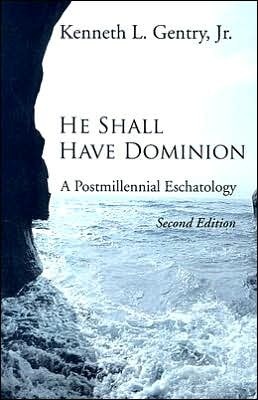
Continuing on with my somewhat deep dive into preterism, I realized that I didn’t know much about what full preterists call partial preterism, and Gentry calls orthodox preterism. He calls full preterism ultra-preterism or unorthodox preterism, perhaps because he finds the terms full preterism or consistent preterism too flattering. Unfortunately this book was much more about postmillennialism than preterism, although I did learn some good stuff about preterism.
Gentry argues that postmillennialism is the only optimistic eschatological system, though he stresses that the optimism is based on God's efforts and not human efforts. He writes, "*We may not convincingly argue for any optimistic expectation for mankind's future on a secular base* (emphasis original)." Nonetheless, he seems to be an enthusiastic supporter of the GOP (God's Own Party, perhaps?). In a Facebook post, he writes, "Interestingly, our two best presidents of the 20th and 21st century are named similarly, Ronald and Donald (not to be confused with Ronald McDonald)." Leaving aside the question of Reagan's presidency (I personally think he was a good, though not great president), how can anybody seriously argue that Trump is better than the two Roosevelts, Truman, or Eisenhower?
He uses the following scriptures to show that the Bible supports modern conservative ideas: Securing free market bartering (Matthew 20.1-15), Defending private property rights (Act 5.4), Encouraging the family as the primary welfare agency (1 Tim 5.8). This is a very selective use of scriptures. Elsewhere he says communism is inherently anti-Christian, ignoring the many Christian communes in the 19th century, not to mention Acts 4.32 "No one claimed that any of their possessions was their own, but they shared everything they had."
A significant portion of the book (Part 5) was dedicated to meeting objections to postmillennial optimism. I found Gentry's arguments concerning Matthew 7.13-14 interesting (Enter through the narrow gate. For the gate is wide and the road is broad that leads to destruction, and there are many who go through it. How narrow is the gate and difficult the road that leads to life, and few find it). Gentry cites Matthew 8.11 and Revelation 7.9 to show that sometimes many are described as entering the kingdom, and Isaiah 2.2-4 and Micah 4.1-4 to show that some O.T. prophets envisioned the nations as coming to God at the end of time. Thus he claims that Matthew 7.13-14 is an ethical, not a prophetic word. For me, all Gentry demonstrates is that the Bible has contradictory passages which various school reconcile in different ways.
Much of the book contrasts postmillennialism with dispensationalism. He is preaching to the crowd here. Dispensationalism is an awful system. Full preterist Ed Stevens wrote an excellent article about how dispensationalism's pessimistic eschatology keeps them from being an effective moral force in the world as well as causing many to unconditionally support Israel.
Gentry does rail against the hyper-literalism of the dispensationalists, a position with which I heartily agree. This became clear to me while watching the Left Behind movie where literal fire literally came out of the mouths of the two witnesses (I literally laughed out loud)! I especially got a kick out of Gentry's asking if we should interpret Luke 3.5a literally: "Every valley will be filled, and every mountain and hill will be made low"!
As fun as it is to poke fun at the dispensationalists, I didn’t read this book to get new arguments against the dispies, but to understand Gentry's position. As a partial preterist, he believes that most, but not all, biblical prophecy has been fulfilled. So as far as the Olivet discourse goes, he believes that it has been fulfilled up until Matthew 24.36. He explains Matthew 24.30 as "The sign that the Son of Man is in heaven is the smoking rubble of Jerusalem, which he prophesies beforehand." This is a weird interpretation. The usual (and probably correct) interpretation of this verse is that the *sign* is in heaven (more properly the sky; the Greek word can mean either heaven or sky), not the Son of Man in heaven. To interpret it the way Gentry does requires inserting an article which is not there in the Greek: "And then shall appear the sign of the Son of man [the one] in heaven (KJV)." Most modern translations, including the NKJV put the sign in heaven, not the Son of man: "Then the sign of the Son of Man will appear in heaven."
Gentry isn’t particularly consistent as to whether to interpret biblical passages as literal or not. So whereas full preterists interpret 2 Peter 3.10, 12 figuratively, Gentry says that this passage, "seems to go beyond apocalyptic imagery and prophetic hyperbole." On the other hand, in commenting on Daniel 12.1-2, widely seen as describing a literal bodily resurrection, Gentry says, somewhat bizarrely, that the resurrection imagery applies to corporate imagery, not individuals. He uses the same apologetic to claim that the first resurrection in Revelation 20.4-6 refers to the spiritual regeneration of believers in the first century, not to a bodily resurrection.
Gentry agrees with the full preterists that the Greek word gē, which can mean either "earth" or "land," generally refers to the land of Israel in Revelation. So he claims, rather bizarrely in my opinion, that the beast from the land (gē) "represents apostate Judaism as concentrated in its religious leadership in its high priestly aristocracy." How in the world did the high priestly aristocracy cause the people of Israel to worship the first beast (Rome)? Unlike Gentry, I think that gē in Revelation generally refers to the entire earth, as it does in Revelation 17.8, where gē (earth) is equated with kosmos (world): "The inhabitants of the earth whose names have not been written in the book of life from the creation of the world will be astonished when they see the beast".
Some of the claims in this book were interesting. "Never was 'so high a percentage of a great city so thoroughly and painfully exterminated and enslaved as during the Fall of Jerusalem. (D. A. Carson)'" IDK. Seeing as *everyone* was killed or enslaved at the fall of Carthage in 146 BC this claim seems hard to sustain.
Or, "Chronos indicates a long period of uncertain duration." I was suspicious of this one. However Google AI says, "While chronos does not exclusively mean 'a long time' (it just means 'time' in general), it is commonly used to express that concept."
Or, "Perhaps no period in the world's history has ever been so marked by these convulsions as that which intervenes between the Crucifixion and the destruction of Jerusalem. (W. Boyd Carpenter)." I was suspicious of this one, too. However Google AI Overview: "Yes, historical records indicate there was an unusually high concentration of significant earthquakes, tremors, and other natural disasters in the Roman Empire between 30 AD and 70 AD. This period, particularly during the reign of Nero, saw multiple cities damaged by seismic activity, culminating in the major earthquake of 62/63 AD that heavily damaged Pompeii and surrounding areas, acting as a precursor to the 79 AD eruption." However, it just may be an accident of history that more natural disasters were reported during this time.
Gentry includes an important appendix on what he calls the error of hyper-preterism. He points to five things which he claims were not fulfilled in 70 A.D. and have yet to be fulfilled:
*The visible, glorious, personal Second Coming of Christ
*The physical resurrection of the dead
*The final corporate judgement of all men on Judgement Day
*The end of the present earth and temporal history
*The establishment of the consummate, physical new creation
Gentry claims that these five doctrines are among those universally accepted by orthodox Christians. The first three are beyond dispute. I am unsure what he means by the last two. The orthodox view is generally that the present earth will be *remade*, not that it will be destroyed and a new physical creation established. But perhaps I am misunderstanding what he means by physical new creation.
Many of Gentry's arguments against full preterism are familiar and don’t need to be reiterated here. Probably his worst point is that full preterism can lead to universalism (as though this is a terrible thing!). While Gentry is careful to point out that postmillennialism, despite it optimism, does not fall into the liberal (horror of horrors!) error of universalism, he cites full preterist Samuel G. Dawson as denying hell. (I think there are too many passages affirming eternal conscious torment to dismiss them easily.) But Gentry did make one point in this appendix concerning 1 Corinthians 15.44 that I had not heard before and which I found very interesting: "According to scholars such as A. T. Robertson, generally adjectives ending in -inos denote compositional material, while those ending in -ikos denote characteristics. This fits the flow of Paul's argument regarding the "natural" (psuchikos) and the "spiritual" (pneumatikos) body." The point, explained well by Gentry, is that the spiritual body is not made of spirit; it is just as material as the natural body.
So am I glad I read this book? Yes, I suppose I am though some of the theological parts were a slog for me. I guess that is only natural because as an unbeliever who has no theological irons in this fire I am obviously not part of Gentry's intended audience. I grudgingly give it three stars, the same rating I gave to the two previous Gentry books I read: The Beast of Revelation and Navigating the Book of Revelation.