

What do you think?
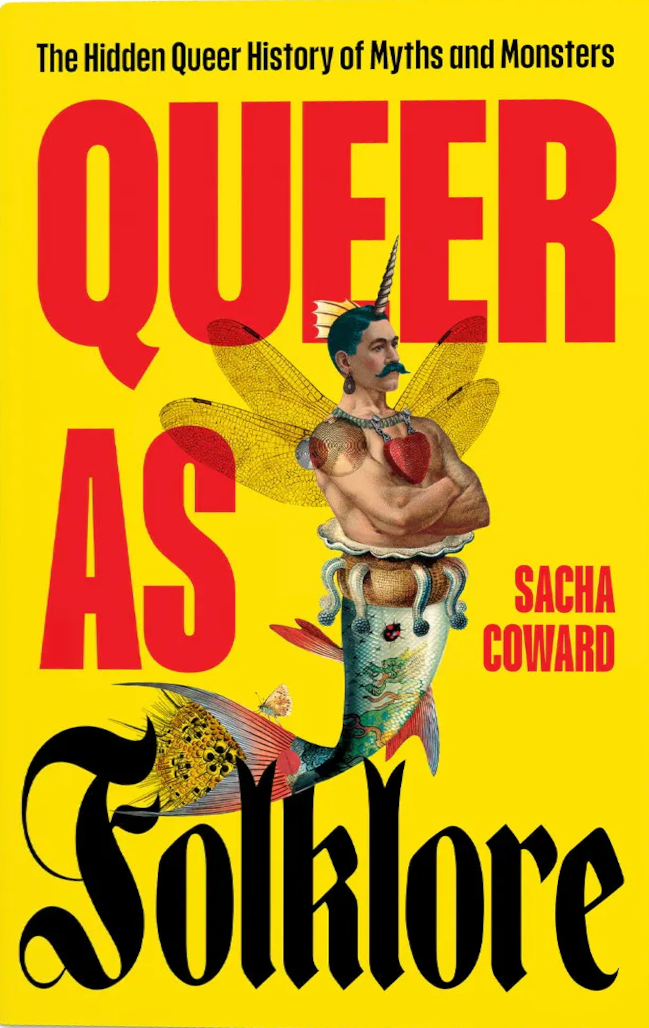
Queer As Folklore: The Hidden Queer History of Myths and Monsters
Queer as Folklore takes readers across centuries and continents which reveals the unsung heroes and villains of storytelling, magic and fantasy. Featuring images from archives, galleries and museums around the world, each chapter investigates the queer history of different mythic and folkloric characters, both old and new.
Leaving no headstone unturned, Sacha Coward will take you on a wild ride through the night from ancient Greece to the main stage of RuPaul’s Drag Race, visiting cross-dressing pirates, radical fairies and the graves of the ‘queerly departed’ along the way. Queer communities have often sought refuge in the shadows, found kinship in the in-between and created safe spaces in underworlds; but these forgotten narratives tell stories of remarkable resilience that deserve to be heard.
Join any Pride march and you are likely to see a glorious display of papier-mâché unicorn heads trailing sequins, drag queens wearing mermaid tails and more fairy wings than you can shake a trident at. But these are not just accessories: they are queer symbols with historic roots.
To truly understand who queer people are today, we must confront the twisted tales of the past and Queer as Folklore is a celebration of queer history like you've never seen it before.
Leaving no headstone unturned, Sacha Coward will take you on a wild ride through the night from ancient Greece to the main stage of RuPaul’s Drag Race, visiting cross-dressing pirates, radical fairies and the graves of the ‘queerly departed’ along the way. Queer communities have often sought refuge in the shadows, found kinship in the in-between and created safe spaces in underworlds; but these forgotten narratives tell stories of remarkable resilience that deserve to be heard.
Join any Pride march and you are likely to see a glorious display of papier-mâché unicorn heads trailing sequins, drag queens wearing mermaid tails and more fairy wings than you can shake a trident at. But these are not just accessories: they are queer symbols with historic roots.
To truly understand who queer people are today, we must confront the twisted tales of the past and Queer as Folklore is a celebration of queer history like you've never seen it before.
324 pages, Hardcover
First published August 22, 2024
Ratings & Reviews
Friends & Following
Create a free account to discover what your friends think of this book!
Community Reviews
Displaying 1 - 30 of 381 reviews

Read
August 19, 2024Interesting and heartfelt popular-academia book on the intersections of queer identities and folklore (monsters, shapeshifting, gender-bending, storytelling, the sense of something not fitting in the 'normal' world). It's a well thought-through thesis with a wide range of examples that bends over backwards to be inclusive and non appropriative. The relatively informal style makes it highly readable, in fact I could have done with fewer exclmation marks, but then I always could.
Thoughtful and passionate; anyone with an interest in folklore or queer fantastical stories would get something from this. Great chapter illustrations, too.
Thoughtful and passionate; anyone with an interest in folklore or queer fantastical stories would get something from this. Great chapter illustrations, too.

March 3, 2025
So disappointed by this... I think there are some gems in here, but overall this is simply a book of surface-level and poorly organized ramblings of a conventional cis white gay millennial man who refuses to let a certain Wizarding World go.
I was hoping for a deep dive into obscure queer folklore, or obscure folklore examined under a queer lens. Instead I got a series of boring summaries of extremely well-known stories and Disney films.
I agree with other reviews in that the final chapter is the strongest bit and somewhat ties his thoughts together. Even so, I closed this book thinking, "Why did he write this? What was he even trying to say?" Despite claiming to examine these myths with an all encompassing queer lens, Coward relies heavily on his own experience as a cis white British gay man to guide his book. (Not necessarily a bad thing, but if you came into this hoping to find in-depth discussions of transgender theory within oral history and folklore, this isn't the book for you. Not much exploration of lesbianism either, aside from the obvious Sappho and Carmilla.)
This man writes as if he is a subject matter expert, but I think this entire book could have been a tipsy post-dinner conversation amongst friends. In another world, I think this could have been an engaging memoir. His writing voice is very well-suited to that. However, it's difficult to consider this historical or academic when the author makes rookie research mistakes or deems a claim as "alleged" based on the fact that he hasn't confirmed it with his own semi-hobbyist eyes.
Also, to publish a queer book in 2024 and to dedicate so many pages to JKR is literally unhinged. I laughed out loud when the author said "the most infamously queered franchise" is Harry Potter. (yes, he does mention the famously well-documented Spirk slash fandom in a later chapter, but I should not have the read that sentence in 2024. Sacha, I'm begging you, have a single conversation with a media theorist. There are people who go to school for fan/media history.) No mention of Xena? Minimal mentions of Star Trek? Wild.
I encourage this author to read books written by non-white authors. There are plenty of texts about yokai, for example, written by Japanese people. I am not saying white folks can't learn and write about other cultures' folklore, but I think it's good practice to read and source a variety of authors when writing something like this.
Anyway, at the end of the day, this was disappointing and amateur in my opinion, but there was certainly potential!
I was hoping for a deep dive into obscure queer folklore, or obscure folklore examined under a queer lens. Instead I got a series of boring summaries of extremely well-known stories and Disney films.
I agree with other reviews in that the final chapter is the strongest bit and somewhat ties his thoughts together. Even so, I closed this book thinking, "Why did he write this? What was he even trying to say?" Despite claiming to examine these myths with an all encompassing queer lens, Coward relies heavily on his own experience as a cis white British gay man to guide his book. (Not necessarily a bad thing, but if you came into this hoping to find in-depth discussions of transgender theory within oral history and folklore, this isn't the book for you. Not much exploration of lesbianism either, aside from the obvious Sappho and Carmilla.)
This man writes as if he is a subject matter expert, but I think this entire book could have been a tipsy post-dinner conversation amongst friends. In another world, I think this could have been an engaging memoir. His writing voice is very well-suited to that. However, it's difficult to consider this historical or academic when the author makes rookie research mistakes or deems a claim as "alleged" based on the fact that he hasn't confirmed it with his own semi-hobbyist eyes.
Also, to publish a queer book in 2024 and to dedicate so many pages to JKR is literally unhinged. I laughed out loud when the author said "the most infamously queered franchise" is Harry Potter. (yes, he does mention the famously well-documented Spirk slash fandom in a later chapter, but I should not have the read that sentence in 2024. Sacha, I'm begging you, have a single conversation with a media theorist. There are people who go to school for fan/media history.) No mention of Xena? Minimal mentions of Star Trek? Wild.
I encourage this author to read books written by non-white authors. There are plenty of texts about yokai, for example, written by Japanese people. I am not saying white folks can't learn and write about other cultures' folklore, but I think it's good practice to read and source a variety of authors when writing something like this.
Anyway, at the end of the day, this was disappointing and amateur in my opinion, but there was certainly potential!

August 9, 2024
I do recommend this if the premise interests you! I liked this author’s voice for nonfiction, I found it engaging. Some chapters held my attention more than others, but I found all of them to be insightful in their own right. (Also giving kudo’s for reasonable chapter length.)

August 7, 2024
Thanks to Unbound and NetGalley for the advanced e-copy.
3.5 stars
This book is fun. It's a book that explores queerness in folklore, classic myths and today's pop culture. Sacha Coward takes us on a journey of exploration, from magical creatures and faeries, to werewolves and ghosts; to greek myths and legends, to Lord Byron and Aleister Crowley; to today's superhero like the x-men, and robots and aliens. Coward's writing style is so fun and approachable. It's clear that this work is precious for him, so every theme is handled with care, but with so much humour too. I really had a blast learning about queer characters, authors, and symbols, and how the in-between spaces and hybrid creatures are beloved and relatable to so many LGBTQ+ people.
The book is divided in five sections. Coward is respectful and never tries to speculate on real people's identities. He is also always clear in reminding the reader that current views on gender and identity are different and sometimes not even comparable to earlier times.
He moves from topic to topic with great pacing, with neat organization and structure, and there are a lot of themes he explores. And because of the quantity of this work, it's both commendable and also, very, very broad.
Some sections are very shallow, some are almost written as anecdotes. There's not much depth in some parts, because well, the length of the book and the enormous magnitude of it doesn't allow such profoundness. So, if you are an expert on some topics here, if you have a love for folklore or ancient Greece for example, you might find some of these stories very basic, very condensed. Me, personally, I understand the reasons of such a brief scope, so I would just look up for myself some of the stories or people referenced. I guess on the positive side, Sacha's examples are so interesting you want to keep reading about them, and that means he did a great job selecting them and introducing them to his public.
I have a few critiques. First, I think that in the middle of this book, Sacha tried to focus a little too much on current people loving some piece of media or some specific 'symbol' and it seemed like he was really trying to stretch to find connections to the original topic. For example, the little mention of the woman who loved The Exorcist. I think some of these sections were too casual, too shallow, too anecdotal.
Second, I think the fifth section, which acts as a kind of summary/conclusion, was so good, it should have been the introduction of the book.
The five qualities were so well written, it would have presented the book even better to the reader.
Lastly, this book is very eurocentric. Very western focused. And though Coward mentioned a few examples from different mythologies around the world, he does warn the reader of the lack of representation in these pages and how he decided to write only of what he grew up with. So, it's understandable, but also very frustrating too. Me, as a Chilean reader, I don't recall any little mention of South American folklore even in passing. So, if you are looking for a book that collects mythology and folklore from around the world, this one might not be what you are looking for.
Though sometimes I think Coward was trying very hard to look for connections, I think this work was done with such passion and respect I really enjoyed reading about every topic. Some, of course, more than others.
Still, I love how Coward tried so hard to find the threads that run from past to present, how he tried to rescue lost identities of gender non-conforming people. How he explored it all with a sassy, yet academic way.
The intention of this book is wonderful, and though it is not perfect, I think it is a remarkable work.
3.5 stars
This book is fun. It's a book that explores queerness in folklore, classic myths and today's pop culture. Sacha Coward takes us on a journey of exploration, from magical creatures and faeries, to werewolves and ghosts; to greek myths and legends, to Lord Byron and Aleister Crowley; to today's superhero like the x-men, and robots and aliens. Coward's writing style is so fun and approachable. It's clear that this work is precious for him, so every theme is handled with care, but with so much humour too. I really had a blast learning about queer characters, authors, and symbols, and how the in-between spaces and hybrid creatures are beloved and relatable to so many LGBTQ+ people.
The book is divided in five sections. Coward is respectful and never tries to speculate on real people's identities. He is also always clear in reminding the reader that current views on gender and identity are different and sometimes not even comparable to earlier times.
He moves from topic to topic with great pacing, with neat organization and structure, and there are a lot of themes he explores. And because of the quantity of this work, it's both commendable and also, very, very broad.
Some sections are very shallow, some are almost written as anecdotes. There's not much depth in some parts, because well, the length of the book and the enormous magnitude of it doesn't allow such profoundness. So, if you are an expert on some topics here, if you have a love for folklore or ancient Greece for example, you might find some of these stories very basic, very condensed. Me, personally, I understand the reasons of such a brief scope, so I would just look up for myself some of the stories or people referenced. I guess on the positive side, Sacha's examples are so interesting you want to keep reading about them, and that means he did a great job selecting them and introducing them to his public.
I have a few critiques. First, I think that in the middle of this book, Sacha tried to focus a little too much on current people loving some piece of media or some specific 'symbol' and it seemed like he was really trying to stretch to find connections to the original topic. For example, the little mention of the woman who loved The Exorcist. I think some of these sections were too casual, too shallow, too anecdotal.
Second, I think the fifth section, which acts as a kind of summary/conclusion, was so good, it should have been the introduction of the book.
The five qualities were so well written, it would have presented the book even better to the reader.
Lastly, this book is very eurocentric. Very western focused. And though Coward mentioned a few examples from different mythologies around the world, he does warn the reader of the lack of representation in these pages and how he decided to write only of what he grew up with. So, it's understandable, but also very frustrating too. Me, as a Chilean reader, I don't recall any little mention of South American folklore even in passing. So, if you are looking for a book that collects mythology and folklore from around the world, this one might not be what you are looking for.
Though sometimes I think Coward was trying very hard to look for connections, I think this work was done with such passion and respect I really enjoyed reading about every topic. Some, of course, more than others.
Still, I love how Coward tried so hard to find the threads that run from past to present, how he tried to rescue lost identities of gender non-conforming people. How he explored it all with a sassy, yet academic way.
The intention of this book is wonderful, and though it is not perfect, I think it is a remarkable work.
July 3, 2025
Not surprised, but still a bit disappointed that most of the references here are about gay or bisexual men.
While there are mentions of sapphics, and some historical accounts of queer, transgender women and nonbinary people, these sections are too brief for my taste.
It’s also told mostly from a white perspective, with only a few mentions of non-Western concepts.
This could’ve been a perfect read if the author had dialed down on the focus on gay and bisexual men (those stories are repeated so many times!!!) and instead dedicated more space for other sexual identities as this could've been a more interesting compilation.
I’ll admit my expectations were a bit high, having read other queer non-fiction books, so most of the topics weren’t new to me.
I should've known from the cover though so definitely judge the book on this one.
That said, I did appreciate the mentions of the babaylan and manananggal so woohoo?
While there are mentions of sapphics, and some historical accounts of queer, transgender women and nonbinary people, these sections are too brief for my taste.
It’s also told mostly from a white perspective, with only a few mentions of non-Western concepts.
This could’ve been a perfect read if the author had dialed down on the focus on gay and bisexual men (those stories are repeated so many times!!!) and instead dedicated more space for other sexual identities as this could've been a more interesting compilation.
I’ll admit my expectations were a bit high, having read other queer non-fiction books, so most of the topics weren’t new to me.
I should've known from the cover though so definitely judge the book on this one.
That said, I did appreciate the mentions of the babaylan and manananggal so woohoo?

July 21, 2024
(Rounded from 3.5)
I regularly talk about the importance of story and storytelling as a means of understanding what it means to be human, and I also have an interest in and gone on ad nauseum about the relationship between queer identity and genre fiction, especially horror. Which is all to say, this should be like catnip for me… and yet I finished feeling a little wanting.
Let’s start with the good, and there is a lot of it. Firstly, in just broad strokes, the writing style is fun. It is smooth and very readable, conveying historical research with a confidence that combines with a few little personal flourishes here and there that keep the tone light and fun. It never felt like a stuffy lecture, and always kept me engaged. That’s not always easy in a nonfiction book that covers as much material as this one without having a strong central narrative or character; it could easily have become a dry textbook, and that never happened.
I like his broad exploration of what it means to be folklore. The idea that all story and story telling are valid and important, whether that be in myth or art or campfire stories or video games. The ways he navigated some contemporary material was what bothered me a little, which I will get to below, but the respect he gave for the broad category of storytelling and the role it plays in shaping cultural identity was wonderful.
Sacha Coward is a researcher and historian, and that shows. I really enjoyed all of the actual historical research that was done. He was very conscious of the fact that current ideas of gender and sexuality that are wrapped up in the idea of queer identity are not entirely mappable across time and space, and to impute contemporary labels on other cultures could easily become acts of historical appropriation and orientalism. With this in mind he does a great job of exploring how ways of being in the world influenced the stories that were told, and the deities and monsters found in those stories.
The research I thought was great. But this isn’t just about presenting research. This combines research with contemporary ideas and identities, and tries to draw lines between (ancient) story and (contemporary) reality. Obviously I see the value in this, but these sections always just felt remarkably anecdotal to me. They felt really light, like simple handpicked observations that seem like they are supporting the historical research but really might just run parallel to it. For example, the connection between the gender politics of witchcraft and witch hunts with marginalized queer identity and then young queer kids who are/were obsessed with the films “The Craft” or “Buffy the Vampire Slayer” just felt remarkably tenuous and not particularly enlightening. This is magnified by the fact that sometimes, especially in the first section, he is looking at queer representation and participation in ancient society through mythological beings. But as he moves on to other types of story-land creatures, he is sometimes talking less about the monsters and more about the individuals who wrote their stories. So, this historical excavation gets messy, sometimes focusing not on the representation in shared mythological history but instead individual creators celebrated for creating certain types of the fantastical. There is utility in seeing how queer folks write themselves in and through their stories in ways that make marginalized identities appealing to the masses, but that isn’t the same thing as mythological or monstrous or fantastical beings being queer-coded or imbued with queer spirit at a societal level. They are both valid avenues of exploration, but they aren’t the same. So, as we got into the second and third sections of the book some of what the historical project was trying to do got messy (even when the historical information was interesting and clearly well-researched). Combine that with what felt like remarkably anecdotal and sometimes thin, surface-level contemporary resonance and it felt like it lost a lot of its bite.
I did appreciate the way it ended, and I almost think the final section would have worked better at the beginning, to help shape the whole project. Coward identifies five archetypal traits that connect queer identity to the monstrous and fantastic. He explains each of them, noting that none of them are the sole domain of queer identity, and some are shared but various marginalized identities, and that not all queer folk will feel like they seem themselves in all five, but there is something unique in the way these five archetypes overlap that speak to the historical, classical, and contemporary queer experiences. This I think is powerful, whether you agree with his assessment 100% or not, and if the historical research was done more explicitly unpacking these five archetypes, instead of using them as summation at the end, then maybe I would have felt less put off by what felt like hand-wavey, anecdotal connections to contemporary experience, and so on.
This was a pretty massive undertaking, and it felt that in the effort to make it as robust and pertinent as possible it occasionally felt a little too rambling, stretching itself thin and occasionally losing the plot. That said, the research alone was worth it, it is pretty meticulously done and carefully put together, recognizing scholarly subjectivity and respecting the object of study without sacrificing personal interpretation. And, importantly, it was presented in a compelling and engaging manner, never feeling like a dusty lecture hall but instead always feeling light on its feet and with a spring in its step. For that alone I think this is worth it. While some of the contemporary analogues didn’t work for me, (not in that I thought they were wrong, just that I felt there was a pretty huge gap between the research and some of these conclusions/propositions), they still provide an interesting locus for reflection. If nothing else it offers a great tool for us to observe the ways we consume and celebrate art, celebrate and dive into story, and see what kind of cultural and historical antecedents might be participating in that ongoing conversation.
I want to thank the author, the publisher Unbound, and NetGalley, who provided a complimentary eARC for review. I am leaving this review voluntarily.
I regularly talk about the importance of story and storytelling as a means of understanding what it means to be human, and I also have an interest in and gone on ad nauseum about the relationship between queer identity and genre fiction, especially horror. Which is all to say, this should be like catnip for me… and yet I finished feeling a little wanting.
Let’s start with the good, and there is a lot of it. Firstly, in just broad strokes, the writing style is fun. It is smooth and very readable, conveying historical research with a confidence that combines with a few little personal flourishes here and there that keep the tone light and fun. It never felt like a stuffy lecture, and always kept me engaged. That’s not always easy in a nonfiction book that covers as much material as this one without having a strong central narrative or character; it could easily have become a dry textbook, and that never happened.
I like his broad exploration of what it means to be folklore. The idea that all story and story telling are valid and important, whether that be in myth or art or campfire stories or video games. The ways he navigated some contemporary material was what bothered me a little, which I will get to below, but the respect he gave for the broad category of storytelling and the role it plays in shaping cultural identity was wonderful.
Sacha Coward is a researcher and historian, and that shows. I really enjoyed all of the actual historical research that was done. He was very conscious of the fact that current ideas of gender and sexuality that are wrapped up in the idea of queer identity are not entirely mappable across time and space, and to impute contemporary labels on other cultures could easily become acts of historical appropriation and orientalism. With this in mind he does a great job of exploring how ways of being in the world influenced the stories that were told, and the deities and monsters found in those stories.
The research I thought was great. But this isn’t just about presenting research. This combines research with contemporary ideas and identities, and tries to draw lines between (ancient) story and (contemporary) reality. Obviously I see the value in this, but these sections always just felt remarkably anecdotal to me. They felt really light, like simple handpicked observations that seem like they are supporting the historical research but really might just run parallel to it. For example, the connection between the gender politics of witchcraft and witch hunts with marginalized queer identity and then young queer kids who are/were obsessed with the films “The Craft” or “Buffy the Vampire Slayer” just felt remarkably tenuous and not particularly enlightening. This is magnified by the fact that sometimes, especially in the first section, he is looking at queer representation and participation in ancient society through mythological beings. But as he moves on to other types of story-land creatures, he is sometimes talking less about the monsters and more about the individuals who wrote their stories. So, this historical excavation gets messy, sometimes focusing not on the representation in shared mythological history but instead individual creators celebrated for creating certain types of the fantastical. There is utility in seeing how queer folks write themselves in and through their stories in ways that make marginalized identities appealing to the masses, but that isn’t the same thing as mythological or monstrous or fantastical beings being queer-coded or imbued with queer spirit at a societal level. They are both valid avenues of exploration, but they aren’t the same. So, as we got into the second and third sections of the book some of what the historical project was trying to do got messy (even when the historical information was interesting and clearly well-researched). Combine that with what felt like remarkably anecdotal and sometimes thin, surface-level contemporary resonance and it felt like it lost a lot of its bite.
I did appreciate the way it ended, and I almost think the final section would have worked better at the beginning, to help shape the whole project. Coward identifies five archetypal traits that connect queer identity to the monstrous and fantastic. He explains each of them, noting that none of them are the sole domain of queer identity, and some are shared but various marginalized identities, and that not all queer folk will feel like they seem themselves in all five, but there is something unique in the way these five archetypes overlap that speak to the historical, classical, and contemporary queer experiences. This I think is powerful, whether you agree with his assessment 100% or not, and if the historical research was done more explicitly unpacking these five archetypes, instead of using them as summation at the end, then maybe I would have felt less put off by what felt like hand-wavey, anecdotal connections to contemporary experience, and so on.
This was a pretty massive undertaking, and it felt that in the effort to make it as robust and pertinent as possible it occasionally felt a little too rambling, stretching itself thin and occasionally losing the plot. That said, the research alone was worth it, it is pretty meticulously done and carefully put together, recognizing scholarly subjectivity and respecting the object of study without sacrificing personal interpretation. And, importantly, it was presented in a compelling and engaging manner, never feeling like a dusty lecture hall but instead always feeling light on its feet and with a spring in its step. For that alone I think this is worth it. While some of the contemporary analogues didn’t work for me, (not in that I thought they were wrong, just that I felt there was a pretty huge gap between the research and some of these conclusions/propositions), they still provide an interesting locus for reflection. If nothing else it offers a great tool for us to observe the ways we consume and celebrate art, celebrate and dive into story, and see what kind of cultural and historical antecedents might be participating in that ongoing conversation.
I want to thank the author, the publisher Unbound, and NetGalley, who provided a complimentary eARC for review. I am leaving this review voluntarily.

December 22, 2025
I've been trying to read this since last year, and I give up.
This is not about folklore, it's about history. Every single topic is bent backwards so Coward can connect it to a historical personage or phenomenon in the last 200 years and then tell us all about that person or thing, instead of exploring or explaining the actual folkloric thing. This was so extremely not what I wanted, or what this book claimed to be. I grant you folklore and history are very intertwined, but they're still not the same thing.
For example, the section on Western demonology spent so much time on Aleister Crowley, John Keats, the film The Exorcist, and the Satanic Panic about Dungeons and Dragons back in the 80s. The D&D stuff led into the homophobic/transphobic abuse directed towards modern drag queen storytime events, and like - what is any of this doing in here? I want to hear about actual demonic folklore, not why conservatives think I'm a demon!
The parts that were actually about demons and angels and whatnot were great, albeit short and shallow as you'd expect from a book attempting this wide an overview, but it was so much effort to get to them through all the maddening filler. I quit when I reached Part Four, which features chapters on aliens, pirates, sci-fi AI, and superheroes, none of which I'd consider folklore.
(I don't know how to articulate why starting a chapter about aliens with David Bowie pisses me off so much - from one angle, I can see how that's kind of cool, and if you closed the chapter with a bio on Bowie and his alien imagery to illustrate how the queer community has adopted alien iconography or whatever, that might be fine? But a) what are aliens doing in a book of folklore and b) what are you doing opening the chapter on aliens with a human being???)
Going back to my copy of Cassell's Encyclopedia of Queer Myth, Symbol and Spirit: Gay, Lesbian, Bisexual and Transgender Lore, which remains the best example of what I want from a book of queer folklore/mythology, even with the lack of citations. (It's not like Coward cites m/any sources either.)
This is not about folklore, it's about history. Every single topic is bent backwards so Coward can connect it to a historical personage or phenomenon in the last 200 years and then tell us all about that person or thing, instead of exploring or explaining the actual folkloric thing. This was so extremely not what I wanted, or what this book claimed to be. I grant you folklore and history are very intertwined, but they're still not the same thing.
For example, the section on Western demonology spent so much time on Aleister Crowley, John Keats, the film The Exorcist, and the Satanic Panic about Dungeons and Dragons back in the 80s. The D&D stuff led into the homophobic/transphobic abuse directed towards modern drag queen storytime events, and like - what is any of this doing in here? I want to hear about actual demonic folklore, not why conservatives think I'm a demon!
The parts that were actually about demons and angels and whatnot were great, albeit short and shallow as you'd expect from a book attempting this wide an overview, but it was so much effort to get to them through all the maddening filler. I quit when I reached Part Four, which features chapters on aliens, pirates, sci-fi AI, and superheroes, none of which I'd consider folklore.
(I don't know how to articulate why starting a chapter about aliens with David Bowie pisses me off so much - from one angle, I can see how that's kind of cool, and if you closed the chapter with a bio on Bowie and his alien imagery to illustrate how the queer community has adopted alien iconography or whatever, that might be fine? But a) what are aliens doing in a book of folklore and b) what are you doing opening the chapter on aliens with a human being???)
Going back to my copy of Cassell's Encyclopedia of Queer Myth, Symbol and Spirit: Gay, Lesbian, Bisexual and Transgender Lore, which remains the best example of what I want from a book of queer folklore/mythology, even with the lack of citations. (It's not like Coward cites m/any sources either.)
Read
April 15, 2025if you know next to nothing about queer history, symbols and popculture this is a great book to start with. i thought the research was pretty good and i liked the writing style a lot. i loved reading about the connections i made myself before and even learning something new!
however it feels very targeted towards gay white men rather than anyone else in the community. there are other identities explored, but i found them lacking in deph a bit. mentions of asexuality are almost non existing. i expected a little more from it than very-well-known examples and queer readings, but it's not a bad book at all. the best part of it was the very last section, i really loved it.
however it feels very targeted towards gay white men rather than anyone else in the community. there are other identities explored, but i found them lacking in deph a bit. mentions of asexuality are almost non existing. i expected a little more from it than very-well-known examples and queer readings, but it's not a bad book at all. the best part of it was the very last section, i really loved it.

July 15, 2025
Enticing concept that gets bogged down by repetition and lack of depth unfortunately. Tries to provide some explanation for the affinity for, and prevalence of, mythological imagery and characters within the queer community as a whole. Each chapter follows a fairly similar pattern of picking a category of mythological creature, explaining its hidden queer connections, diving into a bit of etymology, making some reference to Greek and/or Roman and/or other civilization of antiquity, and calling it a day. Not to say these chapters wouldn’t be interesting in isolation but as a whole collection things got dull and I found myself mostly skimming the second half of the book.

April 28, 2026
Sacha Coward hat sich mit “Queer as Folklore” zum Ziel gesetzt, die “verborgene Queerness” von verschiedenen Figuren und Werken aus Mythologie und Folklore zu “enthüllen” und sie zu feiern. Was für mich ganz grundlegend zu einem solchen populären Sachbuch gehört ist, dass Begriffe definiert werden und auf verständliche Art Bezug zu wissenschaftlichen Diskursen genommen wird.
Hier findet sich der Grund für meine magere 2-Sterne-Bewertung: Basics wie “Pronomen” oder “cisgender” werden kurz in Fußnoten erklärt, aber das Thema des Buches nicht?! Mythologie ist hier alles, was wage “alt” ist und in englischer Tradition ist das vor allem griechische Mythologie; Folklore wird nie wirklich eingeordnet und kann alles sein, von Märchen bis Marvel-Superhelden, und ist immer eurozentrisch, aber nie regionalspezifisch. Das mag alles vom Vibe her stimmen, aber es gibt nie eine Einordnung, warum der Begriff der “Folklore” so mehrdeutig ist, kontrovers diskutiert wird oder es in anderen Gegenden der Welt ganz andere Definitionen und Abstufungen von Folklore gibt, insbesondere geformt durch Kolonialismus und ganz generell, vom großen Faktor der Migration. So schwammig Coward hier argumentiert, so statisch wirkt seine Perspektive trotz “gequeerter” Geschichte.
Apropos, ihr wisst, ich liebe den Ansatz, Geschichte, Mythen, Legenden, Märchen usw. durch eine queere Perspektive zu sehen - da liegt unglaublich transformatives Potenzial drin und dieses Buch schafft es sicherlich, ein breites Publikum abzuholen und insbesondere diejenigen anzusprechen, die noch keinen Kontakt mit queeren Kulturprodukten hatten. Es ist durch die eher anekdotische Struktur auch wirklich zugänglich.
Aber ich möchte gerne, dass sich mehr Anspruch in pop. Sachbüchern durchsetzt 😅 Folklore wird nicht nur von Queers gefeiert und weiterverarbeitet (was toll ist!), sondern hatte historisch eben auch etwas mit ideologischen Agenden zu tun, die nicht so progressiv waren, sei es z.B. das Vereinnahmen bestimmter Sagen, oder (implizite) Verbote regionaler Traditionen zugunsten einheitlicher “Kultur”.
Ich verbleibe damit, dass ich dieses Buch als Sachbuch zum Thema Folklore eher nicht empfehlen kann.
Hier findet sich der Grund für meine magere 2-Sterne-Bewertung: Basics wie “Pronomen” oder “cisgender” werden kurz in Fußnoten erklärt, aber das Thema des Buches nicht?! Mythologie ist hier alles, was wage “alt” ist und in englischer Tradition ist das vor allem griechische Mythologie; Folklore wird nie wirklich eingeordnet und kann alles sein, von Märchen bis Marvel-Superhelden, und ist immer eurozentrisch, aber nie regionalspezifisch. Das mag alles vom Vibe her stimmen, aber es gibt nie eine Einordnung, warum der Begriff der “Folklore” so mehrdeutig ist, kontrovers diskutiert wird oder es in anderen Gegenden der Welt ganz andere Definitionen und Abstufungen von Folklore gibt, insbesondere geformt durch Kolonialismus und ganz generell, vom großen Faktor der Migration. So schwammig Coward hier argumentiert, so statisch wirkt seine Perspektive trotz “gequeerter” Geschichte.
Apropos, ihr wisst, ich liebe den Ansatz, Geschichte, Mythen, Legenden, Märchen usw. durch eine queere Perspektive zu sehen - da liegt unglaublich transformatives Potenzial drin und dieses Buch schafft es sicherlich, ein breites Publikum abzuholen und insbesondere diejenigen anzusprechen, die noch keinen Kontakt mit queeren Kulturprodukten hatten. Es ist durch die eher anekdotische Struktur auch wirklich zugänglich.
Aber ich möchte gerne, dass sich mehr Anspruch in pop. Sachbüchern durchsetzt 😅 Folklore wird nicht nur von Queers gefeiert und weiterverarbeitet (was toll ist!), sondern hatte historisch eben auch etwas mit ideologischen Agenden zu tun, die nicht so progressiv waren, sei es z.B. das Vereinnahmen bestimmter Sagen, oder (implizite) Verbote regionaler Traditionen zugunsten einheitlicher “Kultur”.
Ich verbleibe damit, dass ich dieses Buch als Sachbuch zum Thema Folklore eher nicht empfehlen kann.

February 22, 2025
Libro maravilloso. Bien escrito, bien documentado, bien explicado. Amo al autor y su manera de conectar la historia con la vivencia queer

September 2, 2025
Absolutely stunning. I completely loved it.
July 1, 2024
This was great!! You can tell the author knows and loves what he’s writing about. I love when fellow history nerds write about their passions. I learned so much about queer lore and history. I would buy this book and put it on my coffee table. It’s engaging and reads like a book of mythology instead of nonfiction analysis. Fascinating! Funny! 10/10. I highly recommend
June 14, 2024
This book takes the myths and legends that we all know and love and dives into the queer history hidden beneath them.
As a lover of myth and folklore, it was very interesting to see things in a queerer light!
Thanks to NetGalley for this early read!
August 21, 2024
This is a really fascinating read, showing different queer histories of folkloric and mythological entities. I enjoyed Sacha Coward’s writing style, he made it very easy to follow along and understand all the different figures and references for someone who wasn’t any type of history or folklore scholar.
Each chapter covers a different “creature,” from mermaids, unicorns, witches, fairies, to things that people might think of as being more modern or not typical beings from folklore like aliens, robots, and superheroes. I liked getting to see the evolution of these different characters and how they have had queer roots going back centuries. These different chapters really go to show how many queer people were involved in the creation of these folkloric creatures and why the stories continue to appeal to so many queer people. I also appreciated how Coward didn’t shy away from referencing messy situations and how these figures weren’t always positive representations.
Definitely check this book out if it sounds interesting to you. It’s not a dry history textbook, Coward’s writing makes the subject really come to life. And it’s compelling to see how these old stories have evolved and how they tie in to the current queer community.
Thank you to the publisher for providing an advance copy via NetGalley in exchange for an honest review.
Each chapter covers a different “creature,” from mermaids, unicorns, witches, fairies, to things that people might think of as being more modern or not typical beings from folklore like aliens, robots, and superheroes. I liked getting to see the evolution of these different characters and how they have had queer roots going back centuries. These different chapters really go to show how many queer people were involved in the creation of these folkloric creatures and why the stories continue to appeal to so many queer people. I also appreciated how Coward didn’t shy away from referencing messy situations and how these figures weren’t always positive representations.
Definitely check this book out if it sounds interesting to you. It’s not a dry history textbook, Coward’s writing makes the subject really come to life. And it’s compelling to see how these old stories have evolved and how they tie in to the current queer community.
Thank you to the publisher for providing an advance copy via NetGalley in exchange for an honest review.
October 13, 2025
"History is the account of events as recorded by those in power. Religion is often the tool of that power, used to enforce its authority. But folklore is the story of the common people, their hopes and dreams, or their desires and fears, passed from mouth to mouth, often in defiance of those in authority, for generations."
Ursula, the Cecaelian (half-human, half-octopus) Disney sea witch based on infamous drag queen Divine. Kitsune, the transformative foxes of Japanese mythology. Lord Byron, the queer father of the contemporary vampire and all the other queer Gothic writers (Bram Stoker, Henry James, Robert Louis Stevenson and more). The original superheroes, Gilgamesh, Achilles, Hercules: far from heterosexual.
Sacha Coward is connecting myths and stories, often randomly, showing that ancient as well as modern folklore is full of queerness, because queer people were always here and always will be.
Though mostly based on folkloric traditions and popular culture of Europe and the global north, Sasha Coward respectfully gives many examples from indigenous cultures from all over the world.
Very entertaining, fun and a great source for reclaiming your favorite witches, fairies, aliens, vampires, mermaids, werewolves, superheroes, ghosts, pirates, robots, and unicorns.
CN: physical and psychological abuse of LGBTQIA+ people, (sexual) violence, torture, patriarchal structures, misogyny, ableism, slurs and hateful speech against LGBTQIA+
Ursula, the Cecaelian (half-human, half-octopus) Disney sea witch based on infamous drag queen Divine. Kitsune, the transformative foxes of Japanese mythology. Lord Byron, the queer father of the contemporary vampire and all the other queer Gothic writers (Bram Stoker, Henry James, Robert Louis Stevenson and more). The original superheroes, Gilgamesh, Achilles, Hercules: far from heterosexual.
Sacha Coward is connecting myths and stories, often randomly, showing that ancient as well as modern folklore is full of queerness, because queer people were always here and always will be.
Though mostly based on folkloric traditions and popular culture of Europe and the global north, Sasha Coward respectfully gives many examples from indigenous cultures from all over the world.
Very entertaining, fun and a great source for reclaiming your favorite witches, fairies, aliens, vampires, mermaids, werewolves, superheroes, ghosts, pirates, robots, and unicorns.
CN: physical and psychological abuse of LGBTQIA+ people, (sexual) violence, torture, patriarchal structures, misogyny, ableism, slurs and hateful speech against LGBTQIA+

August 10, 2026
RIP James Somerton’s YouTube channel he would’ve loved to rip off this book. He wouldn’t even have to come up with facts to misrepresent since this book is already full of such cases!
In the spirit of the book I’ll start my review with a disclaimer: I’m not the target audience for this book. I read it for a book club which is why I finished it at all. I’m not very interested in folklore and I prefer my non-fiction written by experts, so my reading of this book was perhaps doomed to end this way.
This is badly written and thematically confused. Here and there is a glimpse of a decent facts based memoir but in actuality it’s just a series of loosely connected word definitions and ”did you know!” style factoids. If you already know a lot about the topic you won’t learn anything new, and if you don’t know much on the subject you risk missing the glaring omissions and sometimes falsenesses presented. At the very start is a long ”I’m sorry about all the things I don’t know” disclaimer, which makes you wonder why he decided to publish the book at all. I’m sure he’s a good guy but if you’re not an expert in the subject matter or a very good writer a decent enough idea does not a good book make.
In the spirit of the book I’ll start my review with a disclaimer: I’m not the target audience for this book. I read it for a book club which is why I finished it at all. I’m not very interested in folklore and I prefer my non-fiction written by experts, so my reading of this book was perhaps doomed to end this way.
This is badly written and thematically confused. Here and there is a glimpse of a decent facts based memoir but in actuality it’s just a series of loosely connected word definitions and ”did you know!” style factoids. If you already know a lot about the topic you won’t learn anything new, and if you don’t know much on the subject you risk missing the glaring omissions and sometimes falsenesses presented. At the very start is a long ”I’m sorry about all the things I don’t know” disclaimer, which makes you wonder why he decided to publish the book at all. I’m sure he’s a good guy but if you’re not an expert in the subject matter or a very good writer a decent enough idea does not a good book make.
Read
November 9, 2025it didn’t go quite as in depth as i hoped but had a really great overview of tons of different perspectives and mythologies!
August 17, 2025
always new I loved faeries for a reason
August 30, 2024
What a beautiful book this has been! A big thank you to NetGalley and the publisher for providing me with early access to this gem.
I've been diving into folklore, tales, and legends over the last few months, and "Queer as Folklore" has been a wonderful addition to my reading list. Sacha Coward takes us on a well-researched journey through history, myths, art, and media, exploring queer representation in a refreshingly inclusive way. I was pleasantly surprised by how the book covers a wide range of cultures and experiences, moving beyond the usual Western focus, and it gave me a new perspective on stories I thought I already knew. And I looooved that the gorgeous art images discussed were included in the book, as most, it not all, of them l wasn't familiar with.
This is the kind of book that would be lovely to have on your coffee table to revisit and flick through from time to time; it’s so richly detailed that I’m sure I missed a few things on my first read.
Overall, I highly recommend this book to readers interested in LGBTQ+ history, folklore enthusiasts, students of gender studies, fans of alternative histories, and anyone looking to explore diverse and inclusive narratives in myths and legends.
4/5 ⭐
I've been diving into folklore, tales, and legends over the last few months, and "Queer as Folklore" has been a wonderful addition to my reading list. Sacha Coward takes us on a well-researched journey through history, myths, art, and media, exploring queer representation in a refreshingly inclusive way. I was pleasantly surprised by how the book covers a wide range of cultures and experiences, moving beyond the usual Western focus, and it gave me a new perspective on stories I thought I already knew. And I looooved that the gorgeous art images discussed were included in the book, as most, it not all, of them l wasn't familiar with.
This is the kind of book that would be lovely to have on your coffee table to revisit and flick through from time to time; it’s so richly detailed that I’m sure I missed a few things on my first read.
Overall, I highly recommend this book to readers interested in LGBTQ+ history, folklore enthusiasts, students of gender studies, fans of alternative histories, and anyone looking to explore diverse and inclusive narratives in myths and legends.
4/5 ⭐

June 21, 2024
Thank you to NetGalley and Unbound for providing me with an e-galley in exchange for my honest review and thoughts.
Do you like folklore? Find yourself dreaming about faeries, werewolves, and epic hero(ines)? Do you also like gay shit? Queer as Folklore might just be your next non-fiction read if you said yes to any of the above. Coward takes the reader through the history of folklore and myth, relating each of his chosen topics to the typically implicit, sometimes explicit, and/or often unintended connection to queer lives and ways of being. The book is divided into five main parts: first are the magical creatures (mermaids, unicorns, faeries), then the cursed and shapeshifters (werewolves, vampires), third are the occult and supernatural (witches, demons, and the deceased), fourth are the contemporary additions to folklore (aliens, pirates, robots, and superheroes), and finally he ends with a quick discussion on five archetypes that can emerge from folklore and queer intersections.
I'm no stranger to myth and folklore - in my undergraduate, prior to shifting to healthcare, I got degrees in classical studies and religious studies. I have to say, Coward's explanations of various stories, monsters, and mythologies are quite well translated for a non-academic audience. He's clearly ensured the book is well researched without making it inaccessible to the general public - something that is a lot harder for academic-minded folks than many would think it would be! Another thing really I appreciated about the book was how conscientious Coward was in his use of language. From the very beginning of the prologue and introduction he's careful with terms, ensures there are explanatory notes, and provides justification for how he interprets the historical information.
On a critical side, I will admit I was hoping for a more globally focused book. While there are many instances of non-Westernized folklores, these are usually super quick. I found the majority of the focus was on European, European-adjacent, or Classical (Greece, Rome, Egypt) creatures and myths. This isn't a bad thing if that's what you go in expecting, but I unfortunately had the impression of more so it affected my experience. Another comment I'd like to leave in this section is regarding section four - namely, that the modern folklores of aliens and robots seemed like a stretch. While Coward did manage at points to connect these to what an average person would more typically consider "folklore", I feel like these are largely different considerations requiring different analyses and tools. Perhaps a different framing would have been better - for example, instead of focusing on sci-fi-style robots and supplementing with ancient constructs, a better focus may have been to focus on those folkloric constructs and then supplement with the connection to sci-fi content.
Do you like folklore? Find yourself dreaming about faeries, werewolves, and epic hero(ines)? Do you also like gay shit? Queer as Folklore might just be your next non-fiction read if you said yes to any of the above. Coward takes the reader through the history of folklore and myth, relating each of his chosen topics to the typically implicit, sometimes explicit, and/or often unintended connection to queer lives and ways of being. The book is divided into five main parts: first are the magical creatures (mermaids, unicorns, faeries), then the cursed and shapeshifters (werewolves, vampires), third are the occult and supernatural (witches, demons, and the deceased), fourth are the contemporary additions to folklore (aliens, pirates, robots, and superheroes), and finally he ends with a quick discussion on five archetypes that can emerge from folklore and queer intersections.
I'm no stranger to myth and folklore - in my undergraduate, prior to shifting to healthcare, I got degrees in classical studies and religious studies. I have to say, Coward's explanations of various stories, monsters, and mythologies are quite well translated for a non-academic audience. He's clearly ensured the book is well researched without making it inaccessible to the general public - something that is a lot harder for academic-minded folks than many would think it would be! Another thing really I appreciated about the book was how conscientious Coward was in his use of language. From the very beginning of the prologue and introduction he's careful with terms, ensures there are explanatory notes, and provides justification for how he interprets the historical information.
On a critical side, I will admit I was hoping for a more globally focused book. While there are many instances of non-Westernized folklores, these are usually super quick. I found the majority of the focus was on European, European-adjacent, or Classical (Greece, Rome, Egypt) creatures and myths. This isn't a bad thing if that's what you go in expecting, but I unfortunately had the impression of more so it affected my experience. Another comment I'd like to leave in this section is regarding section four - namely, that the modern folklores of aliens and robots seemed like a stretch. While Coward did manage at points to connect these to what an average person would more typically consider "folklore", I feel like these are largely different considerations requiring different analyses and tools. Perhaps a different framing would have been better - for example, instead of focusing on sci-fi-style robots and supplementing with ancient constructs, a better focus may have been to focus on those folkloric constructs and then supplement with the connection to sci-fi content.
December 30, 2025
A fun starting point and whistlestop overview of how various myths and common pop culture monsters are, or may be, linked to queerness.
Unfortunately it does get a bit list-like and repetitive, and the last chapter on pirates and aliens seems slightly out of place.
I'm also not sure what criteria the author used for which myths/stories/creatures to include? It kinda seems like it was 'ones I've heard of, plus a scattering of Native American and non-Western stories to mitigate bias'
It's ambitious and accessible, just maybe needed one more round of editing
Unfortunately it does get a bit list-like and repetitive, and the last chapter on pirates and aliens seems slightly out of place.
I'm also not sure what criteria the author used for which myths/stories/creatures to include? It kinda seems like it was 'ones I've heard of, plus a scattering of Native American and non-Western stories to mitigate bias'
It's ambitious and accessible, just maybe needed one more round of editing

December 15, 2024
There is something inherently transgressive and seductive about folklore, about all the monsters and creatures, both good and evil, which may hide in the nooks and crannies of our culture. In Queer as Folklore Sacha Coward traces both how queer people find comfort in folklore and how folklore itself builds on the queer. Thanks to Unbound and NetGalley for providing me with a copy of this book in exchange for an honest review.
I have adored fairy tales, folklore, legends, and myths for as long as I can remember. And I fully believe that reading them was foundational to who I am, what I value, and how I live my life. It is how I ended up now working with medieval material, much of which features similar creatures, motifs, and tropes. I have read a few books on fairy tales now, ranging from new collections, adaptations, to discussions of the tradition itself. I'd especially recommend The Fairy Tellers by Nicholas Jubber, for those interested in the tradition of fairy telling. I think that everyone who has encountered fairy tales, especially the wilder, darker, more outrageous ones, has a sense that they play with the taboo, the forbidden, the odd, the queer. They give a voice to forbidden desires, to unseemly wishes, and to hopeful dreams. So when I saw Sacha Coward's Queer as Folklore, I immediately connected to what he wanted to do.
Throughout this book, Coward explores various creatures, from the famed werewolf and vampire, to the mermaid, unicorn, and robot from a queer perspective. This is very much a book written for queer readers, in the sense that it gives them the space to see themselves reflected in the broad tradition of fairy tales and folklore. Coward mostly focuses on European folklore and addresses why in the introduction. Folklore exists across the world, but it is marked by the cultures from which it emerges. This cannot necessarily translate easily into another culture and not wanting to appropriate or misconstrue, the focus is on Europe and the West. I think this is a very valid reason and explained well by Coward, but I do hope someone writes the book on the other folklores soon, because it is a crucial piece for someone interested in folklore like myself. I enjoyed a lot of Coward's takes on the folklore and for a solid 60%, I'd say, his queer reading was apt and appropriate. I even followed him wholly when it came to including more "modern" folklore creatures like the robot, where he made a good case for its inclusion in the book. The other 40% however, I sometimes felt like he was reaching a little with his connections. At times he even stated this himself, that he saw a connection somewhere but appreciated it was open to interpretation. The nice thing about this is that it makes folklore something very open and accessible, something everyone gets to look at, work with, and use. But for a book that might be read by readers as "the word" on queerness in folklore, that stretching needed more scaffolding.
As someone who (just about) ekes out a living in academia, I have become used to a certain kind of writing style. When I write articles, or when I'm working on my PhD, I need to reference almost every claim I make, by referring to the work of other scholars or directly to the primary material from which my claim stems. Popular knowledge books, such as Queer as Folklore but also, for example Feeding the Monster by Anna Bogutskaya, do not need to reference to the same extent, or even at all. They get to claim things and make grand statements in ways I am deeply uncomfortable with, as a hopeful academic. This is in no way a critique of Coward and his work, it is clear that he has done his research, cares deeply about the material, and does not want to make incorrect statements. But when it comes to material I am familiar with, specifically Old Norse literature, I can't help but be a little piqued when statements are made of which I can't trace the origin. This came up when Coward discusses the poem Þrymskviða, in which Thor's hammer is stolen and he cross-dresses as a woman to retrieve it, and compares it to the Red Riding Hood fairy tale. I did some digging and this is apparently discussed by Iona and Peter Opie in their book The Classic Fairy Tales. It might be that, tracing folktales back to their motifs etc. one arrives at a common folktale type with the two, but they are two vastly different kinds of texts, and so this kind of stuck with me. But again, this is a me thing because I am used to a particular way of writing about these materials. Coward does provide references and background information, but Queer as Folklore is more of an introduction to this kind of material, from which you yourself need to take the next step.
A thing to end on, however, is something I immensely enjoyed about Queer as Folklore, which is Sacha Coward's clear passion for the material and his genuine love for his audience. Coward wants his readers to feel embraced by the material, to keep that door towards the magical, odd, and beautiful open to them. My own experience within academia means that I am familiar with the gatekeeping which can take place, where certain texts or ideas are considered capital-C Culture and therefore not for the masses. Vice versa, some material is considered low brow and therefore not given the same cultural cache that other works receive. Folklore straddles this divide, on the one hand something "of the people" and on the other something adored by parts of academia. Queer as Folklore is a relevant work in making sure folklore remains of the people, remains alive to us today and not something hidden and sanitised in books. While I have my issues with some connections and what feels like a lack of referencing to me, Queer as Folklore is an excellent introduction to folklore considered through a specific lens. If you're already familiar with a lot of folklore it might not hold a whole lot of new material, but it might suggests a new way of reading it. If you are new to folklore, take this as your starting point and enjoy digging for more info, more tales, and more delight.
Queer as Folklore is a delightful read, a book on folklore written with passion both for the tales and for their readers. The book is as much Coward's love letter to folklore as to the queer community.
URL: https://universeinwords.blogspot.com/...
I have adored fairy tales, folklore, legends, and myths for as long as I can remember. And I fully believe that reading them was foundational to who I am, what I value, and how I live my life. It is how I ended up now working with medieval material, much of which features similar creatures, motifs, and tropes. I have read a few books on fairy tales now, ranging from new collections, adaptations, to discussions of the tradition itself. I'd especially recommend The Fairy Tellers by Nicholas Jubber, for those interested in the tradition of fairy telling. I think that everyone who has encountered fairy tales, especially the wilder, darker, more outrageous ones, has a sense that they play with the taboo, the forbidden, the odd, the queer. They give a voice to forbidden desires, to unseemly wishes, and to hopeful dreams. So when I saw Sacha Coward's Queer as Folklore, I immediately connected to what he wanted to do.
Throughout this book, Coward explores various creatures, from the famed werewolf and vampire, to the mermaid, unicorn, and robot from a queer perspective. This is very much a book written for queer readers, in the sense that it gives them the space to see themselves reflected in the broad tradition of fairy tales and folklore. Coward mostly focuses on European folklore and addresses why in the introduction. Folklore exists across the world, but it is marked by the cultures from which it emerges. This cannot necessarily translate easily into another culture and not wanting to appropriate or misconstrue, the focus is on Europe and the West. I think this is a very valid reason and explained well by Coward, but I do hope someone writes the book on the other folklores soon, because it is a crucial piece for someone interested in folklore like myself. I enjoyed a lot of Coward's takes on the folklore and for a solid 60%, I'd say, his queer reading was apt and appropriate. I even followed him wholly when it came to including more "modern" folklore creatures like the robot, where he made a good case for its inclusion in the book. The other 40% however, I sometimes felt like he was reaching a little with his connections. At times he even stated this himself, that he saw a connection somewhere but appreciated it was open to interpretation. The nice thing about this is that it makes folklore something very open and accessible, something everyone gets to look at, work with, and use. But for a book that might be read by readers as "the word" on queerness in folklore, that stretching needed more scaffolding.
As someone who (just about) ekes out a living in academia, I have become used to a certain kind of writing style. When I write articles, or when I'm working on my PhD, I need to reference almost every claim I make, by referring to the work of other scholars or directly to the primary material from which my claim stems. Popular knowledge books, such as Queer as Folklore but also, for example Feeding the Monster by Anna Bogutskaya, do not need to reference to the same extent, or even at all. They get to claim things and make grand statements in ways I am deeply uncomfortable with, as a hopeful academic. This is in no way a critique of Coward and his work, it is clear that he has done his research, cares deeply about the material, and does not want to make incorrect statements. But when it comes to material I am familiar with, specifically Old Norse literature, I can't help but be a little piqued when statements are made of which I can't trace the origin. This came up when Coward discusses the poem Þrymskviða, in which Thor's hammer is stolen and he cross-dresses as a woman to retrieve it, and compares it to the Red Riding Hood fairy tale. I did some digging and this is apparently discussed by Iona and Peter Opie in their book The Classic Fairy Tales. It might be that, tracing folktales back to their motifs etc. one arrives at a common folktale type with the two, but they are two vastly different kinds of texts, and so this kind of stuck with me. But again, this is a me thing because I am used to a particular way of writing about these materials. Coward does provide references and background information, but Queer as Folklore is more of an introduction to this kind of material, from which you yourself need to take the next step.
A thing to end on, however, is something I immensely enjoyed about Queer as Folklore, which is Sacha Coward's clear passion for the material and his genuine love for his audience. Coward wants his readers to feel embraced by the material, to keep that door towards the magical, odd, and beautiful open to them. My own experience within academia means that I am familiar with the gatekeeping which can take place, where certain texts or ideas are considered capital-C Culture and therefore not for the masses. Vice versa, some material is considered low brow and therefore not given the same cultural cache that other works receive. Folklore straddles this divide, on the one hand something "of the people" and on the other something adored by parts of academia. Queer as Folklore is a relevant work in making sure folklore remains of the people, remains alive to us today and not something hidden and sanitised in books. While I have my issues with some connections and what feels like a lack of referencing to me, Queer as Folklore is an excellent introduction to folklore considered through a specific lens. If you're already familiar with a lot of folklore it might not hold a whole lot of new material, but it might suggests a new way of reading it. If you are new to folklore, take this as your starting point and enjoy digging for more info, more tales, and more delight.
Queer as Folklore is a delightful read, a book on folklore written with passion both for the tales and for their readers. The book is as much Coward's love letter to folklore as to the queer community.
URL: https://universeinwords.blogspot.com/...

June 15, 2026
This was fine, it wasn’t really what I thought it would be though. I was expecting a journey through the folklore of various cultures and an examination on the queer roots or readings of different creatures, but honestly we really only did that for a couple chapters. I know the author said in the intro that they were playing fast and loose with what folklore meant, but like, I kinda feel like maybe don’t write a book about folklore if you wanna spend multiple chapters not talking about it? Like did we really need entire sections on robots, aliens, wizards (LOTS of Harry Potter…), and superheroes? Most people wouldn’t call those folklore and that was at least half the book. The superhero section specifically was weird, especially because we spent most of it talking about Greek heroes. Like girl, please talk about the Greek monsters and not Achilles and Patroclus.
I don’t know, I guess I was just a bit disappointed? Like it was written well and I learned stuff, but I really wanted to learn about folklore I’d never heard about and not Wonder Woman.
I don’t know, I guess I was just a bit disappointed? Like it was written well and I learned stuff, but I really wanted to learn about folklore I’d never heard about and not Wonder Woman.

March 22, 2025
“whether it be the homoeroticism in sparkly teenage vampires or the grandeur of baroque counts and countesses of nineteenth-century fiction, we see ourselves reflected in the vampire’s dark mirror. the LGBTQ+ community don't just enjoy vampires, we also understand that at some level we are the true children of the night.” - p. 87
October 21, 2025
4.75 stars for me.
The knowledge this little book had on folklore, legends and myths was outstanding. I learned so much about where my love of witches and all things weird came from just from this book. It all makes sense now.
The knowledge this little book had on folklore, legends and myths was outstanding. I learned so much about where my love of witches and all things weird came from just from this book. It all makes sense now.
July 28, 2026
This was a nice overview but I would’ve appreciated more analysis
April 11, 2026
3.5🌟*
March 6, 2025
Very enjoyable and an interesting way of looking at gay history and mythology.
I wonder if the more modern material could have been a second book?
I wonder if the more modern material could have been a second book?
June 16, 2026
I loathe using the word "definitive," but this was. Reading this during Pride month made it extra special, and I agree with the person on the cover who said that there are pearls and nuggets of fascinating information on every page of this book. I will not only stay wyrd, but enhance my wyrdness as a result of reading this.
----
Upon reading some of the negative reviews that. have been posted, I will add that, if you find yourself to be someone who generally agrees with what it means to be "woke," but think that the "woke mafia" gets in its own way more often than not, you are likely to enjoy this book.
----
Upon reading some of the negative reviews that. have been posted, I will add that, if you find yourself to be someone who generally agrees with what it means to be "woke," but think that the "woke mafia" gets in its own way more often than not, you are likely to enjoy this book.
Displaying 1 - 30 of 381 reviews