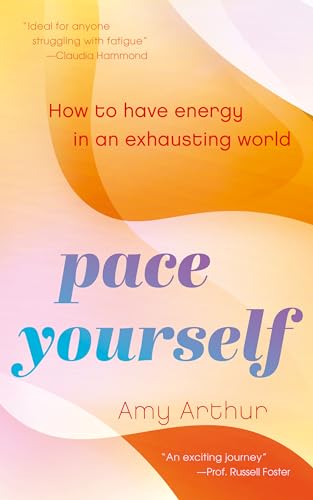
Life these days can feel like an endless, exhausting to do list with far too many "to-dos" and not nearly enough time to complete them. Self-help gurus will tell you to time block, wake up at five a.m., to try the Pomodoro method, and get rid of everything in your life that doesn't spark joy--but the reality is you can't bullet journal your way out of exhaustion. Instead, science journalist Amy Arthur argues for a radical new approach. We must learn to manage not our time, but our energy.
While time passes at the same rate for everyone, energy expenditure is as fluid and as individual as our personalities. In PACE YOURSELF, Arthur draws on cutting edge research as well as her experience managing her Chronic Fatigue Syndrome, to walk readers through how to find and maintain their ideal pace of life. Featuring experts across science, technology, history and philosophy, PACE YOURSELF lays out what we know about our bodies' energy how we make it, how we use it, how we often waste it, and what we can do to renew our relationship with it. Some of the ideas presented are at the forefront of scientific and medical research, from fields like nutrition, biology, psychology and physics. Others are exercises that you can complete on a spare sheet of paper, but that are sure to reshape how you think about the energy you spend throughout your day.
It is time we stop lying to ourselves that we can do it all. PACE YOURSELF introduces readers to a vital new framework to know their limits, work within them, and, ultimately, watch themselves flourish in this new, balanced pace of life.
As someone with ME/CFS and Long Covid, I wish someone had given this book to me when I first got ill - or even before that! I found the book to be a really comprehensive overview of the importance of pacing and how to actually do it.
I did find a lot of the information familiar to me already, but now I know when I need to refresh my mind on pacing, it's all in one place
Bien fait, bonnes sources :) Un self-help book très structuré et concret. Les exercices ont nourris mes réflexions et ont soutenus de beaucoup mon quotidien des derniers mois.
Seulement, trop pragmatique et méthodique pour moi. J’ai été impatiente et j’ai sauté plusieurs étapes pour arriver au « vital pace » étant de nature beaucoup plus intuitive dans la construction de mon quotidien que l’autrice. Quoiqu’il en soit, j’en garde de super apprentissages et de supers outils qui resteront de ma poche pour le futur (tant pour moi-même que pour des usagers•ères).
* 28 octobre: je constate que ce livre, c’est de l’ergothérapie! Je fais actuellement des horaires occupationnels de la sorte. Une grande révélation coudonc.
Although it is largely aimed at people with Chronic Fatigue/ME, I still really enjoyed this book as someone without either condition, but with a tendency to overwork and to stress that I'm not productive enough.
The book finds a balance between guidance on how to find a good pace and understanding that the process is not straightforward and we are likely to stumble along our journey.
I also found that the tone was nicely balanced between the anecdotal (which makes it human and relatable) and the science that backs it up.
Fantastic book, especially for me as someone with ME CFS. Although it is relevant for everyone. Very thorough, entertaining and educational too. Highly recommended!
This book feels to me that it tries to fill a gap somewhere between advice for people with mild ME, and advice for people who are experiencing burn out but have no health conditions.
The author has obviously spent a good deal of time researching happiness and goals and thinking about what makes it hard for people to stop and rest. She gives a lot of good, basic advice.
However, as a person who's had ME over 30 years and at the lower end of moderate I was frequently frustrated or slightly upset by some of the suggestions given. Her experience of ME is obviously (thankfully) of a much milder form but she shows very little understanding of the way more severe ME can impact people and the type of pacing they may need.
For example when she mentions severe ME needing help from friends and family she also says "and adjustments with work". She describes rest as binge watching a TV series, going for a walk in nature, doing art or listening to music. All of these activities are... not rest but activity, and are likely to be impossible, challenging or very limited for those who don't have mild ME. I did not find a mention of proper rest meaning lying down in the quiet and dark doing nothing, or as little as possible.
I can see this being useful for the newly diagnosed if they are mildly affected. Or for the general public who made need to slow down their way of life. I don't think it's suitable for people with more moderate or severe ME, especially if newly diagnosed as I feel it could give confusing messages.
She talks about being able to Pace Up from a base of vital pacing, but does stress to be careful and only increase if you feel able. confusingly before her wedding she was careful to not do too much but also increased physical activity as she wanted to dance at the wedding. This strikes me as a dangerous strategy for someone who gets PEM, as she does.
Sadly I was made to feel inadequate while listening to this audiobook. Or at least, that her version of ME is a town garden compared to the rough wilderness I experience it as. And my experience hasn't gone as far into dangerous country as many. Her ME sounded manageable, with a nasty crash that reduced her working hours significantly, but which she left after a few months.
I'm glad she's doing as well as she is, and her pacing ideas may help others mildly affected. But I couldn't recognise my needs in her suggestions.
Mixed feelings about this book. As someone with ME/CFS, this would have been very helpful to read when I was diagnosed. I think it would be really helpful for anyone feeling exhausted or with an energy-limiting condition. However, in the 6 years since I've had the condition, through trial and error, hard work, and a good specialist, I've figured out pretty much everything in here myself. So for me personally it didn't add much that was new, although there were a few reminders that were good. I also found it annoying in places - to be fair she doesn't say she is "cured" and still says she has relapses and has to monitor what she does. But I'm not sure someone with very severe ME who can't get out of bed will be able to do much with it. I think this is really aimed at people with mild/moderate ME or just burnout/exhaustion. I found it quite irritating though when she said she prepared for her wedding by reducing activity beforehand and building up physical stuff instead, because most people, if they're managing to keep working with ME, won't be able to just work 2 hours a day for several months to prepare for a big event. It's just not realistic for the average person's situation, and that's if you can manage to work at all. If you're in bed several hours a day there's not much you can reduce. There's a lot of great stuff in here and I did appreciate the way she explains the difference between emotional, mental, and physical energy and how to manage each of them differently. However - if she is back to functioning as well as she says, she's really lucky, because most people with ME/CFS aren't able to recover to the extent she seems to have done, so don't read this hoping for a "cure". It might work loads better if you are burned out/stressed kind of exhausted. I'd recommend it if you know nothing about pacing or ME management, or you are exhausted for some other reason, but for me personally it wasn't anything new or amazing.
Having M.E myself, I could really connect immediately with the author of this book as she shares her greatest tips and tricks for managing M.E/CFS, Long Covid or general fatigue. Using her own experiences she has a really lovely way of sharing advice of ways she has learnt and picked up over the years of managing your health, going easy on yourself but also finding ways to manage life with these conditions and how to improve your energy so you're not wasting it or standing still energy wise.
Pacing is at the heart of the advice, and it's easier said than done!! But the author breaks things down in easy to understand sections to focus on different outputs - be that your day to day life, what you eat, how to recharge your energy both physical and emotional - and I think it's the kind of book that makes you look at your life in a different way as you look more closely on where your energy is being spent.
It gives you that little incentive of rewarding yourself for the progress you're making, and not to rush things on those days when you do feel more energised. Really informative and helpful!
Very helpful to set better routines across the day to avoid becoming overtired and stressed leading to being exhausted the next day possibly unable do anything much. The practise of pacing across each day to make time for productivity balanced with physical tasks and just-for-fun tasks actually works. Reduces stress and anxiety and extreme exhaustion from what the author cites as a 'boom or bust' approach to daily life. Very relevant in the current lifestyle where busyness, productivity and 24/7 working availability is often given expectation from management and. Colleagues. It is more than a work-life balance situation; rather it is a desirable way to live life. It will be different for each individual as each of us has different situations. The ideas are those the author has explored through extensive research. The author also states it is not a replacement for discussions with health professionals as it is not designed as such. Rather it is a potential lifestyle alongside off good health care. Very practicle, very easy to read.
Das Buch hatte mich in einem englischsprachigen Buchladen in Utrecht angesprochen. Die Autorin beschreibt, wie man sich seine Energie einteilen kann, wenn man davon eher wenig hat. Sie selbst ist von Myalgische Enzephalomyelitis/Chronische Fatigue Syndrom betroffen und schreibt aus dieser Perspektive, sie ist aber auch für Long Covid relevant oder wenn man einfach so zu wenig Kraft hat.
Letztlich beschreibt sie einige hilfreiche Aspekte. So soll man nicht nur zwischen physischer und psychischer Energie unterscheiden, sondern letztere noch in mentale und emotionale Energie aufteilen. Sie schlägt vor sich Aktivitäten aufzuschreiben, die Erholung für jeweils eine der Energieformen darstellen. Weiter empfiehlt sie ein »Pacing Diary«, in dem man zwei Wochen sein Energieniveau verfolgt. Vor allem soll man aber ein Grundniveau finden, bei dem man sich nicht verausgabt. Sobald es einem zu viel wird, kann man sich darauf zurückziehen. Somit verhindert man einen kompletten Zusammenbruch.
Ich fand das Buch deutlich zu lang für das, was ich daraus mitnehmen konnte.
Everyone should read this book. It's practical, informative and easy to read. Whatever the reason for your interest - health issues of varying types, managing work or family - you'll find plenty of value. Pace yourself and learn about different types of energy - physical, mental and emotional. Understand boom and bust patterns. Discover how all the little and big things you do, from eating and sleeping to resting and socialising, affect energy levels and how to manage them. Highly recommended.
I got this book in hopes it would help me cope with my recent diagnosis of myalgic encephalomyelitis/chronic fatigue syndrome (ME/CFS). Right now, my mind is boggled with all the information. I would have trouble believing that the advice here could apply to me were it not for the fact that Arthur has the same condition and says she has been more severely affected than I am. It's just a lot to take in. I'll hang on to this one and refer back to it when I've had a chance to sort through it all.
This book gave me more of an insight into ME/chronic fatigue but the subject matters and lessons can be applied to anybodies life.
It invites you to take an honest, constructive look at how your life is and where you would like to be and to take steps to create that lifestyle on your own terms, milestones, goals, in a way which advocates for self-care.
3.5- great info and advice but harder to apply it all since this book is really geared towards ME/CFS. Not for me but would be super useful for some :)
Very useful resource on pacing when you have a chronic illness. Enjoyed the writing style, and it reminded me of techniques and ideas to try. Nothing when you are unwell or have a disability will solve everything, but this book gave me more hope to keep trying new ideas / ways to manage lifes demands. Even if they haven’t worked before.