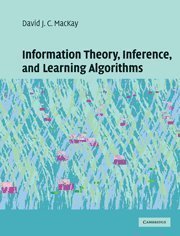
While deliberating buying the book, I came across many reviews giving the impression that this was an upper-tier book meant only for those already well-versed in bayesian inference, information theory, and machine learning. Fortunately for me (having purchased it for ~50$), I have been gliding along at quite an easy pace. Already I've learnt about hamming codes and the formulas & axioms (interestingly formulated!) of bayesian probability theory. The treatment probably isn't the most sophisticated, I'm sure, but for me at least it's a good enough fit.
I think my apparent ease might have to do with the fact that I've been doing a lot of abstract math recently (axiomatic set theory, differentiable manifolds, lin alg), and to me, this goes to show how powerful math is as a language. (People say it is a universal language, and it is in this sense: once we understand, we rarely have room for mis- or non- understanding). I have to say that it truly pays to be rigorous! (nod to Wittgenstein).
Our brains work by applying well-optimised strategies learnt in the past to new situations, and then custom-fitting this strategy as it accumulates more and more data (although some brains, noticeably adult ones, stop doing this altogether). In fact, this whole process, which can be summed under the term 'learning', is itself a strategy we have to fine-tune constantly. Given these facts, it follows that it will be immensely helpful to identify guaranteed ways of
1. 'picturing' the same thing differently (shortening the time needed to search for alternative strategies, and lending itself to psychological convenience) and of
2. equating very different notions of things by reimagining them under the same picture (allowing the quick identification of applicable strategies without reference to irrelevant details)
And math, which goes above and beyond the precision of natural language, manages this with elegance and grace.
And yet learning math takes a lot out of me, it is physically exhausting, and emotionally-dangerous to get sucked into the non-human, ruthless, high-octane world of abstract math. Yet it is only in these regions of the mind that math is doable... it requires that we rewrite our axioms of thought: there is no space for human guesses or hunches, only previously apprehended notions which must be burnt into memory. But that is its beauty, it is a world perfect in its own right.