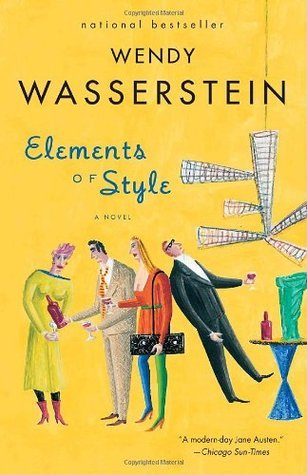
What a mess. Wendy trains the Big Guns on a sitting duck, i.e. the sort of women (the male characters only exist as appendages to their consorts with one exception) who staff the upper echelons of New York City "society", something that has been a pain in the ass to the rest of the country since Mrs. Astor's fabled 400. As if the shallow, narcissistic harpies that Wasserstein drags out aren't overkill enough, she sets them in the immediate aftermath of 9/11, but even that doesn't really do it. So for good measure she invents a Starbucks explosion that kills 70, blowing up child ballerinas.. Child ballerinas, people! And still the socialites continue their meaningless lives of excess consumption and hypocritical charity galas. One might almost think they are retreating behind their money! (Large hint there as to what Wasserstein is really doing in this novel).
Wendy's heroine is Dr. Francesca Weissman, who belongs tangentially to this world as a high-priced pediatrician, but who has a foot in Real Life because she donates time to the ethnic/African-American poor, thereby risking professional ostracism from the upper-class girls because their own children might get poor people cooties in the waiting room. But Francesca-Call-Me-Frankie is also a graduate of Spence and Princeton, so, y'know, she is basically smart. And Jewish, with earthy roots in the garment trade.
Wasserstein, like Frankie, was an outsider. In real life, she orbited the kinds of folks she skewers in this play, lived a very comfortable Manhattan life, but, thanks to her gimlet eye, kept her distance. And even though Frankie flirts with the upper classes, she always goes back to those deserving poor. Because they are authentic. Or something. It's hard to tell, since we never actually get a chance to meet any of the poor people because Frankie is too busy panting after the rich bitches.
And bitches they are. There are no real friendships depicted in Elements of Style. By the way, get the title? It is all Style uber alles, although Wasserstein confuses style with brand names, names scattered throughout the book like confetti. Henry James and Edith Wharton, who effortlessly did what Wasserstein tries to pull off here, don't spend a lot of time looking at the name tags on their characters' clothing. Or presumably separate the upper classes from the lower classes because money and good clothes make you shallow. Or something.
But here's the deal. This is a rewritten Great Gatsby. Not a tribute, an actual swipe. Wasserstein cribs the character of Nick Carraway --- that's Frankie. And since it is hard to shake the feeling that Frankie is an avatar for Wendy, Wendy sees herself as Carraway, for those playing the home game. But there is also a Myrtle and a Tom and Daisy Buchanan. Indeed, Wasserstein paraphrases several of Gatsby's best lines, one of them so obviously that it made me stop sprawling in my reading chair and sit up in disbelief.
We don't need The Great Gatsby Lite. I'd like to think that had Wassersein lived, she would have thought better of this novel. Because it is a lot closer to Jackie Collins than Scott Fitzgerald.
Even if you like Wasserstein's other work, and I do, not recommended.
separate the upper from the lower classes