Jump to ratings and reviews
Rate this book

The Temple: The Poetry of George Herbert

Rate this book
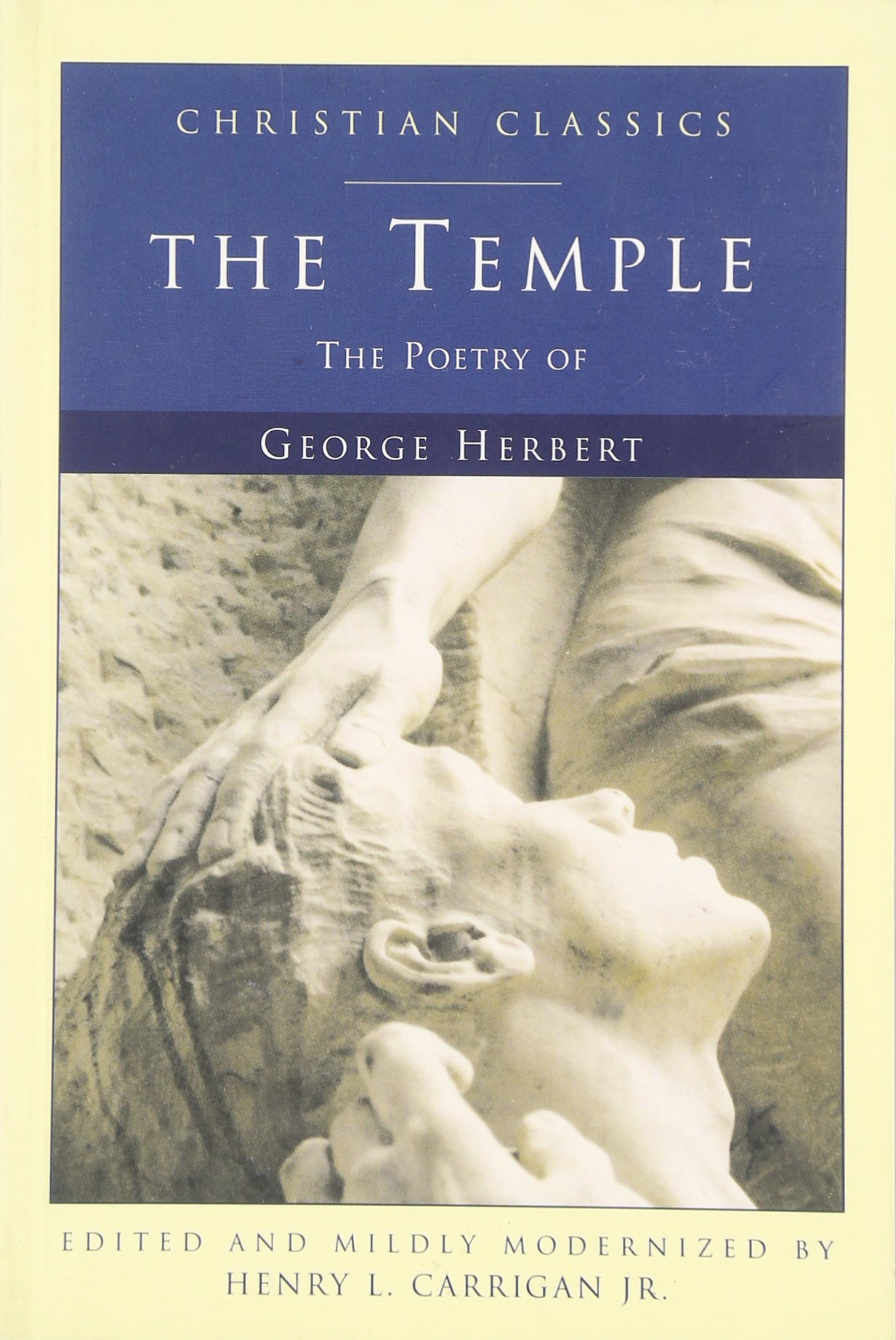
In 1633, George Herbert published what has become the best-known religious poem in the English language, The Temple. Actually a sequence of poems, The Temple is shaped by the order of church ritual and liturgy. At the heart of The Temple stands "The Church," poems that are patterned on the Church's liturgical calendar and that discuss theological ideas such as death, judgment, and heaven. Herbert's poetry is at once personal and confessional. His poems about the Eucharist and holy baptism are not only general theological explorations of the sacraments but also the poet's expression of the struggles of his own flesh to be reconciled to God. This mildly modernized edition makes the spiritual insight and quiet passion of this great poet available to today's reader.

212 pages, Paperback

First published January 1, 1633

122 people are currently reading
1899 people want to read

About the author

George Herbert

501 books138 followers
George Herbert (1593-1633) was a Welsh-born English poet and orator. Herbert's poetry is associated with the writings of the metaphysical poets, and he is recognized as "a pivotal figure: enormously popular, deeply and broadly influential, and arguably the most skillful and important British devotional lyricist."

Born into an artistic and wealthy family, Herbert received a good education that led to his admission in 1609 as a student at Trinity College, Cambridge, Herbert excelled in languages, rhetoric and music. He went to university with the intention of becoming a priest, but when eventually he became the University's Public Orator he attracted the attention of King James I and may well have seen himself as a future Secretary of State. In 1624 and briefly in 1625 he served in Parliament. Never a healthy man, he died of consumption at the early age of 39.

Ratings & Reviews

What do you think?
Rate this book

Friends & Following

Create a free account to discover what your friends think of this book!

Community Reviews

5 stars
309 (46%)
4 stars
192 (29%)
3 stars
125 (18%)
2 stars
28 (4%)
1 star
8 (1%)
Displaying 1 - 30 of 70 reviews
Profile Image for Fergus, Weaver of Autistic Webs.
1,270 reviews18.4k followers
March 23, 2025
Metaphysical Poetry!

What’s that mean? Well, for the great poet T.S. Eliot, the term perfectly characterizes that moment in history when poetic writing became split into a Cartesian duality - ‘A disassociation of sensibility.’

And that, he says, happened back in the late Renaissance.

I think he’s right, and I’ll use one example from this book to show you the prelapsarian (in a literary sense) genius of George Herbert...

(But let’s first take a look back to the early Renaissance before the Reformation clicked into high gear.)

At that time, artists heartened back to the classical ideal of the Whole Human Being - “mens sana in corpora sano.” But the intellect was always their watchtower.

So early Shakespeare is full of Eden-like natural settings in which wit ruled the roost:

“It was a lover and his lass
That through the green cornfields did pass
In Springtime...”

So, there you have it: a pastoral setting and an opportunity for risqué punchlines.

But near the end of the Tudor Era, Europe started to come of age, and so while writers like Herbert stressed an Edenic sound morality and intellect - nature and wit - other authors were growing cynically sophisticated, like Donne before he was converted in his deep malaise.

A deep rift had begun.

Watch carefully, now, as George Herbert uses sensory images to lead you into a carefully-laid trap IN WHICH IDEAS, AND NOT FEELINGS (as in the first stanzas) STILL REIGN SUPREME - THOUGH THE CONNECTION BETWEEN THE TWO REMAINS INTACT:

VIRTUE:

Sweet day, so cool, so calm, so bright,
The bridal of the earth and sky,
The dew will weep your fall tonight
For you must die.

Sweet rose, whose hue angry and brave
Makes the rash gazer wipe his eye,
Your root is always in its grave,
And you must die.

Sweet spring, full of sweet days and roses,
A box where sweets compacted lie,
My music shows you have your closes,
And all must die.

Only a sweet and virtuous soul
Like seasoned timber never gives,
But though the whole world turns to coal
Then chiefly lives.

There! Did you see the Trap sprung by that strange symbol of Coal? A ‘false note’ for sure!

Did you see how it took you from the Dying of sweet Bodily things into the Immortality of the Soul?

Right where Herbert wants to take us - by stealth!

***
When I discovered the great George Herbert - seems strange, doesn’t it, to ‘discover’ someone whose soul has been at peace for 400 years? - I was humbled!

Here I was, 50 years ago, riding the merry coattails of the boisterous, rambunctious throng of ‘great writers’ who enlivened the seventeenth century with their testosterone-charged vigour -

And ignoring the still, silent voices of such intelligent quietists as Herbert.

He was the Jan Vermeer of Renaissance word-painting. Full of a variety of symbolic meanings, and totally free of worldliness.

My hat’s off to you, dear friend and ange guardien of my youth!

The still waters you were trying to lead me to were infinitely clearer, deeper and more satisfying than those tempest-tossed oceans Shakespeare & Co. so pride themselves on.

Your simple faith could have guided me to a peaceful harbour, instead of straight into the midst of heretical storms of anger against countless soulless antagonists.

If only I had known.

But Thank Heaven I do NOW.
Profile Image for Riley Carpenter.
67 reviews6 followers
November 25, 2024
Incredible. Some of the best stuff I’ve read.

“Love is that liquor so sweet and divine
Which my God feels as blood, but I as wine”
Profile Image for Douglas Wilson.
Author 319 books4,537 followers
May 20, 2012
Read this in another edition. But always fantastic. Some glorious lines in here.
Profile Image for Graham.
111 reviews13 followers
June 21, 2024
I’m not a great lover of poetry, but I’m trying to develop the taste. I found that the last third of this book was worth all the effort of getting there. Many of these poems went over my head, but the few glimmers of light that happened to strike my eyes were lovely.
Profile Image for Becky.
6,175 reviews304 followers
March 15, 2016
Do I read a lot of poetry? I wouldn't say that I do. Perhaps two or three books per year, usually. And often those "poetry books" are poems for the very young. So reading George Herbert, in many ways, was going outside of my comfort zone. Yet, it was good for me to go outside my comfort zone in reading. I assumed--presumed--that it would be an intimidating read: at best a bit boring, at worst, incomprehensible. But I really enjoyed reading this one.

I enjoyed "The Sacrifice" which is a poem written from the point of view of Jesus Christ. It has a refrain of "Was ever grief like mine?" and it would be a timely read for Lent and Easter. (Another timely read would be "Good Friday.") Though I think believers would profit from it year round.

"The Call" would probably be in my top three. Here's how it opens:
Come, my way, my Truth, my Life: Such a Way, as gives us breath: Such a truth, as ends all strife: And such a Life, as killeth death.

Though I'm just sharing the first stanza, I really adore this one from start to finish.

"Colossians 3:3" is a fun little poem, and, definitely in my top three.
My words and thoughts do both express this notion, that Life hath with the sun a double motion. The first Is straight, and our diurnal friend, the other Hid and doth obliquely bend. One life is wrapped In flesh, and tends to earth: The other winds towards Him, whose happy birth Taught me to live here so, That still one eye Should aim and shoot at that which Is on high: Quitting with daily labour all My pleasure, To gain at harvest an eternal Treasure.

I love the "hidden" message: My life is hid in Him, that is my treasure.

I also appreciate Herbert's "The Twenty-Third Psalm" which opens like this:

The God of love my shepherd is, And he that doth me feed: While he is mine, and I am his, What can I want or need?
Profile Image for Anna.
275 reviews
December 25, 2023
Many poems here worth revisiting and pondering. Some I understood and appreciated better than others, but his love for God and poetic insight are beautiful and moving.
Profile Image for Ben Zornes.
Author 23 books92 followers
July 31, 2018
A really wonderful collection of devotional poetry. George Herbert's poetry sinks deep roots into the glorious doctrines of the Christian faith, and then raises us up to soar with poignant praise. He is witty, lucid, and demonstrates that good doctrine with a beating heart is a potent combination. Herbert also mingles in a healthy dose of that good, ol' fashioned earthiness of English poets. In almost every selection you find some sort of proverbial statement which are often quite Solomonic. I'd highly suggest leaving a copy on your nightstand and read a selection each evening. Really good stuff.

Here are a few of my favorite lines:

Pick out of tales the mirth, but not the sin.

A verse may find him, who a sermon flies,

The way to make thy son rich,
is to fill His mind with rest,
before his trunk with riches.

Do all things like a man, not sneakingly.

Laugh not too much: the witty man laughs least.

Towards great persons use respective boldness.

Be calm in arguing: for fierceness makes
Error a fault, and truth discourtesy.

All worldly joys go less
To the one joy of doing kindnesses.

Restore to God his due in tithe and time.

Praying’s the end of preaching.

Churches are either our heav’n or hell.

Sum up at night, what thou hast done by day.

And praise him who did make and mend our eyes.

The bloody cross of my dear Lord
Is both my physic and my sword.

What Adam had, and forfeited for all,
Christ keepeth now, who cannot fail or fall.
Profile Image for Em Karsten.
46 reviews
June 23, 2025
TOOK ME A YEAR BUT I DID IT love myself a monk who wants to be left in peace to look at stain glass and walk to make sure he can hear music.
Profile Image for Elisabeth.
Author 27 books193 followers
August 29, 2025
I've been reading through Herbert's poetry on my Kindle slowly for a long time, and was a bit surprised and regretful to come to the end of it today. Simply marvelous.
Profile Image for Jess McDonald.
224 reviews1 follower
August 15, 2022
From the underlying structure to the beauty of the poems, this is some of the best Christian art you’ll experience
Profile Image for Jim Leckband.
783 reviews1 follower
December 29, 2018
This is why I read random books from lists of the great books - that dirty word - (sound effect here...duh duh duuuuuuh...) the canon.

Herbert's poetry is on the surface about God, religion, devotion and other mind-numbing (to me) generalities. However, these doctrinal MacGuffins are only there (in my secular reading) for Herbert to jump-start his creativity. His fecund display of wit, craft, rhyme and meter are in almost every poem. He dabbles in concrete poetry (and makes a masterpiece). He sneaks in word-play like acrostics and hidden words. He uses "tricks" like using the last word of a line to begin the next line to great effect. And above all, you can understand and appreciate what he is doing (unlike *cough* John Donne).

All in all, I get the feeling that the religion biz was just his beard to get his serious creativity out. Thank God.
Profile Image for William Schrecengost.
907 reviews33 followers
August 12, 2020
If a Christian is to read one work of poetry in his or her life, it ought to be this. Herbert is a masterful poet and he is amazing at structuring his poems. Each one is full of theological meaning and help convey a yearning for God. Truly lovely poems with a heart for God.
Profile Image for Heather Ferguson .
174 reviews2 followers
January 18, 2021
I did not connect with this as much as some have, but I do not argue with the fact that it is beautiful and has been influential in the world of literature for centuries. Glad I read it.
Profile Image for Rose Rosetree.
Author 15 books469 followers
February 4, 2023
Yes, I shelved "The Temple" under memoir, as well as all the other shelves you'll see linked to this review. Why memoir? Because George Herbert couldn't have written words like these unless he'd lived them.

TO QUOTE FROM "LOVE"

Love bade me welcome. Yet my soul drew back
Guilty of dust and sin.
But quick-eyed Love, observing me grow slack
From my first entrance in,
Drew nearer to me, sweetly questioning,
If I lacked any thing …


NOT THE THEOLOGY BUT THE EXPERIENCE. THAT'S WHAT I LOVE IN HERBERT'S WORK.

Two thieves who pass each other on the street may recognize each other as thieves.
Like that, are some of us who love God, recognizing each other.
We might use different words, have different beliefs.
But we know our own.
Profile Image for Tori Samar.
601 reviews99 followers
November 17, 2020
"Invention rest,
Comparisons go play, wit use thy will:
Less than the least
Of all God's mercies, is my posy still."


George Herbert is one of my favorite poets. This collection is full of beautiful gems in language, form, and theme. Surely some of the greatest devotional poetry ever written.
Profile Image for Jessie Pietens.
277 reviews24 followers
October 23, 2021
Two stars, not because it was bad, but just because I didn't really connect to it. It was long and at some point the poems start to blurr together somewhat. Some review or blurb of this work somewhere gave me very high expectations that were barely met. It was interesting to dive into religious poetry as a genre, but I am not sure this hit me the way it should have or could have. If you are into renaissance poetry and are specifically into religious genres this would be for you.
Profile Image for Caspar "moved to storygraph" Bryant.
874 reviews55 followers
Read
December 17, 2022
the natural pair with morvern. The Temple is effectively What GH here contributed to english poetry (posthumously) and it has stuck ever since. Also neat that Herbert sent the manuscript to Nicholas Ferrar on his deathbed asking whether it should be published. That is, Nicholas Ferrar, Ted Hughes' ancestor, of Little Gidding. What a boys' club it is.

Herbert is fantastic, transcendental - indeed a Metaphysical - and you don't need me to say it. I think this is one of the earliest cases of A Collection existing as something like what we think of it today in English and he's formally so dextrous, convulsive even. Easter Wings and The Altar are iconic for obvious enough reasons but in here we also have anagrams, dialogues, autoechoic poems (Heaven is an excellent example of what I mean by that. It's not rhyme but again, internal. Wheels within them). So much experimentation is happening ! So many lines are iconic and seeped into the language and it's so sweet to stumble on poems that people like Denise Riley have pinched from

what a funny chap
Profile Image for Aneece.
187 reviews11 followers
November 24, 2012
Ew. Did not realize that "modernized" meant "rewritten for the dull reader". I'm all for normalized spelling and punctuation, but this was gag inducing. Am now in the market for a different edition.
Profile Image for Hannah of Camelot.
21 reviews1 follower
January 1, 2024
On a re-reading of these poems for the purpose of revision, the beauty of them was by no means lost on me. They are not complicated, nor easy to understand; in fact many of them are themselves about simplicity. This is part of Herbert's project, and it lends itself to poetry as prayer: deeply private on the one hand, but open to all on the other. Of course, they are far from simple when you reach in and dig around, in which case they garner a host of interest. But if you just want to read beautiful poetry and get caught up in the beauty without stumbling too much over the meaning, The Temple is perfect.

Herbert is perhaps most famous for his "concrete" poems like "The Altar" and "Easter Wings", which are what we might call "shape poems" whose shapes have mildly ambiguous meanings. Really, we might call many of them "shape poems", since, whilst most fit to a regular rhyme scheme, the meters are often unique and strangely laid-out, betraying a curious interest Herbert has with the way we find things on the page. "Discipline", for example, has two 3-syllable lines that jut into each stanza like a grasp for air. "Paradise" depends even more on the printing, with each line-ending collapsing into the next (as in GROW... ROW... OW).

In approaching Herbert, it is greatly enriching to come with a knowledge of Biblical scripture and early modern liturgy. He engages with them both ubiquitously. For this, an annotated edition would be very profitable. However, it's by no means essential to enjoy the beauty of these poems.

They work nicely, reading them in sequence. If dipping in is more your style, however, here are a few of my favourites to get you started: "The Altar", "The Sacrifice", "Easter Wings", "Repentance", "Jordan (1/2)", "Church-monuments", "Prayer (1)", "Paradise", "Easter Wings", "Deniall", "Discipline", "The Collar", "The Flower"...

Have fun Herbert-ing. And read his prose work "The Country Parson" if you've been converted - it's very interesting to get a glimpse of his public life as well as the deeply personal!
Profile Image for Oliver Brauning.
109 reviews
September 23, 2024
The Temple is rightfully known as a masterpiece of devotional poetry, and yet its scope is very narrow. Perhaps this is because it is “devotional” poetry rather than merely “religious” poetry—it is a work that’s fitting to read on Sundays but perhaps no other day. Herbert tells us why in “The Elixir”:
A man that looks on glasse,
On it may stay his eye;
Or if he pleaseth, through it passe,
And then the heav’n espie (9-12).

Nature is never just nature; it is always only a vessel by which we see heaven and God. It is never enjoyed on its own. As “The Rose” says,

If then all that worldlings prize
Be contracted to a rose;
Sweetly there indeed it lies,
But it biteth in the close (21-24).

It could never be found out from these lines that God made all things good or that the heavens declare the glory of God or that creation groans awaiting the fullness of redemption. No, creation is the world, the antithesis of heaven; and the things of the world are to be rejected, being only “a scourge/For they all produce repentance/And repentance is a purge” (26-28). Contrast Herbert’s approach from that of a religious poet:
As the trees sap doth seeke the root below
In winter, in my winter now I goe,
Where none but thee, th’Eternal root
Of true love I may know. (“A Hymne to Christ,” 27-28)


Now this is a theology for life, for here nature is shown to be a pattern of heavenly realities. By looking at nature we can come to a better understanding of God. The Temple teaches that we must look through nature to see God, and that she provides only a testing ground for Christians before the next world. This sort of theology is not exactly dangerous—it’s far too tiresome to be followed whole heartedly—and, indeed, there is even some truth to it. Thankfully, it doesn’t even penetrate into every single poem in The Temple. Nevertheless, it is still very annoying and limits Herbert from being as good a poet as he might have been. As the Apostle John says, “No one has ever seen God,” and so, because the usual objects of our imagination are those things we can see, things which Herbert severely qualifies the goodness of, the contents of The Temple tend to repeat the same few ideas. This is not to suggest those ideas are poorly executed, but that they are not for every day; only for that one day a week when the saints are gathered together and not only their eyes, but also their souls, ascend in angelic harmony to heaven's court.
Profile Image for Mark Caleb Smith.
98 reviews1 follower
December 13, 2025
I am not a poetry person, at least not in the sense that I read poetry regularly. During the past year, I have read more poetry than at any point in my life. There are several reasons for this (gifts, a research interest in Robert Penn Warren, my job), but it has been a sincere blessing.

George Herbert's The Temple is unlike anything else I have read. It is deeply confessional. The reader gets an insight into Herbert's own life and struggles. It is also devotional, an extended meditation on God, Christ, the Spirit, the Church, and the Christian life. Herbert requires patience at points, and I, being an unskilled reader of poetry, had to work through different schemes and rhythms, but it was worth the effort.

Instead of highlighting or marking up the text, I decided to dog-ear pages as a signal to revisit passages. I have too many misshapen corners to count. The Altar and Easter-wings are notable for their shapes as well as the text. I was moved by The Thanksgiving and many, many more.

Finally, every person who writes in any way should read poetry on a regular basis. In many ways, it is the height of language arts. Choosing the right word to convey the right meaning in the right amount of space in either a memorable or revealing way takes an outrageous amount of talent and skill. Merely observing these patterns should influence the way you write and inspire you toward linguistic felicity.
Profile Image for Carol.
Author 1 book1 follower
September 23, 2022
As is a hazard with old English, despite being updated to modern spelling, ease of comprehension proved challenging. I confess that even after reading some of Herbert's poems three or four times, I know I still don't fully grasp his meaning, and thus the metaphor in them feels disjointed.

But, don't let that deter you! There are so many precious pieces in this book; I want to read back through in the next year and put those little post-it flags next to the ones I loved most, so I can easily find them again.
Once again I've felt a strong impression of how... shallow... belief in the Almighty and Jesus Christ is in comparison to Herbert's day, and even that pales compared to when the Apostles still lived. It's a song coming at such a far distance, we must strain to hear it, and even then miss most of the tune. The Temple brings it a little closer, a little louder.

Support your local library! Though this may take a hot minute to read, so maybe support your local used bookstore instead.
Profile Image for Nate.
8 reviews
October 15, 2025
Grace distilled into a conversation.

George Herbert’s Love (III) is a poem so simple it almost feels disarming—and that’s exactly its power. As an evangelical pastor who believes deeply in free grace, I find myself both humbled and astonished by it every time I read.

The guest comes to Love’s table full of excuses: unworthy, guilty, ashamed. But Love—Christ Himself—meets each objection with gentle truth: “Who made the eyes but I?” “You shall be he.” “You must sit down, and taste my meat.” Every line is pure Gospel. The sinner offers to serve to earn his place, but Love insists: sit, receive, rest. Service belongs in life, not as the price of grace.

Some readers miss its artistry because it’s so quiet and spare—but that’s where its genius lies. In only a few stanzas, Herbert captures the entire movement of redemption: resistance, surrender, and communion. It’s the Gospel in miniature, and it still moves me to awe and gratitude centuries later.
Profile Image for David Willey.
40 reviews
June 4, 2025
Ok fine, I didn't quite read the whole thing, but this was my second time not quite reading the whole thing, so I'm allowed to leave a review at this point.
-Definitely improves on the second time of almost reading
-Some of the most deeply liturgical poetry I've ever read
-Apparently has something to do with the rhetorical tradition (we'll never know what)
-Everyone should at least read the really famous ones: "Love 3," "The Collar," and "The Pulley" etc.
-Some other absolute bangers (in no particular order): "Evensong," "Mary Magdalene," "The Dawning," "The Son," "Redemption," and especially "Church Porch" (yes, I said what I said)
Profile Image for Katherine Cowley.
Author 7 books234 followers
May 7, 2017
George Herbert was my favorite poet in the Early British Literature class that I took, and so I was delighted when my book group to read him. We read about thirty of his poems and I loved revisiting his works. In particular, what I find striking is the nuances and challenges of faith, and his notions of God and spirituality, which really speak to me and encourage me. Sometime I plan to read the entire book.
Profile Image for Jesus Salgado.
322 reviews
December 4, 2022
I have mixed emotions when it comes to poetry. I often get confused and I often fall in love with the beautiful lines displayed. The latter part applies when it comes to George Herbert. He does such a wonderful job displaying beautiful words to beautiful Christian truths and the Christian life. I simply couldn’t put the book down!
Profile Image for Halle Wassink.
249 reviews
June 2, 2023
ehhhh. Was in a poetry mood when I started this (thank you spring), was not in a poetry mood when I finished this. Could've/should've read this slower, like one poem a day at a time, but my brain took a bit to get used to reading it in the morning that I had to read 2-3 before I was into it. I maybe enjoyed four or five of the poems in total.
Displaying 1 - 30 of 70 reviews

Can't find what you're looking for?

Get help and learn more about the design.