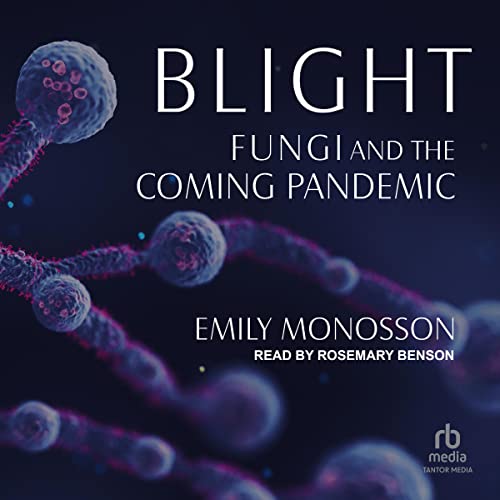
Let's dispense with my greatest nit to be picked about Blight: Fungi and the Coming Pandemic, the title. The word pandemic denotes a multinational disease affecting animal life with a decided emphasis on human animals. However, Monosson's book is decidedly focused on plant diseases, particularly those spread by fungal spores, which are ubiquitous in the environment. Personally, I would be perfectly happy to apply the term pandemic to botanical diseases; however, multiple online and print dictionaries are quite clear that it applies to diseases infecting humans. The word itself derives from Greek pandēmos meaning “of all the people.” The title, one must conclude, is misleading and does not accurately describe the contents of the book.
Since I've begun by picking nits, we may as well get the minor ones out of the way as well. While Blight is generally well written with few stylistic errors, as readers near the end they do encounter a few surprising grammatical faux pas. Page 193 tells us that fungi “will bide their time in some other species—a plant or an animal—waiting for a preferred host or lay [sic] dormant in the soil for months or years as spores.” I do not expect a professional author to confuse the verbs lie and lay. As readers are recovering from this shock, along comes this on page 200: “I am grateful to Luis Pocasangre, who hosted my husband and I [sic] at EARTH University in Costa Rica. . . .” A pronoun object of the verb hosted should be in the objective case, not the nominative. Much earlier in the book on page 148, the acronym for The American Chestnut Foundation is given as TAFC instead of the correct TACF. Yes, these are isolated errors that fortunately do not characterize most of the text; still, considering the work of the author, the editor, the proofreader, and others who, according to the acknowledgments, also read the text before publication, there should be none whatsoever foisted upon readers of the published book.
What precisely does Monosson wish to accomplish in her book? Page 199 refers to an article in Nature magazine entitled “Emerging Fungal Threats to Animal, Plant and Ecosystem Health,” and Monosson observes that “scientists were ringing a warning bell.” She explains that one of her goals “was to amplify their warning and wake readers up to the breadth of species lost to fungal pathogens that have gone pandemic. Another goal was to remind them that this is just the beginning unless we take responsibility for our actions, which have aided these outbreaks.” Blight does a very effective job in accomplishing these goals—at least among those who will read it.
Are there indeed pandemic (to use the word as Monosson does, etymologically accurate or not) diseases among the Earth's plants and non-human animals that impact the planet's ecosystem? She offers many examples: coffee rust, the American chestnut tree, California's tanoak and live oak trees, tar spot fungus on corn crops, the Netherland's fire salamanders, potato blight, a species of frogs in Costa Rica, Fusarium wilt of bananas, and more. As for causes of such widespread infections, especially as they are worsened by human action, she cites the planting of monocultures by farmers and the inadequately regulated worldwide trade in animals and plants by commercial dealers.
I did not find this an especially entertaining book nor one characterized by inspired or engrossing text. Explanations of genetic manipulation of plants with the goal of heightening natural resistance to infection seemed to become a bit too technical at times for easy comprehension by laymen. Nonetheless, I did find Blight informative and, as the author hoped, a wake up call as to the breadth of species damaged or lost to fungal pathogens. There are portions of the book of interest to readers who wish to expand their knowledge of agricultural practices, international trade in animal and plant species, fungi and fungal spores, ecology and the Earth's ecosystem, methods of (unintentionally) spreading disease across oceans and continents, and even a bit of the science of genetics. Blight is not unduly long, 203 pages not counting peritext, and is surely worthy of one's time expended in its reading. Just be prepared to concentrate fairly frequently to achieve a firm grasp of the content.