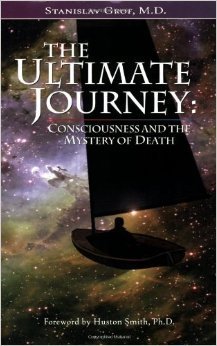
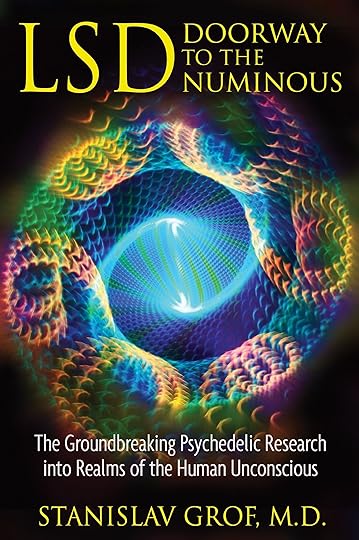
Loaded with case studies which present a unified model of human consciousness—a revolutionary map of the mind that explains our evolution, behavior, personality, and the mind-body connection—this work takes readers on a compelling journey into the mind, human behavior, and future of humankind.
Stanislav Grof is known for his early studies of LSD and its effects on the psyche—the field of psychedelic psychotherapy. Building on his observations while conducting LSD research and on Otto Rank's theory of birth trauma, Grof constructed a theoretical framework for pre- and perinatal psychology and transpersonal psychology in which LSD trips and other powerfully emotional experiences were mapped onto one's early fetal and neonatal experiences. Over time, this theory developed into an in-depth "cartography" of the deep human psyche.
Following the legal suppression of LSD use in the late 1960s, Grof went on to discover that many of these states of mind could be explored without drugs by using certain breathing techniques in a supportive environment. He continues this work today under the title "Holotropic Breathwork".
Grof received his M.D. from Charles University in Prague in 1957, and then completed his Ph.D. in Medicine at the Czechoslovakian Academy of Sciences in 1965, training as a Freudian psychoanalyst at this time. In 1967, he was invited as an Assistant Professor of Psychiatry at Johns Hopkins University School of Medicine in Baltimore, United States, and went on to become Chief of Psychiatric Research at the Maryland Psychiatric Research Center where he worked with Walter Pahnke and Bill Richards among others. In 1973, Dr. Grof was invited to the Esalen Institute in Big Sur, California, and lived there until 1987 as a scholar-in-residence, developing his ideas.
Being the founding president of the International Transpersonal Association (founded in 1977), he went on to become distinguished adjunct faculty member of the Department of Philosophy, Cosmology, and Consciousness at the California Institute of Integral Studies, a position he remains in today.
Grof was featured in the film Entheogen: Awakening the Divine Within, a 2006 documentary about rediscovering an enchanted cosmos in the modern world.
"Joseph Campbell, who was for many years my dear friend as well as an important teacher, taught me much about the relevance of mythology for psychology, religion, and human life in general. ... Gregory Bateson, a "generalist" whose inquisitive mind explored many disciplines in search of knowledge was the most original thinker I have known. ... I am particularly grateful for my long friendship and cooperation with Fritjof Capra..."
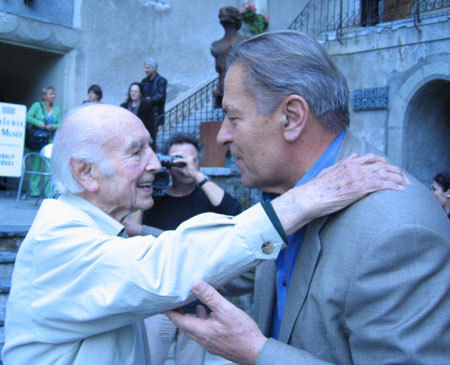
(Hofmann and Grof)
Quoting Victor Hugo, Grof may believe that “the great spectacle” is far wider at the soul level, than at the seas´ or the skies´.
The expression “new Psychology” attracted me to this book. It seems that there are psychological facts/experiences and "pathologies" …”not accounted by “current Psychology and Psychiatry”.
Even the whole “cartography” of the Psyche needs re-definition. And if you re-define the cartography, you’ve got to re-define also the (Psycho) therapies. The “whole architecture” of psychosomatic disorders needs re-definition, according to the author.
His experience (and theoretical construction) is drawn from contacts with Shamans, and people who were dying; also, contacts with “Tanatologists”, who know about “near-death experiences”.
He studied alien-abduction cases. Participated in “native ceremonies” . Had “lots of contacts” with Zen monks, yogis, as well as Tibetan and Benedictine monks.
Somehow revolutionary are his admissions of “transpersonal identities”: one can identify with a group of people (“all children of the world”; all mothers of the world”…) or with plant life or animal life (whatever from a unicellular and virus…to primates), …down to the “inorganic material”. Grof himself, recalls having had the experience as a “sequoia tree” and a “carnivorous plant”.
Moreover, transpersonal experience can reach “deities”, “demonic presences”, “mythological” entities.
Grof has 50 years of research on the effects of LSD. But it all started in his youth years, with him as patient in an experiment which included the exposure to “stroboscopic light”, in Prague. He witnessed “millions of suns, light as never seen”; it was an “out of the body experience”. Now, he could understand such scientific terms as “black holes” and “white holes” , the ”big-bang" and “pulsars”. Such was the intensity of the experience. It included 250 mg of LSD.
The word “holotropic” was coined by himself; it simply means: “states which move us in the direction of wholeness”.
Back to the “experiences”, Grof has got this “umbrella expression “( my expression) which includes these: "NON-ORDINARY" (“altered") states of consciousness. On a personal note I would like to doubt that some of the related experiences may actually lead to “wholeness”.
Nevertheless, his approach has some validity because it incorporates experiences that go far beyond the birth (trauma, namely), and perinatal period, extending to the phylogenetic level as well as the mythological (Jung had already approached), and many other “spiritual experiences”.
Lately, he has devised techniques (based on breathing, yet no LSD involved) directed at promoting “halotropic” experiences.
This new psychology recognizes the role of astrological configurations.
Clearly, his new psychology implies a new world vision (and training agenda): interventions like those humanity got used to (military, diplomatic, and economic) don’t work.
He’s for a “large-scale” INNER TRANSFORMATION. It’s a matter of survival humanity faces: with deforestation, nuclear weapons, pollution, population explosion etc.
“Happiness is an inner job”.
"I've seen powerful healing after past-lives experiences".
-هيچ مداخله ي بيروني نمي تواند دنياي بهتري بسازد مگر اين كه همراه با تحولي عميق در آگاهي بشر باشد.
-ثروت فعلي جهان به حدي است كه خوشبختي همه ي ساكنان زمين را تضمين مي كند.به همين ترتيب دليلي وجود ندارد كه ميليون ها نفردر اثربيماري هايي جان دهند كه علم پزشكي براي آن ها درمان موثر دارد. علم جديد قادر به توليد منابع تميز و تجديد پذير انرژي و جلوگيري از خراب شدن محيط فيزيكي ماست.دليل اصلي شكست تلاش هاي ما براي صلح به اين خاطر است كه هيچ يك از رويكردهاي فعلي ما به آن بعدي نمي پردازد كه به نظر مي رسد در كانون بحران جهاني قرار دارد؛ روان انسان! اين است دليل اصلي تاراج نامعقول منابع طبيعي؛آلودگي آب،هوا و خاك؛ و هدر رفتن مقادير غيرقابل تصوري از پول و انرژي در جنون مسابقه ي تسليحاتي؛ به اين دليل بايد تا جايي كه مي توانيم آگاهي خود را از ابعاد روان شناختي و معنوي وضع ناگواري كه همه به آن دچار شده ايم افزايش دهيم.
-آگاهي و روان انسان بازتاب يك هوش كيهاني است كه كل عالم و همه ي هستي را در بر گرفته است. ماانسان ها صرفا حيوانات بسيار تكامل يافته اي نيستيم كه در جمجمه ي مان يك كامپيوتر زيست شناختي نصب شده باشد؛ما ميدان هاي آگاهي بي حد و مرز،وراي زمان ،فضا، ماده و روابط علل و معلولي خطي هستيم.
-زمان ممكن است به جاي آن كه مثل خط آهن به صورت يك مسير باريك در دو جهت (گذشته و آينده) امتداد پيدا كند بيشتر شبيه يك درياي بي كران باشد، دريايي كه مي توانيم فورا و صرف نظر از اين كه كجاي آن ايستاده ايم به هر قطره ي آن دسترسي داشته باشيم!
I'm disappointed with this book. Quite the only positive aspect is that it increases understanding of the various and extraordinary experiences people can have in altered states of consciousness. It cannot be considered "scientific research" when the theories are only supported by case reports of the author. The arguments are unclear and the reasoning is weak. The themes were all over the place. Are these theories really the foundation of current frameworks for psychedelic-assisted therapy? That is quite concerning.
Understanding consciousness through holotropic breathwork
If you are interested in the holographic model of the universe and consciousness, then you would like to read this book. The model is largely based on the work of physicist David Bohm and neurophysiologist Karl Pribram. The author, well known for his work in transpersonal psychology and many states of consciousness, describes many of his clinical cases in his investigation of various levels of consciousness to explain the physical reality. A brief summary is as follows: The author uses connected breathing, music, and artwork to alter consciousness and explore deep dimensions of the psyche called holotropic breathwork. He uses the non-ordinary states of consciousness and gain access to the unconscious and other super-conscious psyche with his psychoanalytical methods. The author argues that although the mental functions are linked to biological processes in the brain but consciousness does not originate in or produced by brain. The author gives an analogy; when a television repairman states that the TV set needs a spare part to fix it, we don't make the conclusion that TV set it self is responsible for the program we see on TV. Yet this is the kind of conclusion we make in neurobiological experiments that consciousness is seated in the brain apparatus. Experiences available to us through non-ordinary states of consciousness, particularly those of transpersonal nature offer evidence that consciousness is not confined to brain.
Exploration of non-ordinary states of consciousness has provided convincing evidence for perinatal experiences in our psyches, and the author describes this occurs in four distinct experiential patterns called Basic Perinatal Matrices (BPM). Each of it is closely related to the four stages of birth just prior to labor and delivery; the amniotic universe, the cosmic engulfment and no exit, death and rebirth struggle and death and rebirth phase. Each of these stages has biological, psychological, archetypal, and spiritual aspects. Carl Jung calls this area of perinatal matrices an interface between our individual psyches called collective unconscious experience. The functions of these different matrices combine memories of various biological births with sequences of human history or mythology. These elements belong to transpersonal domain, which challenge the belief that human consciousness is limited by the range of our senses and environment. This paradigm states that consciousness exists outside, independently, in essence not bound by matter. It is infinite stretching beyond the limits of space and time. The consciousness may also permeate all of nature existing in most elemental and most complex forms. The experiences in transpersonal consciousness can include the entire spectrum of existence. It includes; near death experience, communicating with dead, contacting with aliens, encounter with primordial emptiness, etc.
The archetypes of collective unconsciousness termed psychoid are trans-individual in nature, and not created by an individual's history or experience. Carl Jung proposed acausal connecting principle in which he tried to connect the inner world of visions and dreams with the outer world of objective reality. This principle broke the boundaries between; consciousness and matter; the objective-subjective; real-unreal; existent-nonexistent; and tangible-intangible states of reality.
Psychoid experiences are understood under three types: Synchronicities phenomenon, where an acausal link between inner experiences synchronous with external experiences exists. Secondly, events in the external world are linked to inner experiences, examples include, poltergeist phenomena, UFO encounters, etc. Thirdly, the psychoid experiences where mental activity manipulates conscious reality, example include; psychokinetic phenomenon, supernatural feats of yogis (called siddhies), etc.
The Jungian principle of acausal connecting principle stated that casualty is a statistical phenomenon, and in many instances the causal principle does not apply. For example, Swami Rama has shown incredible powers such as changing body temperature, blood flow and heart rate in matter of seconds without a rational medical explanation supporting the acausal principle, the control of mind over body.
The author concludes that human consciousness is an expression and reflections of cosmic intelligence that permeates the entire universe and all existence. We are fields of consciousness without limits transcending time, space, matter, and linear casualty.
This is the 2nd time i've read this book. In my view Stanislav Grof is one of the worlds most experienced healers, and most knowledgeable about the structure and experiences of consciousness; or as he calls them 'non-ordinary' states of consciousness. In this book Stan shows us how womb / birth canal traumas can manifest in terms of psycho-emotional issues faced in life, and in subjects attending psychotherapy. In fact these experiences, together with unconscious archetypes, and previous karma and our links to the collective consciousness shape our lives much more than we appreciate or care to understand.
According to Stan, real and profound healing MUST embrace this transcendental knowledge and experience, and other unknown/unconscious sources of suffering (womb, karma, archetypes etc). Stan's experience is derived from his therapeutic use of psychedelics (low & high dose) and Holotropic breath work in thousands of patients over more than 5 decades. Stan is my number one source of information, alongside Consciousness and my own transcendental experiences, for practical knowledge we can use/apply to navigating the universe as consciousness and for our healing.
Read this book if you wish to develop a good landscape of new knowledge to help you explore transcendental states of consciousness (from a mind you can trust), and their applicability for spiritual awakening, profound psychoemotional healing, and self-realization. Once you understand the structure of consciousness, and how to move your awareness (using rituals, shamanic methods, etc), and how psychoemotional issues arise and transform then real and profound healing can take place. Healing can only take place when psychoemotional material is brought to the surface; and transcendental experiences greatly facilitate this process of revelation & transformation.
Much of the material in this book is also offered in his other books; in this regard its a little repetitive. His style of writing is easy to read and assimilate. His use of patient examples adds relevant context and provides mirrors so we can see ourselves - and this information's relevance. Well worth a read, especially if you plan on moving your consciousness and using this to heal.
This goes easy on my top 5. I love how this guy makes me question many topics I've always had my opinion set in stone for ever. There's a lot of good stuff here, even if you dont even entertain the chance that there could be something interesting here. Def psychotherapy, 30 years after this book, is finally going (again) and study these topics, or at least some of them. I love the argument for science to study the weird and the unknown, and not have tabu areas that won't be looked at just because. To finalize, I think the one thing he could've done better would be to acknowledge the fact that a lot of these topics attract a lot of charlatans and people in a weak spot that are taken advantage of. He talks about Sagan and the Demon Hunted world, a book I LOVED, 5 y ago. Great book still, but funny how we change as perspective changes and now I see the book, and Sagan, tru dif lenses. 4.5 stars!
There are no scientific facts in this book, it is all about hallucinations which maybe real or unreal. I can't deny there are new ideas and a new psychological approach that needs to be studied. When I first started reading it I thought it will be as powerful as the holographic universe but both can't be compared.
Can anybody explain what is the similarity between the conscious and the holographic principle and on which bases the conscious levels are separated?
El informarme acerca de la investigación científica sobre los "estados alterados de conciencia" fué lo que me llevó a leer este libro, sin embargo, la única evidencia presentada dentro del mismo es la anecdotica, los argumentos para respaldar las teorías que promueve tienen evidentes saltos de lógica y bases freudianas muy marcadas, lo que es preocupante al saber que estos principios se ejercen en (pseudo)terapia incluso hoy en día.
a psychotherapist whom got to work with LSD in the early days of such research. discusses his finds, the territory he's mapped of man's consciousness, and the benefits of using LSD in a controlled environment. fascinating!!
استدلال و منطق کتاب خیلی اعصاب خورد کنه نقل قول ها و رفرنس ها از محقق هایی که حتی اسمشون هم تو گوگل پیدا نمیشه کتاب حرفای خیلی جذابی میزنه ولی خب متاسفانه اکثرا مبنای علمی نداره و ثابت شده نیست.
El pensador Stanislav Grof nos propone una teoría para salvar a la consciencia, la idea central de La mente holotrópica es que el cerebro es un receptor de una conciencia cósmica, que tradicionalmente se ha identificado con Dios y nuestra conciencia individual, particular, personal; es un fragmento, una partícula de esa totalidad, o también nosotros podríamos atrevernos a decir el Absoluto.
از میان بینهایت پرسپکتیو بخورد با جهان، به گمان من ساده لوحانه ترین شان نگاه پوزیتیویستیک، اثبات گرایانه و تجزیه گرایانه ست. جهانی مکانیکی که در آن همه چیز باهم رابطه علت و معلولی دارند دیگرجایی برای «تصادفهای بامعنا» نیست!
The first chapter presents you with a different perspective about consciousness. I have to be honest, it was hard for me to understand his proposal.
Later, the first chapters focused more on perinatal experiences, which were boring until I reached out to a point where he started describing current experiences I was facing. From there, the book turned into a spiritual journey.
It would be very hard to follow the ideas of this book if you have never experienced a non conventional states of consciousness, because most of the work describes the meaning behind the visions, images, and archetypes experienced during this state.
It changes the way one would want to experience psychodelics from here and on. Needles to say, if you have never been high, probably won't find it insightful.
I appreciate the recurrent paraphrasing of Jung, since I find his ideas very interesting.
THE TRANSPERSONAL PSYCHOLOGICAL RESEARCHER GOES ‘FARTHER OUT’
Stanislav Grof (born 1931) is a psychiatrist from Czechoslovakia and one of the founders of transpersonal psychology, who is known for his early studies of LSD as well as his more recent studies of ‘Holotropic Breathwork’. He has also written books such as 'Beyond the Brain: Birth, Death, and Transcendence in Psychotherapy,' 'Psychology of the Future: Lessons from Modern Consciousness Research,' etc.
He explains, “The main focus of this [1993] book is to describe and explore the radical changes in our understanding of consciousness, the human psyche, and the nature of reality itself that become necessary when we pay attention to the testimony of non-ordinary states, as all other cultures before us… Since we are interested here in exploring the most general implications of modern consciousness research for our understanding of ourselves and the universe, the examples that I use in this book are drawn from a variety of situations. Some come from Holotropic Breathwork or from psychedelic therapy, others from shamanic rituals, hypnotic regression, near-death situations, or spontaneous episodes of spiritual emergency.” (Pg. 13-14)
He recalls, “My first LSD session radically changed both my personal and professional life… There was no doubt in my mind that what I was experiencing was very close to experiences of ‘cosmic consciousness’ I had read about in the great mystical scriptures of the world… I emerged from this experience moved to the core. At the time I did not believe as I do today, that the potential for mystical experience is the birthright of all humans. I attributed everything to the drug itself… I felt strongly that this drug could heal the gap between the theoretical brilliance of psychoanalysis and its lack of effectiveness as a therapeutic tool.” (Pg. 15-16)
He reports, “As a result of observing literally thousands of people experiencing non-ordinary states of consciousness, I am now convinced that our individual consciousnesses connect us directly … also with events that are far beyond the reach of our physical senses… and into the cosmos… Having started this research as a convinced materialist and atheist, I had to open myself to the fact that the spiritual dimension is a key factor in the human psyche and in the universal scheme of things.” (Pg. 18)
He states, “Exploration in non-ordinary states of consciousness has provided convincing evidence that we do store memories of perinatal experiences in our psyches, often at a deep cellular level. People with no intellectual knowledge of their births have been able to relive, with extraordinary detail, facts concerning their births, such as the use of forceps, breech delivery, and the mother’s earliest responses to the infant. Time and time again, details such as these have been confirmed by questioning hospital records or adults who were present at the delivery.” (Pg. 28-29)
He continues, “Perinatal phenomena occur in four distinct experiential patterns, which I call Basic Perinatal Matrices (BPMs)… The first matrix, BPM I, which can be called the ‘Amniotic Universe,’ refers to our experiences in the womb prior to the onset of delivery. The second matrix, BPM II… pertains to our experiences when contractions begin but before the cervix opens. The third matrix, BPM III… reflects our experiences as we move through the birth canal. The fourth and final matrix, BPM IV… is related to our experiences when we actually leave the mother’s body.” (Pg. 29-30)
He asserts, “People who are especially tuned in to BPM II tend to see human existence as utterly futile… At birth, we are thrown into this world with no choice in the matter and the only certainty we can find in all of it is that one day we will die.” (Pg. 49) “Sigmund Freud once shocked the world when he announced … that sexuality does not begin in puberty but in early infancy. Here [in BPM III] we are asked to stretch our imaginations even further and accept that we have sexual feelings even before we are born!” (Pg. 60)
He outlines, “In mapping out the transpersonal realm, I found it useful to think in terms of the following three experiential REGIONS: (1) an expansion or extension of consciousness WITHIN the everyday concept of time and space; (2) and expansion or extension of consciousness BEYOND the everyday concept of time and space, and (3) ‘psychoid’ experiences. This list represents the types of transpersonal experiences that I have witnessed in my own research and that have been described repeatedly by various respected authorities in the field.” (Pg. 87)
He states, “In altered states of consciousness, transpersonal experiences such as these can be very profound, vivid, and graphic, lasting for only seconds of for hours… Although it may be difficult to imagine for a person who has never had these experiences, one can have under these circumstances an absolutely convincing feeling of becoming … a single consciousness that contains hundreds or even millions of individuals. Visionary experiences of this kind have been described again and again in sacred scriptures and mystical literature of all ages… such experiences are not the exclusive privilege of the great figures of religious history… One of the most surprising revelations of modern consciousness research has been the discovery that … such visionary experiences can become available to virtually every one of us.” (Pg. 93)
He says, “In our modern Western society, reincarnation has been accepted by the Theosophists, Anthroposophists, and certain spiritualists… beliefs in reincarnation were part of early mystical Christianity… The most famous Christian thinker speculating about … souls returning to earth was Origen.” (Pg. 132)
He recounts how “Many years ago… I wanted more convincing proof that what I was experiencing was ‘objectively real’ in the usual sense. I finally decided to set up a test… but was overcome by an unpleasant feeling that what I was about to do was a dangerous undertaking. I felt myself immersed in an uncanny atmosphere that was suggestive of evil forces and black magic. It seemed as if I was gambling with my own soul. I immediately stopped what I was doing … I could not bring myself to carry through with the intended experiment… To this day there are times when I deeply regret that I wasted such a unique opportunity to test my ability to manipulate space-time…” (Pg. 135-137)
He notes, “In the past two decades, channeling has become popular and has attracted the attention of large audiences… Contacts with spirit guides, or channeling, belong to the wide spectrum of transpersonal experiences that can occur in non-ordinary states of consciousness.” 153)
He argues, “In light of the overwhelming evidence we have regarding visionary experiences in virtually every area of life, it is remarkable to think that traditional Western science continued to ignore this crucial force… The paradox is that René Descartes’ 'Discourse on Method,’ the book that provided the foundations for modern science … came to its author in three visionary dreams, and a dream within a dream.” (Pg. 170)
He says of Uri Geller, “While capable of the most astonishing feats in some seances, he was caught cheating in others… it is difficult to imagine that everything associated with [him] has been a product of trickery and sleight of hand.” (Pg. 196)
More ‘metaphysical/occult’ than ‘psychological’ when compared to his other books, this book will appeal to those interested in ‘transpersonal’ ideas.
More psychedelic therapy for understanding consciousness and healing early life/birth trauma. Even though the accounts on this book are written after controlled use of LSD, this is a great introduction to Holotropic Breathwork developed also by Mr. Grof where no substance ingestion is required.
This is a good companion book to The Psychedelic Explorer’s Guide and The Doors of Perception. There are many references to C.G. Jung and, of course, Joseph Campbell about archetypes and how we access them during non ordinary states of consciousness. When these visions are relived during the session, new neural pathways are created thus allowing healing and/or bypassing traumas.
First it challenges the Newtonian Universe with physical rules broken during the sessions. You have to live them yourself to understand it better. Then the book goes deep into connecting the meaning of the visions with specific perinatal matrices (phases of fetal life in the womb and finally birth).
The final part of the book may be challenging since it tries to tie down many unexplained phenomena to these non ordinary states of consciousness.
At the end, if you are using holotropic work for you or your loved ones and you are not a trained psychiatrist, this book will give a great guide for interpreting the visions which is a more than valuable help. It is still recommended that you seek out good professional advice.
I wasn't always open to this kind of thing, seeing it as too wishy washy in the past, but the past year has been a bit of a spiritual revolution for me and I believe there's a lot more then the eye can see. I find Grof's theories to be very interesting and well supported. I think the human mind is definitely a lot more complicated than we think and I like the way Grof looks at the mind as being something not particularly part of our physical being. The book made me very interested in Holotropic Breathwork and it's something I would like to try at some point under professional instruction. This is, after Eckhart Tolle's A New Earth one of those books that, in a way, has been life changing. Or, well, perhaps, mind changing. I'm a lot more open to this type of thing now and after reading this I'm convinced that these theories are realistic. Grof manages to make everything connect logically and I think he definitely has a point. I thought it was immensely interesting to read about all the different experience of different people going through the different levels of conciousness. looking forward to reading more by Grof as I found his writing to be very clear and concise and also gripping, not something you would particularly expect in a work of nonfiction.
نکته جالبی که باعث ترغیبم به خواندن کتاب بود، استفاده از مواد روان گردان مثل ال اس دی برای روان درمانی بیماران بود. و البته همین نکته هم نقطه ضعف و پاشنه آشیل برخی نتیجه گیری ها بود. مشخصا مواد روان گردان باعث میشن انسان چیزهایی رو تجربه کنه که تا به حال تجربه نکرده. اثبات چنین چیزهایی با قرائن و شواهد هم خود جای شک بزرگی داره. سایر موارد ذکر شده در کتاب هم مثل کتاب جهان هولوگرافیک بیشتر ریشه در خرافات داره. در سال نگارش این کتاب قابلیت جستحوی مثال های ذکر شده خیلی امکان پذیر نبود. ولی در حال حاضر با یک سرچ ساده میشه فهمید خیلی از مواردی که به عنوان مثل ذکر شدن حتا وجود نداشتند. مثل مورد ثبت شدن دمای بدن پدر پیو تا 112 درجه فارنهایت. یا برخی مثال های دیگه که علل جدید دیگه ای براشون پیدا شده. مثل مورد سوآمی راما که قادر بود ضربان قلب خودشو کنترل کنه و چنین کاری امروزه به اسم نوروفیدبک شناخه میشه
Stanislav makes striking wise points while finding the role of spirituality in the shaping of our mind, our conscious biases, but fails to keep his out of the equation.
The influence of Freud is still clear on the author by how he assigns biased descriptions of what his patients are going through during the sessions.
His scientific drive to define this topic of consciousness is both his strength but also his weakness. He introduces many new concepts and explanations, which make sense, sound good but which I also consider irrelevant to what he is really trying to explain.
The book includes pretty insightful thoughts in some paragraphs, but unfortunately they're buried deep in between boring chapters, not making worth the search.
Another one of those books that I wish everyone would read. From Grof: "It is my belief that a movement in the direction of a fuller awareness of our unconscious minds will vastly increase our chances for planetary survival. I hope that this book will make a contribution toward those ends, offering assistance and guidance for those who will choose this path or are walking it already."
I picked it after reading “the holographic universe”. Didn’t like the reasoning of the author for his claims. It was more like a science fiction book which provides almost no sufficient evidence in support of the core idea. Comparing to “the holographic universe”, it does not worth even reading once. Don’t waste your time on it!
For school. Some parts were very interesting. I have a cynical side of me that questions why we're reading such old books that have to do with science and research...It's not current anymore and that makes me question a lot of these books.
Insightful, surprising, enlightening, potentially world changing. I'm going to quote some of the most relevant segments of the book that best summarize it: "Deep experiential work has revealed similar multilevel structures in other conditions treated by psychiatrists. The perinatal levels of the unconscious, which we explored in the first chapters of this book, are important repositories of difficult emotions and sensations and are frequently found to be the source of anxiety, depression, feelings of hopelessness and inferiority, as well as aggression and violent impulses. Reinforced by later traumas from infancy and childhood, this emotional material can lead to various phobias, depression, sadomasochistic tendencies, criminal behavior, and hysterical symptoms. the muscular tensions, pains, and other forms of physical discomfort that are a natural part of the birth trauma can later develop into psychosomatic problems such as asthma, migraine headaches, peptic ulcers, and colitis."
"In work with non-ordinary states of consciousness, the roles of therapist and client are quite different from those in traditional psychotherapy. The therapist is not the active agent who causes the changes in the client by specific interventions, but is somebody who intelligently cooperates with the inner healing forces of the client."
"According to the insights provided jointly by observations from non-ordinary states of consciousness and the findings of psychohistorians, we all carry in our deep unconscious powerful energies and emotions associated with the trauma of birth that we have not adequately mastered and assimilated."
"Over the years I have seen profound transformations in people who have been involved with serious and systematic inner quests. Some of them were meditators and had a regular spiritual practice. Others had spontaneous episodes of psycho spiritual crises or participated in various forms of experiential psychotherapy and self-exploration. As their level of aggression decreased, they became more peaceful, more comfortable with themselves, and more tolerant of others. Their ability to enjoy life, particularly the simple pleasures of everyday existence, increased considerably."
This tour was the most extraordinary journey of my life. The vistas of intelligent design repeatedly swept me into cognitive ecstasy. Though these experiences were amazing in their own right, the most poignant aspect of today’s session for me was not the discovered dimensions of the universe themselves, but what my seeing and understanding them meant to the Consciousness I was with. It was so happy to have someone to show its work to. I felt that it had been waiting for billions of years for embodied consciousness to evolve to the point that someone could at last see, understand, and appreciate what it had accomplished.
I felt the loneliness of this Intelligence having created such a masterpiece and having no one to appreciate its work, and I wept. I wept for its isolation and in awe of the profound love that had accepted this isolation as part of a greater plan. Behind creation, I felt a Love of extraordinary proportions. All of existence is an expression of Love. The intelligence of the universe’s design is equally matched by the depth of Love that inspired it.
Somewhere in here I realized that I was not going to be able to take back with me the knowledge I had gathered on this journey. The Intelligence I was with also knew this, making our few hours of contact all the more precious to it. There was nothing I was going to be able to do with this knowledge, except experience it now. My greatest service was simply to appreciate what I was seeing. It seemed extremely important to mirror existence back to its Creator in loving appreciation. To see, to understand, and to appreciate.