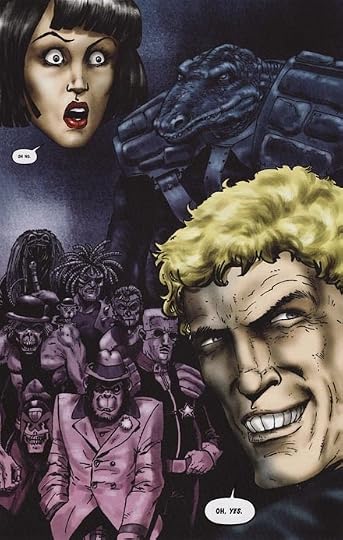
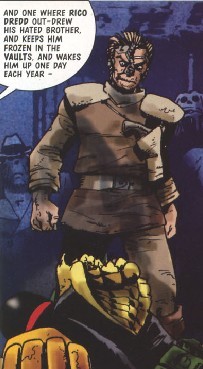
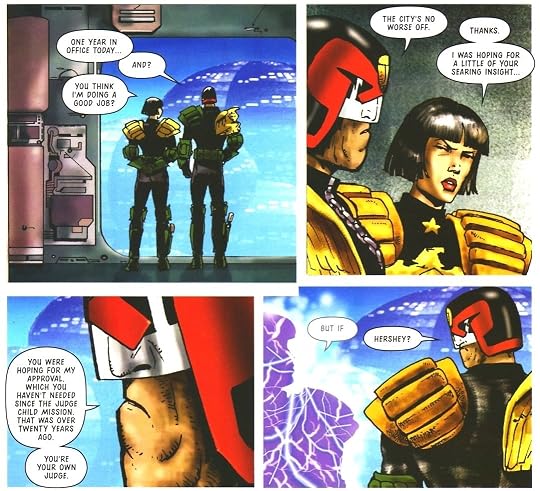
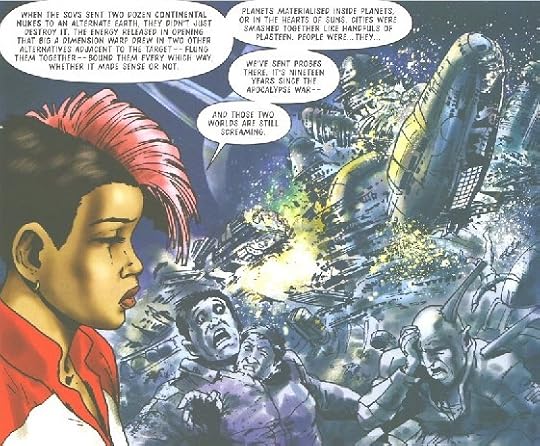
Ten years after the acclaimed run on Judge Dredd that first bought him to brink of comics superstardom, writer Garth Ennis Preacher returns to Mega-City One for the ultimate Dredd saga. In Helter Skelter, the very structure of reality is altered in Mega-City One. Dredd finds himself on the run, pursued by ghosts and demons from his own past. Walls between alternate dimensions are collapsing, unleashing other-Earth counterparts of Dredd's vilest villains. And in charge, the one man to comprehensively bring Mega-City One to its knees on a previous occasion, Chief Judge Cal. Dredd's only hope of saving the city lies in the reluctant figure of warp specialist Darien Kenzie. All he's got to do is keep her alive. And himself, of course...
Ennis began his comic-writing career in 1989 with the series Troubled Souls. Appearing in the short-lived but critically-acclaimed British anthology Crisis and illustrated by McCrea, it told the story of a young, apolitical Protestant man caught up by fate in the violence of the Irish 'Troubles'. It spawned a sequel, For a Few Troubles More, a broad Belfast-based comedy featuring two supporting characters from Troubled Souls, Dougie and Ivor, who would later get their own American comics series, Dicks, from Caliber in 1997, and several follow-ups from Avatar.
Another series for Crisis was True Faith, a religious satire inspired by his schooldays, this time drawn by Warren Pleece. Ennis shortly after began to write for Crisis' parent publication, 2000 AD. He quickly graduated on to the title's flagship character, Judge Dredd, taking over from original creator John Wagner for a period of several years.
Ennis' first work on an American comic came in 1991 when he took over DC Comics's horror title Hellblazer, which he wrote until 1994, and for which he currently holds the title for most issues written. Steve Dillon became the regular artist during the second half of Ennis's run.
Ennis' landmark work to date is the 66-issue epic Preacher, which he co-created with artist Steve Dillon. Running from 1995 to 2000, it was a tale of a preacher with supernatural powers, searching (literally) for God who has abandoned his creation.
While Preacher was running, Ennis began a series set in the DC universe called Hitman. Despite being lower profile than Preacher, Hitman ran for 60 issues (plus specials) from 1996 to 2001, veering wildly from violent action to humour to an examination of male friendship under fire.
Other comic projects Ennis wrote during this time period include Goddess, Bloody Mary, Unknown Soldier, and Pride & Joy, all for DC/Vertigo, as well as origin stories for The Darkness for Image Comics and Shadowman for Valiant Comics.
After the end of Hitman, Ennis was lured to Marvel Comics with the promise from Editor-in-Chief Joe Quesada that he could write The Punisher as long as he cared to. Instead of largely comical tone of these issues, he decided to make a much more serious series, re-launched under Marvel's MAX imprint.
In 2001 he briefly returned to UK comics to write the epic Helter Skelter for Judge Dredd.
Other comics Ennis has written include War Story (with various artists) for DC; The Pro for Image Comics; The Authority for Wildstorm; Just a Pilgrim for Black Bull Press, and 303, Chronicles of Wormwood (a six issue mini-series about the Antichrist), and a western comic book, Streets of Glory for Avatar Press.
In 2008 Ennis ended his five-year run on Punisher MAX to debut a new Marvel title, War Is Hell: The First Flight of the Phantom Eagle.
In June 2008, at Wizard World, Philadelphia, Ennis announced several new projects, including a metaseries of war comics called Battlefields from Dynamite made up of mini-series including Night Witches, Dear Billy and Tankies, another Chronicles of Wormwood mini-series and Crossed both at Avatar, a six-issue miniseries about Butcher (from The Boys) and a Punisher project reuniting him with artist Steve Dillon (subsequently specified to be a weekly mini-series entitled Punisher: War Zone, to be released concurrently with the film of the same name).
Garth Ennis' return to Dredd after his glorious Preacher series is a funny Doctor Who style tale with Judge Cal and other familiar villains from parallel dimensions plotting to kill old chin-face because they can't stand existing a world where he's still alive.
Ezquerra was not at all at his best when drawing this 12 parts tale and needed help from another artist, the ending is just an heresy for die-hard Dredd fans with the Judge totally acting out of character and showing un unexpected soft heart with Kenzie's past transgressions, but I just loved this tale and the splash page showing Slaine, Rogue Trooper and other 2000 AD characters gave me chills.
A not bad at all funny read with a few great moments, and a nice nostalgia trip through not just Dredd's past, but the past of the 2000 AD magazine itself. It inspired an upcoming tabletop game that I really have to look for.
Mediocre Dredd. Ezquerra’s great art is ruined by the colorist. And the story is an excuse to bring back old villains. Multiverse crap. And to be honest, I’m not the biggest fan of supernatural Dredd stories. I’m more into police-comedy Dredd that just happens to be in a future-tech world.
Bad story from Ennis. He never really nailed Judge Dredd. Good art by Esquerra, alhtough there were bit done Flint. And I hate when artist changes in the middle of the story.