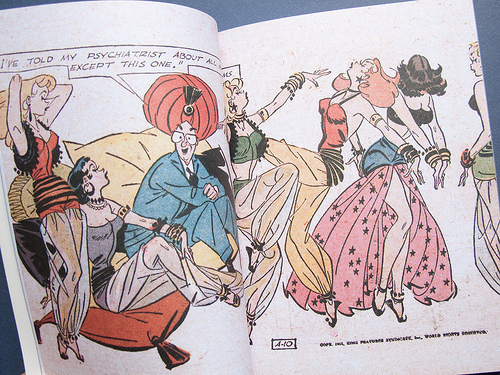
When the life of Don Flowers was cut short in 1968 by the ill effects of emphysema, he left behind a career in newspaper cartooning that spanned more than four decades as well as one of the most fluid lines to grace the comics page. His cartoons evoked the art of Russell Patterson and Hank Ketcham, and nowhere was this more evident than in his quintessential single-panel pin-up cartoon, the aptly named "Glamor Girls": Whether blondes or brunettes, showgirls or housewives, Flowers rendered his comely protagonists with equal aplomb. A close look at Flowers' body of work reveals that he was really an illustrator playing cartoonist. He was equally skilled with the brush and the pen, and was also highly regarded by his fellow artists for his expert spotting of blacks. Flowers boasted "about the finest line ever to be bequeathed to a cartoonist," wrote Coulton Waugh in his classic history, "The Comics," "It dances; it snaps gracefully back and forth; the touches related." While Flowers spent nearly a quarter of a decade on "Glamor Girls," it wasn't until the 1960s that he finally broke free of Russell Patterson's influence and established a more modern style that was uniquely his own. This volume collects the best of those cartoons, and showcases Flowers at the height of his skill. "Don Flowers' Glamor Girls" also features a foreword by cartoon legend Sergio Aragones and an introductory essay by editor Alex Chun.
Fantagraphics is unearthing some great vintage cheesecake cartoons from men's magazines. First they put out Bill Ward, then Dan DeCarlo, and now Don Flowers. I like Flowers a lot; his lines are thin and scratchy. As curavaceous as his cuties are there's a definite angularity to the artwork that gives his cartoons a jazzy futura Fifties groove to them. Thanks, Fantagraphics!
really nice art and period humor. flowers seems to have been influenced by, in addition to hank ketcham, marty links. three things i wish the editor had done - put them chronologically, reprinted more (i lot more!) of the "diana" strips, the few that are shown are great and not put the same topics side by side. the size of the book is also well chosen, glad fantagraphics chose not to do the old pocket book size/format. the intro by argones and afterword by flowers jr added to the book and were worth the read.
The art is fantastic. Flowers had a real eye for women's clothing. I loved when there were several comics in a row with similar content, particularly the set of a woman visiting a fortune teller. It's the same scenario with the same positioning of the characters, but each woman is wholly original. A lesser cartoonist would have had an identical fortune teller in each panel.
This is a nice collection of decent gag cartoons, themed (relatively chastely--Flowers draws attractive woman but generally avoids anything cheesy or sleazy), as the title suggests, around attractive women. The gags are mild but occasionally fairly funny. Most, however, elicit a smile at best. Flowers does have an elegant, fluid (if somewhat scratchy, especially in the later cartoons) line; it's an economical, effective style. It also depends fairly heavily on a stock set of designs, however; every woman's profile has the same contour, every ankle is drawn the same way, etc. Most odd, once you notice it, is that every woman in high heels seems to have truncated, toeless feet. The organization strategy of gathering together cartoons with similar gags works fairly well, and the occasional image shot from original art rather than from a finished comic is very nice. On the other hand, otherwise, the organizational principle is unclear. A very few examples of Flowers's early strip appear, in two different formats, one with them printed in tiny format, four to a page, another with them printed big, two strips across two pages. Neither is a particularly good design choice, but at least in the larger size they're readable. But why so few of these, or why these few in particular, is not clear. This is a book probably more for the real fan of gag cartoons with a mildly sexual element to them rather than for the more general reader.
I must say that the gags here aren't really my type. Probably because they are a bit dated and almost impossible to relate to. That's not to say that they are bad, it's just that they probably would appeal readers who used to read these comics. After a while, the jokes start to get monotonous.
Gags aside, the drawings of these glamor girls are fantastic. I love fluid lines that create the curvaceous, highly stylised, yet elegant ladies. If you study the cartoons closely, you'll realised that these girls are proud too. Most of the time, they are looking up — jawline horizontal — and standing taut. Sometimes, no outlines are drawn with form only suggested through the clever use of black.