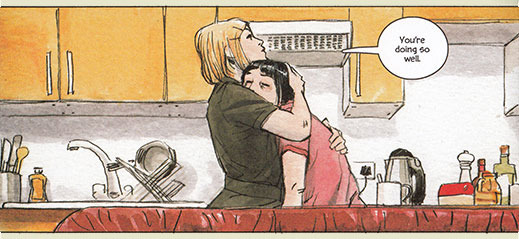
Nao Brown è un’hafu per metà inglese e per metà giapponese che lavora in un negozio di art toys di Londra. La sua vita, tormentata da pensieri ossessivo-compulsivi, scorre da tempo con la convinzione che il mondo sia diviso in bianco e nero. Ma la ricerca dell’anima gemella le farà riconsiderare se stessa e le permetterà di esplorare la variegata gamma di colori dietro cui si nasconde l’animo umano. Il capolavoro di Glyn Dillon, da molti indicato come il libro dell'anno, arriva dall'Inghilterra in un'edizione sontuosa, cartonata con debossing, sovraccoperta con mappa all'interno e bordi del libro rossi. Un libro che vi cambierà.
Amazing book. Pencil, watercolor, wonderful art to match the great storytelling, certainly one of the best graphic novels I have yet read. The story of Nao, a girl working in toys and illustration and looking for love and peace, who has OCD with violent obsessions. Ray, her Buddhist teacher, Steve, her co-worker and long time friend, her roommate, her friend Gregory, all these folks figure in to help her get from black and white to. . . Brown, from Past to Present.
Nao is hafu, half English, half Japanese. Much richness, depth, compassion, and to balance some of the Buddhist reflections, some surprising moves in the plot. Others review this in greater depth and better, so I would check them out, chiefly Seth Hahne, but I agree with him that this book is part of the growing body of graphic literature that demonstrates the greatness, the possibilities of the craft.
To be honest, I did not really enjoy this book. I found the characters irritating, was unsympathetic to their personal problems, and did not care for the way the account was wrapped up.
However, the drawing is very good, if you like the realistic sort of graphic illustration, and the story is well done, so I'm saying that it is objectively good at what it sets out to do. It just didn't work with my personality.
Also, an interesting soundtrack:
The Shangri-Las, "Hate to Say I Told you So" Magazine, "My Tulpa" "Oh My Darling Clementine" Yello, "Oh Yeah" Bowie, "Oh you pretty things" The Breeders, "Oh!" PJ Harvey, "My Lover" Moz, "I'll never learn" Roxy Music, "Oh Yeah" Yoko Ono, "Let me Count the Ways" Yoko Ono, "I'm your angel" Frankie Valli, "Oh What a Night" Chuck Berry, "Baby Doll" Faces, "Ooohlala" Neil Diamond, "Lady" Neil Sedaka, "Carol" Maxine Brown "Oh no, not my baby" ZZ Hilo, "Oh Darling" Kate Bush, "To be in love" The Fall, "Oh Brother" Buzzcocks, "Shit" Xray Spex, "Bondage, up Yours" Pixies "Oh My Golly!" Harry Belafonte, "Day-O" Quincy Jones "Oh Happy Day" John Lennon, "Oh My Love" Velvet Underground, "Sweet Nuthin'" Beatles, "Oh Darling" Cud - "Only A Prawn In Whitby"
Nao Brown is a half-English/half-Japanese young woman with Obsessive Compulsive Disorder. After a visit to her dad in Japan, she returns to London to work at her friend’s kitschy Japanese toy shop where she meets and falls for an alcoholic washing machine repairman. Also Buddhism and Ghibli-esque stuff.
Glyn Dillon, little brother of the late, great Steve Dillon who co-created and drew Preacher, among many other famous comics, turns out to also be a talented comics artist himself… not so great a writer though. As pretty as The Nao of Brown looks, the story itself was no great shakes and, if there was a deeper point here, it completely went over my head.
The romance between Nao and Gregory is meh. I suppose you get an idea of what having OCD is like. The Ghibli-esque interstitials probably have some symbolic meaning that feeds into the main story in some way but it was so boring that it was totally lost on me. I guess it’s good that Nao uses Buddhism as a mental tool to help with her OCD rather than prescription drugs?
It’s a unique story, I’ll give it that, I just don’t know what Dillon was shooting for here. An unremarkable romance story with a measure of spirituality, mental health stuff and a smattering of fantasy sprinkled throughout… to say what? Who knows. Not me. And even if there is no meaning, what there was wasn’t interesting.
It is really gorgeous art though - the Dillon family seems to produce remarkably talented artists. I liked the art generally but I especially loved the Ghibli-esque parts where the art is really something. Great use of colour, very arresting imagery - shame about the words. Which is how I’d sum up my experience with The Nao of Brown too, which turned out to be a forgettable and unimpressive read.
I've always had a soft spot for comics, but before I started Good Ok Bad, I was more interested in literary fiction. The Savage Detectives, Wind-Up Bird Chronicle, Never Let Me Go, Franny and Zooey, Cat's Cradle, Foucault's Pendulum, Lord of the Flies, The Great Gatsby, A Tree Grows in Brooklyn. I don't mention these to drop names but to give you a place to hang your hat, a way of knowing what I'm talking about. Maybe you've read all of these. Maybe only one or two. But in either case, you should understand that I'm talking about those literary works of heft (and not necessarily of physical heft) that demand careful reading and even more careful interpretation.
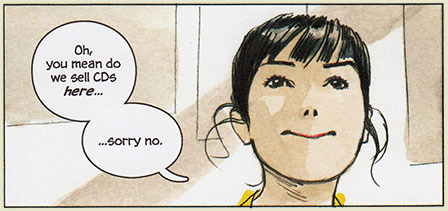
[This doesn't have to do with literature. I just found her expression cute and endearing.]
There was just something in the challenge presented by those books that called out to me in a way that enriched my life. And since beginning Good Ok Bad, I've had to shelve my interest in literary fiction almost entirely.1 I spend all my spare time (after work and family and side work) reading comics for review and then reviewing a handful of those. I read a lot every week and preparing a review takes up at least an evening. And so I've missed my first love: meaty books. Sadly, comics haven't ever risen to the task of filling that void. At least not generally.
Even the best comics are works of genre fiction, fantasies or sci-fi or sci-fi fantasies. Maybe an adventure or a graphic crime novella. There's nothing particularly wrong with that. I adore Nausicaä of the Valley of Wind and think it's one of the best comics I've ever read. But it's no 2666. Not that it has to be, either. There's plenty of room for fiction that is fun and fiction that is hard. It's just, comics has been largely missing the hard stuff for a long time now.
The last few years though have been particularly encouraging to me. There have been more serious works produced in English-language comics2 in the last half-decade than in possibly the entire rest of English-language comics' history.3
I mean, look. We've gotten Moon and Ba's Daytripper. Chris Ware's Building Stories (and before that, Jimmy Corrigan). What else? Habibi, Asterios Polyp, Big Questions, Sailor Twain, Mother Come Home, The Arrival, and the work of Nate Powell (Swallow Me Whole and Any Empire). Each of these are huge steps toward comics producing something of literary magnificence. We can see them straining for and even sometimes touching a goal that I hold (even if no one else does) for the medium: that comics would at least in some of its product transcend4 its medium and give the world Literature. With a capital L.
With these works, I could see comics on the cusp. I could see creators growing at an almost unnatural pace toward something amazing. When Duncan the Wonder Dog came out I wondered if we hadn't arrived. The work was complex, filled with allusions, and spoke to something deep within the human experience. I was stunned to hold something in my hands that was exactly what I had been missing from the medium. But a single work is not an arrival. There had to be more. There had to be more creators doing things that were not just good and not just great, but incredible. Two years after Adam Hines' Duncan, Chris Ware's Building Stories was collected and proved my faith in the medium. It really is an astounding work, something that proves the essentiality of comics for certain stories and gives readers a work of complexity and importance. But Chris Ware is a known entity (and not exactly representative of comics as a whole). This is exactly what everyone expected of him. I felt I needed more. Hines was unknown (and sadly remains so, despite crafting such a sublime work) and Ware's star will not cease to shine brightly among the outside-comics literati. What would be the third work and how long would it take to arrive?
As it turned out (at least according to a quick look at Amazon), The Nao of Brown hit American shores the day before Building Stories. It's sad to think that such a beautiful, careful work could be so entirely subsumed in the wave of press for another work (even one that is great and careful itself), but fortunately some people were aware of The Nao of Brown. If it weren't for reading other people who gave the book a shot and thought highly of it, I wouldn't have known it existed in order to give it one myself. And now, like I did with Duncan the Wonder Dog, I'm going to be telling everyone I know that if they want to read a worthy graphic novel, Glyn Dillon's book is what they want to be reading.5
[Introducing: Nao Brown, killer. Sort of.]
The Nao of Brown is a wonderful collection of visual and literary themes, marked by a compassionate visual sense and a deeply dialogical atmosphere. It's one of those books in which word and image conspire together in a harmony unusual for comics.6
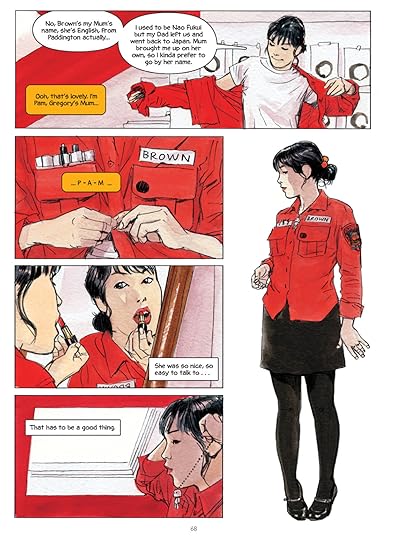
Dillon is not only an impressive illustrator and designer. His art always on every page aids his story, lending voice and colour to his characters' dialogue—and to Nao's narration. In a work in which the majority is filled with mundane conversation, Dillon invests his characters with expression, carriage, and posture such that their story would be incomplete if only left with their words. These are real people and they are rendered realistically save for the fact that Dillon captures them in the best possible moment—all in order of course that the reality their story should be validated by their presence.
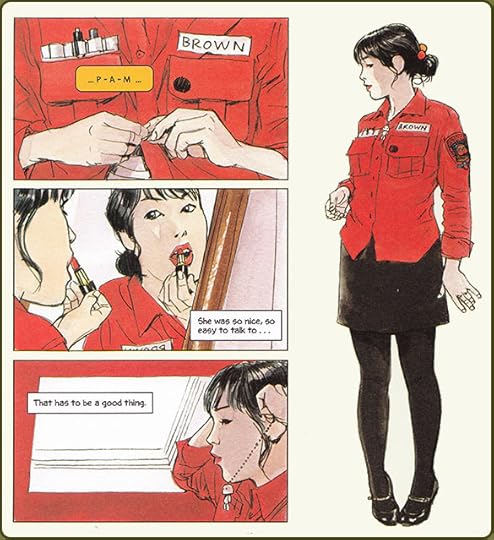
The art is gorgeous, pencil and watercolour (though these days it can be hard to tell just how much is post-processed in Photoshop—as if it mattered in the end). Dillon couches his work in a rich tapestry of visual metaphor. Rich enough at least that there's plenty of fodder for those willing to put the work in to interpret him. Visual motifs abound. From the recurring use of the circle to foreign and foreign-esque cartoon characters, everything evokes. The pages bleed with purpose. Even Dillon's use of colour seems to bear on his meaning. Nao wears red. All the time. Every time. Until the times she doesn't. The Nao of Brown is such a delight to the eyes that I find myself wishing every book looked like this—despite loving much the more simple work of Chris Ware and Jason. Dillon's art breathes, it has life. And life is exactly what his story demands.
[Check out this awesome page in which the bartender and Nao are juxtaposed, perhaps insinuating against Nao's apparent relationship to Steve.]
The Nao of The Nao of Brown is half-Asian, half-Caucasian and suffers from a violent interior life. She has a few friends but seems distant and distancing. She is afraid of herself and Dillon's exploration of her thought life gives merit to her fears. Generally, it would be about at this point in the book's description that I would slowly begin shutting down, losing interest. I realize that comics are a uniquely powerful medium for communicating the experience of the fracture of the inner self. Epileptic did it well. Swallow Me Whole did it well. It's a Bird... did it well. Even Fun Home and Are You My Mother? did it well in their own ways. The problem is that books about broken people tend to be mopey affairs. Really, Epileptic should carry a government label on its spine warning against combining with the consumption of alcohol—for such a terrible meeting would surely end in toasters and bathtubs and things too terrible to contemplate.
Happily, The Nao of Brown forges its own path. It's not The Pleasure of My Company, but it's probably not far off.7 For all of her fear and violence and actual, visceral anguish, Nao is a charming and beautiful young woman. I would want her as a friend. You probably might too. And from the outside, it's easy to see why few people realize that she's troubled any more than the next person on this sad, strange globe. In fact, she comes off at a glance better than a great number of us regular citizens. All of this means that Nao's story, while dark and terrible and innately concerned with the depravity of the human spirit, is sold with a buoyant gait and trudges along with the delightful pluck of a three-year-old in slightly too large rain boots, kicking leaves and stomping puddles. The book is a delicate admixture of sobriety and humour, and it's imbibing this concoction that carries the reader through, granting the pleasure and honour of coming to the place at which interpretation may begin.
As with all books pregnant with complexity, The Nao of Brown requires dutiful attention and a steady hand—even when trying to piece together the overt story elements. (And that's before we even dream of answering the question of Dillon's purpose and goal.) After reading, desperate for someone to converse with on the book (since my wife wouldn't finish reading it for another three days), I glanced around at reviews and found critics incorrectly reading all sorts of things into the book. One suggests that Nao was the author of the Pictor stories. Another suggests that Nao is oblivious of Steve's affection for her while Nao herself pretty much plainly states otherwise. And then, I haven't found a single critic who correctly identifies who Dillon most likely pairs with Nao by story's close.8 And if these details escape us, then legitimate understanding of the work's intent is almost necessarily elusive. And this is not to criticize those inattentive critics but simply to remark upon The Nao of Brown's glorious complexity.9 Many readers, even, are split on the book's conclusion, debating whether Dillon's finale was a cop-out or not. I would suggest that whatever one's gut reaction to the climax and denouement, it should probably not be trusted. Dillon's weaving of his story is subtle and multifarious, not the kind of thing to be judged quickly.
[Role reversal.]
I am so very deeply grateful for this book. I am grateful to Self Made Hero for going to the trouble to make this artifact available a world away in nearly-sunny California. I am grateful to Glyn Dillon for putting so evident an effort into making his story come to life with such colour and in such a beautiful production. I am grateful for The Nao of Brown for assuring me that literary fiction holds a life beyond the confines of prose and can even sometimes make visitation to the shores of the comics medium. And I am thankful to Nao Brown for springing into pregnant life from the pages of her book—because I think the questions that fuel Nao's dreams and fears are the questions that haunt and help whole populations of this earth. And we need a cipher, someone to ask the question that we might scrabble for the answers. ____________________
Footnotes:
1) I did squeeze in 1Q84 when it came out, but it was such a juggling match that I haven't attempted anything of the sort since.
2) And let's be clear here that I'm talking about American, Canadian, and British comics (and maybe Australian?). My lack of familiarity with non-English-language productions makes it impossible for me to judge there. Though I have been encouraged to know that there's definitely some, I guess, off-the-beaten path serious literature like Jiro Taniguchi's The Walking Man.
3) And let's remember here that I'm talking about fiction. Serious-minded, even outright dour autobiography has been a staple in English-language comics since at least, what, the Seventies?
4) And I don't mean transcend in the sense that they should stop being comics. More just in the sense that comics' evolution was retarded for so long that it still struggles against infantalizing its potential. Comics is, in a sense, a ghetto—and wild critical success in comics is often really just an example of big fish/small pond. I want to see comics able to present great cultural artifacts that can stand up with the Beethoven's Fifth Piano Concertos, the Citizen Kanes, the Crime and Punishments. That's what I mean by transcendence.
5) My recommendation of Duncan actually went over largely as a lead balloon. Very few of those who gave it a shot actually appreciated it. Some were confused by its complexity, some were too staunchly opposed to message, some thought it was fine but couldn't empathize with my adulation. Here's hoping things go better with The Nao of Brown.
6) Generally a great comics work is far stronger in one of the two elements (visual and textual) and diminished in the other. Works like Gaiman's Sandman display verve and grace in their writing while the art suffers and is many times at odds with the written words. On the other hand we have something like Building Stories, whose design sense is beatific while its dialogue (while not bad) stutters by the comparison.
7) At least in terms of tone. It's nowhere in the neighbourhood of plot or purpose.
8) The author drops a tremendous tip in the first panel of page 202 if the rest of the story doesn't help spell it out.
9) I have struggled and wrestled with what Dillon has accomplished, and though I now think I get a lot of it, there are still questions and I cannot be certain that in the final evaluation I have gotten it right. This is a book that demands discussion. Maybe even heated discussion. _____________________
Znate kad za nešto kažu kako je topla i nežna ljudska priča a vama sve pod zubima škripi od lažnoće? E, Nao Braun je PRAVA topla i nežna ljudska priča na kakvu generalno ne očekujete da naiđete jer je onako ćoškasta i sa neočekivanim zavijucima u zapletu i likovima. Moram da priznam kako sam na osnovu prvih par tabli zaključila da je to nešto mnogo turobno (greška!) i odložila čitanje na duže: Nao Braun je, naime, devojka koja pati od prinudnih misli. To je ono kad Stavrogin oseća neodoljiv poriv da nekog ujede za uvo pa ga i ujede (i zato ga svi volimo još od adolescencije ali zato mu takođe ne bismo prilazili na manje od deset metara). Za razliku od Stavrogina, Nao se protiv tih misli bori i to je čini mnogo boljom ali ne i manje nesrećnom osobom od njega. Posle tog uvoda sledi priča koja na mahove deluje kao neki francuski film o slatkoj hipsterki osim što... naprotiv. Dilon vrlo lepo pokazuje kako neko ko spolja deluje slatko i simpatično uvrnuto iznutra kuva od očajanja i usamljenosti. I kad se Nao upozna sa nekim ko joj se svidi, to se prikazuje kao "slatka" i "šašava" romansa ali na takav način da je čitaocu od početka prilično jasno koliko to dvoje ljudi nisu jedno za drugo i koliko su njihovi (ozbiljni) problemi nekompatibilni. (Vidim po prikazima da to nije jasno svima tako da... okej... poštujmo umetničko delo koje dozvoljava divergentna čitanja.) I preokret pred kraj može delovati nemotivisano i spada u meni najomraženije varijante preokreta ali eto - ovde je uspešno izveden. Sam kraj nemilosrdno rabi jedno dosta često viđeno rešenje ali i dalje funkcioniše i nije preterano rozla. E da, Nao Braun je između ostalog nešto što lično mnogo volim, ono što Nemci zovu Schachtelgeschichte tj. priča-kutija - kad u priči imate drugu priču ili, ovde, strip koji je sasvim različit od okvirnog i priča jednu alegorično-bajkovitu priču koja spaja... mmm... konkretan motiv iz bajke i kafkijansku mangu? recimo? Šta još reći. Crtački stil je meni lično vrlo legao, uglavnom je realističan i sa izuzetno brižljivo raspoređenim detaljima i kompozicijom tabli koji mnogo toga nagoveštavaju/otkrivaju/simbolišu, ali uz povremene izlete u sasvim drugačije stilove u rasponu od mange to tibetanske tanke (za koju sam sad eto naučila kako se zove). Nikad više nećete gledati veš-mašinu na isti način!
-Not great, it was nowhere near as good as I thought it would be — the plot and main character (Nao) just weren't interesting.
-I loved the illustrations, they were the best thing about the novel.
-The story was kind of blah… It revolved around a half Japanese/half English girl who had OCD and other issues. Yea, I didn't really connect with Nao's character, I found her issues and love life largely boring.
-I enjoyed the story within the story way more than the main story. It was quite a fascinating tale.
-Everything was wrapped up way too neatly at the end, it was all rather cheesy.
All in all, not impressed. If it wasn't for the illustrations I wouldn't have liked it all.
I mean, LOOK at that cover. Then, rotate the book - the edges of the pages are colored red. You probably don't even notice that the jacket is double sided (especially if you're looking at a library book where the jacket is taped to the cover). Then, you flip through those red-tipped pages and see these stunning, full-color, totally frameable watercolors. There are sections which are colored fairly realistically, sections which are washed in blue or red, and sections which seem to be set in some fantasy world reminiscent of the work of Miyazaki, drawn in drastically crisper lines.
And then you read it.
It's the story of a girl, an illness, a novelty toy shop, a washing machine repair man, violence, out-of-the-box romance, obsession, race, poetry, and the struggles of daily life. It is shocking, stunning, heart-breaking, sweet, awkward and gross in turns.
I think I read it in one sitting. It's one of those where I'm teetering on the edge of buying the thing. I'm incredibly impressed at the achievement and scope. Although I didn't connect with it. I didn't feel a sense of ownership, of it being my story. But maybe that shouldn't matter. I thoroughly appreciate this window into a way of life that is so different from my own. It's out of the box. It's unexpected storytelling. Maybe that's why it hasn't won more acclaim. Innovation has a hard time finding an audience sometimes. But THIS. Deserves one.
Posudio sam ovaj strip čim sam na poleđini pročitao da glavni lik pati od opsesivno kompulzivnog poremećaja, ali ne od pretjerane urednosti, kako to većina nas zamišlja, nego morbidnih opsesija nasiljem.
Dakle, Nao Brown ima opsesivno kompulzivni poremećaj. To joj je karakterna osobina. To i da je malo čudna. Njezina cimerica ne zna da miševi prenose razne zaraze i da su ozbiljan problem u stanu, iako je medicinska sestra. Vlasnik trgovine "dizajnerskih" igračaka (hipsterke kopije manga/anima stila), za kojeg Nao povremeno radi, pati za njom još od zajedničkih fakultetskih dana, ali to vidimo samo iz par gesti i pogleda.
A priča u biti počinje kada Nao vidi debelog bradatog vodoinstalatera za kojeg se odmah zainteresira jer izgleda kao Ništa (lik iz fiktivne kvazi-mange koju ona obožava) pa pokida perilicu rublja svoje cimerice da bi ga upoznala. Susret je čudan i neugodan, ali oni ipak krenu izlaziti. Međutim on je uvijek pijan prije nego što ona dođe na sastanak, ali kao nema veze to je, jebiga, ljubav. I oni se sve bolje upoznaju iako se sve svodi na par pomaknutih situacija i dijaloga.
I sad, da ne bi sve završilo kao obična ljubavna priča: on doživi moždani udar, a nju udari automobil!
I to nije sve. Nakon toga vodoinstalater napiše autobiografsku knjigu o tome kako ga je na satima budizma seksualno zlostavljao jedan od učitelja, a ona pobjedi svoj opsesivno kompulzivni poremećaj, čak i rodi dijete što joj dotad nije bilo zamislivo. Jedino nisam siguran čije je dijete. Možda od onog prijatelja s faksa? On je prikazan na par zadnjih sličica, pa pretpostavljam...
Da, nasumično je ubačena i nekakva alegorična priča u kvazi-manga stilu o dječaku drvetu koji čuva ovce, kasnije oženi kći kapetana, a na kraju mu spale lice i on postane lijep.. ili tako nešto.
Nedavno sam gledao jedan odličan dokumentarac OCD: A Monster in my Mind gdje je kroz par primjera prikazano kako je teško živjeti s tim poremećajem, cijeli se život svodi na ponavljanje rutina. No, autor ovog stripa je OCD iskoristio samo da pokaže kako je njegova glavna junakinja čudna - čisti hipsterizam. Likovi su emotivno hladni i nemaju karakternih osobina - svatko je samo "čudan" na svoj način. Sama priča je konfuzna, a u trenutku kada bi konačno moglo doći do zanimljive drame ili možda čak i neobične ljubavne priče autor oba glavna lika baca u komu - i to doslovno! A nakon toga priča skače nekoliko godina unaprijed gdje je sve kao razriješeno. Hm, iz toga bi se svašta moglo isčitati i o samom autoru...
Uglavnom jedino pozitivno je crtež. Brze, povremeno i nesigurne linije odlično se uklapaju u temu, a sviđa mi se i paleta boja kojom je strip obojan. Prolazna ocjena je isključivo zbog crteža.
Confieso que me costó entrar en un cómic cuya historia y estilo gráfico no me llamaban de inicio, pero a las pocas páginas me atrapó y pude terminarlo casi de una sentada. La protagonista, que tiene TOC, lucha por llevar una vida normal, relacionarse con otras personas y encontrar el amor. Dillon lo retrata a la perfección y logra que empatizar con ella sea sencillo, y esto es lo que quizá me hizo meterme tan rápidamente. Lástima el final; le habría dado cuatro estrellas si no cerrara de una manera tan complaciente, porque pierde la oportunidad de hacer algo importante: Nao no se medica, ni siquiera queda claro si tiene diagnosticado TOC, creo que hasta se banaliza su trastorno con una especie de semi-curación milagrosa. Los otros personajes tienen también su cruz y ello les hace interesantes, si bien en conjunto la lectura resulta por ello bastante deprimente. La edición es muy chula, el nivel de detalle y el color son increíbles. ¡Gran regalo!
Mislim da poslednjih dana čitam samo knjige koje Tijana toplo preporučuje, hvala Tijana ♥
Nao Braun (koja je polu-Japanka, polu-Engleskinja) pati od opsesivno-kompulzivnog poremećaja, sa većim akcentom na opsesijama da će nauditi nekome (zabosti olovku u karotidu, pregaziti biciklom dete na ulici, tako te neke svakodnevne, dražesne stvari). Ona očajnički želi da se zaljubi, i kada vidi čoveka svog (izmučenog) života koji je jedan gojazni vodoinstalater, neće prezati od toga da uništi cimerkinu veš mašinu samo da bi ga ponovo srela. Greg deli njene vrednosti i interese, plus neviđeno liči na jednog lika iz neke fiktivne mange, i Nao je ubeđena da je baš on delić koja nedostaje u njenom fragilnom svetu, nešto što bi popunilo rupu u njenoj staklenoj kugli. I počinje opsesija njim (iako Greg ima ozbiljan problem sa alkoholom - kao i njen otac uostalom - oh Sigmunde, Sigmunde).
Autor je inače završio u bolnici zbog ozbiljne upale šake i oštećenja nerava jer je svaki kadar bojio lično (i rezultat je SAVRŠEN). Nije Nao jedina sa opsesijama, ha. Cela tema mentalne bolesti je izuzetno odrađena (nikad dosta simbolike - sam atak na veš mašinu koja prežvakava isti veš i vrti ga ukrug je u stvari atak na lične ruminacije, koje kao i centrifugiran veš, postaju sve brže, sve glasnije i prete da izlete iz glave i realizuju se, osim ako se ne upotrebi gorovo nadljudska snaga da se nekako zadrže i sakriju od ostalih).
Lice Nao u kadrovima kad je sama pokazuje taj svakodnevni grč u borbi sa bolešću; i ono što spolja deluje kao luckast stil života je u stvari sam prikaz truda da se održi nekako na površini. Da bude normalna. Da svet konačno ima smisla za nju.
Vidim da su zamerke na roman potpuni preokret događaja, pa čak i hepiend (?!) Ali lečenje određenih psihičkih problema zaista jeste hemingvejevski “gradually and then suddenly”. Može se raditi na tome godinama, progres će biti gotovo nevidljiv, i onda se osoba jednog dana probudi i neočekivano - OKEJ JE. Našla je svoje mesto, okružena je ljudima koji je podržavaju, odlučuje da ide napred i pored straha od recidiva. I živi, konačno živi van vrtloga prinudnih misli.
Tutto molto bello, dal disegno (che, pur non riscontrando in pieno il mio gusto, riconosco essere fatto con cura ed eleganza) alla tematica importante trattata (la silenziosa, ma costante lotta della protagonista contro il suo disturbo). La trama è delicata ed il relativo soggetto abbastanza originale, anche se alcuni risvolti sono decisamente prevedibili, i dialoghi sono piacevolmente realistici, la struttura del romanzo è agile (carina anche la storia nella storia, disegnata con un tratto diverso), la palette selezionata in maniera ineccepibile, la resa dei turbamenti mentali efficacemente trasposta.
Tutto molto bello, ma forse manca un po' di anima: non all'autore, che si vede che ha messo tantissima dedizione nella realizzazione della graphic novel, e nemmeno alla protagonista, che di anima ne ha da vendere, ma alla storia nel suo complesso.
Caratteristica che più ho apprezzato: la qualità del non detto. L'autore sceglie di mostrare la realtà della protagonista senza fornire spiegazioni o motivare i suoi comportamenti, il lettore è catapultato nella vita di Nao senza preamboli; si familiarizza con il suo disagio a poco a poco, e trovo sia la maniera migliore per affrontare la tematica della fragilità psicologica, riuscendo ad essere contemporaneamente rispettoso nella narrazione e a dare alla condizione mentale un impatto molto più forte, un paio di scene sono proprio schiaffi. Non è necessario conoscere la teoria clinica di una fragilità o l'etichetta di una divergenza per empatizzare con una persona e avvicinarsi alle sue sensazioni.
Aspetto peggiore: la conclusione. Frettolosa, incompiuta, sembra quasi liquidare tutta la complessità creata fino a quel momento. Ho avuto la percezione che Dillon si sia proprio perso nel finale, che mi è risultato, in parte, forzato, ed è un po' un peccato.
Lo primero que tengo que decir es que el dibujo, y sobre todo el color de las viñetas me ha encantado. Destaca sobre todo el color rojo, el cual solemos asociar con la ira, con la sangre... La verdad es que le viene bien (y no, no es un cómic gore).
La protagonista, Nao, me ha dejado sentimientos encontrados. Había momentos en los que me gustaría tenerla como amiga, había otros en los que no podía aguantarla, y otros en los que me daba o pena o miedo. Y todo esto es porque tiene TOC. Siempre me ha producido curiosidad este tipo de trastorno o enfermedad, y creo que en esta novela gráfica el autor lo expone muy bien.
También quiero destacar que la novela es muy visual, sin escatimar en detalles. Tales como apuñalar al novio con un bolígrafo, o incluso a una mujer embarazada (todo ello solo en la imaginación de Nao, pero aún así se muestran).
Una historia cruda pero real, una historia angustiosa pero con momentos más relajados, sobre todo cuando Nao esta con su amigo Steve.
---
Para mí ha sido una historia diferente a lo que acostumbro a leer en cómic, o en este caso novela gráfica.
Dadle una oportunidad, seguro que no os arrepentís.
Mamma mi vuole bene, mamma mi vuole bene, mamma mi vuole bene
Nao, ragazza molto remissiva, è affetta da un “disordine ossessivo–compulsivo”. In certi momenti si immagina, colta da rabbia improvvisa, di picchiare o uccidere qualcuno che le sta vicino, di travolgere bambini in bicicletta o di rompere una sedia in testa a qualcuno. In queste vere e proprie crisi si immagina addirittura di dare dei punteggi all'intensità dello squilibrio (8 su 10, 6 su 10...), cercando di calmarsi con frasi ripetute ossessivamente (mamma mi vuole bene, sono buona, mamma sa che sono buona). Nonostante questo disturbo, che a volte le risulta insopportabile, cerca di vivere serenamente anche se, oppressa dal lavoro e dalle relazioni sentimentali, fatica molto a trovare un equilibrio.
L'equilibrio sembra arrivarle improvvisamente con l'arrivo di uno stranissimo riparatore di lavatrici, Gregory, un gigante buono che quando è ubriaco cita Shakespeare e i filosofi antichi. E’ lui ad aiutare Nao a capire che nella vita e in ognuno di noi niente è in assoluto bianco o nero, ma spesso e volentieri il colore che più ci assomiglia è il marrone. Curioso il collegamento col titolo: Nao in inglese si legge come Now, ora. E Brown è marrone...
"Siamo bravi a insegnare il linguaggio, il calcolo, i giudizi e le paure, tutti concetti di cui abbiamo bisogno, non per sopravvivere ma per comunicare, raccontare e ascoltare storie. Le persone parlano spesso di uccidere il proprio Io, senza capire che la cosa più importante è comprenderlo per quello che è davvero, dal momento che non riusciremo mai a farne a meno. L'Io è il prezzo da pagare per la poesia."
Lo squilibrio creato dalla malattia è compensato dall’artificio narrativo del “fumetto nel fumetto”, di cui Nao è appassionata. I richiami, i collegamenti, le citazioni, la storia nella storia, la cura del dettaglio potrebbero davvero creare un libro meraviglioso. Forse il finale troppo affrettato, o la complessità eccessiva porta a fare, terminato il libro, la terribile domanda: e allora?
Un capitolo a parte invece è la parte grafica. Sembra che le tavole con la vita di Nao siano state realizzate a matita per poi essere importate sul computer, ritoccate con Photoshop, quindi stampate su carta per acquerello e così colorate. Le tavole del “fumetto nel fumetto” invece sono colorate digitalmente, per differenziare le due parti.
Il risultato è graficamente strepitoso. I disegni sono reali, bellissimi e con colori meravigliosi. Uno dei fumetti esteticamente più belli letti. Una bellezza che va a coprire anche parzialmente le carenze narrative. Tre stelle molto molto abbondanti.
Alors... Je n'ai rien compris. (Et je précise que je peux parfois aimer ne pas comprendre, mais là je suis restée complètement extérieure.)
J'avais un certain nombre d'attentes étant donné le sujet du livre. Je pensais qu'on allait entrer dans la tête d'un personnage atteint d'une maladie mentale, comme le suggère le synopsis. Eh bien non. Ses "crises" sont très artificielles, et répétitives, et plaquées dans le "récit" qui se résume à enchaîner des scènes de discute dans un magasin de jouets japonais et d'autres dans un bar. Il y a un vendeur de machines à laver et un temple bouddhiste. En parallèle, une fable raconte comment un bonhomme à tête d'arbre doit trouver une épouse pour réintégrer sa famille (et son visage humain). Bref, un salmigondis ennuyeux où les personnages sont inexistants et l'histoire au mieux confuse, au pire sans intérêt.
Nao Brown is a Hafu : half Japanese, half English. She’s in her 20s. She shares a flat with a nurse. She lives and works (in an adult Japanese toy shop – anime figurines etc) in North London. She’s looking for love. She regularly attends a Buddhist centre where she meditates.
She has obsessive-compulsive disorder, and she is frequently consumed by intrusive, violent thoughts. She doesn’t trust herself around anyone weaker than her, in case she attacks them. In one (admittedly disturbing) scene, she imagines herself attacking a pregnant women, stabbing and killing the unborn child.
You may be grimacing at this point. I was.
Nao’s boss at the toy shop is Steve, an old college friend, who has a crush on Nao but never does anything about it. Nao, in turn, becomes obsessed with Gregory – a stout, bearded, washing machine repairman – for (apparently) no reason other than that he reminds her of a favourite anime character.
I must declare at this juncture that I’ve read very few graphic novels in my time, so I can’t really compare this with too many other examples of the genre.
It is beautifully illustrated. Nao is drawn very appealingly. Regarding the ‘graphic’ side of things, I had no complaints.
As far as the ‘novel’ aspect… oh dear. This was a real mess. The story was all over the show. The (frankly weird) (apparently wholly unrelated) parallel story about a half human/half tree boy (who, at one point, asks someone to burn his head off!) just made me shake my head in confusion. On her third date with Gregory, Nao has a complete meltdown. In the real world, any sane man would run a mile. Gregory, however, not only sticks around but has a stroke (!).
At this point, the author abandons the graphic novel format for a few pages, in favour of standard prose, in the form of a book apparently written by Gregory after his stroke. Counterintuitively, Gregory finds the experience life-affirming and life-changing.
In the last couple of pages, Nao seemingly overcomes all her mental health issues by (in a single bound) deciding to think about things differently – if only the answer to most forms of mental illness was so simple. In a page or two, four years pass, and Nao tells us about her toddler son.
My predominant thought while reading the last page was: “I hope Social Services are monitoring this situation.”
As noted, the book LOOKS beautiful – not just the images, but the physical book. I was very impressed by the author’s drawing skills. The plot, though, for me, was just too illogical and bizarre. Don’t get me wrong, I have no problem with weird, or dark, or disturbing, but there was just something too unbelievable about the plot for me.
Very very cool drawings and paintings. [If only it had all been done like the story within the story, though!] Main story, rather weak and the ending, rushed; the coincidence of the two life-changing accidents, forced. Buddhist stuff went right over my head, and so did the references to the Japanese toys. The love plot seemed completely improbable. But again, very cool artwork, much much cooler than the plot itself.
Wow. Ich bleibe beeindruckt zurück nach der Lektüre dieser Graphic Novel. Dieser Zeichenstil, die Farben, das Talent, das dahintersteht. Wahnsinn! Was für eine Kunst. Die Ideen sind teilweise echt skurril und ergeben doch so viel Sinn. Ich habe so viele Denkanstöße bekommen und habe mit der Potagonistin so sehr mitgerätselt über ihren eigenen Verstand. Ich bin ihr richtiggehend dankbar dafür, dass sie mir einen Einblick in ihre Welt gewährt hat. Eine tolle Persönlichkeit, genauso wie die Figur, die später Naos Leben bereichert. Es ist so erfrischend weg von irgendwelchen Klischees zu gehen, sondern individuelle Charaktere mit den tollsten Einfällen zu begleiten. Eine außergewöhnliche Geschichte, die mich einfach nur beeindruckt zurücklässt. Ich möchte mehr solche Graphic Novels lesen!
Ping-ponging between photorealistic naturalism and frankly Miyazaki- (and Moebius) inspired fantasy interludes, The Nao of Brown is a smart, layered novel about the relationship between reality and fantasy—in this case the fantasies, both violent and romantic, of Nao Brown, a young British woman of partly Japanese descent, who struggles with OCD and her own murderous daydreams. Nao is a good person, and desperately needs to keep reminding herself of that fact, but she cannot trust herself; she so often imagines hurting or killing the people she is with. To keep these terrifying fantasies at bay, Nao resorts to compulsive mental routines that are meant to distract and redirect her thoughts (memories of Justin Green's Binky Brown cannot help but come to mind, and indeed Dillon pays homage to Green several times). She has other fantasies too, such as her crush on a washing machine repairman with a complex and poetic soul, a man she likes at least partly because he resembles a favorite character of hers from anime. As she pursues her fantasy of being with this man, she ignores obvious signals from another: the owner of the toy and collectibles shop where she works.
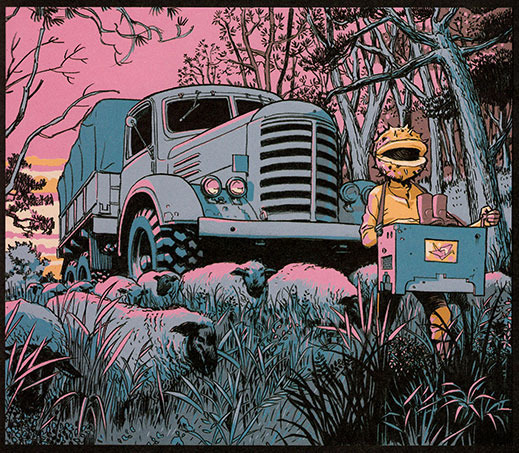
While these romantic possibilities, or entanglements, drive the plot, Nao's involvement with a Buddhist community center and her often frustrated practice of Buddhist meditation inspire fascinating digressions, detours rather, in the narrative. At the same time, the fantasy interludes (which tell an animistic fairy tale about a sort of tree spirit that recalls Miyazaki's eco-fantasies and the Brothers Grimm equally) take the story and art in still other directions. The important thing here, though, is Nao's relationship with her own mind, and her search for calm and self-mastery in spite of her disability. The Buddhist reflections play a large role in putting that struggle into perspective.
Visually, atmospherically, Nao is often brilliant, usually gorgeous, and a bravura performance overall. Dillon conjures London, and scenic interiors, with seeming effortless expertise, and the characters are distinctive and expressive. He handles layout ingeniously, using formal conceits (e.g. a split panel) cleverly but unobtrusively. His photorealistic drawing is nicely set off by a lightness of touch; the linework has an open, delicate quality, enhanced throughout by the lovely watercolors, which let the whiteness of the page shine through and never cloy or distract. The fantasy sequences are different in style: rendered more lavishly, with something approaching the clear-line aesthetic of Moebius or Cosey and full, saturated, traditional BD-style color, they pop out immediately from their surroundings. Presumably Dillon's drawing has been extensively photoreferenced—facial expressions are so acutely, precisely right that they suggest long study—but only in the climactic struggle between Nao and her object of desire, the repairman, does this quality become distracting, almost grotesque, perhaps because it's supposed to be (this is where the relationship between the two characters tips into outright confrontation, and buried secrets come screaming to the surface). It's there, in the home stretch, that Dillon sacrifices charm in a bid for realism, depth, and climax.
Nao enthralled me on several levels; it kept me up late one night when I was supposed to be sleeping. I have to say, however, that the book's attempted climax and resolution didn't quite come off. Sudden lurches in the plot, as [SPOILER ALERT] Dillon leaps years into the future to show us Nao's self-transformation, do not explain enough. That Nao's perspective on life is transformed when she is struck by a car—a sort of satori or Paul-on-the-road-to-Damascus moment, and at precisely the point of greatest stress in the story—strikes me as too convenient a leap. The repairman's own deep backstory, hinted at earlier, is simply spilled in several pages of prose, abruptly inserted (mind you, I'm not against the use of such devices in comics in general; there is no reason prose and comics cannot work together powerfully, as in, e.g., books by Phoebe Gloeckner or Posy Simmonds). There are several delightful and humane surprises in the book's conclusion, and they make me want to like that conclusion more, but Dillon's plot-rigging is too patent there, too rushed. Long and rich as the novel is, it needed to be even longer to earn the kind of warm emotive payoff it asks for.
It remains a rich character study, a beautifully made book, and a delightful confirmation of how comics can redefine the relationship between reality and fantasy. But, oh, the unearned leap of the ending.
It seems the medium of graphic novel is quite apt at covering illnesses in general. Just this year, I read Stiche (cancer), Swallow Me Whole (schizophrenia) and Le Combat Ordinaire Intégrale (anxiety and panic attack). All those novels offer a serious treatment of the aforementioned illnesses, and I suppose more or less succeed if you were to asked someone who really knows his stuff (i.e., not me...)
In the Nao of Brownthe protagonist suffers from OCD, not the type where she would check the lock on her door a hundred times, but the type where she develops sudden and uber-aggressive thoughts about hurting strangers. In one scene, for instance, she thinks about stabbing the belly of a pregnant woman with a pen... Quite graphic, and completely at odds with her cuteness and charming/slightly awkward demeanor; as often the case, the inner turmoil not readily visible. And the crippling and haunting question: could I, someday, do this for real? There is much more to the book then this succinct premise, but this is the essence.
A word on the art before moving on; phenomenal! Really nice water color. Incredible rendition of expressions, it carries the book along. Even if one was to totally dislike the story, I am unsure you could dismiss the artwork as easily.
I have read that Dillon's depiction of OCD was inaccurate and incomplete. It is an interesting problem though, what is the writer's responsibility when telling stories revolving around serious issues? To be sure, I will form in my mind an idea of what having OCD might be like after reading this, a form of empathy. So how it is portrayed in the book is important, and there are some tangible consequences to a writer playing fast and loose with the facts. I guess there are some form of responsibilities from the writer then; but by the same token if, I, the reader assume that only one story can possibly cover the entire spectrum of possibilities in discussing something as complex as OCD, then I am the one with the problem.
It is the writer's responsibility to be honest and engaged with his topic, is it the reader's responsibility to be exposed to a multitude of perspective and to recognize that a story is just that, a unique voice that doesn't and can't speak for everyone. My opinion is that Dillon was honest and engaged here, so I have no problem. Obviously, since I do not suffer from OCD, my reasoning is flawed, if someone suffering from OCD points out the flaws, who am I to be dismissive? Still, I am not convinced that an all out attack on his work is warranted.
I'll leave it here but it is something to think about, the responsibility of fiction when tackling on serious issues; when your voice as the creator might be the only one your reader will hear. Let's face it, there isn't a lot of time and there are a lot of serious issues, being well versed in all is impossible.
This being said, I did, however, have a problem with the ending which seems at odd with the tone of the book... No spoiler here so shhhhh...
Dillon's "The Nao of Brown" is a vividly illustrated story centred around a neurotic, emotionally disturbed Nao, of a unique half Japanese, half English descent. Beyond the resulting condescension she receives of her "exoticism", Nao continues to seek for that "perfect love" in London, and come to terms with her mental state -- her life is constantly disrupted by the violent nature of her intrusive thoughts and her obsession with them. This book offers a convoluted and disturbing but refreshingly new point of view on the nature of struggling to live a perfect (or at least normal) life amidst the complexity of the human mind that is capable of tormenting us, even in the most everyday setting. This unexpected nature of Nao's thoughts among her ostensibly mundane daily routine becomes reflected in the jarringly beautiful surrealist reliefs in illustration that occasionally surface and take the readers' breath away.
I read this last year on a school trip to the beautiful and romantic city of London, and on the night that I bought it on impulse under the "Best Graphic Novels" section of Waterstone's. It made me stay up a little later than I should, but it contributed so much to making the trip memorable. Only downside was the resolution that seemed a little too rushed and happy and ambiguous for anything to sink inside my head before the book ended -- but I appreciate the ambiguity of such emotionally convoluted stories that leave things mostly to the reader's interpretation, and for their satisfaction to personally resolve. It will leave you thinking for a while after you're done reading.
I picked this from the library shelves the other day because it looked like it was about a character named Nao, and I loved the character named Nao in Ruth Ozeki's A Tale for the Time Being. This illustrates the point that people pick up books for all sorts of weird and happenstance reasons.
This has the most beautiful artwork and character renderings. A story about OCD, obsessive thoughts, washing machines and Buddhism, taking place in an upscale Japanese novelty vinyl toy shop and an urban Buddhist center.
Quite pleasant to look at and all the characters are likeable to an extent. The story is very 'slice of life' but where everything is deeply profound and puzzling in some way. Deals with themes of mental health, anxiety, existentialism, lots of woolly stuff that doesn't quite gel together, though I guess that's realistic... though the arch-pontificating on the nature of self feels a little forced. Slightly similar themes as Asterios Polyp but not as well explored... though at least a cat doesn't die at the end of it.
The Nao of Brown is a graphic novel written and illustrated by Glyn Dillon. It is a surprising and challenging piece, which serves up a richly nuanced look at the daily life of Nao Brown, a 20-something hafu (English/Japanese) woman who works as a designer at a specialty toy store in contemporary London.
Nao finds herself stuck in the nebulous area of biracial biculturalism and weathers the trials of the dating arena while also contending with common misperceptions about her Asian side. Further complicating her existence is a case of debilitating OCD, coupled with the frequent desire to inflict violent harm on people she encounters, twin demons that at times necessitate her retreat from the world.
The Nao of Brown is written and constructed rather well. This is a dense work that gets into the often-disturbing realms found in Nao's mind and the more readers get to know of her, the more wrenching her situation becomes. Dillon turns in a narrative tour de force, featuring a script that works in perfect concert with almost cinematic art.
All in all, The Nao of Brown is a wonderful journey about a life of a person suffering from OCD.
La premessa di questo fumetto, una protagonista che soffre di Disturbo Ossessivo Compulsivo che si manifesta tramite fantasie violente, mi aveva intrigata non poco. Tuttavia devo dire che la sua realizzazione mi ha lasciata piuttosto insoddisfatta, perché quello che doveva essere il tema centrale della storia risulta un po' marginale e poco approfondito, per tornare in superficie solo alla fine della vicenda, in un finale risolutivo un po' frettoloso. Questo singolare problema di Nao, la protagonista, risulta quasi soffocato dalle altre sue "manie", in un continuo citazionismo di cultura nerd giapponese (che io non conosco minimamente e che quindi facevo fatica a seguire) e di pratiche e insegnamenti buddhisti. Nota di merito va però alle tavole più intimiste che ho trovato davvero tenere e toccanti.
I happened to randomly find this book as I was looking through the stacks at the public library. I thought it looked interesting. It sat on a chair in my hallway for the better part of a week before I picked it up one day, after getting home from work early. I’m a busy lady, I had dinner to cook, phone calls and plans to make, a cat to feed, I needed time to turn off my brain and watch trash tv, and then after dinner mess to clean up—- throughout all of these nightly tasks I found myself coming back to this book. The world and story was so easy to fall back into, and extremely compelling. By the end of the night I had finished all 206 pages, and wished I could’ve kept reading.