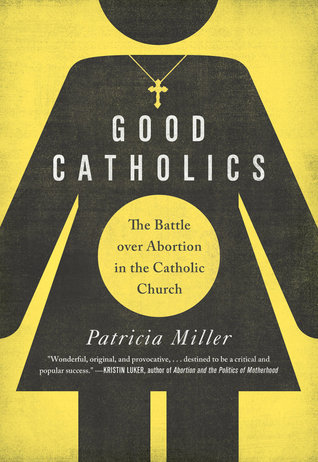
Good Catholics tells the story of the remarkable individuals who have engaged in a nearly fifty-year struggle to assert the moral legitimacy of a pro-choice position in the Catholic Church, as well as the concurrent efforts of the Catholic hierarchy to suppress abortion dissent and to translate Catholic doctrine on sexuality into law. Miller recounts a dramatic but largely untold history of protest and persecution, which demonstrates the profound and surprising influence that the conflict over abortion in the Catholic Church has had not only on the church but also on the very fabric of U.S. politics. Good Catholics addresses many of today’s hot-button questions about the separation of church and state, including what concessions society should make in public policy to matters of religious doctrine, such as the Catholic ban on contraception.
Good Catholics is a Gold Medalist (Women’s Issues) in the 2015 IPPY awards, an award presented by the Independent Publishers Book Association to recognize excellence in independent book publishing.
Patricia Miller is an award-winning author and journalist whose fascination with the untold stories of women led her on a 10-year journey to unearth the story of the Breckinridge–Pollard scandal. Her work on the interplay of politics and sexual morality has appeared in The Atlantic, Salon, The Nation, Huffington Post, and Ms. Magazine. She received a master’s degree in journalism from New York University and lives outside of Washington, DC, with her husband and dog.
If you would like to invite Patricia Miller to join your book club live (DC area) or by Skype to discuss Bringing Down the Colonel, you can contact her at: contactpattimiller@gmail.com.
It is very, very difficult work to stay in a faith tradition and struggle to reform it from within as it tries to push you out. Patricia Miller's book tells the story of some smart and activism-savvy women who worked to do just that by forming a pro-choice Catholic movement that gave women the theological framework and the voice to dissent from the dictates of a small group of powerful men. The book makes it clear how difficult it was to stay- given the extent of the bishop's power, the depths of their political connections, and their intent to squash all debate on the abortion and contraception issue. I wish that I had gotten a better sense of why these pro-choice leaders did stay in the church, what their faith meant to them, what it looked like and some of the internal struggles they must have had over staying in a church where the leaders wanted them out. That issue aside, Good Catholics is an enlightening, inspiring and infuriating book.
Atheist and believers alike have always been amazed why anyone would want to remain a member of a church which at its best is hypocritical, sexist and homophobic, while spending your money keeping pedophiles out of jail. I have met individual priests and nuns doing great work - often in contravention of church directives on contraception - but until the arrival of Pope Francis, the Vatican seemed to have a singular obsession with other people's sexuality, rather than what seems to many the essence of Jesus' message: fighting poverty and injustice. My perception changed when Catholics for Choice spoke at a seminar I co-sponsored at the European Parliament. It turns out many millions of Catholics do not share the Vatican's political priorities. They stay within the Church because it is theirs as well and try to refocus it towards those other less visible goals: social justice - including ending discrimination against women- and an end to violence.
Good Catholics promises to give the reader one of these stories: "The Battle over Abortion in the Catholic Church" and it does this very well. From early theology laying the foundations for centuries of institutionalized misogyny to the latest political battles to give women control over their reproductive rights, Patricia Miller present the historical details as an easy to read, page-turning thriller of courageous individuals fighting for an end the horrible loss of life that comes from illegal back-alley abortions and the injustice of abortion being available for the rich, but not the poor.
But the book is much more than this. It is a case study in successfully taking on a conservative male patriarchy and as such has a relevance for many emancipation battles being fought all over the world, in religions, in politics and in societies.
As a passionate trans-Atlantic European who grew up in the US, I have long been concerned about the growing cultural divide between our two continents. For all the values that unite us - from democracy to free trade - there are a number of trends in the US many Europeans find alienating: the widespread availability of firearms to the public, the adulation of the military, the role of money in politics, increasing puritanism and the acceptance of a strong role for religion in public life. In this regard, "Good Catholics" is a great re-balancer, shedding light on the thinking and the actions of those that try to limit the influence of the Church, fight for real religious freedom and try to bring it back to the progressive politics that to many were the trademark of its founder, Jesus.
Any student of politics will enjoy learning how the Catholic Bishops made abortion the central topic in American politics, which it still is today. It was not enough to convince their own flock to avoid abortion, they wanted to make it illegal for all Americans, regardless of faith. The book is drenched with debates on political strategy - from both sides of the debate - that will be an inspiration to activists worldwide. The Catholic hierarchy discovered in the 70's that constitutional amendment banning abortion would be complicated, so they lobbied instead to stop Medicaid from funding it. When the Catholic Sisters of Mercy continued to provide sterilization for women where another pregnancy would threaten their life, the Vatican threatened to fire the leadership and bring the hospitals under direct Vatican control. The Sisters backed down. Conservatives made abortion a wedge issue in presidential and state campaigns, but this success for the bishops helped politicians in power who were diametrically opposed to other Catholic policies such as nuclear disarmament, fighting poverty, strong trade unions and care for the environment. Despite the efforts of progressive bishops for a more balanced focus, the church hierarchy relegated all these issues to second tier by placing abortion above everything. Its strategy to silence internal dissent is a chilling lesson in autocracy.
For pro-choice activists faced with this well-funded, well-organised church campaign, finding theological and ecumenical allies, as well as allies among groups who agreed with the Bishops on substance, but disapproved of their strategies, was crucial in setting up an effective counter-strategy. Good staffing and strategic choices saved the fledgling shoestring Catholics for Choice from near collapse at times. Anyone who has ever worked for a small campaign organisation will immediately recognize the dynamics. I hope the activists are sharing their experiences widely, notably with Muslim feminists waging similar battles for reproductive rights.
Miller writes very well. I found myself rooting for the brave individuals taking on the powerful establishment. This story needs a wider audience and many chapters have Hollywood written all over them. One of my favorites is Catholics for a Free Choice founder Patricia McQuillan crowning herself pro-choice feminist Pope on the steps of St. Patricks cathedral in New York, thereby stealing crucial media attention away from the first 6000 strong anti-abortion rally in Washington DC. A good screenwriter could make a captivating "West Wing"- like series or film out of "Good Catholics".
McQuillan's words will continue to inspire progressive forces everywhere: "I am an activist, thoroughly involved in the most revolutionary of all revolutions in history - the women's struggle to emancipate themselves religiously, spiritually and politically from sinful patriarchal oppression". Amen and inspired reading.
When I was in Harrisburg a couple of months ago to lobby for Planned Parenthood, I attended a panel discussion focused on representatives of different religions and their attitudes and approaches to abortion. I was surprised to find that there is an organization called Catholics For Choice. Having read a couple of their brochures, I was impressed with their their focus on empowerment of women and individual conscience in matters of moral decision-making.
This book is offers a thorough recounting of the development of this organization and the key theologians and theoreticians involved in making it the major opponent of the well-financed Catholic hierarchy's lobby to influence the laws of the country to reflect conservative Catholic views. CFC, through its conferences, surveys (showing the vast majority of Catholic women practice birth control, and most believe that abortion should be available at least in some circumstances) and lobbying efforts have helped to prevent draconian laws with negative implications for women and families.
What was not surprising, is the incredible hypocrisy of the church.
While theoretically supporting social justice, peace initiatives, and opposing the death penalty, they closed inner city churches and schools while spending millions on lavish office suites and narrowing their focus to the abortion, and even birth control issues. Joining with evangelical protestants and lobbying incessantly-not only in the US but at the UN (where, strangely, they have a non-voting presence because the Vatican is a state entity!) they spoke out loudly against the use of condoms even to prevent the spread of AIDS, and against the development of women's health services in undeveloped countries.
The church continues to promote any and all legislation designed to prevent access to safe abortions, and continues to spend mega-dollars working to seek exemptions from paying for health insurance that includes these important services for women working for catholic institutions-whether they are catholic or not.
This book is well-written and deserves the attention of anyone who is interested in learning what the church is willing to do to promote their medieval ideas about women and reproduction!
I am not finishing this one because while it is crazy interesting, I don't think, for me, it is 344 pages worth of interesting.
This is no fault of the author!
I want to make it clear it is my error. I think this is a terribly important subject, and one I would like to read more about, I just don't think I can delve as deeply into this issue as I thought I could. I guess I am more of an installment type of reader for this issue rather than a reader who can finish and review it quickly for the publisher.
This book was absolutely eye-opening. I never realized just how much the modern anti-choice, anti-contraception movement was a product of the Catholic Church. It helps illuminate many of the recent fights in the reproductive rights movement: the Blunt Amendment, Hobby Lobby, the ACA's contraceptive mandate. Definitely a must-read for those passionate about the fight for reproductive rights.
Very well written and researched albeit heavily biased book (author is obviously pro choice and against pro life and the Catholic hierarchy) on the complex topic and politics of abortion and contraception. For many people, abortion is more of an idea than a hard reality. The pro life groups are painted as heroes of the woman's rights movement and the Vatican and the American Catholic bishops as villains out to push their pro life agenda on the people and the government. At the end of the book, even with all the supposed facts surrounding how heavy handed the tactics of the Catholic hierarchy was in trying to influence the politics of abortion and contraception, I was in no way moved to support the pro choice movement at all; in fact, I remain committed as a Catholic pro life supporter. There was no mention of how many abortions are actually performed in the United States, or detailed descriptions of the principal methods of abortions. There was no mention about the real reasons that are driving the Vatican and the Catholic hierarchy to resort to heavy handed methods to influence the issues. It boils down to the issue of the morality of abortion. Abortion is murder. Life begins at conception and unborn babies are human beings with a right to life. The unborn babies need somebody to stand up for them.
I'm blown away by the first few chapters. Very powerful, untold stories of how a few brave but also quite practical women took a stand for all women.
I was too young to remember what the world was like in the 50s, 60s and early 70s before birth control and abortive medical care were made safe, available and legal. The consequences and burden of unwanted pregnancies was placed fully on young women, with almost no where to turn for help. So, what did they do? It's human nature to find a way to survive.
Miller writes, "In 1967 alone, 10,000 women were admitted to New York City hospitals suffering from botched . . . [many] self-inflicted abortions--the ultimate act of desperation for women too poor or too ashamed to even seek out an illegal provider." Here we are, 50 years later re-fighting the same battle, with the bishops smugly asserting that we can have a better world where women have no choice, or even access to birth control.
This book details the struggle over abortion in the Catholic church, demonstrating how it has less to do with dogmatic purity than control--controlling the narrative, controlling women, controlling sexuality--and how the debate has had implications far outside parish walls, thanks to a well-timed (or ill-timed, in my eyes) alliance formed with the religious right. The author isn't anti-Catholic, but it's very clear that her sympathies lie with local Catholics, not the institution, and the book is written accordingly.