This is a richly absorbing autobiography by the physicist whose hydrogen bubble-chamber experiments won him the 1968 Nobel Prize in his field. Alvarez launches his "adventures" with a gripping description of his participation in (via an observation plane) the Enola Gay's historic mission over Hiroshima in 1945. Personally as well as scientifically forthright and plainspoken, he holds the reader with the story of his life as a scientist, much of the time at Berkeley, Calif., working with such men as Robert Oppenheimer, Ernest Lawrence and Enrico Fermi. Central to this account is the picture of life at Los Alamos climaxed by the first A-bomb test in 1945. But subsequent episodes describing work in small-particle physics, capped by a recent switch to "impact" theory that explains the dinosaur extinction 65 million years ago, are equal highlights. Photos.
The development of the first bomb also involved American physicist Luis Walter Alvarez, who won a Nobel Prize of 1968 for his study of subatomic particles.
People awarded Luis Walter Alvarez, an experimental inventor. The American Journal of Physics commented, "Luis Alvarez was one of the most brilliant and productive experimental physicists of the twentieth century."
Let me preface this review by saying that at this time I am employed in experimental, high energy particle physics detector based work and so much of the contents of Alvarez's detailed accounts meant something to me that the average reader might not enjoy. However, as Alvarez himself notes, you can skip the technical details and still enjoy the anecdotes - of which there are plenty!
This is an often-times hilarious and swiftly moving account of Alvarez's career in science: I say science rather than simply physics because he touched on technical engineering projects, nuclear/atomic/particle/astro physics, geology, ballistics, the list goes on.
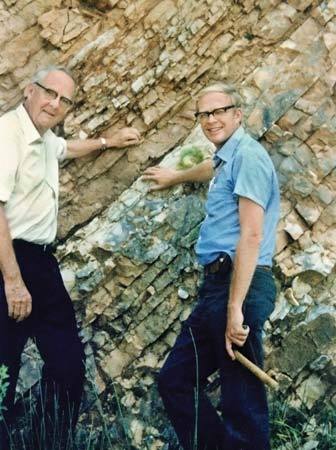
There are some wild stories about researcher's approaches to hazardous chemicals and how they began to discover the effects of radiation. There are some incredible stories from the war and post-war America. There are his incredible forays, late in his career, into the extinction of the dinosaurs (pictured above), pyramid tomb-hunting, and searching for Nemesis!
Some notable things I took from this book: science moved fast in the last half-century. The amount that Alvarez and co. accomplished in a lifetime would be completely unfeasible today which personally I believe is due to the frontier of new discovery being so much less physically attainable than it was in Berkeley's glory days. As such a lot of Alvarez's opinions on early '90's science feel very dated: in particular his attitude to large collaborations and peer review.
Despite this the autobiography is a refreshing read and if you have previously enjoyed Feynman's collected tales then you will most certainly enjoy the same period as seen through the eyes of the archetypal experimentalist.
As an experimental physicist, this was pure pleasure reading... every word.
This book has great detail, and at times it felt like I had my feet kicked up in the lab talking to an old Emeratus professor telling me some story from his past. It was a delight to share this mans perspective and experience. And my god, I never realized how their vacuum chambers were held together! Copper gaskets and knife edge stainless for days in my lab, I can only imagine if we had to use their methods to keep our vacuum stable :D
A fascinating scientific autobiography — from on-board physicist for the Hiroshima shot, to creating ever-larger cyclotrons and new instruments, the creation of instrument landing systems, scanning the great pyramids with muons looking for hidden chambers, to the impact theory of dinosaur extinction, Luis Alvarez has been everywhere a government scientist has the right to be — and a few he doesn't.
Perphaps because an experimentalist, or perhaps because he was a modest man who avoided the limelight, Luis Alvarez is not as famous as he out to be. This book stands alongside Feynman's self-effacing biography as my favorite life of a scientist. Two thumbs up!
This should be required reading for prospective science students. Be aggressive. There are too many smart people who have spent their whole careers doing nothing original.
An amazing individual that could apply himself in so many capacities, from nuclear physics and radar, to seeing inside pyramids and helping to understand how dinosaurs became extinct.
Slowly making my way across nuclear physics auto/biographies from Einstein, Rutherford, Szilliard, and Alvarez closed a gap between Rutherford and WWII. No reservations on recommending this book.
It seems like theoretical physicists get all the press, but Luis Alvarez’s autobiography might convince you that experimental physicists have all the fun. It’s hard to think of anything that happened in the 20th century that he wasn’t in the middle of. He started out helped Lawrence build and operate some of his first cyclotrons. When the war started, he went to the rad lab at MIT to help develop radar. He was the designer of the first radar system for landing aircraft in bad weather. He left the rad lab and traveled to wartime Britain to help deploy the new systems. From there he went to Chicago to help Fermi with the first nuclear reactor. Then it was off to Los Alamos to help develop the implosion bomb. He went to the South Pacific and flew in one of the observation planes during the Hiroshima bombing. He didn’t seem to slow down much after the war. The stories include bigger accelerators, trips to Vietnam during the early days of the war, flying in an F-104 Starfighter, one of the first scientific trips to the Soviet Union, studying pyramids and the Zapruder film, and, oh yeah, the Nobel prize too. But in the long he’ll probably be best known for one of his last projects. Working with his son (a geologist), he proved that the extinction of the dinosaurs was caused by an asteroid impact. Quite a life, a lot of great stories, and he tells them all with a great sense of humor.
(non-fiction) Developed GCA (ground control approach) radar for assisted landing of planes and radar for planes themselves and key components of 1st A-Bombs (watched 1st one detonated). Big into particle physics; the development of the particle accelerator cyclotron, electron linear, hydrogen bubble chamber (for which he got a Nobel Prize in 1968). Also key to the discovery of the Iridium laced clay layer at the K/T boundary which established that dinosaurs died due to asteroid impact. Very interesting read.
This guy's amazing accomplishments are enough for several lifetimes of success. It's one one my kicks to read local historical accounts. I read most of this book in the same Berkeley hills that he worked and played in. When he experimented with ballistics testing for Kennedy assassination it was at the San leandro shooting range.