Excerpt from Narrative of a Voyage to Senegal in 1816: Undertaken by Order of the French Government, Comprising an Account of the Shipwreck of the Medusa No person can read this Interesting Narrative without being deeply effected by the perils and misfortunes to which the small remnant of persons, who were saved from this deplorable Shipwreck, were exposed. Of one hundred and fifty persons embarked upon the raft, and left to their fate, only fifteen remained alive thirteen days afterwards; but of these fifteen, so miraculously saved, life constituted the sole possession, being literally stripped of every thing. At Paris, some benevolent individuals have recently opened a subscription for their relief. Should any persons, in this country, feel disposed to contribute to this humane object, Mr. Colburn will feel great pleasure in becoming the medium for transmitting their subscriptions to the unfortunate sufferers. About the Publisher Forgotten Books publishes hundreds of thousands of rare and classic books. Find more at www.forgottenbooks.com This book is a reproduction of an important historical work. Forgotten Books uses state-of-the-art technology to digitally reconstruct the work, preserving the original format whilst repairing imperfections present in the aged copy. In rare cases, an imperfection in the original, such as a blemish or missing page, may be replicated in our edition. We do, however, repair the vast majority of imperfections successfully; any imperfections that remain are intentionally left to preserve the state of such historical works.
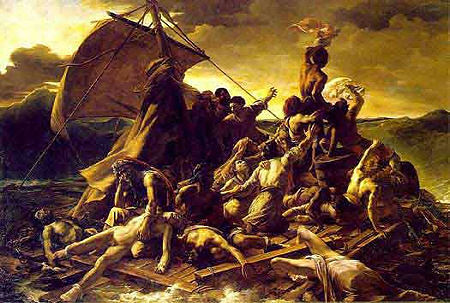
The Raft of the Medusa is an oil painting of 1818–1819 by the French Romantic painter and lithographer Théodore Géricault. Completed when the artist was 27, the work has become an icon of French Romanticism. Source: Wikipedia.
What a beautiful painting!
A few years ago I was reading an excellent book about men who were shipwrecked to be stranded on the coast of Africa.
In it there was a mentioning of another ship called The Medusa that was shipwrecked and men that reached the coast only to be made into slaves by the Arabs. Because I loved the book so and love survival stories and books about expeditions and the likes I immediately searched if there was a book written about the medusa. Well the only thing I could find was this book and I was very pleased to discover it was translated into English. I can understand a bit of French but a whole book?
What I loved about this book was the language. Oh I am saddened how the beautiful language of my mother has changed through the centuries.
It did make it harder for me because there were words I did not know but i love that with my kindle I can touch the word and read what it means.
"After having given the necessary succours to the three men of whom we have just spoken, they proceeded to get out of the frigate."
So because of that and many ship terms I thought the raft was much bigger. Only when I looked up Medusa on my phone and I was shown the beautiful painting did I realise it was just a very small raft. How they managed to get so many men on that raft. 146! on that raft? I was really shocked and understood their anger.
Happy I've read it and am now looking for more books like this.
This is a report of one of the most infamous historical shipwrecks written by two of its survivors. The translation is awkward and caused some confusion, and the structure of the book was strange. After the account of the shipwreck, its aftermath, and the fate of its survivors, the writers go into pleasant descriptions of the area they were in as well as their suggestions for colonization and for ending the practice of slavery. After all this, they include partial accounts from two of their fellow survivors and notes from supporters of their version of events. Despite how things bounce around, it was worth it to read a first-hand account of the wreck, which is a really interesting story.
In 1816, the French frigate Méduse carried 400 sailors, soldiers, and colonists to a port in Senegal. The ship's captain was an inept political appointee who, after taking navigation advice from a passenger rather than his officers, ran the Méduse aground.
A raft was built to carry all those who wouldn't fit in the ship's boats, but all of the boats towing the raft abandoned it after only half a day's travel. Some of the boats landed along the shore, their crews determined to walk to safety, while others sailed to their destination. It was a difficult journey that led to several deaths, but it wasn't nearly as bad as what happened on the raft they'd left behind.
There were 150 men on the small, hastily-constructed raft. It was so loaded down that much of the deck was underwater. They had one bag of wet food that they ate right away, and only a few casks of water and wine. They had no reliable way to steer or move the raft.
The fighting started that first night, mostly between the sailors and soldiers on one side and officers and expedition members on the other. Many people were killed during these fights, others were washed overboard, jumped off to drown, or sickened from starvation and exposure. Some ate from the bodies, and the last few survivors made their resources last by throwing their dying shipmates overboard. When they were found, by chance, thirteen days after the leaving the Méduse, there were only fifteen men left.
The book was written by two survivors of the raft, though they also reported what they'd heard about the groups that walked along the coast and remained behind with the Méduse. One of the authors was sick long after his rescue, and neglected by those who should have helped him get better. Both were treated badly on their return to France by officials who wanted to cover up the incident. I'd like to read a more thorough overview of the whole thing someday.
Si te gustó La sociedad de la Nieve, puede que este libro te interese.
Pese a haber caído en mis manos de casualidad, sorprendentemente me ha gustado.
Está basado en el relato de dos de los pocos supervivientes al naufragio del Medusa en 1816, un barco francés del cual quedaron a la deriva más de 150 marineros durante semanas sin comida ni otro refugio que un bote construído a las carreras con restos de la embarcación principal.
Conocí la historia por un cuadro de la época, del mismo nombre, que plasma el destino y penurias de los supervivientes. Me pareció un relato duro pero llamativo, en cierto modo actual, ya que trata temas como el canibalismo o el instinto de supervivencia ante las adversidades. Nota: digo actual porque estos mismos temas salen en una película de la que se habla mucho recientemente, La sociedad de la nueve (salvando las distancias).
Debates morales aparte, este relato es ameno de leer y está muy bien narrado, consiguiendo mantener siempre el interés del lector.
"What a sight was it to behold a multitude of wretches, who all wanted to escape death, and all sought to save themselves, either in the boats or upon the rafts!"
Even though I knew what I was getting myself into, I was not fully prepared to read what I did. You can almost feel the desperation that Savigny transcribes (and even that is through translation). The fate of the Medusa is ranked among other tragedies like the Titanic and the Donner Party. All this horror could have been prevented but who are we to judge? It is so easy to say what should have been done differently on this side of history.
Good horror is horror that unfolds, horror that peels back, has layers, surprises, horror that has waves compounding sensation and anxiety and more and more and more—good horror is serial. Savigny and Corréard’s Narrative of a Voyage to Senegal is good horror.
It’s good horror not because it is about cannibalism, but because it is visceral and grotesque. What makes Narrative horrible, truly horrific and wrong, lies in the structure of the writing itself. It’s how horror is never explicitly described, and the truth is merely poked at, glimpsed at, eavesdropped in bits and pieces.
Because although it is a story about cannibalism, the word is never even mentioned. The act is never even described.
Instead, the identification of cannibalism almost seems to come from the reader.
The anxiety of the situation, the stress of survival, makes us betray the moral code that built civilization and ask perhaps. The sailors fight starvation; they “succeeded in swallowing some little morsels. Some eat linen. Other pieces of leather from the hats on which there was a little grease, or rather dirt.” The writing, like good horror, is serial. It’s alive—constantly interrupting itself, refusing to settle. It leaves us with a lingering discomfort, a tingling feeling that something isn’t right. The way the sailors describe eating “morsels” of non-edible objects, “linen” or “leather,” inches toward the horrible conclusion, just enough to feel the discomfort, but it never quite lets us digest it fully. By never fully describing the act, the text forces us to fill in the gaps, to imagine the unimaginable, experiencing the horror as a continuous process.
In moments of stress or panic, our consciousness fractures. We cannot follow a smooth path. Our thoughts jump from one action to the next, never in a continuous, coherent flow. The writing style in Narrative reflects this psychological anxiety. The narrator, like the mind processing trauma, skirts around the full force of its horror, leaving behind voids that we, as readers, are forced to fill in.
They write, "We gave up our project. But an extreme resource was necessary to preserve our wretched existence." This abrupt transition from one failed plan to the introduction of a more extreme measure reflects the self-interruption. There is no coherent progression or final resolution, only the horror of “what’s next.” The sailors are not working toward a singular goal or a conclusive end—they are trapped in an endless cycle, constantly discarding one survival method for another.
We are left not with catharsis, but with the suffocating sense that we, like the sailors, are trapped in a perpetual cycle, forever striving, forever failing, forever unfinished. The horror is not in what is done, but in what is left undone, in the dark chasm of motion without an end, in the ceaseless unfinishedness of existence itself. We are dragged through this story, forced to confront the abjection of the human spirit, and yet, the more we read, the more we sense there is no end, no release, no escape. The gaps in the narrative are not our refuge—they are where the true horror festers, where our minds are left to fill in the most grotesque possibilities.
When survival forces us into such depths, when it pulls us into the void, we are left with one terrifying question: What is to be continued, when the struggle for survival is a horror in itself, forever consuming, never finished? What horror lies in the cycles we cannot break, the moral decay that never resolves, the darkness that perpetually pulls us under? What is to be continued?
Le récit terrifiant et fascinant du naufrage de la Méduse par ceux qui l'ont vécu... se lit facilement comme un livre d'aventure si on passe sur le style très daté et les remarques d'un racisme d'un autre temps... Évidemment l'histoire est contée d'un certain point de vue, et on peut regretter que les auteurs prennent beaucoup de pages à régler leur compte à ceux qu'ils considèrent comme les responsables de cette tragédie, alors que d'autres aspects me sembleraient mériter un plus grand développement, notamment les options les plus extrêmes décidées par les naufragés sur le fameux radeau (se résoudre au cannibalisme après seulement 3 jours, choisir de sacrifier les blessés...).
Als Ergänzungslektüre zu "Das Floß der Medusa" (Franzobel) interessant, ansonsten braucht man dafür schon ein spezielles Interesse für historische Reisebeschreibungen und Nautik, insbesondere Schiffsunglücke. Mehr informaiv als unterhaltsam.