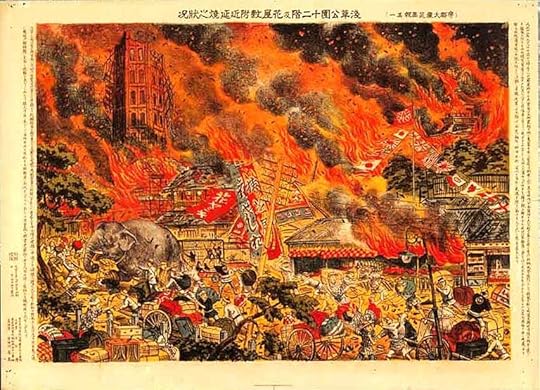
"Yokohama Burning "is the story of the worst natural disaster of the twentieth century: the earthquakes, fires, and tsunamis of September 1923 that destroyed Yokohama and most of Tokyo and killed 140,000 people during two days of horror. With cinematic vividness and from multiple perspectives, acclaimed Newsweek correspondent Joshua Hammer re-creates harrowing scenes of death, escape, and rescue. He also places the tumultuous events in the context of history and demonstrates how they set Japan on a path to even greater tragedy.
At two minutes to noon on Saturday, September 1, 1923, life in the two cities was humming along at its usual pace. An international merchant fleet, an early harbinger of globalization, floated in Yokohama harbor and loaded tea and silk on the docks. More than three thousand rickshaws worked the streets of the port. Diplomats, sailors, spies, traders, and other expatriates lunched at the Grand Hotel on Yokohama's Bund and prowled the dockside quarter known as Bloodtown. Eighteen miles north, in Tokyo, the young Prince Regent, Hirohito, was meeting in his palace with his advisers, and the noted American anthropologist Frederick Starr was hard at work in his hotel room on a book about Mount Fuji. Then, in a mighty shake of the earth, the world as they knew it ended.
When the temblor struck, poorly constructed buildings fell instantly, crushing to death thousands of people or pinning them in the wreckage. Minutes later, a great wall of water washed over coastal resort towns, inundating people without warning. Chemicals exploded, charcoal braziers overturned, neighborhoods of flimsy wooden houses went up in flames. With water mains broken, fire brigades couldonly look on helplessly as the inferno spread.
Joshua Hammer searched diaries, letters, and newspaper accounts and conducted interviews with nonagenarian survivors to piece together a minute-by-minute account of the catastrophe. But the author offers more than a disaster narrative. He details the emerging study of seismology, the nascent wireless communications network that alerted the world, and the massive, American-led relief effort that seemed to promise a bright new era in U.S.-Japanese relations.
Hammer shows that the calamity led in fact to a hardening of racist attitudes in both Japan and the United States, and drove Japan, then a fledgling democracy, into the hands of radical militarists with imperial ambitions. He argues persuasively that the forces that ripped through the archipelago on September 1, 1923, would reverberate, traumatically, for decades to come.
"Yokohama Burning," a story of national tragedy and individual heroism, combines a dramatic narrative and historical perspective that will linger with the reader for a long time.
Joshua Hammer was born in New York and educated at Horace Mann and Princeton University, graduating with a BA in English literature. In 1988 he joined Newsweek Magazine as a business and media writer, transitioning to the magazine's foreign correspondent corps in 1992. Hammer served, successively, as bureau chief in Nairobi, Buenos Aires, Los Angeles, Berlin, Jerusalem, and Cape Town, and also was the magazine's Correspondent at Large in 2005 and 2006. He was a Nieman Fellow at Harvard University in the 2004-2005 academic year.
Since leaving Newsweek in 2006 Hammer has been an independent foreign correspondent, a contributing editor at Smithsonian Magazine and Outside, and a frequent contributor to the New York Review of Books, GQ, the New York Times Magazine, and other US publications. He was a finalist for the National Magazine Award in reporting in 2003, and won the award, for his writing about the Ebola crisis in West Africa, in 2016. He is the author of 5 non-fiction books, including the New York Times bestseller, "The Bad-Ass Librarians of Timbuktu," which was published by Simon & Schuster in April 2016. Hammer is currently based in Berlin.
On September 1, 1923, the world seemed to have come to an end for Yokohama and Tokyo. Hit by a massive quake, more than 140,000 people perished as firestorms and enormous waves pummeled the land. The tremblor measured 7.9 on the Richter Scale and lasted for almost 10 minutes. As someone who lives in quakeland, that is hard to imagine. Really, it is an eternity. There was no place to run to, away, or from, as the tsunami that followed wiped out the seafront and the poor thousands who huddled in the open centre found they had chosen the worst spot...a fire tornado whipped up by enormous winds came after them and incinerated all 38,000 souls.
And then there was the Typhoid Fever outbreak and the ugly massacre of Koreans and various government opponents. Whew. Joshua Hammer makes an effort to prove that this incredible disaster was responsible for the future warpath taken by the Japanese government. I'm not sure I finished this book believing that premise, but he makes a valiant argument and some of it does make sense. I was more fascinated by the idea put forth that the massive storm taking place just before the quake hit was the very reason for the catastrophe, due to the pressure being exerted upon the faultline.
I was completely riveted by this book. Hammer's contention that the results led to the upswell of Japanese militarism has some valid points, but it's not as though Japan was a peaceful nation prior to the Great Kanto Earthquake. There is no doubt this disaster defined the Japanese culture for many decades, and it led to more green spaces and a revision of building codes. A great read for any history or catastrophe buff.
During world war 2 the Japanese killed a lot of Filipinos especially during the orgy of killings their crazed soldiers, facing certain defeat, did during the battle for the liberation of Manila. Unknown to many, however, some two decades before this it was the Philippines which killed thousands of Japanese and other nationalities and flattened two cities—Yokohama and Japan. This was during the “Kanto Daishinsai” or the Great Kanto Earthquake which occurred around two minutes before noon of September 1, 1923. This was how the Philippines did it:
“Six miles beneath the floor of Sagani Bay, under thick layers of silt and sedimentary rock, the Philippine Sea playte begins a forty-five-degree descent toward the liquid mantle of the earth. As it strains silently against the softer and more malleable Eurasian continental plate, creeping, edging, sliding forward by two or three inches a year, the massive slabs gradually build up pressure, until the interface between the two plates can hold no longer. At that moment, an event that occurs roughly once a century in Japan, a portion of the ocean plate lunges forward, forcing up the continental plate and releasing a burst of destructive energy. It was precisely this scenario that occurred at two minutes before noon on September 1, 1923. A sixty-mile-long by sixty-mile-wide segment of the Philippine plate suddenly ruptured, fractured, and thrust itself forward and downward to a point thirty miles below Tokyo. If a witness could have observed the movement from on high, he would have watched the entire Miura Peninsula, east of Tokyo Bay, plus the Kanto Plain and the surrounding regions—the upper side of the plate interface—rear upward and south ward by twenty feet over a period of sixty seconds. The lowered of the plate interface, Sagami Bay, slid simultaneously downward and to the north. The initial seismic vibrations—primary waves—raced from the fault zone on a diagonal path to the surface of the earth a speed of eighteen thousand miles an hour. Behind them came slower and more destructive vibrations—shear waves—moving at roughly seventy-five hundred miles an hour. These vibrations traveled with a lateral motion, shaking the earth violently as they burrowed through the crust. A third and fourth set of vibrations—Rayleigh and Love waves—then shot directly up from the fault and followed the contours of the earth’s surface. The waves shook the ground in rolling vertical and horizontal motions, similar to the action of ocean swells.”
One survivor related his experience this way: it was around noontime in his familiar city and after the tremor, in the blink of an eye, the city is no more. Rubbles everywhere instead of buildings, and he didn’t even know where he was since the streets and familiar landmarks have disappeared.
Then came the tsunami and the fires, fire sso great that what the falling debris failed to kill, the fires finished off. Harrowing tales of victims still alive, pinned by fallen slabs of cement or wood, crying helplessly for rescue until the flames reached them. Tornados of fire so hot that even the coins inside the victims’ pockets melted, boats on the catching fire from the shore. Of the pre-earthquake population of 2 million in Tokyo, 84,014 perished. In Yokohama, 30, 771 died out of the population of 434, 170. There were around 250,000 injured in both cities combined. Only a few buildings were left standing. The Great Kanto Earthquake was the most terrible calamity of the 20th century until it was eclipsed by the 1976 earthquake in Tangshan, China and the tsunami in southeast Asia last 2004.
Why the frequent earthquakes in Japan? Three geological plates (and possibly even more)—the Pacific Ocean plate, the Philippine Sea plate, and the Eurasian continental plate—are constantly pressing and straining against one another, placing enough stress on the Japanese islands to keep them in a constant state of instability. When the pressure finally exceeds the strength of the interface between the plates, which happens somewhere in Japan once every decade or so, it is released suddenly: a massive shift takes place along one of these geological fault lines, directly beneath Japan, with terrifying force, says the book.
Overall I would say that this book did it's job on showing the catastrophe that occurred on September 1 1923 in Japan. It did not tell the full story by any means, as it focused mainly on Americans and British people living in or visiting Japan at the time and had only a few small accounts from Japanese citizens. However I did find this book at times tough to put down at times. The suspense was built up at the beginning describing everyone going about their business on the morning of the first and then all of the sudden the earth begins to shake, buildings collapse and fires take hold. Then the story takes off and the author puts you right in the middle of the action. You can feel the fear of the survivors, hear the panicked screams of those who were trapped and unable to escape the fires, those who jumped out of buildings just before they fell or into creeks, and the ocean in desperation not knowing the water was boiling and would kill them instantly. You could feel the panic in the air, smell the fires burning, see the streets littered with the dead and the debris. As I said the book was very readable and well written. There were parts that were a bit dry, relatively short parts though and it was well worth pushing through them as once the earth starts to shake this book becomes impossible to put down.
This is the best book to read for anyone interested in learning more about the Great Kanto Earthquake of 1923 that left Yokohama a smoking ruin and Tokyo and nearby environs devastated, killing 140,000 people in the great conflagration of earthquake, tsunami, and fire that lasted over two days. It is a remarkable hour by hour reconstruction of events focusing most of all on individuals of the foreign community, but also including the stories of Japanese victims, who suffered the most from the two days of horror, which ground the entire nation to a halt. Most poignantly the author interviewed Shigeo Tsuchiya, 95 years old in 2004, a 12 year old boy in 1923 when he was about to sit down on a tatami mat to eat lunch with his family when the epic temblor struck a few minutes before noon and Japanese history turned a corner. Coming at the worst possible time, when thousands of hibachis and gas stoves were lit throughout the Kanto Plain as lunches were being prepared, the earthquake shook so terribly that thousands of buildings came tumbling down, an event immediately followed by the greatest fire of the twentieth century spreading uncontrollably within minutes to storage tanks of oil, gas, chemicals and every category of flammable material. Approximately 40,000 were killed almost instantaneously in a firestorm that overtook the Army Clothing Depot where thousands of Japanese had huddled together in what was presumed to be a sanctuary from the raging fire. Throughout the Kanto Plain thousands more died violently as individuals, families and entire communities were consumed by the disaster.
Disturbingly, perhaps five thousand or more Koreans were slaughtered by armed vigilantes, after false rumors circulated (some stemming from government authorities) that Koreans were taking advantage of the tragedy to poison wells. In an era when international media relied on the telegraph the Kanto Plain was for several days a communications dead zone, very hard to imagine today. The author makes a case that the martial law that went into effect after the disaster was never rescinded and the march to militarism that culminated in Japan's role in World War II began immediately after the earthquake. In actuality, American and Japanese relations were at a high point with the U.S. leading all nations in relief efforts to aid Japan. The Japanese considered the American ambassador, Cyrus Woods, who raced against the clock to rush aid to the country, to be a national hero. More likely what spoiled relations between the two countries was the passage of the National Origins Act, otherwise known as the Japanese Exclusion Act, the following year. The anti-Japanese movement, largely centered in the western United States where Japanese immigrants were concentrated, justifiably infuriated the Japanese, as the author himself relates in the epilogue. By focusing most of all on individuals and their experiences during the disaster, the author brings the reader front and center into the greatest natural disaster of the twentieth century. Highly recommended.
This is a fascinating account of a major earthquake in Japan (I had heard of the 1906 San Francisco quake and fires, but not the one in Japan) and how the response to this disaster shaped the political and military ambitions of Japan. Yokohama, a major trading port and primary residence of many foreigners, was completely destroyed and the nearby capital, Tokyo, was severely damaged; over 120,000 people died and over 60% of the area's population was left homeless.
The author also draws parallels between the response to the Yokohama earthquake and other natural disasters including Hurricane Katrina. He explains the political climate in America at the time where Congress was passing laws to specifically limit the number of Japanese immigrating to the US for racial reasons. Despite this the American Red Cross raised $12 million in relief funds for these earthquake victims -- an incomprehensible sum in 1923.
I love history and especially the events that precede and influence major change (in this case WWII); this book fits the bill. The author does a good job of following specific individuals - both those who survived and those who didn't - to humanize the event and his approach is successful. You are elated when people who are separated reunite, and depressed when people you grew to like don't survive.
I recommend this book to those who like to read history - especially history which, as Americans, we never learned in school. We are so over-focused on our own culture that we sometimes forget many other nations have fascinating pasts.
All in all, a very good book and one that I learned a great deal from. My only issue is that so much of it is written from the Western perspective - most of the people that are introduced in any detail were foreigners, mostly American or European. Few of the people that are discussed in depth or introduced by name were Japanese citizens.
This is partly explained by the focus of the book being primarily Yokohama, which had a large foreign population. It's likely that the major obstacle is that the destruction was so extreme that Japanese first-person accounts from so long ago are rare and difficult to come by, not to mention the bombings of WWII.
Regardless, considering the book is geographically based in Yokohama and Tokyo, Japan, it feels like a major flaw in the book, particularly as it's not acknowledged. But that's my only large criticism of the book, as I recall. I did still learn a great deal from this book and enjoyed reading it.
Update: a really great read and detailed examination of the 1923 earthquake that destroyed Yokohama and Tokyo. Unfortunately, the title is terribly misleading as he spent about 4 paragraphs on how it lead to WWII. Very disappointing in that respect. Also, since Yokohama at the time was an international city full of foreign diplomats and tourists, Hammer spent a lot of time recounting their experiences as opposed to the Japanese experience. I was reminded of the British in India somehow. That said, the book is a brilliant recount of the disaster. You get to learn about plate tectonics and the development of the telegraph as an added bonus.
This book is meticulously researched, vivid, heart-breaking and very effective at giving a glimpse of Japan's history of opening its shores to Westerners, and the brief heyday of a vibrant European community in Yokohama. Then: the 1923 Kanto earthquake, which devastated Yokohama and Tokyo in a nightmare of destruction and fire.
Traditionally, Japanese culture envisioned earthquakes as the outcome of a world out of balance. Coming as it did during a time of greater contact with the rest of the world, and uncertainty about what such a future looked like, the idea that the devastation "helped forge the path to WWII" is supported in a compelling way.
This had so much potential. The story was amazing, a lot of untold history (or at least history I hadn't heard about in this much detail).
The issue was that the history was there, but the writing was not. It was lacking SO much. It was boring. I want to find another book of the same subject by a different author.
The Deadly 1923 Earthquake and Fire that Helped Forge the Path to World War II.
That's the subtitle of the book, although, at least in my opinion, the book doesn't really have very much relationship to WWII. It's an excellent study of the terrible earthquake and subsequent fires of 1923, but it doesn't really have a lot that ties it in to WWII.
Early on, p. 6, the book talks about previous problems with fires and earthquakes in the area of Yokohama and Tokyo. It then goes into the history of Yokohama, and how it developed into a major city due to the change in Japan's relationship to the world. Japan had been forced to open its borders to U.S. trades goods, and eventually that led to the development of industries making things for sale and trade to other countries.
The book talks about a man, Colonel Earl Hancock Ellis who, in 1922, wrote that he expected Japan to eventually expand and seize the Philippines, Singapore, the Dutch East Industries and other territories in the South Pacific, and to launch a war against the U.S., which is exactly what happened a couple of decades later.
The book goes into great detail about the earthquake itself and the subsequent fires, but also writes about how Koreans were made the target of Japanese hatred and how many of them were killed after the earthquake, rumors of Korean “attacks” planned on Japanese being widespread. “The Japanese viewed the Koreans as taking food out of their mouths” said a Japanese newspaper. Over a hundred Koreans at a time were massacred in various occasions, with hundreds killed on others. The exact number that were killed is unknown, although the book notes it could have been as high as about 8,000.
The book does talk about the Rape of Nanking in 1937, and quotes a Japanese foreign minister, Hirota Koki, who wrote in 1938 after visiting Nanking that “The Japanese Army behaved...in fashion reminiscent [of] Attila [and] his Huns”, and “[Not] less than 300,000 Chinese civilians slaughtered, many cases [in] cold blood.” This is a very interesting quote in that it's from a Japanese person writing about a year after the Rape of Nanking, and verifying that the number killed was in the hundreds of thousands, a number which many historical revisionists in Japan today deny as being far too high.
The book also writes about how the massive U.S. relief effort was greeted with “hostility.” The entire U.S. relief mission was sabotaged by Yokohama officials.
Only in the Epilogue does the book deal with anti-Japanese feelings in the U.S. , especially on the West Coast, and the various anti-Japanese bills that were passed. Martial Law declared in areas of Japan helped the military gain more control over Japanese society, says the book.
Love disaster books! ( I hope to never be involved in one, though...) This is a well-written account of one of the worst natural disasters in history. In 1923, Japan was hit by an earthquake, typhoon, fire, and tsunami. Tokyo and Yokohama were left in ruins and 4% of the Japanese population was dead. Hammer gives a very vivid description of the natural disasters and lets us see how the events affected a number of individuals. He explains what causes earthquakes in terms even I can understand. He also clearly explains how this disaster helped cause Japanese actions that led to WWII.
The breathtakingly awful story of the massive earthquake in the 1920s that flattened an enormous section of Japan and then finished it off with horribly destructive fires. Impeccably researched chronicle gives you the before-and-after picture of people and places in the different neighborhoods that were lost forver. Goes into the aftermath of the disaster that had major implications for Japan...and everyone else.
This was an absolutely awesome book to read. I purchased it after learning that my grandfather was there right after this occured in Japan on September 13, 1923.