

What do you think?

Ellery Queen Detective #4
The Greek Coffin Mystery
From the very beginning, the Khalkis case struck a somber note. It began, as was peculiarly harmonious in the light of what was to come, with the death of an old man. Georg Khalkis, internationally famous art dealer and collector, died of heart failure. After his funeral, his attorney found that the will was missing and immediately called in the district attorney.
When Inspector Queen and his son, Ellery, are brought in to solve the mystery of the missing will, Ellery mentions the one place they have not searched for the will . . . the coffin! Upon exhumation of the Khalkis coffin they find that it contained not one body -- but two!
When Inspector Queen and his son, Ellery, are brought in to solve the mystery of the missing will, Ellery mentions the one place they have not searched for the will . . . the coffin! Upon exhumation of the Khalkis coffin they find that it contained not one body -- but two!
288 pages, Mass Market Paperback
First published January 1, 1932
About the author
Ellery Queen
1,778 books512 followersaka Barnaby Ross.
(Pseudonym of Frederic Dannay and Manfred Bennington Lee)
"Ellery Queen" was a pen name created and shared by two cousins, Frederic Dannay (1905-1982) and Manfred B. Lee (1905-1971), as well as the name of their most famous detective. Born in Brooklyn, they spent forty two years writing, editing, and anthologizing under the name, gaining a reputation as the foremost American authors of the Golden Age "fair play" mystery.
Although eventually famous on television and radio, Queen's first appearance came in 1928 when the cousins won a mystery-writing contest with the book that would eventually be published as The Roman Hat Mystery. Their character was an amateur detective who used his spare time to assist his police inspector father in solving baffling crimes. Besides writing the Queen novels, Dannay and Lee cofounded Ellery Queen's Mystery Magazine, one of the most influential crime publications of all time. Although Dannay outlived his cousin by nine years, he retired Queen upon Lee's death.
Several of the later "Ellery Queen" books were written by other authors, including Jack Vance, Avram Davidson, and Theodore Sturgeon.
(Pseudonym of Frederic Dannay and Manfred Bennington Lee)
"Ellery Queen" was a pen name created and shared by two cousins, Frederic Dannay (1905-1982) and Manfred B. Lee (1905-1971), as well as the name of their most famous detective. Born in Brooklyn, they spent forty two years writing, editing, and anthologizing under the name, gaining a reputation as the foremost American authors of the Golden Age "fair play" mystery.
Although eventually famous on television and radio, Queen's first appearance came in 1928 when the cousins won a mystery-writing contest with the book that would eventually be published as The Roman Hat Mystery. Their character was an amateur detective who used his spare time to assist his police inspector father in solving baffling crimes. Besides writing the Queen novels, Dannay and Lee cofounded Ellery Queen's Mystery Magazine, one of the most influential crime publications of all time. Although Dannay outlived his cousin by nine years, he retired Queen upon Lee's death.
Several of the later "Ellery Queen" books were written by other authors, including Jack Vance, Avram Davidson, and Theodore Sturgeon.
Ratings & Reviews
Friends & Following
Create a free account to discover what your friends think of this book!
Community Reviews
Displaying 1 - 30 of 232 reviews

November 25, 2012
The two authors who have taken the pen name of Ellery Queen are many things, but great writers they are not. By great I mean - maybe - humanizing. To see someone solve a rubik cube in record time inspires nothing but awe; I don't mean that in a good way by the way. They do not know how to make the journey to the final solution of the mystery memorable. But such is the force with which the authors have created this story that even an average minded person like me followed most of the ongoing developments without trouble.
I learned by pure chance today that in the past a series of Ellery Queen on television lasted only for one season in the US. It was replaced by Murder She Wrote. That one went on for many seasons, and garnered pretty much every award. The detective called Ellery Queen is not distinctive in appearance. He is not fleshed out. He is far from being despicable, or mundane, but he is not relatable. As time went by, and slowly as we are nearing the 100 year anniversary of the first Ellery Queen book, the appeal of Ellery becomes less and less fetching.
Despite all this the books remain on my imaginary book shelf. The Queens books are much better, despite the limitations I chalked up regarding the authors' abilities, than most of the modern fluff being sold currently. It's difficult to have unanimous reviews that sort the wheat from the chaff. There's so many contemporary books to choose from and most of them will be subpar. The burnt hand teaches best and I've been burnt several times by inferior literature. But I digress.
The tour de force which the authors accomplished and which earned a perfect score from me lay in the deconstruction of a complex plot so that I could follow most of it. The book never got boring. It has a big cast. One of them is the murderer. There's no lengthy questioning of any select group of them. But I feel that if the authors were in another category of writing, say text books, they would have been immensely successful. They know how to make a complex idea go within reach of the masses.
I am very impressed. I had one or two suspects in my mind, but I could never guess the solution here. The authors don't show their hand blatantly. Agatha Christie shows us a lot daringly, that's why I could guess some of her mysteries. But the Queen mysteries are very delicately logical, like a puzzle. What most impressed me here was -spoilers!- the apprehension of the false murderer and the amazing, step by step dismantling of what supposedly happened. To fool the reader and leave none the wiser with such an in depth analysis of a false trail is genius work. The Queen authors were very confident of their case. I hope, however, that they don't use this device more than twice or thrice, as it would lose its novelty. Once is enough.
I learned by pure chance today that in the past a series of Ellery Queen on television lasted only for one season in the US. It was replaced by Murder She Wrote. That one went on for many seasons, and garnered pretty much every award. The detective called Ellery Queen is not distinctive in appearance. He is not fleshed out. He is far from being despicable, or mundane, but he is not relatable. As time went by, and slowly as we are nearing the 100 year anniversary of the first Ellery Queen book, the appeal of Ellery becomes less and less fetching.
Despite all this the books remain on my imaginary book shelf. The Queens books are much better, despite the limitations I chalked up regarding the authors' abilities, than most of the modern fluff being sold currently. It's difficult to have unanimous reviews that sort the wheat from the chaff. There's so many contemporary books to choose from and most of them will be subpar. The burnt hand teaches best and I've been burnt several times by inferior literature. But I digress.
The tour de force which the authors accomplished and which earned a perfect score from me lay in the deconstruction of a complex plot so that I could follow most of it. The book never got boring. It has a big cast. One of them is the murderer. There's no lengthy questioning of any select group of them. But I feel that if the authors were in another category of writing, say text books, they would have been immensely successful. They know how to make a complex idea go within reach of the masses.
I am very impressed. I had one or two suspects in my mind, but I could never guess the solution here. The authors don't show their hand blatantly. Agatha Christie shows us a lot daringly, that's why I could guess some of her mysteries. But the Queen mysteries are very delicately logical, like a puzzle. What most impressed me here was -spoilers!- the apprehension of the false murderer and the amazing, step by step dismantling of what supposedly happened. To fool the reader and leave none the wiser with such an in depth analysis of a false trail is genius work. The Queen authors were very confident of their case. I hope, however, that they don't use this device more than twice or thrice, as it would lose its novelty. Once is enough.

October 5, 2023
The Greek Coffin Mystery by Ellery Queen is the 4th book in the Ellery Queen Detective series. When it is discovered that art dealer and collector Georg Khalkis' will is missing after his funeral, Inspector Queen is called in. After a thorough search, his son Ellery deduces that it must be in the coffin which is then exhumed and found to contain an extra corpse. A rather complex mystery taking various directions. I like that we are taken step by step through the deduction process. Ellery though is rather pompous and condescending. A strange and very intellectual puzzle.

September 27, 2025
A complex (and probably convoluted, but in such a fun way) mystery full of twists and turns. Not the best characters writing, but I think this book can afford it. It has its own charm and a lot going on. I loved all the occasions of Ellery proudly proclaiming his brilliant sounding solutions just for his father, the actual inspector, the scold him for his method and for the theories to turn out wrong

March 31, 2026
My first Ellery Queen book, lots of twists and turns. Paths that go nowhere and others that get you there after a time.
It is not my favorite style of writing and storytelling but it is a tough mystery.
Well done.
It is not my favorite style of writing and storytelling but it is a tough mystery.
Well done.

September 1, 2016
My first Ellery Queen mystery! For reasons now forgotten to me, I have Ellery Queen's The Scarlet Letters on my TBR list. Unfortunately, the library only has The Greek Coffin Mystery, so that's what I got.
The Greek Coffin Mystery starts with a will gone missing, a body in a coffin where it should not be, and then ends up with a stolen painting. Chronologically, it's the 'first' of the Ellery Queen mysteries, so it features a young Ellery Queen.
I have no idea if this Ellery Queen is different from the older version, but he really is a very unique character. The only way I can describe him is that he's amusing on paper, but if I had to work with him in real life, I would probably go crazy.
Apart from Ellery himself, another interesting feature of the book is that once all the facts are given, the fourth wall is broken and the reader is invited to guess what the correct solution is. And there are absolutely no tricks here (obviously I didn't manage to guess it)
Oh, and I also thought it was interesting how the first letter of each chapter title made up the title 'The Greek Coffin Mystery'
I really enjoyed this book. It feels very 'American' (or at the very least, very different from Christie), although their romances follow the same inscrutable pattern. Or perhaps I just suck at discerning romances, which is a definite possibility.
I'll be on the look out for more Ellery Queen mysteries, and I think it's a shame that the library doesn't have more.
This review was first posted at Inside the mind of a Bibliophile
The Greek Coffin Mystery starts with a will gone missing, a body in a coffin where it should not be, and then ends up with a stolen painting. Chronologically, it's the 'first' of the Ellery Queen mysteries, so it features a young Ellery Queen.
I have no idea if this Ellery Queen is different from the older version, but he really is a very unique character. The only way I can describe him is that he's amusing on paper, but if I had to work with him in real life, I would probably go crazy.
Apart from Ellery himself, another interesting feature of the book is that once all the facts are given, the fourth wall is broken and the reader is invited to guess what the correct solution is. And there are absolutely no tricks here (obviously I didn't manage to guess it)
Oh, and I also thought it was interesting how the first letter of each chapter title made up the title 'The Greek Coffin Mystery'
I really enjoyed this book. It feels very 'American' (or at the very least, very different from Christie), although their romances follow the same inscrutable pattern. Or perhaps I just suck at discerning romances, which is a definite possibility.
I'll be on the look out for more Ellery Queen mysteries, and I think it's a shame that the library doesn't have more.
This review was first posted at Inside the mind of a Bibliophile

May 15, 2014
One of the joys of reading Ellery Queen novels is that moment toward the end of the book when the narrator steps out of character and challenges the reader to solve the mystery. I’ve read four of them now and I haven’t come close to getting the solution right. This time I caught one of the red herrings with a fair degree of accuracy—which means I was wrong, but not as clueless as I sometimes feel when I reach this point.
This novel is a slow read but well worth your time. (It’s slow because you will want to take the time to consider each event as it occurs and try to decide what, if anything, it tells you about who committed the crime.) I’m reluctant to say too much about the plot lest I give something away, but this one has it all—missing wills, multiple deaths and a plethora of possible criminal masterminds. Four stars.
This novel is a slow read but well worth your time. (It’s slow because you will want to take the time to consider each event as it occurs and try to decide what, if anything, it tells you about who committed the crime.) I’m reluctant to say too much about the plot lest I give something away, but this one has it all—missing wills, multiple deaths and a plethora of possible criminal masterminds. Four stars.

April 4, 2023
Although this is the fourth entry in the Ellery Queen series, it’s actually a prequel. How does the reader know this? Well the author(s) says so repeatedly. That being said this is an entertaining read.
An art dealer is found dead at his desk - his recently rewritten will missing. The subsequent plot twists and turns would have made Raymond Chandler smile. Ellery - fresh from university - stumbles a few times and his father and the other police personnel are not quite as patient or deferential as they are in the other books.
If you enjoy this series - I think you’ll enjoy this slight change of pace.
An art dealer is found dead at his desk - his recently rewritten will missing. The subsequent plot twists and turns would have made Raymond Chandler smile. Ellery - fresh from university - stumbles a few times and his father and the other police personnel are not quite as patient or deferential as they are in the other books.
If you enjoy this series - I think you’ll enjoy this slight change of pace.

February 15, 2021
This is one of those mysteries that just keeps getting more and more twisted the farther you get into it. It starts out with a simple theft from a locked room. Then there is a touch of the grotesque followed by revelations of conspiracies, treachery, secrets, and even a moment of chagrin for our hero. Then right at the end, just when I was willing to accuse every single character, Ellery works his magic and points out all the wonderfully obvious yet cleverly veiled clues.
Was I ever fooled! But first, I thought I was oh so clever and had it all figured out. Not even close! I was so far off. All the clues are there so maybe you can sort out this tangled mystery yourself. I couldn’t, but I had fun trying, and I think you might also.
It’s chronologically the earliest Ellery Queen mystery even though it was written after several other Ellery Queen books. It gives the authors a chance to explain some of Ellery’s rather notable quirks. As this is the first book I read in the series, I think it set up the rest of the stories well.
This would have been a three-star or four-star mystery except there were quite a few ‘mild’ curse words.
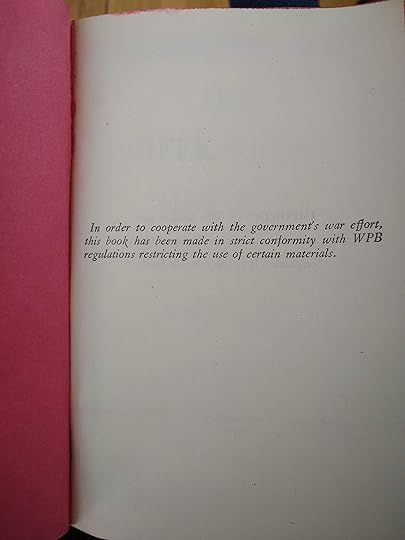
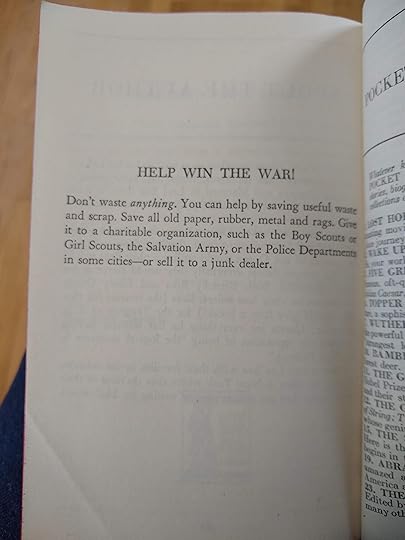
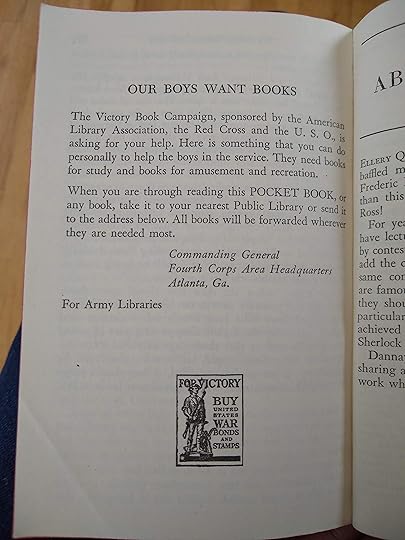
My copy was printed in 1942 and as a history buff, I found the WW2 related messages printed in the book fascinating. I will include pictures of that for all the other history buffs out there.
Was I ever fooled! But first, I thought I was oh so clever and had it all figured out. Not even close! I was so far off. All the clues are there so maybe you can sort out this tangled mystery yourself. I couldn’t, but I had fun trying, and I think you might also.
It’s chronologically the earliest Ellery Queen mystery even though it was written after several other Ellery Queen books. It gives the authors a chance to explain some of Ellery’s rather notable quirks. As this is the first book I read in the series, I think it set up the rest of the stories well.
This would have been a three-star or four-star mystery except there were quite a few ‘mild’ curse words.
My copy was printed in 1942 and as a history buff, I found the WW2 related messages printed in the book fascinating. I will include pictures of that for all the other history buffs out there.

August 8, 2021
Interesting puzzle, but way longer than it needed to be. Of course, I did not figure out the killer’s identity.
April 30, 2010
Ellery Queen [1:] and S. S. Van Dine each began to write and publish a successful detective series in the late 1920s/early 1930s. The lead character in each was a young man who had a personal relationship with members of the law enforcement community in New York City (close friends with the DA in the case of Vance and son of a prominent Inspector on the force in the case of Queen) but was not himself officially part of the force. As the series begin there are many parallels and a few major differences between the amateur detectives themselves and the police forces they aid. Both Vance and Queen are privately wealthy (Queen inheriting money from his mother), both are well educated and both affect a pseudo-aristocratic attitude. Vance, the reader is told, attended university in England and his speech still reflects that. He makes a point of decrying the pedestrian methods of the police and underlines whenever possible how much more interesting it would be for him to attend a play or go to an museum than visit a crime scene. Queen wears a pince-nez and seems to feel a need to make reference to operas, plays, poems and books whenever possible even if they are at best tangentially relevant. He hides clues from police officers, does not wait for a member of the police to be present to question witnesses and withholds results from the police labs from police officials involved in the cases.
The first Philo Vance book, The Benson Murder Case, is about the first murder investigation Vance is involved with therefore the reader sees over the course of several books the development of Vance's relationship with different members of the police force. In the first Ellery Queen book, The Roman Hat Mystery, Ellery has already worked with his father and other police officers investigating crimes. However in both cases the amateur detective around whom the series revolves has already developed their method of thinking, their deductive principles, and thus the reader gets no sense of how they came to be. Since both detectives are markedly different from the “regular” police officers in terms of their syntax, vocabulary and mannerisms their superior abilities seem to arise from differences of education and cultural exposure rather from innate intellectual abilities. To put it more starkly, one learns not to expect incisive and logical thinking from members of the working class or lower middle class. In S. S. Van Dine one learns to expect brutish and unimaginative thinking and actions from anyone who is a regular member of the police force or, indeed, who works for a living.
The fourth Ellery Queen book, The Greek Coffin Mystery, begins with a departure from the formula used in the first three books. The first mystery we encounter is not a murder but rather the disappearance of a strong box and the will it contains. The murder is discovered only in the course of the attempt of the police, including Inspector Queen and his son Ellery, to find the missing will. This is a younger Ellery than the detective the reader met in previous books since The Green Coffin Mystery is a prequel rather than a sequel to the already published books. When Ellery Queen first appears on the scene we are told, “It was a younger and cockier Ellery, and, since his connexion [sic:] with the policing of New York City was not so firmly established at this time, he was still considered something of an interloper despite his unique position as the son of Inspector Richard Queen. (p. 37)”
The Ellery Queen the reader has come to know in earlier books is still recognizable but he is, as the author points out, noticeably more cocky in his behaviour towards officials and witnesses.
As happened so often in the earlier books Ellery makes comments so vague that none can follow, makes people do things that are silly (why have everyone drink tea when all you need to demonstrate is how much water is in the percolator) and archly hints that he knows more than anyone else. What is different than in previous books is what happens when Ellery lays out, in painstaking detail, his deductions. It is clear that Ellery believes that they are inarguable and yet immediately two people punch holes in his theories -- one with a fact that he had been unaware of and the other with demonstrable proof that was of his deductions was factually incorrect.
"Years later Ellery Queen was to go back in memory to this moment with the sad remark: 'I date my maturity from Knox’s revelation. It changed my entire conception of myself and my faculties.’
“ The whole delicate structure of his reasoning, so glibly outlined, toppled and shivered into fragments at his feet. This in itself would not have been so disastrous to his ego had it not been coupled with a strong element of personal mortification. He had been 'smart’ about it. He had been so clever and subtle....p. 126"
Although this passage does not mark a sea change in the characterization of Ellery it does mark the moment, for this reader, when the authors indicate that they themselves are aware of some of the more problematic ways in which Ellery’s ratiocination have been demonstrated and described. And in a way, this can be read as a direct shot across the bow of Philo Vance since Vance repeatedly argued that “clews” and the other elements of routine police work were unnecessary to someone with a mind such as his and indeed could be misleading. All of Ellery’s logic was as nothing because he didn’t know all the facts and all the logic in the world could not replace the holes in any story left by missing data and misapprehensions.
This backstory is also used to explain why, in the first three books, Ellery was so often evasive about providing information about his conjectures to his father and other police officers. It seems that the authors had noticed some degree of criticism from readers and reviewers about that behaviour.
To buy into the Ellery Queen (or Philo Vance) mysteries one also has to buy into the idea that the authors behind these men are actually as well informed as their detectives are supposed to be. Yet there are many instances in which I am not sure the detectives (or rather their authors) are as well informed as they believe themselves to be. For example, in this book, I rather doubt that the authors even understand what colour-blindness is since they define partial colour-blindness as follows: “Demmy is afflicted with a common case of partial colour-blindness in which he consistently sees red as green and green as red." pg. 140. Demmy, it is made clear to the reader, doesn’t confuse the two colours nor does he have problems distinguishing between them he just uses the word red to describe green and green to describe red. Given that Demmy has a limited IQ one could imagine a circumstance in which he learned the wrong names as a child and has not been able to unlearn his mistake but this is not colour blindness. In fact it is the opposite of colour blindness because Demmy clearly sees those two colours as different. The fact that Demmy does not use the correct names for these colours is all the authors needed to establish.
Similarly there are moments when a reader wonders at the authors choice of words, for example when Inspector Queen is carefully but very openly searching a suspect’s rooms the authors describe his actions as follows: “The Inspector was very circumspect; he allowed nothing to escape him; he dropped to his old knees and probed beneath the rug, tapped the walls, explored the interior of the closet.” p. 165
As with all the early Ellery Queens, indeed, as with most popular books written at that time, there is so much casual sexism and racism that it becomes almost pointless to highlight individual examples. This is the first Queen book in which I noticed a large amount of “lookism” as it is sometimes called giving physicals details such as weight, height, and hair such exaggerated detail and importance that the behaviours and statements of the described individuals will be judged quite differently than they would by and from individuals differently described. One thing that does stand out is the way in which stereotypes and prejudices of then and today do not always map over each other perfectly.
This book is interesting for what it attempts while still showing the weaknesses of the formula on which the authors depended. For many modern readers these shortcomings are probably of little interest since they are most notable when one reads several books in quick succession. For the casual reader the formula may be at most a minor irritant. What may be more difficult for the today’s readers is the constant sexism, racism, classism and lookism.
[1:] For the purposes of review and analysis I will write as if Ellery Queen was a single person although in fact it is the joint pen name for Frederic Dannay and Manfred Lee. In later years other writers were also hired to write under that name but the initial books were written by Dannay and Lee and they always had a fairly tight control of material that went out under their professional name.
The first Philo Vance book, The Benson Murder Case, is about the first murder investigation Vance is involved with therefore the reader sees over the course of several books the development of Vance's relationship with different members of the police force. In the first Ellery Queen book, The Roman Hat Mystery, Ellery has already worked with his father and other police officers investigating crimes. However in both cases the amateur detective around whom the series revolves has already developed their method of thinking, their deductive principles, and thus the reader gets no sense of how they came to be. Since both detectives are markedly different from the “regular” police officers in terms of their syntax, vocabulary and mannerisms their superior abilities seem to arise from differences of education and cultural exposure rather from innate intellectual abilities. To put it more starkly, one learns not to expect incisive and logical thinking from members of the working class or lower middle class. In S. S. Van Dine one learns to expect brutish and unimaginative thinking and actions from anyone who is a regular member of the police force or, indeed, who works for a living.
The fourth Ellery Queen book, The Greek Coffin Mystery, begins with a departure from the formula used in the first three books. The first mystery we encounter is not a murder but rather the disappearance of a strong box and the will it contains. The murder is discovered only in the course of the attempt of the police, including Inspector Queen and his son Ellery, to find the missing will. This is a younger Ellery than the detective the reader met in previous books since The Green Coffin Mystery is a prequel rather than a sequel to the already published books. When Ellery Queen first appears on the scene we are told, “It was a younger and cockier Ellery, and, since his connexion [sic:] with the policing of New York City was not so firmly established at this time, he was still considered something of an interloper despite his unique position as the son of Inspector Richard Queen. (p. 37)”
The Ellery Queen the reader has come to know in earlier books is still recognizable but he is, as the author points out, noticeably more cocky in his behaviour towards officials and witnesses.
As happened so often in the earlier books Ellery makes comments so vague that none can follow, makes people do things that are silly (why have everyone drink tea when all you need to demonstrate is how much water is in the percolator) and archly hints that he knows more than anyone else. What is different than in previous books is what happens when Ellery lays out, in painstaking detail, his deductions. It is clear that Ellery believes that they are inarguable and yet immediately two people punch holes in his theories -- one with a fact that he had been unaware of and the other with demonstrable proof that was of his deductions was factually incorrect.
"Years later Ellery Queen was to go back in memory to this moment with the sad remark: 'I date my maturity from Knox’s revelation. It changed my entire conception of myself and my faculties.’
“ The whole delicate structure of his reasoning, so glibly outlined, toppled and shivered into fragments at his feet. This in itself would not have been so disastrous to his ego had it not been coupled with a strong element of personal mortification. He had been 'smart’ about it. He had been so clever and subtle....p. 126"
Although this passage does not mark a sea change in the characterization of Ellery it does mark the moment, for this reader, when the authors indicate that they themselves are aware of some of the more problematic ways in which Ellery’s ratiocination have been demonstrated and described. And in a way, this can be read as a direct shot across the bow of Philo Vance since Vance repeatedly argued that “clews” and the other elements of routine police work were unnecessary to someone with a mind such as his and indeed could be misleading. All of Ellery’s logic was as nothing because he didn’t know all the facts and all the logic in the world could not replace the holes in any story left by missing data and misapprehensions.
This backstory is also used to explain why, in the first three books, Ellery was so often evasive about providing information about his conjectures to his father and other police officers. It seems that the authors had noticed some degree of criticism from readers and reviewers about that behaviour.
To buy into the Ellery Queen (or Philo Vance) mysteries one also has to buy into the idea that the authors behind these men are actually as well informed as their detectives are supposed to be. Yet there are many instances in which I am not sure the detectives (or rather their authors) are as well informed as they believe themselves to be. For example, in this book, I rather doubt that the authors even understand what colour-blindness is since they define partial colour-blindness as follows: “Demmy is afflicted with a common case of partial colour-blindness in which he consistently sees red as green and green as red." pg. 140. Demmy, it is made clear to the reader, doesn’t confuse the two colours nor does he have problems distinguishing between them he just uses the word red to describe green and green to describe red. Given that Demmy has a limited IQ one could imagine a circumstance in which he learned the wrong names as a child and has not been able to unlearn his mistake but this is not colour blindness. In fact it is the opposite of colour blindness because Demmy clearly sees those two colours as different. The fact that Demmy does not use the correct names for these colours is all the authors needed to establish.
Similarly there are moments when a reader wonders at the authors choice of words, for example when Inspector Queen is carefully but very openly searching a suspect’s rooms the authors describe his actions as follows: “The Inspector was very circumspect; he allowed nothing to escape him; he dropped to his old knees and probed beneath the rug, tapped the walls, explored the interior of the closet.” p. 165
As with all the early Ellery Queens, indeed, as with most popular books written at that time, there is so much casual sexism and racism that it becomes almost pointless to highlight individual examples. This is the first Queen book in which I noticed a large amount of “lookism” as it is sometimes called giving physicals details such as weight, height, and hair such exaggerated detail and importance that the behaviours and statements of the described individuals will be judged quite differently than they would by and from individuals differently described. One thing that does stand out is the way in which stereotypes and prejudices of then and today do not always map over each other perfectly.
This book is interesting for what it attempts while still showing the weaknesses of the formula on which the authors depended. For many modern readers these shortcomings are probably of little interest since they are most notable when one reads several books in quick succession. For the casual reader the formula may be at most a minor irritant. What may be more difficult for the today’s readers is the constant sexism, racism, classism and lookism.
[1:] For the purposes of review and analysis I will write as if Ellery Queen was a single person although in fact it is the joint pen name for Frederic Dannay and Manfred Lee. In later years other writers were also hired to write under that name but the initial books were written by Dannay and Lee and they always had a fairly tight control of material that went out under their professional name.

January 25, 2026
Changing my rating to 5+. This is really a tour de force of construction and logic (though, to be sure, quite short on emotion).
4.5 rounded up. This is my first full EQ novel. It is one of the earlier ones (1932) from phase one of Ellery Queen, and the first of these early phase one novels to be generally acclaimed to be excellent. It is a pure puzzle piece; a wonderful example of the ‘intuitionist’ school; ingenious; pure deduction. And, so far as I can tell, there is no fakery, jiggery-pokery, or sleight-of-hand. One of the key moves, I noticed, was a perfect reductio ad absurdum. And what is most remarkable of all is that the authors were only 27 when this book was constructed. Mere kids! Lee’s prose is a bit overwritten at times; Dannay’s complications unerring but so intense — so I suspect there was room for growth in their artistic enterprise. That said, if you like this sort of thing (which I do), it is a fine example or instance of a pure puzzle detective novel.
4.5 rounded up. This is my first full EQ novel. It is one of the earlier ones (1932) from phase one of Ellery Queen, and the first of these early phase one novels to be generally acclaimed to be excellent. It is a pure puzzle piece; a wonderful example of the ‘intuitionist’ school; ingenious; pure deduction. And, so far as I can tell, there is no fakery, jiggery-pokery, or sleight-of-hand. One of the key moves, I noticed, was a perfect reductio ad absurdum. And what is most remarkable of all is that the authors were only 27 when this book was constructed. Mere kids! Lee’s prose is a bit overwritten at times; Dannay’s complications unerring but so intense — so I suspect there was room for growth in their artistic enterprise. That said, if you like this sort of thing (which I do), it is a fine example or instance of a pure puzzle detective novel.

May 14, 2022
Ingenious solution—in fact, four solutions—offered by a very young Ellery Queen on a peculiar case of two bodies discovered in the same coffin and involving a stolen Leonardo.
All three previous solutions were convincing to me until knocked down and the next is proposed by Ellery. The final solution went on a tad long, but there were a lot of loose ends to tie up. And Ellery does just that.
Considered a classic and one of the very best Ellery Queens.
All three previous solutions were convincing to me until knocked down and the next is proposed by Ellery. The final solution went on a tad long, but there were a lot of loose ends to tie up. And Ellery does just that.
Considered a classic and one of the very best Ellery Queens.

May 23, 2021
I found the mystery/mysteries rather dull in the end, though for most of the book I was interested to know the whodunnit. I didn’t particularly care about any of the characters and then I had to read the usual dose of old-timey sexism, racism, etc. Not a book I would recommend.

October 4, 2023
Rating: 4.7 stars.
Okay, this Ellery Queen mystery is in fact quite delightful! The sense of humour is good, the murder mystery is logically and finely explained, although the murderer's motivation can look a bit weak, at least it is to me.
Okay, this Ellery Queen mystery is in fact quite delightful! The sense of humour is good, the murder mystery is logically and finely explained, although the murderer's motivation can look a bit weak, at least it is to me.

May 13, 2014
This book while not the first Ellery Queen book ever published is chronologically the earliest Queen novel. The thing to understand about Ellery Queen is that unlike Nero Wolfe, Philip Marlowe, or Father Brown, there's not a whole lot of characters or wisdom to be garnered beyond the mystery, but when the mystery is good, it carries the rest of the book.
Such is the case here. A man dies and the latest version of his will is missing. A murder soon follows The book proceeds according to typical plan as Ellery ever the know it all detective and sets out to solve the case. This is Ellery's first case chronologically even though there'd been other Ellery Queen books. Ellery had some good guesses particularly figuring out that the new will was located in the coffin of the testator. However, then Ellery delivers a brilliant summation of who the murderer is that is irrefutable--only for him to be shown wrong. At the point, I was definitely hooked.
Of course, this is one of three false solutions in the case and not all are proffered by Ellery. This is a book that keeps your mind engaged all the way through and has a quite shocking conclusion. Overall, this is a superb puzzle mystery.
Such is the case here. A man dies and the latest version of his will is missing. A murder soon follows The book proceeds according to typical plan as Ellery ever the know it all detective and sets out to solve the case. This is Ellery's first case chronologically even though there'd been other Ellery Queen books. Ellery had some good guesses particularly figuring out that the new will was located in the coffin of the testator. However, then Ellery delivers a brilliant summation of who the murderer is that is irrefutable--only for him to be shown wrong. At the point, I was definitely hooked.
Of course, this is one of three false solutions in the case and not all are proffered by Ellery. This is a book that keeps your mind engaged all the way through and has a quite shocking conclusion. Overall, this is a superb puzzle mystery.

December 13, 2024
An odd puzzle that manages to be mostly fair play but also challenging. The reader is never completely sure who can be trusted. Ellery Queen is less engaging than in future books; it was difficult to find a character to wholly like. Still, the twists and turns kept it engaging and there were some really great passages of description or atmosphere that lifted it out of strict procedural.

October 18, 2011
One of the all-time greats. 4 different solutions proposed in a cat-and-mouse game between a very young Ellery and a cunning killer.

August 26, 2025
It's been kind of hard getting into Queen for me. I've always been into mystery novels for the crazy, elaborate machinations and the complex psychological motives and the room for interesting themes, and Queen is very much none of those things. Queen loves the super indulging in these extremely detailed logical chains of deduction based on very innocuous details. There aren't really any impossible crimes for you to wonder at or grand deceptions or narrative tricks that pull the ground from under you, but instead simply pieces of a puzzle that seem insignificant on their own but can lead you to narrowing down the pool of suspects in surprisingly ingenious ways.
And I'm honestly glad that I decided to read the Queens in order, because it's taken me some time to get into the frame of mind where I can actually properly appreciate that kind of thing for what it is rather than looking for what it's not. And Greek Coffin doesn't do anything different than the previous novels per se, it just perfects the craft it had already begun to hone. The deductions are even more meticulous and beautiful in their logic, the problem had even more layers (a ton more layers) than before, and the characters of Ellery and Richard and their interactions are even more entertaining than before. It's definitely the best of the 4 Queen books I've read thus far.
And I'm honestly glad that I decided to read the Queens in order, because it's taken me some time to get into the frame of mind where I can actually properly appreciate that kind of thing for what it is rather than looking for what it's not. And Greek Coffin doesn't do anything different than the previous novels per se, it just perfects the craft it had already begun to hone. The deductions are even more meticulous and beautiful in their logic, the problem had even more layers (a ton more layers) than before, and the characters of Ellery and Richard and their interactions are even more entertaining than before. It's definitely the best of the 4 Queen books I've read thus far.

November 10, 2015
Once again, good plotting let down by poor writing. The dialogues especially are poorly written in that they are not believable. Besides, the characters are unreal. A pity because the Ellery Queen series would have been brilliant had the writing been half as good as British crime writers' or Earl Stanley Gardner's, and had the characters been more real and endearing.
Take Ellery Queen for instance. He is young man recently out of university, and far younger than the district attorney (Sampson) and of course his father. Yet, this upstart says stuff like "Sampson, Sampson, when will you learn?" How believable is that? And he goes around ordering not only the detectives of New York Police, but also the Asst DA. And his affected spouting of inappropriate literary quotes continues.
And then, the way the high-handed Richard Queen speaks is utterly unrealistic. You would think that the world is at his feet despite his station, his pigheadedness and his inability to solve cases. At the end of the day, he is a mere police inspector, not the President of the US or the Mayor of NYC. In this book, he turns out to be a joker.
As I said, the plotting is very good. However, the reader would be entirely justified in feeling cheated with the final solution. Besides the modus operandi of the crime is not at all credible. That's why I am giving this 3 stars and not 4.
Take Ellery Queen for instance. He is young man recently out of university, and far younger than the district attorney (Sampson) and of course his father. Yet, this upstart says stuff like "Sampson, Sampson, when will you learn?" How believable is that? And he goes around ordering not only the detectives of New York Police, but also the Asst DA. And his affected spouting of inappropriate literary quotes continues.
And then, the way the high-handed Richard Queen speaks is utterly unrealistic. You would think that the world is at his feet despite his station, his pigheadedness and his inability to solve cases. At the end of the day, he is a mere police inspector, not the President of the US or the Mayor of NYC. In this book, he turns out to be a joker.
As I said, the plotting is very good. However, the reader would be entirely justified in feeling cheated with the final solution. Besides the modus operandi of the crime is not at all credible. That's why I am giving this 3 stars and not 4.

March 23, 2018
ENGLISH: This novel got me puzzled. Ellery is in the same position for some time, but not as long as me. In this intrigue, the maximum suspects succeed one another by accumulation of clues, until Ellery explains the final solution, which is totally surprising, but evident a posteriori. As I read this book in an Argentinian version, I found it a little difficult.
ESPAÑOL: Esta historia consiguió desconcertarme. Algo parecido le pasa al propio Ellery, aunque no tanto tiempo como a mí. Se trata de una intriga en la que los sospechosos máximos se van sucediendo unos a otros por acumulación de indicios, hasta que Ellery explica la solución, que resulta absolutamente sorprendente, pero evidente a posteriori. Leí este libro en versión argentina, que me resultó un poco dura.
ESPAÑOL: Esta historia consiguió desconcertarme. Algo parecido le pasa al propio Ellery, aunque no tanto tiempo como a mí. Se trata de una intriga en la que los sospechosos máximos se van sucediendo unos a otros por acumulación de indicios, hasta que Ellery explica la solución, que resulta absolutamente sorprendente, pero evidente a posteriori. Leí este libro en versión argentina, que me resultó un poco dura.

June 13, 2021
Después de haber dejado, el libro: "el muñeco de nieve". Tenía un mal humor terrible, me hizo perder tiempo valioso y encima durante los pocos capítulos que leí, me la pase terrible. Sacando eso de lado. Vi un capítulo de detective Conan: "el asesino fanático", este capítulo habla sobre Sherlock Holmes; pero luego escuche: Ellery Queen, me puse a revisar y encontré un montón de novelas. Agarre esta y me devolvió el animo.
Algo que me gustó fue que la casa del viejo adinerado, estaba esquematizada, ni bien abrías el libro o en mi caso el kindle. Tenia el nombre las calles aledañas a la casa, otra cosa importante que deben tener en consideración antes de empezar a leer, es que tengan a mano, el listado de los nombres importantes, ya que puede que se pierdan. Al haber tantos personajes.
La historia comienza con la muerte de un viejo adinerado y el robo de su testamento, la novela inicia de esa manera. Investigan a fondo todo lo que paso antes y después del funeral del viejo. Luego interviene el protagonista de la novela: Ellery Queen, debido a sus brillantes deducciones abren el ataúd del viejo adinerado y ahí descubren... (¿Qué será?)
Cuando lo iba leyendo, creí que leía: la ratonera de Agatha Christie o estaba a las puertas de un capítulo de Conan (anime). Otra cosa que me gusto: es que apareciera uno de los siete sabios de la antigua Grecia, y justo el que me gustaba a mi.
"No digas de antemano lo que vas a hacer; porque si no lo logras, se burlaran de ti" (frase del sabio)
Ellery en esta novela es muy joven y es un diccionario con patas, llega a cansar un poco. Pero esto no arruina la experiencia de la lectura.
Joan Brett es el personaje más entrañable y su personalidad es genial. La historia te lleva de un lado a otro y te hace confundir, con quien es el culpable. Es engañosa en principio.
Algo que me gustó fue que la casa del viejo adinerado, estaba esquematizada, ni bien abrías el libro o en mi caso el kindle. Tenia el nombre las calles aledañas a la casa, otra cosa importante que deben tener en consideración antes de empezar a leer, es que tengan a mano, el listado de los nombres importantes, ya que puede que se pierdan. Al haber tantos personajes.
La historia comienza con la muerte de un viejo adinerado y el robo de su testamento, la novela inicia de esa manera. Investigan a fondo todo lo que paso antes y después del funeral del viejo. Luego interviene el protagonista de la novela: Ellery Queen, debido a sus brillantes deducciones abren el ataúd del viejo adinerado y ahí descubren... (¿Qué será?)
Cuando lo iba leyendo, creí que leía: la ratonera de Agatha Christie o estaba a las puertas de un capítulo de Conan (anime). Otra cosa que me gusto: es que apareciera uno de los siete sabios de la antigua Grecia, y justo el que me gustaba a mi.
"No digas de antemano lo que vas a hacer; porque si no lo logras, se burlaran de ti" (frase del sabio)
Ellery en esta novela es muy joven y es un diccionario con patas, llega a cansar un poco. Pero esto no arruina la experiencia de la lectura.
Joan Brett es el personaje más entrañable y su personalidad es genial. La historia te lleva de un lado a otro y te hace confundir, con quien es el culpable. Es engañosa en principio.

July 2, 2022
I won't even try to sum up the plot because there are so many elements and twists that it's bananas. But bananas in a really good way. I loved how complex the mystery was, the large cast of characters, and I thought I knew the solution just as many ties as the detectives did. Plus, Ellery Queen is an absolute hoot. He's like Sherlock Holmes' bratty-but-charming kid brother. This was my first of his mysteries but it won't be my last.

April 18, 2020
I've really enjoyed the first three books, but I had a difficult time with this one ... I just couldn't connect with it no matter how many times I restarted. Maybe it had something to do with the fact that the narrator kept referring to the case being one of the most unsatisfactory of Queen's cases ... my goodness, he came up with four solutions before he got it right!

October 31, 2022
(antiga) coleção vampiro (de bolso) #39
269 páginas de letra microscópica.
Releitura.
Vários encadeamentos de lógica como dividindo em mini-desafios mas que tirou um pouco de brilho à premissa inicial.
269 páginas de letra microscópica.
Releitura.
Vários encadeamentos de lógica como dividindo em mini-desafios mas que tirou um pouco de brilho à premissa inicial.
June 24, 2023
Pretty good. Had some old timey sexism vibes. The way he immediately decides that he can never allow himself to make any mistakes in public ever again without deserving to be shot was relatable.
This entire review has been hidden because of spoilers.

November 7, 2021
Loved, loved, loved! So clever and well written!
January 11, 2020
Fun read, wit and beauty in the use of words. An enjoyable mystery to follow with twists and turns. Technically accurate and convincing.

December 23, 2020
My first major GAD disappointment this year. Queen is known for not writing particularly interesting characters or a gripping narrative. He is known for writing good mysteries, and if so, this book should not count as one among them. It does not mean the murderer was obvious, it just means the solution was as dull as the rest of the book. It is written as an early mystery and promises further development in Queen's character which should be interesting since he is insufferable in this one . I do plan to continue, but have significantly tempered expectations going on. (p.s. expect the usual dollop of casual sexism and racism)

June 22, 2021
Well that didn't last long, did it? After praising the previous book in this series for its tight pacing and lean, straightforward plot structure, we're back to an overstuffed story with about 3 too many twists and an overly complicated, convoluted ending. The fact that this one is 100 pages longer than #3 is your first clue.
This is Ellery's first case, chronologically. He's a fresh-faced college graduate tagging along with his dad, who still considers these crimes to be more philosophical/existential/rhetorical questions, or mind puzzles, than gruesome murders. This is the case that changed his mind, and brought him down a few pegs in his own self-importance.
It all starts when a Greek tycoon, Georg Khalkis, dies unexpectedly. After his funeral, his lawyer goes looking for his will but can't find it. This is especially important because a new will was drawn up a week prior to Georg's death, with a couple of key differences. If they can't prove the new will exists, it throws his estate into disarray. This is the point where the police become involved, searching for a stolen will. They look everywhere (and search everyone) but can't find it. Ellery suggests that maybe it was tucked into the deceased's coffin to make it conveniently disappear, so when they exhume the body to test his theory, they stumble upon a new crime - for the coffin contains not one, but two bodies, and the unexpected corpse was very definitely murdered.
The stolen will is more or less tossed to the wayside as the police and DA's office attempt to discover the identity of the dead man, who wanted him dead, and how he may be tied to the Khalkis estate (after all, why bury a man with a stranger, I suppose). Ellery is well on his way to becoming insufferably smug about his deductive abilities even as a young whelp, and it was rather satisfying to see him make a complete ass of himself in front of some folks that he desperately wanted to impress. That misstep didn't stop him for long, though; as the bodies start piling up, Ellery is the only one willing to see a link between them that's not quite as easily explained away as the police would like to believe.
Aside from the development of Ellery's smugness, there is a lot of casual racism/use of ethnic slurs and rampant misogyny that is really hard to overlook, even setting this story in the context of its time, so unless you're like me and have an insatiable need to read a series in order, I'd give this one a pass.
This is Ellery's first case, chronologically. He's a fresh-faced college graduate tagging along with his dad, who still considers these crimes to be more philosophical/existential/rhetorical questions, or mind puzzles, than gruesome murders. This is the case that changed his mind, and brought him down a few pegs in his own self-importance.
It all starts when a Greek tycoon, Georg Khalkis, dies unexpectedly. After his funeral, his lawyer goes looking for his will but can't find it. This is especially important because a new will was drawn up a week prior to Georg's death, with a couple of key differences. If they can't prove the new will exists, it throws his estate into disarray. This is the point where the police become involved, searching for a stolen will. They look everywhere (and search everyone) but can't find it. Ellery suggests that maybe it was tucked into the deceased's coffin to make it conveniently disappear, so when they exhume the body to test his theory, they stumble upon a new crime - for the coffin contains not one, but two bodies, and the unexpected corpse was very definitely murdered.
The stolen will is more or less tossed to the wayside as the police and DA's office attempt to discover the identity of the dead man, who wanted him dead, and how he may be tied to the Khalkis estate (after all, why bury a man with a stranger, I suppose). Ellery is well on his way to becoming insufferably smug about his deductive abilities even as a young whelp, and it was rather satisfying to see him make a complete ass of himself in front of some folks that he desperately wanted to impress. That misstep didn't stop him for long, though; as the bodies start piling up, Ellery is the only one willing to see a link between them that's not quite as easily explained away as the police would like to believe.
Aside from the development of Ellery's smugness, there is a lot of casual racism/use of ethnic slurs and rampant misogyny that is really hard to overlook, even setting this story in the context of its time, so unless you're like me and have an insatiable need to read a series in order, I'd give this one a pass.

June 12, 2014
This was one darn good mystery. First of all, Ellery "solves" it four times. Secondly, while I did pick out the most important clue, I was totally befuddled as to the third "solution." Thirdly, I NEVER would have guessed the correct solution. While Ellery can be a bit snobby and annoying at times, he is the best (most intricate) logician I've ever seen. If you are looking for a mystery which explains why the clues must give you this result, this is the book for you. Also, all Ellery Queen's (among those I've read) have a fairly long explanation at the end. While sometimes an early solution may be misleading, if you come across a solution late in the book but with still a number of pages to go, Ellery is going to explain the whole thing to you. Every little detail. Ad infinitum.
I was totally blown away by the solution. A well-plotted mystery.
I was totally blown away by the solution. A well-plotted mystery.
Displaying 1 - 30 of 232 reviews