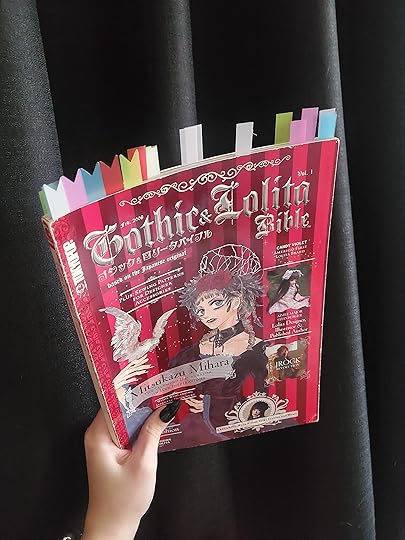
More than any other publication, Gothic & Lolita Bible has played an instrumental role in defining the Japanese Lolita style. A quarterly mook (magazine/book hybrid) that's a combination fashion magazine, culture guide, and art book, the Bible caters to fans of two separate but related fashions: Gothic and--to a greater extent--Lolita. Volume 1 of the U.S. edition offers content from four volumes of this definitive Japanese mook for the first time in English, along with exciting original content covering the Gothic and Lolita culture in North America.
I love Gothic & Lolita fashion. It is beautiful and so so cute :) The thing that makes this book for me is the photographs. I love the pages where they have stopped Japanese people in the street and taken their picture. I also really liked the story 'Merry Christmas, Rose Scent'. This is the only book/magazine where I actually look at the fashion pages. I've seen a beautiful Denim gathered Corset dress from Excentrique but the website is only in Japanese :( Still their are lots of sites in English for me to look at. Although I did really like looking at the pictures, this is not enough to make me want to buy the next mook.
My first time reading a mook! Very cute style with a lot of potential. While English GLB seems a bit scattered and low on resources, it’s a nice start and a great resource to people just getting into lolita fashion. I do understand why the series was unfortunately cancelled—likely a combination of niche subject matter and a production value that just wasn’t high enough to attract outsiders. At the same time, I think it’s worth checking out.
My main complaint is that this book is not the original GLB in English. That's all I want. You can give me translation notes or add an introduction on WHAT IS LOLITA?, but please just give me an accurate translation of the original. Much of the bonus English-language content appearing for the first time-- like a "what's your loli style" quiz which asked you to add up points to get your result of "Gothic Lolita" "Punk or Casual Lolita" (pictured: a girl in Sweet Lolita) and "Sweet Lolita" (pictured: another girl in Sweet Lolita, but in a cheaper wig)— wound up seeming like low-quality filler.
I also can’t be certain whether this was due to the design of the original, but the mook’s layout occasionally made for some very difficult reading—small text or oddly colored text on bright and busy backgrounds, that sort of thing. In particular, the magazine features a short story about halfway through (which was wonderful!) and I just wish that it had been given a plain and simple page for easier reading.
I just get this feeling that this book was not given the time or resources it needed. There’s some great reporting with interviews of various band members and singers from Japan, but it’s buried in typos and an overall somewhat childish feeling, as though the magazine is a Wattpad book being posted by a few high-aiming teenagers. Of course, I can’t say whether the Japanese version is very different but I wish this had been given more time. (<- Just keep playing that one sentence on repeat throughout this entire review.)
Several photos in this mook, for example, had poor lighting or were of people in really low quality clothing (particularly noticeable in the wigs department), and I cannot believe I am saying this but it really looks like there is a panty shot in this book. I'm not going to post the photo for obvious reasons, but there's a shot of some poor girl sitting on some stairs and due to the angle and pose it really looks like you can see, well, you know. I'm not going to harp on this. I just feel bad for the gal who volunteered to be in a GLB and ended up in this position.
There’s a section in the middle featuring several European princesses which intends to discuss what it means to be a princess. This posed a really interesting translation problem—with Marie Antoinette, for example, a few things were inaccurate. The article says that she preferred chemise dresses, which could be true, but ignores the firestorm of controversy that surrounded Marie for that preference (it was seen as wildly inappropriate, since the style was popular with women of the lower class.) Madame du Barry is listed as Marie’s husband’s mistress—this is not correct! du Barry was famously Marie’s father-in-law’s mistress, a detail which one visit to Wikipedia confirmed for me. Of course, you want to keep things accurate to the Japanese editions, but when these inaccuracies are present, what can you do…? This is where I think the translation notes would come in!
In general, the book shines when showcasing Japanese content. It’s very, very difficult to find people well versed on Japanese culture in America, and the writers didn’t seem to have the budget, context, or research to do what the Japanese magazine could—which is fine! I was very well satisfied with the Japanese spreads, short stories, and photoshoots. Even though they’re now out of date, they were beautiful and allowed me access to a kind of nostalgia I didn’t think would be possible! Again, I wish they’d just stuck to translating the originals, since it would’ve been more realistic for their seeming resources anyway.
With that said, I did enjoy much of the mook, and I would consider reading another one (even if it’s kind of a lot to get through on a library loan period—I’d prefer to own it and be able to flip through at my leisure, like a coffee table book.) Even with the limitations, it’s clear that the people making this really cared about it, and I can think of very few articles this magazine would’ve actually benefited from removing. In all honesty, I’m sure my opinion is heavily colored by the massive changes that have occurred since this mook was published in 2008—most of it just isn’t accurate anymore, and there’s not much they can do about that.
My absolute favorite parts of this mook were consistently the photoshoots; I loved all the work that went into them, from the makeup to the storylines associated. Mana and AYA’s shoots, in particular, were so gender-bending and detailed; I could’ve stared at them forever. The street snaps were also adorable, and the layouts of all the different items coming out from Japanese fashion brands were like a little glance into lolita history. I personally don’t sew, but the patterns included are a great idea for lolitas who do, particularly given that the Japanese versions must be quite hard to read for overseas seamstresses.
Every interview was a major opportunity: whether a Japanese issue interview translated into English, a fresh interview with Japanese artists by the American journalists, or an interview with overseas lolita fans, this was definitely something I felt like I couldn’t get elsewhere. In fact, the amount of figures I’d never heard of gave me a great place to start looking for more lolita fashion culture and history.
Like I said earlier, I loved the short story in the middle, Merry Christmas, Rose Scent by Kendi Ootsuki. The accompanying photo was adorable, and I have to say I enjoyed the piece overall, even in translation. Translating fiction is hard, and I have to give the team props. It’s also a genius idea to include lolita-specific fiction, including the manga in the back. I felt most excited at the idea of seeing more of this, and getting to read more about the experience of the lolita. For those who also want that, I’d immediately recommend so pretty, very rotten, which completely satisfies that desire for me, every time.
I suppose things are just complicated for me because I’m interested in lolita fashion, and while I appreciated this book, it didn’t wind up sending me to the next level the way so pretty, very rotten did. It’s undoubtedly valuable and important; I wish it had gotten more resources. A lot of American lolita information stops at "it's not related to Nabokov" and "the fashion comes from Japan." This is a great start for anyone who wants to dive into the world of lolita headfirst... I just wish, again, that it had let me actually do that by translating the original Japanese content in order! Augh! Still, indispensable for what it is. You know I’m being nitpicky when I start critiquing translated information about Marie Antoinette’s father-in-law’s lover. I must've been in a negative mood when I started writing this review. Seriously, if you’re into lolita fashion, give this a read! It’s worth it.
Thanks to Tokyopop for FINALLY translating these mooks (magazine/book) to English. Gothic & Lolita Bible Volume 1 condenses four volumes of this Japanese fashion and subculture mook into one quarterly volume. However the assumption, at least for me, was that they were going to translate them straight from the beginning. But that is not the case. This volume includes select articles from volumes 15, 16, 21, and 23 of the originals, dating back to 2005. That makes sense, though, since they probably don't want to give us dated fashion information. There are also new American articles, a manga featurette, and sewing patterns.
I thought the content was good, for both newbies and those familiar with the scene. I only gave it four stars because my primary motivation for buying this book was for the sewing patterns. I was hoping to get patterns for tops and skirts, but there were only patterns for accessories. The preview page for Volume 2 mentions that they will talk more about modifying patterns, so maybe that means they will be publishing more advanced patterns in future issues. /crossingfingers :-)
Annotations (in order of appearance) White - favorite artwork Magenta - non egl inspo Blue - Mana-sama 💙 Red - gothic inspo Yellow - notable text Orange - wardrobe collection Pink - sweet inspo Green - classic inspo
The perfect magazine for Lolitas. Not only did this magazine feature egl fashion, but also things like baked goods and flowers that lolitas also enjoy. I liked that they included occupations for the street shot segments. When someone has nice things people always wonder what they do for a living. At times they even included prices so that was helpful. I'd give this magazine 5 stars if every volume was released in English, and outfits had details of where every piece was from as well as price. On a side note, the inclusion of bl was a pleasant surprise.
I love the Lolita fashion so I was really glad they had this mook at my local Barnes and Noble books store. It pretty much covers all of the basics of Lolita and even covers a small excerpt of Asian Ball Jointed Dolls. It showcases the different dresses and accessories from various Japanese Lolita companies as well as the smaller ones that are here in the U.S. There was a lot of eye candy, but I was vastly disappointed because on a handful of pages they showed straight out Goth you see here in America instead of GOTHIC LOLITA itself.So overall it was okay. It's definitely something any Lolita would have on her bookshelf. The patterns were kind of confusing to read, too.
This book/magazine is the English version of a long-running Japanese "mook". I was sad to see that most of this was about the Lolita fashions with a touch of Gothic here and there. There were some gorgeous clothes, but most of the things they covered seemed just silly to me. Fortunately they focused mostly on fashion and not on the 'Lolita lifestyle'. I think this fashion trend says interesting things about young people in Japan.
The first American version of the Japanese mook (magazine + book) Gothic Lolita Bible. It's a style of clothing that can be really, really cute, or even gothic. The first issue explains the origins of the styles, and the various types of styles. Lots of photos. Fascinating if you are into beautiful styles of clothing.
I am fan of alternative fashion styles and I like lolita fashion a lot. This was essential to have in bookshelf. Not bad and full of interesting tips how to have your own style.