

What do you think?
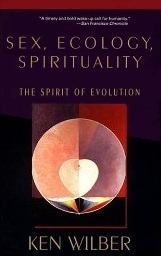
Sex, Ecology, Spirituality: The Spirit of Evolution
In this tour de force of scholarship and vision, Ken Wilber traces the course of evolution from matter to life to mind and describes the common patterns that evolution takes in all three of these domains. From the emergence of mind, he traces the evolution of human consciousness through its major stages of growth and development. He particularly focuses on modernity and postmodernity: what they mean; how they impact gender issues, psychotherapy, ecological concerns, and various liberation movements; and how the modern and postmodern world conceive of Spirit. This second edition features forty pages of new material, new diagrams, and extensively revised notes.
880 pages, Paperback
First published January 1, 1995
About the author
Ken Wilber
230 books1,282 followersKenneth Earl Wilber II is an American philosopher and writer on transpersonal psychology and his own integral theory, a systematic philosophy which suggests the synthesis of all human knowledge and experience.
Ratings & Reviews
Friends & Following
Create a free account to discover what your friends think of this book!
Community Reviews
Displaying 1 - 30 of 80 reviews

June 20, 2008
Ken Wilber is a self-promoting, pompous ass, but this book is great. Weaves it (existence, psychology, sociology, life) all together in a highly derivative but brilliant work.
September 10, 2010
Simply the single most comprehensive, plausible, and useful synthesis of human efforts at accounting for reality available. It harmonizes a dizzyingly diverse array of high-quality thought and practice, from ancient to contemporary, East and West, and all branches of knowledge (the sciences, humanities, folk wisdom, occult/esoteric traditions). While reading this work, I came to the conclusion that I'd spent the previous 7-8 years preparing myself to grapple successfully with the ideas presented therein. A staggering achievement.

July 2, 2009
I know this book is intimidating in its size, but I can really recommend it to everyone who has a basic understanding of Wilber. If you read it in little chunks and don't get ambitious about getting to the end of it, it is delightful bedtime reading to go very deeply into Integral Theory. I love the detailed, slow way he takes you through subjects like Holonic Structures or Postmodernity, and manages to open up new pathways in your brain. Once you surrender, it is like taking a hot bath in a deep understanding of complex subjects.

May 24, 2017
Wilber is an interesting case. I think that his SES, in particular, can serve as a helpful introduction to the philosophy of religion, and as a system I think it's flawed in a lot of ways but is certainly original. The "four quadrants" model is a clever approach to systematicity, and I think many individual ideas in SES, such as the pre/trans fallacy and the Basic Moral Intuition, are genuinely helpful.
With that said, Wilber's focus on "orienting generalizations" is the fatal shortcoming of this book (and all of Wilber's work). The reviews on GR stating that Wilber is the "greatest American philosopher" or "the most brilliant mind of the 20th century" are, I think, probably written by people who haven't read a lot of philosophy. Wilber has not read anything in the original language, and his summaries of the philosophers that I know well (mainly Germans in the 1700s-1900s) are obtuse and shallow. It turns out that "orienting generalizations" is Wilber's shortcut to not actually reading any of the theologians or philosophers in question (at least in any depth), but just plugging them into a predetermined system on the basis of Wikipedia summaries of the world's great thinkers.
(Also, spoiler alert -- Wilber privileges Dzogchen Buddhism as the apex of his system, so unless you happen to align with his viewpoint there, tough luck! It turns out Christianity and other world religions are stumbling along in section 9.A.7.b or whatever of his super-system-chart.)
Now, entirely apart from his arguments, Wilber is an astoundingly pompous ass (see, among many other examples, https://markmanson.net/ken-wilber); I was already clued into this by the fact that he refers, in SES, to his earlier viewpoints as "Wilber-1," "Wilber-2," "Wilber-3" . . . i.e., he really thinks so highly of himself as a thinker that he's treating his earlier positions as akin to early Plato vs. late Plato, or something; in other words, as if scholars were debating the merits of Wilber-2's position on spirituality versus the later developments in Wilber-3, where in fact actual scholars don't write about Wilber at all.
If readers of Wilber are interested in (loosely) similar systems that span all of philosophy and religion, etc., but in much more depth, allow me to recommend von Balthasar's Trilogy, Bulgakov's sophiological works, Florensky's Pillar and Ground of the Truth, and Hegel's mature system. Granted, these thinkers all place some version of Christianity at the apex of their systems, but ultimately a choice must be made ("is ultimate reality a Who or a What?"; Wilber goes with What).
With that said, Wilber's focus on "orienting generalizations" is the fatal shortcoming of this book (and all of Wilber's work). The reviews on GR stating that Wilber is the "greatest American philosopher" or "the most brilliant mind of the 20th century" are, I think, probably written by people who haven't read a lot of philosophy. Wilber has not read anything in the original language, and his summaries of the philosophers that I know well (mainly Germans in the 1700s-1900s) are obtuse and shallow. It turns out that "orienting generalizations" is Wilber's shortcut to not actually reading any of the theologians or philosophers in question (at least in any depth), but just plugging them into a predetermined system on the basis of Wikipedia summaries of the world's great thinkers.
(Also, spoiler alert -- Wilber privileges Dzogchen Buddhism as the apex of his system, so unless you happen to align with his viewpoint there, tough luck! It turns out Christianity and other world religions are stumbling along in section 9.A.7.b or whatever of his super-system-chart.)
Now, entirely apart from his arguments, Wilber is an astoundingly pompous ass (see, among many other examples, https://markmanson.net/ken-wilber); I was already clued into this by the fact that he refers, in SES, to his earlier viewpoints as "Wilber-1," "Wilber-2," "Wilber-3" . . . i.e., he really thinks so highly of himself as a thinker that he's treating his earlier positions as akin to early Plato vs. late Plato, or something; in other words, as if scholars were debating the merits of Wilber-2's position on spirituality versus the later developments in Wilber-3, where in fact actual scholars don't write about Wilber at all.
If readers of Wilber are interested in (loosely) similar systems that span all of philosophy and religion, etc., but in much more depth, allow me to recommend von Balthasar's Trilogy, Bulgakov's sophiological works, Florensky's Pillar and Ground of the Truth, and Hegel's mature system. Granted, these thinkers all place some version of Christianity at the apex of their systems, but ultimately a choice must be made ("is ultimate reality a Who or a What?"; Wilber goes with What).

March 14, 2020
These principles stand out to me:
1. Spirit's movement through form is one of evolution which transcends and includes previous forms (holons). This is true in every quadrant and every area (I, We, It). This is not always consistently "forward" or "linear" but will involve regressions and indirect paths at times.
2. This movement is consistent everywhere. Therefore, development must include all areas of existence and not be limited to one at the expense of the others. All is a reflection of Spirit.
3. Development is horizontal as well as vertical.
4. Any area reflects this same pattern of development and holonic structure - it's true in every internal and external area of an individual human life just as much as it is in the history of human awareness, to the history of a particular community to science, language, ecology, gender relations, etc etc...
This is not a light or quick volume but well worth the time - and the endnotes are a necessary part of it.
1. Spirit's movement through form is one of evolution which transcends and includes previous forms (holons). This is true in every quadrant and every area (I, We, It). This is not always consistently "forward" or "linear" but will involve regressions and indirect paths at times.
2. This movement is consistent everywhere. Therefore, development must include all areas of existence and not be limited to one at the expense of the others. All is a reflection of Spirit.
3. Development is horizontal as well as vertical.
4. Any area reflects this same pattern of development and holonic structure - it's true in every internal and external area of an individual human life just as much as it is in the history of human awareness, to the history of a particular community to science, language, ecology, gender relations, etc etc...
This is not a light or quick volume but well worth the time - and the endnotes are a necessary part of it.

January 2, 2013
Every page in this book cries out for five more explanatory pages!!! and every note seems to want three more notes to fully flesh out its points. Thus the promised two sequels for which we are still waiting, though some of Wilber’s future works and online publications do take up the promised threats a bit.
I read this book for the first time as a 23 year old and it had a Huge impact on my interests onward. I just read it for the third time 14 years later and this review is a few of the many thoughts that it engendered:
In the end Wilber is interested in people telling each other and themselves a better story about the Kosmos: our subjective lives, our culture and social/private passions, the physical world and interconnecting ecologies. Wilber is known as a synthesizing philosopher, but more fundamentally I find him to be a storyteller. He wants our stories to be more inclusive, more broad and deep because often without stories to point the way we might never notice or see aspects of our reality which lie all around and within us waiting to be seen, touched, and talked to.
Some people think Wilber’s creating a philosophical system. I thought so too once upon a time but now I tend to think he's creating a language to allow existing systems of knowing/knowledge to communicate with each other and to be transformed by that communication. He does have his own system which is very interesting, but it’s his creation of a language for dialog where there was a mass of misunderstandings or simple ignorance that will be his most lasting contribution in my opinion.
Wilber’s books really aren’t stand-alone books, at least not the best ones like this one. Wilber has some intellectual intuitions and themes that are present form his first book to his most recent: The idea that consciousness is a spectrum of qualitatively different depths and heights. That different theories often refer to different depths and levels and aspects of the worldspace even when they may use similar language. The vision of a world as connected and Whole, even if we can only see the connections as through a glass darkly. The certainty that spiritual realization is Real and our basic underlying impulse. That interpretations are always more essential then we think and harder to see when they appear as just facts or just experince….these and a handful of other ideas are his recurring themes that echo and unfold in surprising ways throughout all his writings.
His is also not a finished story or a complete/closed system. His work, a unfolding responsive story, is the outward form of a lifelong inward inquiry. He himself breaks it down into the clinical sounding "five phases", but I prefer to see it as chapters that build and open outward from basic themes and interests. So for example the basic idea of spiritual development is initially seen as a realization of a sacred source, then it is seen as an upward development within a ever present sacred ground, then it begins to multiply into streams of varying developments, then it branches vertical into an ever present spiritual journey, and branches horizontal into a contingent human journey full of perilous fragility and unknown possibilities. Most of his major ideas keep morphing over time, thus even a simple abstract idea like development moves forward through a transcendence of the present level but also an inclusion of aspects of it into a greater whole means something very different in concreate specificities in the Atman Project, here in SES, and something very different in his most recent work. But if you see the words transcended and include in all the books, it might look like his ideas haven’t changed.
You would be wrong.
Context really does matter :)
The one aspect of this book that I found frustrating was his writing on feminism. It was sadly lacking in constructive ideas. Wilber’s writing was bloodless when talking about his own ideas on feminism and equality, but full of passion when he was arguing against others ideas on the subject. He has almost nothing to say about feminism over the last 300 years or ideas about the present and future. His basic point that equality of the sexes is an emergent possibility in human history, and not a possible return to some past relational equality which didn’t actually exist is solid but maybe not worth the number of pages it takes up. In an effort to avoid an oppressive narrative in ancient history Wilber empathizes the biological determination of status/tasks over human history, and some of this is insightful as far as it goes but it doesn’t go anywhere as far as Wilber seems to think. There is a great deal in status and historical specificities that the biological narrative alone doesn't explain. Be that as it may, had he also written something insightful about the fight for equality over the past 300 years I'd have been less frustrated, but alas he does not. He just emphasizes that it’s here that equality becomes a real possibility because of the autonomous power of the noosphere [mind/culture realm] that only fully differentiated from the biological realm recently.
I wish he’d dig into the battles taking place in the noosphere and how they play out in society, culture, and individual consciousness. What he does say about the present seems socially reductive at times, as his past narrative is excessively biologically reductive. Possibly he was going to address these kinds of issues in a future volume, but I have only the published work to go on. There has been some work I’m aware of incorporating his ideas into a more in-depth and challenging take on feminism like The Evolutionary Journey of Woman: From the Goddess to Integral Feminism by Sarah Nicholson. This shows to me why his work isn’t primarily a system but a language. Anyone can study it and use that language to make their own story but the nature of the language propels the new stories to be just as if not more inclusive in whatever areas it’s applied to.
There can be a socially conservative bend to integral thought at times, given that Wilber spends so much time formulating criticisms of present trends. Many people simply pick up the criticisms and use them for regressive and even malicious purposes. Wilber is actually quite progressive and innovative in many of his own ideas, but since he spends so much time, particularly in this book and a few others, arguing against other’s progressive/regressive theories it can get overshadowed.
I’m not part of the "integral community" online or irl but I have spent some time interacting with people who are into Wilber's ideas over the years, and overall they have been interesting and very big hearted folks, but I have seen an over attachment in some to things having to be integral or integrally informed which cuts out most of the world and almost all the places/areas where the action, the art and passion is. This is sad, isolating and limiting and the Opposite of the underlying motive of Wilber’s theory imo. I’m not sure this conservative tendency can be avoided though, like Jung said: “I’m glad I’m Carl Jung and not a Jungian” [or something like that].
Outside of his own writings, the best thing I got from this book and Wilber’s other works are the bibliographies. They lead me to read 1000+ specific books and many authors over the last 14 years, many of which I might never have found on my own. In the modern world where there is sooo much information available to us, it’s important to find voices you trust Enough to lead you to sources of wisdom, inspiration and challenge. Wilber is one of the writers who has done that for me, so I’m always appreciative of that aspect of his work, and I look forward to my slow re-reading of all his books.
Ken Wilber, Ranked (9/1/24)
1 - Sex, Ecology, Spirituality
2 - The Eye of Spirit
3 - Grace & Grit
4 - Excerpts A-D*
5 - Marriage of Sense and Soul
6 - Eye to Eye: The Quest for the New Paradigm
7 - Integral Spirituality
8 - A Sociable God
9 - The Spectrum of Consciousness
10 - No Boundary
11 - Kosmic Consciousness**
12 - One Taste
13 - Atman Project
14 - Up from Eden
15 - The Religion of Tomorrow
16 - Transformations of Consciousness***
17 - A Brief History of Everything
18 - Spiritual Choices***
------------------------5Stars
19 - Integral Psychology
20 -Integral Meditation
------------------------4Stars
21 - Boomeritis
22 - Finding Radical Wholeness
23 - The Fourth Turning
24 - Trump and a Post-Truth World
25 - The Integral Vision
------------------------3Stars
26 - A Theory of Everything
------------------------2Stars
*only published online
** Audio Program
*** collection of original essays by multiple writers including Wilber
I read this book for the first time as a 23 year old and it had a Huge impact on my interests onward. I just read it for the third time 14 years later and this review is a few of the many thoughts that it engendered:
In the end Wilber is interested in people telling each other and themselves a better story about the Kosmos: our subjective lives, our culture and social/private passions, the physical world and interconnecting ecologies. Wilber is known as a synthesizing philosopher, but more fundamentally I find him to be a storyteller. He wants our stories to be more inclusive, more broad and deep because often without stories to point the way we might never notice or see aspects of our reality which lie all around and within us waiting to be seen, touched, and talked to.
Some people think Wilber’s creating a philosophical system. I thought so too once upon a time but now I tend to think he's creating a language to allow existing systems of knowing/knowledge to communicate with each other and to be transformed by that communication. He does have his own system which is very interesting, but it’s his creation of a language for dialog where there was a mass of misunderstandings or simple ignorance that will be his most lasting contribution in my opinion.
Wilber’s books really aren’t stand-alone books, at least not the best ones like this one. Wilber has some intellectual intuitions and themes that are present form his first book to his most recent: The idea that consciousness is a spectrum of qualitatively different depths and heights. That different theories often refer to different depths and levels and aspects of the worldspace even when they may use similar language. The vision of a world as connected and Whole, even if we can only see the connections as through a glass darkly. The certainty that spiritual realization is Real and our basic underlying impulse. That interpretations are always more essential then we think and harder to see when they appear as just facts or just experince….these and a handful of other ideas are his recurring themes that echo and unfold in surprising ways throughout all his writings.
His is also not a finished story or a complete/closed system. His work, a unfolding responsive story, is the outward form of a lifelong inward inquiry. He himself breaks it down into the clinical sounding "five phases", but I prefer to see it as chapters that build and open outward from basic themes and interests. So for example the basic idea of spiritual development is initially seen as a realization of a sacred source, then it is seen as an upward development within a ever present sacred ground, then it begins to multiply into streams of varying developments, then it branches vertical into an ever present spiritual journey, and branches horizontal into a contingent human journey full of perilous fragility and unknown possibilities. Most of his major ideas keep morphing over time, thus even a simple abstract idea like development moves forward through a transcendence of the present level but also an inclusion of aspects of it into a greater whole means something very different in concreate specificities in the Atman Project, here in SES, and something very different in his most recent work. But if you see the words transcended and include in all the books, it might look like his ideas haven’t changed.
You would be wrong.
Context really does matter :)
The one aspect of this book that I found frustrating was his writing on feminism. It was sadly lacking in constructive ideas. Wilber’s writing was bloodless when talking about his own ideas on feminism and equality, but full of passion when he was arguing against others ideas on the subject. He has almost nothing to say about feminism over the last 300 years or ideas about the present and future. His basic point that equality of the sexes is an emergent possibility in human history, and not a possible return to some past relational equality which didn’t actually exist is solid but maybe not worth the number of pages it takes up. In an effort to avoid an oppressive narrative in ancient history Wilber empathizes the biological determination of status/tasks over human history, and some of this is insightful as far as it goes but it doesn’t go anywhere as far as Wilber seems to think. There is a great deal in status and historical specificities that the biological narrative alone doesn't explain. Be that as it may, had he also written something insightful about the fight for equality over the past 300 years I'd have been less frustrated, but alas he does not. He just emphasizes that it’s here that equality becomes a real possibility because of the autonomous power of the noosphere [mind/culture realm] that only fully differentiated from the biological realm recently.
I wish he’d dig into the battles taking place in the noosphere and how they play out in society, culture, and individual consciousness. What he does say about the present seems socially reductive at times, as his past narrative is excessively biologically reductive. Possibly he was going to address these kinds of issues in a future volume, but I have only the published work to go on. There has been some work I’m aware of incorporating his ideas into a more in-depth and challenging take on feminism like The Evolutionary Journey of Woman: From the Goddess to Integral Feminism by Sarah Nicholson. This shows to me why his work isn’t primarily a system but a language. Anyone can study it and use that language to make their own story but the nature of the language propels the new stories to be just as if not more inclusive in whatever areas it’s applied to.
There can be a socially conservative bend to integral thought at times, given that Wilber spends so much time formulating criticisms of present trends. Many people simply pick up the criticisms and use them for regressive and even malicious purposes. Wilber is actually quite progressive and innovative in many of his own ideas, but since he spends so much time, particularly in this book and a few others, arguing against other’s progressive/regressive theories it can get overshadowed.
I’m not part of the "integral community" online or irl but I have spent some time interacting with people who are into Wilber's ideas over the years, and overall they have been interesting and very big hearted folks, but I have seen an over attachment in some to things having to be integral or integrally informed which cuts out most of the world and almost all the places/areas where the action, the art and passion is. This is sad, isolating and limiting and the Opposite of the underlying motive of Wilber’s theory imo. I’m not sure this conservative tendency can be avoided though, like Jung said: “I’m glad I’m Carl Jung and not a Jungian” [or something like that].
Outside of his own writings, the best thing I got from this book and Wilber’s other works are the bibliographies. They lead me to read 1000+ specific books and many authors over the last 14 years, many of which I might never have found on my own. In the modern world where there is sooo much information available to us, it’s important to find voices you trust Enough to lead you to sources of wisdom, inspiration and challenge. Wilber is one of the writers who has done that for me, so I’m always appreciative of that aspect of his work, and I look forward to my slow re-reading of all his books.
Ken Wilber, Ranked (9/1/24)
1 - Sex, Ecology, Spirituality
2 - The Eye of Spirit
3 - Grace & Grit
4 - Excerpts A-D*
5 - Marriage of Sense and Soul
6 - Eye to Eye: The Quest for the New Paradigm
7 - Integral Spirituality
8 - A Sociable God
9 - The Spectrum of Consciousness
10 - No Boundary
11 - Kosmic Consciousness**
12 - One Taste
13 - Atman Project
14 - Up from Eden
15 - The Religion of Tomorrow
16 - Transformations of Consciousness***
17 - A Brief History of Everything
18 - Spiritual Choices***
------------------------5Stars
19 - Integral Psychology
20 -Integral Meditation
------------------------4Stars
21 - Boomeritis
22 - Finding Radical Wholeness
23 - The Fourth Turning
24 - Trump and a Post-Truth World
25 - The Integral Vision
------------------------3Stars
26 - A Theory of Everything
------------------------2Stars
*only published online
** Audio Program
*** collection of original essays by multiple writers including Wilber

May 6, 2018
Very thought provoking. Wilber attempts to integrate an enormous amount of information and historical analyses into one overarching theory of how the universe is constructed. His basic premise is one based on the primacy of consciousness (as opposed to the primacy of material existence.) This is the most scholarly attempt to argue this point of view that I have come across which makes it so interesting and worthwhile for me to try and really understand.
I am most of the way through a second read in an attempt to really grasp his arguments but had to pause because other reading is taking precedence.
I am most of the way through a second read in an attempt to really grasp his arguments but had to pause because other reading is taking precedence.
January 17, 2018
No one belabors a point like Ken Wilber.
I can only imagine the editing process of this tome, the world's longest philosophy 201 term paper:
"Ken, we can tighten up this argument..."
"Ken, this is repetitive..."
"Dammit, no, editor, clearly you haven't reached my level transcendent development to understand the subtle uniqueness and necessity of repeating the same arguments and 750 word block quotes over and over again!"
Putting aside the facts that this should have been a 300 page book at most, and further putting aside the often off-putting conversational tone and use of sentence fragments, there are some genuinely interesting nuggets of thought here--so much so that the book itself was on the whole a worthwhile project--but what a project the reading of this book is! Do not undertake this one lightly.
I can only imagine the editing process of this tome, the world's longest philosophy 201 term paper:
"Ken, we can tighten up this argument..."
"Ken, this is repetitive..."
"Dammit, no, editor, clearly you haven't reached my level transcendent development to understand the subtle uniqueness and necessity of repeating the same arguments and 750 word block quotes over and over again!"
Putting aside the facts that this should have been a 300 page book at most, and further putting aside the often off-putting conversational tone and use of sentence fragments, there are some genuinely interesting nuggets of thought here--so much so that the book itself was on the whole a worthwhile project--but what a project the reading of this book is! Do not undertake this one lightly.

August 22, 2022
Sex, Ecology and Spiritually is another massive tome in Ken Wilber's library. I have read quite a few of Wilber's books so far and am taken by his overarching synthesis of developmental psychology, sociology and spirituality. This particular work lays out Wilber's concept of holons or part/wholes in greater detail. He specifies the twenty tenets of holons (part/wholes) that govern their nature and the holarchies that they form, including their characteristics of transcending and include their parts, their tension between agency and communion and their pull towards emergence in that unpredictable move as they evolve into higher forms transcending and including their predecessors. Wilber once again walks us through the history of our cosmos and our human kind, taking us on the grand philosophical historical tour emphasizing favourites such as Plotinus and Schelling among many others. In essence Wilber contrasts the spiritual view of "ascenders" who emphasize the upward movement of spiritual development towards the heights of spirit or Godhead and the spiritual "descenders" who emphasize the pluriform manifestation of Spirit in the world of nature and diversity. These two camps he describes as alternating in human history. In the modern world these have recently taken the form of the camps he terms "Ego", who emphasize reason, rationality, progress and human will and the camp of "Eco", who are repelled by modernity and its consequences and emphasize a return to nature and a regression to an idealized past. Wilber roundly critiques both sides in the modern "flatland" view of the spiritual landscape and calls on an integration of ascent and descent and a holistic spiritual vision. Unfortunately Wilber can be repetitive and has a tendency to devolve into a form of ranting that grates on the nerves after a while. This does not take away from his genius, but can make the reading plodding. I may have to take a break from Wilber for a while, but I will no doubt return and continue to highly value his framework.

January 26, 2008
This is a great introduction to integral theory through the eyes of Ken Wilber. Wilber is a master at weaving together and finding a place for many ideologies and world-views within his theory of interconnection and knowledge. Weighed down with more than 200 pages of footnotes this is a very heady book whose author is very well read and has spent a lot of time developing his ethos. Interesting on many levels; this book will challenge your notions of the rational, hierarchies that we live in and those that are possible for us to achieve.

July 2, 2008
Wilber is the most important philosopher of the 20th century, perhaps the greatest synthesizer in history, and this is his current magnum opus. I am convinced his integral framework will revolutionize all human disciplines and plant the way for a genuine marriage of science and spirituality. It's a fat book, with 500 pages in footnotes alone, so for an introduction to his work see A Brief History of Everything or The Eye of Spirit. :)

February 17, 2009
in his most scholarly work, wilber discusses such pressing topics as the great chain of being (from matter to body to mind to soul to spirit and back again), the relation of diversity to unity, holons, feminism, and evolution among countless others. a better introduction to wilber may be "the spectrum of consciousness", a more brief overview of his studies could be found in "a brief history of everything", but his significant book is right here.

April 6, 2013
The most influential book to my world view in that it helped me bring together many different influences that seemed to contradict each other.
In Wilber's words, the flawed views aren't wrong, they're partial.
In Wilber's words, the flawed views aren't wrong, they're partial.

September 16, 2025
An incredible book. It’s really remarkable that this one didn’t have a larger effect and makes our society look very bad. It explains the unification of consciousness, religion, philosophy and anthropology. Really a masterclass
October 21, 2012
Single handedly, this is one of the most profound books I have read. Wilbur's genius is unparalleled on modem philosophy.

January 20, 2020
Incredibly good despite how badly written it is.

August 28, 2007
While I don't agree with every single thing Ken Wilber says in this book, Sex, Ecology, Spirituality completely rocked my world. A unifying theory without an authoritarian agenda, and contexts for truth that had been so sadly lacking in our contentious, fragmented times. I think Wilber gets some of the minor details wrong from time to time (particularly when he tries to get too specific), but the beauty of his system is not in the details but in the framework: a completely adaptable, self-correcting framework that grows stronger as time goes on, not weaker. It's a growing, changing, dynamic system, and it's plain to see that with every book, Wilber never stops researching and never stops learning.

July 7, 2010
I have been working on this book for several years. Recently began again, at Book Two; the Way Up is the Way Down -because I'm currently between jobs and reading Wilber always helps me shift into a larger perspective.
Ken Wilber writes in a very thorough and comprehensive fashion; I like this a lot. Although I grew up hearing about, and occasionally reading about, ideas such as the ego and the id, or the Godhead my education was never sufficient to allow me to compare and collocate such ideas.
I find Wilbers 20 tennets to be simple, well described and illustrated throughout this work, and I agree with him (so far). His(?) concept of Holons is very easy to understand and I find it wonderfully easy to apply this thinking to my Knowledge Management work.
(more later)
Ken Wilber writes in a very thorough and comprehensive fashion; I like this a lot. Although I grew up hearing about, and occasionally reading about, ideas such as the ego and the id, or the Godhead my education was never sufficient to allow me to compare and collocate such ideas.
I find Wilbers 20 tennets to be simple, well described and illustrated throughout this work, and I agree with him (so far). His(?) concept of Holons is very easy to understand and I find it wonderfully easy to apply this thinking to my Knowledge Management work.
(more later)
March 15, 2007
Ken Wilbur has an incredibly weak grasp of science and science history. I found his arguments against other philosophers to be poorly argued. This book has the underpinnings of many a religion. Paraphrasing: "Once you have achieved the next level of consciousness, the people below you can no more understand you than a child can understand the mind of an adult." Uuugggh!!!
August 31, 2010
Complete fucking genius.

March 18, 2015
Whatever, I just think it is a fucking terrible useless book.

Read
April 26, 2020a stuning work of genius

October 9, 2022
This ambitious tome is a grand compendium of generalizations from every field of study which seeks to reveal the patterns of existence and map our development through it. Often referred to as Wilber’s magnum opus, “Sex, Ecology, Spirituality” carries the reader from the sciences of matter and biology to the psychologies of the individual, the ideologies of cultures, and the politics of societies, demonstrating how in each example, we evolve in leaps to achieve ever greater perspectives (or fail to do so for reasons made explicit).
The key insight here is this: Love, transcendence, and creativity are inherent properties of reality and manifest in every sphere of being. It’s a beautiful, unifying metatheory that is worth the struggle to read it. But yes, it is a tough read. Wilber tends to focus on the nuances of his points rather than baldly stating them; he has an annoying habit of relying on long quotes from much older sources; and he often drops names without introduction, assuming his reader matches his erudition. Worst of all, I’d estimate that a full half of this book is devoted to whipping the dead horses of key insights that were adequately explained much earlier. I finished the first third feeling expanded and excited; I finished the rest frustrated and disappointed.
What follows is my best attempt at a one-paragraph summary:
At every developmental stage, the opposing tensions of separation and union squeeze us towards transcendence. We are individuals, and yet we are also instruments, so the rough borders of self and service (right and responsibility, intrinsic value and extrinsic value, consistency and completeness) rub and chafe with every thought, every feeling, every action. From these unstable contradictions, an excruciating incompleteness builds. If we are brave enough to embrace it, we are rewarded with an ecstatic rebirth into a deeper identity with a wider, multidimensional worldview. With wisdom, we negate our ego (without dissociation), and with compassion, we integrate our ego (without regression). But here, in this new reality, the friction between individuation and relationship begins again. Stage after stage our evolution progresses, birthing ever greater freedom and love, until—at our highest and deepest—we achieve mystical union with the Absolute, which is groundless Emptiness. We become “the clearing in which all wholes and parts arise eternally.”
”Going within me, I am finally free of me: and that is a timeless liberation from the fetters of being only me.”
I’m glad I read Wilber’s masterpiece, but it’s certainly not for everyone. If you would appreciate an undergraduate education with your spiritual insights, it might be a good choice.
The key insight here is this: Love, transcendence, and creativity are inherent properties of reality and manifest in every sphere of being. It’s a beautiful, unifying metatheory that is worth the struggle to read it. But yes, it is a tough read. Wilber tends to focus on the nuances of his points rather than baldly stating them; he has an annoying habit of relying on long quotes from much older sources; and he often drops names without introduction, assuming his reader matches his erudition. Worst of all, I’d estimate that a full half of this book is devoted to whipping the dead horses of key insights that were adequately explained much earlier. I finished the first third feeling expanded and excited; I finished the rest frustrated and disappointed.
What follows is my best attempt at a one-paragraph summary:
At every developmental stage, the opposing tensions of separation and union squeeze us towards transcendence. We are individuals, and yet we are also instruments, so the rough borders of self and service (right and responsibility, intrinsic value and extrinsic value, consistency and completeness) rub and chafe with every thought, every feeling, every action. From these unstable contradictions, an excruciating incompleteness builds. If we are brave enough to embrace it, we are rewarded with an ecstatic rebirth into a deeper identity with a wider, multidimensional worldview. With wisdom, we negate our ego (without dissociation), and with compassion, we integrate our ego (without regression). But here, in this new reality, the friction between individuation and relationship begins again. Stage after stage our evolution progresses, birthing ever greater freedom and love, until—at our highest and deepest—we achieve mystical union with the Absolute, which is groundless Emptiness. We become “the clearing in which all wholes and parts arise eternally.”
”Going within me, I am finally free of me: and that is a timeless liberation from the fetters of being only me.”
I’m glad I read Wilber’s masterpiece, but it’s certainly not for everyone. If you would appreciate an undergraduate education with your spiritual insights, it might be a good choice.

Want to Read
March 7, 2024Having read a fair amount of Wilber (and, as many have already observed, to have read just a few of Wilber's books is to have read them all
†
), before I undertake a proper reading of what's regarded as his magnum opus I'm gonna hazard the following guess: if
Sex, Ecology, Spirituality
has a schlock-to-substance ratio comparable to his other work, I anticipate ⪯30% trenchant (and possibly even useful) theory for Perennialism-influenced contemporary spirituality, versus ≥70% New Age woo-woo. I'll be interested to know whether the update to my review upon completion sees any revision to that figure.
Apropos of other readers' comments about Wilber's fondness for endlessly rephrasing the same already-published ideas to the point of flat-out ad nauseam repetition: these tendencies might be less egregious - and possibly even a little forgivable - if before the ink on Sex, Ecology, Spirituality even had a chance to dry he hadn't immediately undertaken a campaign of gratuitous over-publication exhaustively rehashing this book's theses in "new" volume after "new" volume for the next thirty effing years.
...To say nothing of the cult of personality in which he became ensconced and his self-satisfied, grandiose repackaging and mass-marketing of what amounts to Perennialism synthesized with (often very misinformed) science & contemporary theory; or the icky crudities of his self-help-y, "Tony Robbins, but Buddhist!" seminars and grotesque "enlightenment-for-CEOs" programs. (Read Integral Spirituality for a stomach-turning exercise in abject corporate pandering, self-promotion, and - natch - more repetition of past material.)
The regrettable thing about Wilber's case is that he has an undeniable facility with distilling, synthesizing, systematizing, and fairly cogently communicating core spiritual ideas, and could well have become a titan of contemporary secular-Vedic / Perennialist thought - hell, he may even have had a shot at respectability - had he recognized and overcame his weak grasp of the sciences and focused on marrying the soundest aspects of Integral Theory with actual science, rather than the insipid strawman ideas he represents as being scientific consensus and / or "scientistic" thought - usually products of his own mis- or under-informed construal of the sciences and thus inadequate from the jump - only in order to rhetorically strike them down.
†: the only exceptions that spring to mind are his biographical or autobiographical works, e.g. Quantum Questions, One Taste, and Grace And Grit.
Apropos of other readers' comments about Wilber's fondness for endlessly rephrasing the same already-published ideas to the point of flat-out ad nauseam repetition: these tendencies might be less egregious - and possibly even a little forgivable - if before the ink on Sex, Ecology, Spirituality even had a chance to dry he hadn't immediately undertaken a campaign of gratuitous over-publication exhaustively rehashing this book's theses in "new" volume after "new" volume for the next thirty effing years.
...To say nothing of the cult of personality in which he became ensconced and his self-satisfied, grandiose repackaging and mass-marketing of what amounts to Perennialism synthesized with (often very misinformed) science & contemporary theory; or the icky crudities of his self-help-y, "Tony Robbins, but Buddhist!" seminars and grotesque "enlightenment-for-CEOs" programs. (Read Integral Spirituality for a stomach-turning exercise in abject corporate pandering, self-promotion, and - natch - more repetition of past material.)
The regrettable thing about Wilber's case is that he has an undeniable facility with distilling, synthesizing, systematizing, and fairly cogently communicating core spiritual ideas, and could well have become a titan of contemporary secular-Vedic / Perennialist thought - hell, he may even have had a shot at respectability - had he recognized and overcame his weak grasp of the sciences and focused on marrying the soundest aspects of Integral Theory with actual science, rather than the insipid strawman ideas he represents as being scientific consensus and / or "scientistic" thought - usually products of his own mis- or under-informed construal of the sciences and thus inadequate from the jump - only in order to rhetorically strike them down.
†: the only exceptions that spring to mind are his biographical or autobiographical works, e.g. Quantum Questions, One Taste, and Grace And Grit.
November 9, 2025
At the core of Wilber's work is the concept of "holons," entities that are simultaneously whole and parts of larger wholes. He articulates twenty tenets governing holons and explores how holarchies form by transcending and including previous developmental stages. This model emphasizes evolution as an ongoing, multidimensional process that integrates biological, cultural, and spiritual dimensions.
Wilber contrasts two main currents in the history of spirituality and philosophy: the "Ascenders," who focus on transcending the material world toward spiritual heights, and the "Descenders," who emphasize embracing the multiplicity and diversity of nature as manifestations of spirit. He argues for a synthesis, or integral view, that reconciles these approaches, avoiding the extremes of reductionistic materialism and disengaged mysticism.
The book traces stages of individual and cultural development with references to key thinkers like Piaget, Habermas, and mystics such as Emerson, Teresa of Avila, and Ramana Maharshi. Wilber employs developmental psychology and socio-cultural theory to map how consciousness evolves from egocentric to ethnocentric and beyond, culminating in a holistic global awareness.
Wilber stresses that this integrated consciousness is crucial for addressing the ecological crisis and social fragmentation. True global consciousness involves a subjective transformation allowing spontaneous ethical behavior toward all beings and the environment. He envisions a future where community, individual freedom, and ecological responsibility coalesce, creating a harmonious holarchy of life.
While Wilber’s sweeping synthesis has been praised for its depth and scope, some critics note the complexity and occasional idealization in his writing. The "X diagram" and his encyclopedic layering of knowledge can be challenging, but his commitment to inclusivity and spiritual integration remains influential. Wilber's call to transcend fragmentation by including diverse perspectives offers a hopeful vision for humanity’s future development and spiritual awakening.
Wilber contrasts two main currents in the history of spirituality and philosophy: the "Ascenders," who focus on transcending the material world toward spiritual heights, and the "Descenders," who emphasize embracing the multiplicity and diversity of nature as manifestations of spirit. He argues for a synthesis, or integral view, that reconciles these approaches, avoiding the extremes of reductionistic materialism and disengaged mysticism.
The book traces stages of individual and cultural development with references to key thinkers like Piaget, Habermas, and mystics such as Emerson, Teresa of Avila, and Ramana Maharshi. Wilber employs developmental psychology and socio-cultural theory to map how consciousness evolves from egocentric to ethnocentric and beyond, culminating in a holistic global awareness.
Wilber stresses that this integrated consciousness is crucial for addressing the ecological crisis and social fragmentation. True global consciousness involves a subjective transformation allowing spontaneous ethical behavior toward all beings and the environment. He envisions a future where community, individual freedom, and ecological responsibility coalesce, creating a harmonious holarchy of life.
While Wilber’s sweeping synthesis has been praised for its depth and scope, some critics note the complexity and occasional idealization in his writing. The "X diagram" and his encyclopedic layering of knowledge can be challenging, but his commitment to inclusivity and spiritual integration remains influential. Wilber's call to transcend fragmentation by including diverse perspectives offers a hopeful vision for humanity’s future development and spiritual awakening.

January 6, 2025
A brilliant and masterful piece of writing that integrates so many threads of writings I’ve enjoyed in spirituality and science. My favorite part of this book was the active engagement with it — so many parts of it give words to experiences I’ve had or ways of thinking I’ve embodied, and that helps contextualize theory with lived experience.
The book outlines Wilber’s integral theory - essentially a universal theory of philosophy, science, consciousness, and culture. It does so by characterizing the nature of the world as being composed of holarchies: in essence a hierarchy where each level in the hierarchy is both a whole, and a part of the next level. Growth in each hierarchy involves transcending the current level by negating it, but then preserving and integrating it. This mental model helps explain inner consciousness development, the physical material world, culture, and observable cognitive development - and the levels of these hierarchies are related across all dimensions.
Personally, what I take away from this book is the simultaneous pursuit of Ascent and Descent - of striving towards deeper and deeper transrational consciousness while embracing a love for the world as it is. More broadly, I take away the notion of integration: I can learn from a diversity of perspectives, most individual perspectives are incomplete, and integrating them is one of the most profound tools for developing deeper consciousness.
My only gripe with the book was how much of it was spent reiterating issues with prior worldviews (ie the long chapters on ego vs eco) which perhaps are less relevant now than when the book was written. Some of those sections made put down the book for weeks - whereas the sections positing his positive worldview (not what he disagreed with) were far more captivating and instructive.
Overall, a book id highly recommend to anyone looking to expand their way of thinking and being in the world.
The book outlines Wilber’s integral theory - essentially a universal theory of philosophy, science, consciousness, and culture. It does so by characterizing the nature of the world as being composed of holarchies: in essence a hierarchy where each level in the hierarchy is both a whole, and a part of the next level. Growth in each hierarchy involves transcending the current level by negating it, but then preserving and integrating it. This mental model helps explain inner consciousness development, the physical material world, culture, and observable cognitive development - and the levels of these hierarchies are related across all dimensions.
Personally, what I take away from this book is the simultaneous pursuit of Ascent and Descent - of striving towards deeper and deeper transrational consciousness while embracing a love for the world as it is. More broadly, I take away the notion of integration: I can learn from a diversity of perspectives, most individual perspectives are incomplete, and integrating them is one of the most profound tools for developing deeper consciousness.
My only gripe with the book was how much of it was spent reiterating issues with prior worldviews (ie the long chapters on ego vs eco) which perhaps are less relevant now than when the book was written. Some of those sections made put down the book for weeks - whereas the sections positing his positive worldview (not what he disagreed with) were far more captivating and instructive.
Overall, a book id highly recommend to anyone looking to expand their way of thinking and being in the world.

January 30, 2021
This is a general response to Wilber's integral philosophy, which this book exhaustively presents. I applied the following review to some of Wilber's other books. If you want an overview of integral (religious) philosophy, this is a good place to start, as would be Wilber's A Brief History of Everything.
If unvalidated concepts can be sufficiently embedded in an impressively systematic conceptual edifice, many people (including the authors) can be stunned, charmed, or otherwise impressed to suspend disbelief. I've read and enjoyed many of Wilber's books. He presents numerous thought-provoking ideas, rigorously (obsessively?) systematized. In the end, his arguments fail to validate the magical elements of his systematic philosophy. In reading Wilber, I am wary of the intrusions of an unsubstantiated presumption of fundamental consciousness in the 'universe,' i.e., that conscious is ontologically prior to the material universe. I'm deeply skeptical regarding claims of any non-material essence or source, or of any effect in any real system, that is not dependent upon and mediated by physical structures and processes. His 'kosmos' concept fails to overcome the self-referential quagmire of magical thinking. That said, I do recommend the skeptic read Wilber's works for both their many shards of meaningful insights and to appreciate how the inescapable gravity well of magical thinking (and associated cognitive biases) plays out in the hands (mind) of a brilliant intellect and incisive systematizer.
If unvalidated concepts can be sufficiently embedded in an impressively systematic conceptual edifice, many people (including the authors) can be stunned, charmed, or otherwise impressed to suspend disbelief. I've read and enjoyed many of Wilber's books. He presents numerous thought-provoking ideas, rigorously (obsessively?) systematized. In the end, his arguments fail to validate the magical elements of his systematic philosophy. In reading Wilber, I am wary of the intrusions of an unsubstantiated presumption of fundamental consciousness in the 'universe,' i.e., that conscious is ontologically prior to the material universe. I'm deeply skeptical regarding claims of any non-material essence or source, or of any effect in any real system, that is not dependent upon and mediated by physical structures and processes. His 'kosmos' concept fails to overcome the self-referential quagmire of magical thinking. That said, I do recommend the skeptic read Wilber's works for both their many shards of meaningful insights and to appreciate how the inescapable gravity well of magical thinking (and associated cognitive biases) plays out in the hands (mind) of a brilliant intellect and incisive systematizer.

June 23, 2026
This is simply my opinion, having read only the first third of the book and the closing chapter: Lacking the depth and eloquence of far more erudite works by for example Sri Aurobindo or W.J Shelling , i found it a challenge to gain a foot hold on the author's perspective. If the works of these authors together with for example those of Meister Elkhart or expository works on sufi mysticism ( see Idris Shah's highly recommended overview on Sufism for example) serve as beautifully constructed road maps into the depths of ontological philosophy, this came across as an ego driven mess- although broad in scope , the author has managed to bury his message deep in a fog of obfuscation and circumlocution ( or to put in more technical terms "successfully disappeared up his own rectum") . -maybe there's is something of worth up there ( perhaps ) but consider that if a good translation of say the Rig Veda or Hegel's phenomenology of spirit come in at maybe three quarters of this megalithic 800 pages, is this honestly justified ?
I fully concede I'm perhaps missing a valuable message or have misread/ interpreted the authors points ( as a poorly educated non academic fan of Rick and Morty, Batman and haribo chews- Im doubtless not the intended audience).
To me at least, it bares all of the convoluted hall marks of a Foundational text for a new age cult.
I fully concede I'm perhaps missing a valuable message or have misread/ interpreted the authors points ( as a poorly educated non academic fan of Rick and Morty, Batman and haribo chews- Im doubtless not the intended audience).
To me at least, it bares all of the convoluted hall marks of a Foundational text for a new age cult.

June 13, 2021
I only finished this book because it was part of a class. This book was extremely painful for me to read. And the countless hours I spend reading it are hours I will not get back to my life. To the reviewer who said this 551 pages could have been reduced to 80... AMEN to that.
I get it - the guy is smart, he thinks differently, and he has interesting ideas that bear pondering...but it's so dry, it took me til about page 250 to even kind of appreciate some of what he was trying to say. His good ideas / thoughts / areas for pondering get lost among the abundance of words and repetition. I think he needed a better editor.
If you want to "get" the book - then I suggest going to the Figures and reading the pages around them, read about holons, and read about him in Wikipedia.
Although he references Foucault quite a bit, he is not as dry as Foucault.
This book reads like what I imagine a dissertation would read like and is probably interesting to some, but I can not understand all the 5 star reviews.
This book was not worth the time it took me to read it - IMO.
I get it - the guy is smart, he thinks differently, and he has interesting ideas that bear pondering...but it's so dry, it took me til about page 250 to even kind of appreciate some of what he was trying to say. His good ideas / thoughts / areas for pondering get lost among the abundance of words and repetition. I think he needed a better editor.
If you want to "get" the book - then I suggest going to the Figures and reading the pages around them, read about holons, and read about him in Wikipedia.
Although he references Foucault quite a bit, he is not as dry as Foucault.
This book reads like what I imagine a dissertation would read like and is probably interesting to some, but I can not understand all the 5 star reviews.
This book was not worth the time it took me to read it - IMO.

August 26, 2019
I only read this book because it is on the optional reading list for a course I'm taking. Otherwise I probably wouldn't have touched it. It was interesting as far as the subject of wholes/parts (holons, etc.), and it is clear that overwhelming (literally) scholarship went into it. I have several problems with books like this, including that they say quite long-windedly what might be said more simply and with more understandable terms, which would likely result in greater understanding, and greater willingness to devote the time and patience the thesis might deserve.
It is such a long tome, it literally could have counted for 3 books . . . and does in fact include "Book II."
I also find it too bad that books like this rally around the unquestioned yet accepted view of a world in irredeemable ecological decline in spite of contrary evidence . . . but such is academia.
It is such a long tome, it literally could have counted for 3 books . . . and does in fact include "Book II."
I also find it too bad that books like this rally around the unquestioned yet accepted view of a world in irredeemable ecological decline in spite of contrary evidence . . . but such is academia.
Displaying 1 - 30 of 80 reviews