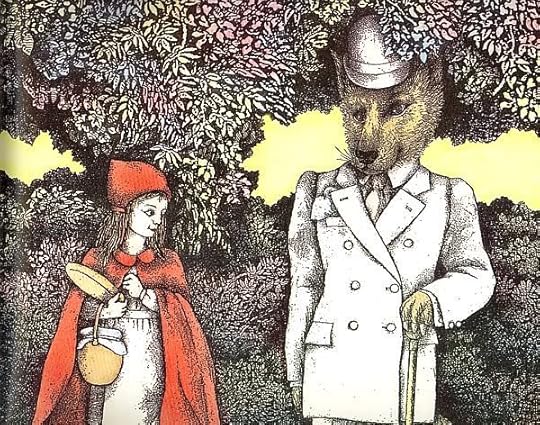
I have been reading “Little Red Riding Hood” ever since I was a child and the version that was always read to me was the “sweet, politically correct, sanitized version where everybody lives happily ever after!”
BUT….
The version I just recently picked up, which is the original text written by Charles Perrault and features illustrations by Beni Montresor, IS NOT the sweet, politically correct and sanitized version that I had grown up with for many years now! I will explain more about this book as I give my thoughts on this particular version of the classic fairy tale, because it is definitely one heck of a doozy!
Basically, the story starts off with a young girl who was known as Little Red Riding Hood due to her always wearing a red cape that was made for her by her grandmother. One day, Little Red Riding Hood’s mother asked Little Red Riding Hood to go to her grandmother’s house and give her a cake and a pot of butter to make her well again. Along the way, Little Red Riding Hood meets up with a gentleman wolf who asks Little Red Riding Hood where she was going and Little Red Riding Hood tells the wolf that she is going to visit her grandmother who is sick in bed. While Little Red Riding Hood picks up flowers for her grandmother in the woods, the Wolf rushes to the grandmother’s house and eats her up when he comes inside the house. Then the wolf dresses himself up in the grandmother’s nighttime clothes and lies in bed until Little Red Riding Hood arrives. When Little Red Riding Hood finally arrives at her grandmother’s house, she opens the door and…
What will happen to Little Red Riding Hood?
Read this book to find out!
Alright, so I basically explained about the story of “Little Red Riding Hood” and since this was a story that was retold over and over again by different generations; I think everyone knows this story already. The only thing different about this version of the classic fairy tale is how the story ends, but I will save that for the cons section of my review! What I really enjoyed about this version of “Little Red Riding Hood” is that we actually get a darker and grimmer version of the classic tale since I had grown up with the “clean” version for so long and it was nice to see a different take on this tale, even though this is technically the original version of the fairy tale. I also really enjoyed Beni Montresor’s illustrations as they are both gorgeous and creepy to look at, especially during the scenes with the wolf preying on Little Red Riding Hood as it makes him look truly scary throughout the book.
The reason why I took off half a star from my rating is because I felt that the ending was a little too abrupt for my tastes, even though this version is darker than the more child friendly version of this tale.
Even though I like the fact that this ending is a lot darker than what we are used to, I would have loved to see some kind of closure with the characters or at least have the book end on a more completed note.
Overall, “Little Red Riding Hood” is a great book to read if you want to check out Charles Perrault’s original story and if you want to read a grimmer version of the classic fairy tale! I would recommend this book to children ages six and up since the ending might scare younger children.
I don’t know if I had ever read a translation of the original text before but especially when paired with Montresor’s illustrations it is haunting from the very beginning. The textured black that makes up walls, forests and curtains seems to loom over you and the heavy shading adds to the darkness. This girl doesn’t even know to be wary and it adds to it that this wolf looks like a gentleman. I don’t think I’d ever seen a version before where you actually see one of them getting eaten but Montresor gives you quite the shot of the wolf with the girl’s head in it’s mouth. The text ends with the girl being devoured but the illustrations continue with her floating almost angelically in the wolf’s distended belly for two double page spreads and then on the last page of the book you get a silhouette of the hunter in the door behind the girl trapped in the belly. I suppose it hints at the more modern versions that include a hero, but if this were a student’s first exposure to the tale it might be confusing.
Beni Montresor tells the original story of Charles Perrault, using a unique visual through illustrations in pencil and watercolors. The story includes the eating of Grandmother and Little Red Riding Hood without the woodcutter saving the day as the Brothers Grimm version assures. This version could be used with grades 3-5 as part of a comparative study.
I use this scarier version of LRRH as a compare/contrast with versions by Hyman and Pinkney when teaching parts of plot to my sixth-grade class. This version has no falling action or resolution. It ends with LRRH floating in the wolf's stomach; the woodcutter is pictured in the background on the last page, but he has not yet saved LRRH.
This version of "Little Red Riding Hood" was very dark. I was surprised at how violent the illustrations were, but I thought the author did a nice job sticking to the original story. This was a story I grew up loving, as I am very familiar with it. However, I think I prefer the happier endings.
This book fits into the fairy tale category of traditional literature. Overall, I thought that this book was okay. I didn't mind the retelling of the story and the words themselves. The story followed the general theme of the original story and is very similar to versions of the story that I read as a child.
However, I didn't like the illustrations used in the book. I thought that often they were very static. They didn't really show motion, just generally a frozen picture of the character that was being mentioned. When I began reading, I felt like they didn't really add to the meaning of the book. As I continued, however, the drawing became darker than I would think is appropriate for young children. There is an illustration of Red Riding Hood hanging out of the wolves mouth, and though not bloody or actually gruesome, it just seemed more violent than necessary. The last 4 pages of the book are just illustrations of Red Riding Hood inside of the wolves stomach. Again, not gruesome, just not needed.
I think for adults it is an interesting and unique take on the illustrations, but for children, I'd pick a different version of the story.
This entire review has been hidden because of spoilers.
I've read many versions of Little Red Riding Hood before but the illustrations of this book haunted me. I'm not sure if I would recommend younger children to read this. It might be too vivid for them to handle. I gave it three stars because I still don't know how I feel about this book. Overall, I wished that the ending wasn't so cryptic and that the huntsman/police officer would rescue Red Riding Hood and her grandmother like in other versions.
However, the illustrations and text were hand in hand as it was true to the original story. The fact that this fairy tale has been popular for three centuries is a major significance to literature. If children were to read this, it would really teach them a lesson to not talk to strangers.