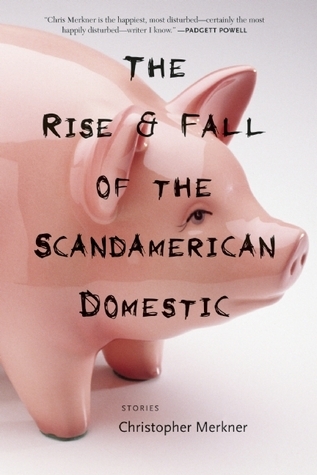
Christopher Merkner is a Shirley Jackson for the contemporary Midwest, where the ties of family and community intersect darkly with suburban American life. In these stories, an enraged village gaslights unsuspecting vacationers and a young man delays a impending confession, fondling the nostrils of his mother's pet pig. Sharp and uneasy, for these inheritors of tradition, that which binds them most closely—offering stability and identity and comfort—are precisely the qualities that set them back, pull them down, burden, limit, and ruin them.
"Merkner’s first short story collection provides a voyeuristic vantage point on fractured lives. He has the striking ability to turn the familiar into the uncanny and morph the comfortable into the weird, and, clearly, he’s at home in that strange realm. In most of the stories, we witness lives at the moment an individual’s identity begins to fray, sometimes slowly and sometimes swiftly. These changes are both painful and thought provoking to witness through the book’s unrelenting first-person perspective. At times Merkner’s prose evokes unease, but more often it encourages a chuckle, and his plot twists will leave even the most seasoned reader surprised. In each story, even those that only run for three pages, the tension mounts deliciously, many times with no foreseeable relief. The true beauty of these tales lies in their delicate endings, which manage to both tie up loose ends and leave everything hanging, so that they are simultaneously satisfying and mysterious. Such complexity makes great reading for lovers of short fiction, and for all who wish to witness a new master at work."—Booklist
Christopher Merkner teaches creative writing at West Chester University. His work has appeared in Black Warrior Review, Cincinnati Review, Fairy Tale Review, Gettysburg Review, New Orleans Review, and Best American Mystery Stories. He and his wife and kids live in West Chester, Pennsylvania.
There are so many talented writers publishing today, and it's not easy to stand out in such a large pack. Merkner does. He is developing into one of our most original voices in contemporary American literary fiction. In a deceptively simple but loaded prose style reminiscent of Grimm's fairytales, he pulls you in to his domestic tales, where his quirky point of view works best. No one looks at the world as he does. Here is a humorous "taste" of his observation on mall pizza:
"Strange breadless pizza--robust, god-awful huge--is smoking in front of us."
And then within his sometimes twisted, dark, confined stories of family, marriage, parenthood, and community come profound insights:
"When they are among us, those we love are so much among us we pretend we don't need to do anything. And when they are no longer among us, those we love are so much completely gone we pretend we have do something, everything, to try to bring them back. It occurs to me we probably have this completely backwards."
My copy is much dog-eared to mark many such passages.
If you can get past the first difficult story in the collection, you're in for a special ride. It even caught the attention of The New York Times. Read it and see why....
This is an astoundingly good debut book of short stories. There is a coherence to the collection - most of the stories are about parenting and, if not parenting directly, the complications and anxieties in families, and there is a similar tone and voice to many of the pieces - but each piece is distinct, and startling on its own. Most of the stories, which range in length from very short stories to much longer pieces, are funny, strange, and at the same time very moving. The final story, "Last Cottage," which was anthologized in The Best American Mystery Stories 2011, is one of the best stories I've read in a long time: quick, odd, beautiful, hilarious, and heartbreaking. I picked this book up again and again after each story, propelled to read another the way a great novel grips your imagination. Read this.
In his debut collection, Merkner presents a darkly funny set of stories that look closely at heartland American culture and reflect it back with devastating accuracy. In “Time in Normallstorg,” for example, violent war games at a child’s birthday party are not only condoned but encouraged as a means to develop the killer spirit from an early age, and the one parent who complains gets beaten up (and more) by the party’s adult hosts. In “Last Cottage,” the permanent residents of a community doggedly work together to banish the last family from their lakeside vacation home by any means (including massive killing of fish) for the sake of commercial development. But they are perplexed by the resilient cheerfulness of the seasonal visitors, which runs counter to their inbred “Scandamerican” work ethic. Merkner’s relentlessly deadpan reportorial voice is not so different from that of Garrison Keillor (Lake Wobegon Days) or the Coen brothers (Fargo). Going in unexpected directions that evoke both laughter and horror, these stories will appeal to readers who are willing to give in to their sense of the absurd.
Many times I was left to scratch my head wondering perhaps something was lost in the translation?
But no, it wasn’t translated... so there’s that.
The book was written well... but just wasn’t for me. Dark, macabre, depressing and oh so very boring. Extremely thankful for the shortness of the collection of short stories... but no, no, no.
Not for me. Two stars - easy read - a collection of stories. Weird for the sake of being weird... no, not for me.
Couldn't finish. Could not get past the first story. Images I don't want are still revolving in my head, which tells me he is a brilliant writer, just not for me at this time.
Going through “The O. Henry Prize Stories 2015”, edited by Laura Furman, I was really taken by the story “Cabins” by Christopher Merkner. So taken, I just had to read more by Merkner. A search of Amazon uncovered “The Rise & Fall of the Scandamerican Domestic: Stories”, Merkner’s short story collection, published by Coffee House in 2013. I felt a certain kinship with Merkner. We were both raised in the northern Illinois/southern Wisconsin area; we are both of Scandanavian descent; as a husband and father, I could identify with the narrator of most of the stories. Additionally, I have always had a strong attraction to American writers of the 60’s, and early 70’s. Merkner’s writings shows significant influence from postmodernist writers such as Donald Barthelme, Kurt Vonnegut, Raymond Carver, and Richard Brautigan. Markner’s language is simple, straightforward, and spare. Thematically, Merkner provides a fresh, updated look at ground previously explored by John Updike in “Rabbit Runs” and the rest of the Rabbit series. While the Rabbit series neatly progresses in chronological order, Merkner’s stories hop around most of the adult narrator’s married life. The stories are all evidently about the same character. Stories about the narrator’s life after his son has grown and left home are intermixed with stories about a young married couple and stories about a couple with young children. Which allows us to see the development of the narrator and provides some insights into his relationship with his grown son. Like Barthelme and Brautigan, Merkner steps outside of what we expect as the ordinary. Yet his characters don’t seem to be aware that they are acting oddly. At times, timelines seem to be surreal. In the story, “Scandamerican Domestic”, the father tells his children, out of the blue, that he’ll “take them to Sweden in the morning”. And in the next paragraph, they are on the plane to Sweden, and then they are staying in a dream/nightmare like hotel room/cottage. The actions and reactions of the characters in his story are also often “not quite right”, and sometimes actually downright disturbing. In "Last Cottage” (the last story in the collection), the townspeople of “Slocum Lake” have been trying to get rid of out-of-towners who own the last cottage on the lake that has not been commercially developed. The steps taken by these, in their own view, normal, hardworking people, go way beyond what we would normally consider “normal”, or even “sane”. In the view of the townspeople the Larsons are a nice enough couple, with four-year-old twin children. The Larsons have been coming to Slocum Lake for 15 years, trying to “live the traditional way for vacationers.” Which the locals find “depressingly outmoded.” The town bands together to sabotage the Larson’s property. Their actions always seem to result in the Larsons not only surviving, but coming out stronger. The story climaxes with a tragedy that is at least allowed to happen by the townspeople that have been staking out and spying on the Larsons on what is probably the Larson’s last trip to Slocum Lake. With the exception of the last story, “Last Cottage”, names are not used. And then, there is only the last names of the outsiders and the last name of one townsperson. This language, the lack of names, unreal timelines, and outsized actions of the characters, Merkner elevates the stories beyond the feelings and experiences of a single character. He helps us to look beyond ourselves and to see a more universal condition.
Fairly dark and funny and scathing stories, and I want to like them for the setting and the humor, but I'm just not feeling suburbia and parenthood right now. I want to read about different people; I'm tired of thinking about this part of culture. Definitely not an indictment of the author, I do like the horror here and the points made, and maybe I will come back to it at a different time. DNF about 50%
Christopher Merkner doesn’t waste time revealing his sensibilities. He kicks things off with the first-person narrator of “Of Pigs and Children” worried about how he’s going to explain how he “accidentally gaffed” his uncle in the temple “with one of my musky bucktails on a very simple and heaving backcast.” He needs to explain what happened to his mother but she’s distracted by her Vietnamese potbelly pig. The story of Uncle Ackvund’s demise comes to us in bits and pieces and we soon learn all the grisly facts, from wheelbarrow to “slop in the culvert,” about the narrator’s miserable attempts to save his uncle’s life.
The opening sentence of “In Lapland” is a perfect example of Merkner’s breezy, easy style: “On Thursday my wife returns from work and says she needs some color in the house, can’t live in this cell-hole another minute, what have we done to bring ourselves to this way of living at our age, we aren’t twenty-five-year-old twist, not anymore.” When the couple encounters a color snob in the form of saleslady who tries to talk them off the “Country Rill” green they are chasing, they bottle up their wrath. “We’ve reserved all this direct outrage for the car ride home and really let the car windows have it,” the husband reports.
The painting project is really, in fact, all about their sexual dynamics and sexual tension between the couple and Merkner isn’t subtle. He goes after the blush.
“Friday, the brush is frayed and starchy, limpid and stiff at the same time—caked in a sort of translucent lacquer and generally incapable of offering a stroke of Country Rill that does not somehow ruin a previous stroke. My whole rhythm is off. I’m doing harm. My wife just winces, says things like ‘Oh, Guud.’”
Merkner finds humor in the ordinary. The stories seem to ask, why are things the way they are? Do we have to accept them just because? How did I get here?
Merkner pushes the envelope, surreal in spots and sardonic in others. Merkner’s characters seem to simultaneously participate in the story and turn to at the reader and say, “can you believe this is happening?’ You catch a wink like Kurt Vonnegut, a flash of humor like the best of Tom Robbins, and then a fun patch of prose a la John Updike.
The titles are ample clue to the tone, “When Our Son, 26, Brings Us His First Girlfriend” and “Check the Baby” and “We Have Them To Raise Us,” a story about a wife who goads and cajoles her husband into helping plan a party with her ex-boyfriends—all 36 of them. (“We Have Them To Raise Us” would make for a great episode of “Portlandia.” So would a few others.)
The last story is a doozie. “Last Cottage,” told in the collective “we” third-person that speaks on behalf of an entire community that’s in favor of “progress” in the sense of commercial development. The “Larsons” have been coming to Slocum Lake for fifteen years and possess the only waterfront property that has not succumbed to The Borg.
The Larsons have been subject to a series of bullying tactics but so far seem oblivious to the collective message to give up their quaint family ways and see the light. So a plot is hatched to electroshock the lake and cover the Larsons’ beachfront in dead fish. The Larsons greet the escalating affronts with pluck, resourcefulness and an innocent shrug. How infuriating!
The ending borders on Kafka country and reminded me of Thomas Berger’s fine novel “Neighbors” in its ambiguous moral compass around a tale set in a place where we’re all supposed to get along.
“Getting along,” in fact, might be the dark undercurrent here—the notion of what we’re supposed to do in middle class, Midwestern America versus how things actually play out.
Merkner’s characters reference the general suburban-Scandinavian-porcelain gene pool, but seem to recognize the pros and cons of their heritage. “My specific roots are northern Midwest, settlers near Green Bay,” the narrator of “We Have Them to Raise Us” informs us, “and while we know our way around the labyrinth of deception, because we are half the time misleading ourselves, we are not actually well prepared genetically for the confined chambers of overt and sustained lying.”
Such explicit self-analysis is rare. More often than not, Merkner’s characters are genetically well prepared for standing in wonder. They don’t often fight. The sabotage in “We Have Them to Raise Us” is sweetly mounted but only after we get some insights on the benefits of passivity. These are not journeys of self-discovery but surreal views of family intimacies that turn the world cock-eyed and make you wonder what we all take for granted.
Two quotes to keep in mind as you read "The Rise & Fall of the Scandamerican Domestic:"
Salvador Dali: “Surrealism is not a movement. It is a latent state of mind perceivable through the powers of dream and nightmare.”
Frank Kafka: “I write differently from what I speak, I speak differently from what I think, I think differently from the way I ought to think, and so it all proceeds into deepest darkness.”
Darkness and, in the case of Merkner, a healthy dose of humor.
I'm giving this two stars and not one, only because the writing itself was fine. There were a few lines that would have been passably good if it wasn't found in this collection. But I found this to be many things. Depressing, bleak, needlessly grotesque. And boring--god, so boring. I would not have read this outside the context of a college assignment.
PLOT - In his short story collection, The Rise & Fall of the Scandamerican Domestic, Christopher Merkner uses humor and satire, to peel apart relationships and family dynamics, with a heavy emphasis on people living in the midwest with scandinavian heritage.
LIKE- The Rise & Fall of the Scandamerican Domestic came my way via the book fair at the 2016 AWP Conference. I love small presses and discovering new authors. My method was to go up to a booth, in this case the booth for Coffee House Press, and ask the seller what they recommended. "Hey, I don't know you, you don't know me, but what is your favorite book at your booth." This method works surprisingly well most of the time. The Rise & Fall of the Scandamerican Domestic came enthusiastically recommended.
I got a kick out of recognizing my relatives in Merkner's characters. I have Norwegian heritage on both sides, with my great grandparents having immigrated to the mid-west region of the United States. Although I was born in Southern California (my parents were mostly raised here too), they still clung to many of the traits and overall way of thinking that they inherited from their parents; stoic, passive aggression, and exceptionally well-mannered while in public. Merkner uses these traits against his characters, forcing them to confront the negative results of their behavior. The funny thing is, even if they understood the moral lesson, I doubt any of the characters would admit it. Stubbornness is another trait.
One of my favorite stories was, Last Cottage, in which a poor lake resort community, decides that it will try to force the Larson family, to sell their land. The Larson's visit their cottage only in the summer and they are the final family that hasn't sold to developers. Rather than speak to the Larson's directly, community members first vandalize their house, damaging the roof during winter, so that they will get interior water damage. When that doesn't make the Larson's leave, the entire community, including law enforcement, pitches in to electrocute fish in the lake and purposefully directing the mass of rotting fish to the small patch of beach by the Larson's cottage. Up until the very twisted end of the story ( No spoilers), both the Larson's and the community play a game of passive aggression and manners, even as the stakes rise. Merkner excels at increasing the tension and keeping the suspense.
Another favorite was Of Pigs and Children. This one is memorable for its imagery. It's gross and weird, but also visceral, and it would not leave my mind. It's the first story in the collection, making it a great litmus test. If you can handle this story, keep on reading, if not, Merkner might not be your cup of tea.
One more stand-out was We Have Them to Raise Us. The concept behind this story was intriguing; a wife tells her husband that she would like to invite all of her former lovers to her thirty-first birthday party. She asks her husband to help plan it, and he can be there, as long as he doesn't make overt references to their marriage or new baby. What is most fascinating is how the husband responds. It's unexpected, however it also plays right into those themes of manners and passive aggression.
DISLIKE - I found myself disconnected from many of the stories, almost skimming them.
RECOMMEND- I would definitely recommend the stories that I liked, Merkner has a vivid imagination. I love his balance between wit and truly dark, horrific material. However, I can't recommend, The Rise & Fall of the Scandamerican Domestic, as a collection, too many of the stories were a disconnect.
A mixed bag of short stories. I really liked the first and last of the stories ("Of Pigs and Children" and "Last Cottage") ...but was less enthused with most of the rest.
The degree to which Merkner relies on shock value and "weird for the sake of being weird" fuckery to distract from the quality of his writing is profoundly annoying.