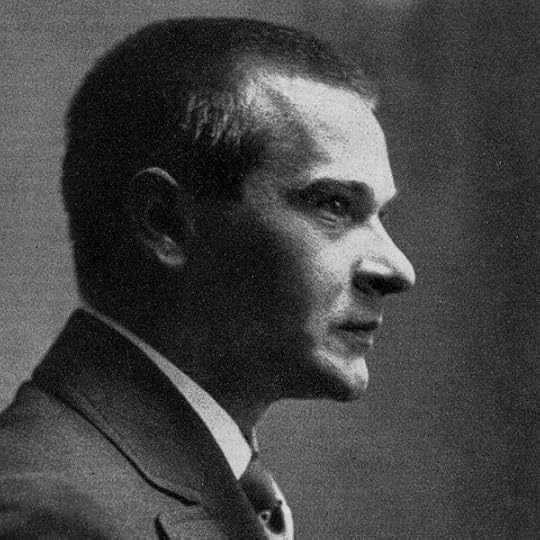
Georg Trakl ist einer der bedeutendsten Vertreter des deutschsprachigen Expressionismus, doch sein Werk weist über weit seine Zeit hinaus. Kaum ein Lyriker der Moderne hatte solch großen Einfluss auf die nachfolgende Generation wie er. Tod, Verfall und der Untergang des Abendlandes sowie die Suche nach Gott sind die zentralen Themen, die er in kraftvollen Bildern und einer melodisch-rhythmischen Sprache umsetzt. Er träumt von einem neuen Menschen und der Rückkehr zu einer paradiesischen Unschuld.
Vom Schatten eines Hauchs geboren Wir wandeln in Verlassenheit Und sind im Ewigen verloren, Gleich Opfern unwissend, wozu sie geweiht.
[From the shadow of a breath born We wander forsaken Lost in the Eternal, forlorn, Like sacrifices unknowing whither they are taken.](*)
Georg Trakl had a very short and rather unhappy life, but his was the first German poetry I fell in love with, long ago. The quiet and deeply resonating darkness of his unique voice still captivates me when I crack open my copy of his complete works - one slim volume.
Fourth in an upper middle class family of six children (not including a much older stepbrother) in Salzburg, Trakl was a poor, because nonengaged student, but very early on he passionately read Baudelaire, Dostoevsky and Nietzsche and started his first literary experiments in 1904. Unfortunately, he also began his first experiments with drugs around the same time, perhaps in imitation of his idol, Baudelaire. The poor reception of his initial attempts at theater induced an even heavier use of the drugs. He tried a career as a pharmacist (!), but he wasn't particularly successful at that, either.
Nonetheless, around 1910/11 he found his poetic voice(**) and, in 1913, a true believer outside of his narrow circle of friends, Ludwig von Ficker, who edited a literary periodical, Der Brenner, and thenceforth published Trakl's work. Indeed, von Ficker eventually played a role analogous to that of Max Brod in Kafka's reception history. Karl Kraus also published some of his poetry in Die Fackel. Trakl's mental problems worsened, though, as did his consumption of drugs.
Strongly influenced by visionaries and mystics like Friedrich Nietzsche and Jakob Böhme, Trakl's intrinsically hypersensitive nature already made him receptive to the atmosphere of decay and impending doom that had built up in most of Europe and particularly in the Austro-Hungarian Empire, resulting in ominous poems of guilt, decay and destruction even before it was clear to everyone that the "War to End All Wars" was ineluctable. Nonetheless, von Ficker was close to the mark when he wrote of Trakl's poem "Helian" that "The form of this text seems to be congealed eternity." Trakl was not merely doomsaying.
His dark, obsessive voice with its recurring images of the Sister, the Youth Elis, Autumn, night, the moon, stones and flowers, along with the colors blue and red and their join, purple, is immediately recognizable in all of his "mature" poems. The word "monotone" is often used to describe his work; but few of his readers would employ the word pejoratively, for mysteries - some dreadful, some wonderful - are evoked, and in neighboring lines quiet resignation is interrupted with a cry of anguish or fear or wonder and then followed by some transfixing horror or moment of grace. He deliberately juxtaposes apparently unrelated lines in order to generate a synesthetic result. The individual poems are not monotone, the mutually reinforcing ensemble is. The full effect is only attained by immersion in many poems, but one of the half-dozen versions of "Abendland" will have to do here.(***) In my experience it is best to read his poems very slowly and really pause at the punctuation, which serves in lieu of much verbiage in his work. Also some endlines should be read as if punctuated. 1.
Mond, als träte ein Totes Aus blauer Höhle, Und es fallen der Blüten Viele über den Felsenpfad. Silbern weint ein Krankes Am Abendweiher, Auf schwarzem Kahn Hinüberstarben Liebende.
Oder es läuten die Schritte Elis' durch den Hain Den hyazinthenen Wieder verhallend unter Eichen. O des Knaben Gestalt Geformt aus kristallenen Tränen, Nächtigen Schatten. Zackige Blitze erhellen die Schläfe Die immerkühle, Wenn am grünenden Hügel Frühlingsgewitter ertönt.
2.
So leise sind die grünen Wälder Unsrer Heimat, Die kristallene Woge Hinsterbend an verfallner Mauer Und wir haben im Schlaf geweint; Wandern mit zögernden Schritten An der dornigen Hecke hin Singende im Abendsommer, In heiliger Ruh Des fern verstrahlenden Weinbergs; Schatten nun im kühlen Schoß Der Nacht, trauernde Adler. So leise schließt ein mondener Strahl Die purpurnen Male der Schwermut.
3.
Ihr großen Städte Steinern aufgebaut In der Ebene! So sprachlos folgt Der Heimatlose Mit dunkler Stirne dem Wind, Kahlen Bäumen am Hügel. Ihr weithin dämmernden Ströme! Gewaltig ängstet Schaurige Abendröte Im Sturmgewölk. Ihr sterbenden Völker! Bleiche Woge Zerschellend am Strande der Nacht, Fallende Sterne.
[ 1.
Moon, as if a dead thing stepped Out of a blue cavern, And of fallen flowers Multitudes are strewn over the stony path. Silver weeps a sick thing By the evening pond, On a black punt Lovers cross over to death.
Or Elis' steps Ring through the Hyacinthine grove Dying out again under the oaks. Oh the boy's figure Formed of crystalline tears, Nocturnal shadows. Jagged lightnings illume his temple, The ever-cool, When on the greening hill Spring storms resound.
2.
So quiet are the green forests Of our home, The crystal wave Dying on the decayed wall And we have weeped in our sleep; Singers walk with hesitant steps Past the thorny hedge In the evening summer, In the holy quiet Of the far radiating vineyard; Now shadows in the cool lap Of the night, mourning eagles. So quietly closes a lunar beam The purple stigmata of melancholy.
3.
You great cities Built of stone In the plain ! So speechless follows The homeless one With darkened brow the wind, Naked trees on the hill. You distantly darkening streams ! A hideous sunset In stormclouds Appalls. You dying peoples ! Pale wave Breaking on the beach of the night, Falling stars. ]
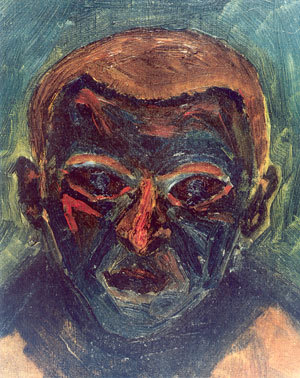
Georg Trakl, selfportrait, November, 1913
When World War I commenced, Trakl was pulled into the army and sent to the Eastern Front. At the beginning of September, 1914, he witnessed the particularly brutal battle at Gródek as a medical lieutenant and for two days and two nights had to treat 100 seriously wounded soldiers in a barn with minimal supplies and without the aid of any doctors. A subsequent attempt to shoot himself was foiled by his fellows, and he was sent to a military hospital in Kraków. He put an end to his torment with an overdose of cocaine on November 3, 1914. His last poem, written during the final breakdown, is still unmistakably Trakl.
Gródek Am Abend tönen die herbstlichen Wälder Von tödlichen Waffen, die goldnen Ebenen Und blauen Seen, darüber die Sonne Düstrer hinrollt; umfängt die Nacht Sterbende Krieger, die wilde Klage Ihrer zerbrochenen Münder. Doch stille sammelt im Weidengrund Rotes Gewölk, darin ein zürnender Gott wohnt Das vergossne Blut sich, mondne Kühle; Alle Straßen münden in schwarze Verwesung. Unter goldnem Gezweig der Nacht und Sternen Es schwankt der Schwester Schatten durch den schweigenden Hain, Zu grüßen die Geister der Helden, die blutenden Häupter; Und leise tönen im Rohr die dunkeln Flöten des Herbstes. O stolzere Trauer! ihr ehernen Altäre Die heiße Flamme des Geistes nährt heute ein gewaltiger Schmerz, Die ungebornen Enkel.
[ In the evening the autumnal woods sound With deadly weapons, the golden plains and blue seas, over which the sun More darkly rolls; the night enfolds Dying warriors, the wild lament Of their shattered mouths. Still in the pastures quietly collects, A red thunderhead in which lives a raging god, The shed blood, lunar coolness; All streets empty into black decay. Under golden boughs of night and stars Sister's shadow falters through the silent grove To greet the heroes' spirits, the bleeding heads; And softly sound the chambers of Autumn's dark flutes. Oh more prideful grief ! You adamantine altars Today the spirit's hot flame is nourished by a monstrous pain, The unborn progeny. ]
I've oft wondered how his poetry would have evolved had Trakl been able to survive his problems, for there had been some evolution after he had found his voice. But there's no need for idle speculation. His moments of poetic grace are now preserved in an eternal, unchanging amber I take out and gaze at late, late at night.
(*) There are many, many translations of Trakl's poetry available. The translations used in this review are by yours truly. A good number of the German language poets of the mid 20th century have acknowledged the importance of Trakl's work to their own, including the greatest 20th century poet in the German language, Paul Celan. If you'd like to hear the actor Oskar Werner (whom you might remember from François Truffaut's Jules et Jim) read the poem of which I gave the opening four lines: https://www.youtube.com/watch?v=qeh_v...
(**) Which is not to say that all of the earlier poems are negligible, just that if they were his sole legacy, Trakl would not be the important and influential poet he became. It is of some interest to note that it was around 1909 that he became acquainted with Rimbaud's work, which apparently helped him to find himself.
(***) Das dichterische Werk contains multiple versions of many poems, as found in his papers posthumously. It also contains what remains of his prose and theater pieces, much of which he destroyed.
Trakl was a significant German poet of the early twentieth century who left a small body of work before he died at the untimely age of 27. Within his extant verse he does present a unique vision of some power, but he seems, unfortunately, to have lacked the time to develop his craft, and the dozens of poems he left us are marked by a striking repetitiveness in style and subject.
Well, first I have to say that my first language is German, so i am much into German literature and read those poems in German too. When Trakl first crossed my way about eight years ago, it was love at first sight. Those poems spoke to me in a way only few others had before.
So whoever wants to give it a try, the dark, mystical and mysterical world of this poems is really special and the more you read and get into it, the more it will capture you in its depth.