Paperback original. #3 in the "Daedalus Mission" series, which also includes The Florians (1976); Critical Threshold (1977); The City of the Sun (1978); Balance of Power (1979); The Paradox of the Sets (1979).
Brian Michael Stableford was a British science fiction writer who published more than 70 novels. His earlier books were published under the name Brian M. Stableford, but more recent ones have dropped the middle initial and appeared under the name Brian Stableford. He also used the pseudonym Brian Craig for a couple of very early works, and again for a few more recent works. The pseudonym derives from the first names of himself and of a school friend from the 1960s, Craig A. Mackintosh, with whom he jointly published some very early work.
This is the third book in a series I never intend to read other books from. I usually prefer to skip the first one or two books in a series – they tend to be filled with uninteresting worldbuilding details that get in the way of the plot – but in this case, I was specifically interested in how this story was told, rather than in the series itself. It seems like both a deliberate reversal of “Dune,” but also a musing on some of its central issues without all of the self-importance. This book takes place on a water-covered world known as “Poseidon” where few creatures if any have developed past the amphibian stage to become land-based, and a human colony has established itself on an island chain; there is a giant species of “whalies” and a highly addictive drug that establishes social order and the colonists exist in a more or less feudal state with a dueling tradition. All of that would make it hard enough to avoid comparisons with “Dune,” but the author’s interest in ecological and evolutionary issues and their effect on local politics, and the longer-term politics of human expansion make it even more obvious. There are some important differences. This is a relatively near-future colonial situation, in which colonies have virtually no contact with interstellar travelers, although the protagonist of our story is part of survey team from Earth trying to determine if any of the colonies sent a few generations before have survived. The locals treat this team with suspicion and a bit of fear, though the protagonist confesses that they have no real power to change anything without local cooperation. It seems to me, given that the author is British (I think this version has been edited for an American audience – there are very few “Britishisms” to be found), that there is some grappling with the legacy of Earth-bound colonialism, and perhaps a bit of wistful reflection of its “positive” side, especially vis-à-vis the exchange with the local native population, but Stableford does not develop this well. In general, what he does well is to write a brief, suspenseful story with a somewhat unlikable protagonist (not sure if that was deliberate, but I’m going to give him the benefit of the doubt and say it was) and a healthy dose of moral ambiguity. It is the kind of story that will at least get you thinking about the human condition and our impact on the world(s) around us.
In their 3rd mission the crew of the Daedalus visit the world of Poseidon, or rather Wildeblood as the planet is now named. It seems that a member of the original survey team had found such an amazing world that he went out on the colony ship and proceeded to take over the entire running of the new colony...
Of course, there's an unseen problem on the world that will need to be solved if the colony is going to continue to thrive, and its up to Alex and the crew to find out what it is before its too late. Complicating the matter is the fact that there is an intelligent native species on the world as well, necessitating the crew to be split up to investigate both.
I remember this book as being one of the lesser stories in the series, and a reread proves so but it also has some interesting elements to it that I would not have picked up on first read. This is a seemingly successful colony but the price of that success has been to give up a lot of freedom to the ruling regime, descendents of Wildeblood. Can a cult of personality turn into a monarchy if if continues for enough generations? I'm thinking here of North Korea, but I could pick other examples such as India (the Gandhi dynasty) or the USA (the Kennedys) equally well.
The world we encounter here is one in transition - going from simply survival to well established if not yet comfortable to everyone. Of course, to maintain an authoritarian regime there has to be an authority which others have to obey or face the consequences. As with most such regimes, there is a rebellious element, and of course this is who Alex ends up dealing with.
There is quite a lot of political intrigues and manoeuvring going on within the the ruling group, but Alex is quick to discover that one reason for their hold on the population is that they are being drugged to keep them compliant. The source of the drug is the main focus of the story, but unfortunately it is rather easy to work out
It's may not be the best story in the series, but it is entertaining in its own right.
Having enjoyed The Halcyon Drift by this author so much last month I just could not keep my hands off more of Stableford's books and I was trying to because the Wildbloods Empire and the other two I have are from the Daedalus Mission novel series, but they are #3 and #4.
And it turns out that this one at least, works pretty well out of sequence.
Now In Greek mythology, Daedalus was an incomparable artisan skilful architect and craftsman, seen as a symbol of wisdom, knowledge and power. He is the father of Icarus. Not having read the first books I am probably missing some of the significance of that naming, though there is a reference to the Greek myth.
The world building/universe building is interesting and what made this book really stand out to me. First the universe building: At some point in human history, humanity got interstellar travel and sent out scouting missions to look for worlds to colonise. I don't know how many, but quite a few, by the sound of it, were surveyed. Poseidon was a water-world, one of those surveyed during this phase. A number of worlds were colonised, including Poseidon, but then a political change back on Earth produced an 80 year moratorium on space travel and that meant that the colonies were left to themselves for a few generations before the Daedalus mission sets out to make contact again.
Our protagonist Alex, is the ecologist on this mission to contact these colonies, assess how they are doing. Possibly provide assistance and eventually to report back to Earth about the colonies. A lot is riding on it because the future of colonising other worlds might be at stake. This is book three and I gather that previous worlds were challenging in different ways.
Now on to the WORLD building. The world was named Poseidon by the Earth committee, but Wildeblood was the ecologist on the survey team and he came back to colonise. He has become almost an ancestor worship figure in this colony. He shaped it, both physically and socially and the colony has continued to follow his lead. The head of the colony is his descendant Philip, who still lives in the manor that James Wildeblood built. It is a true, hereditary empire. Nathan the negotiator of the team and Alex, our protagonist and narrator are staying at the manor.
It is obvious they are not wholly trusted, they always are accompanied everywhere, there is a sense of unrest in the colony and at the beginning of the book Alex is on his way to rendezvous with a member of a rebellion/resistance. This contact is very chary about what is happening, giving out hints, a coded message and not much else.
Alex himself is restless and uneasy. He does not much like the whole, hereditary nobility style of things and he would rather be off with other members of the team who are doing actual ecology. Because the big thing about this planet is that it is unique in having an indigenous, intelligent species.
And here is where the novel really took flight for me! I LOVED the ecological concept; a water world with most usable land on a series of islands and I ADORED the way Stableford proposed the intelligent species. An aquatic race, similar to amphibious, only marine. A species in which Neoteny like we see in Axolotls and some other salamanders and Efts applying to the WHOLE species in a unique way. So we have adult reproductive, individuals in the marine environment. Adult reproductive stages on land, and juvenile stages in both. A really complex, fascinating construct which I loved. I also LOVED the idea of an r- selection species rising to intelligence, and while most ecologists in the 1970's did not consider this possible, Stableford came up with a really good theory for it.
These excellent ecological elements are not central to the story however, mostly it is Alex trying to uncover the secrets, both biological, social and hereditary, of this colony. There is a mystery or thriller type feel to it because of this primary plot which does resolve in a quite fascinating, if morally ambiguous way. And while I did feel like there was a point around two thirds in that the story slowed down a bit, it recovered well.
This whole concept is excellent in my opinion, The contact with many different colonies on different worlds gives Stableford a chance to showcase a range of worlds and ecologists, which is exactly what he does. Reading it out of sequence was ok. There was some reference to previous events, previous worlds, previous injuries. coy mentions of 'Muriel's talent' which is being used to contact the indigenous intelligent species. Otherwise it worked well as a stand alone and I am glad I did pick them up without waiting for the whole series.
I like these books. I like the analytic style, the outlook undergirding them. There's just something preventing them from passing that threshold of "enjoyable" to "very good". A significant portion of it may be the insulting ease with which the ultimate solution works itself out. Finding the solution may be difficult, but implementing it never has a hitch significant enough to mention.
If book one was equal parts politics and ecology, and book two all ecology, this third is all politics. The colony of Poseidon, now called Wildeblood after its first ruler, patriarch and revered ancestor James Wildeblood, is the most successful yet, and also houses the first intelligent native life found by the expedition. A leader of a revolutionary group tips off Alexis to the source of Wildeblood power: an addictive psychotropic drug which energizes and makes physical exertion pleasurable, solely distributed by the Wildeblood family. Unfortunately for him, this isn't enough to declare the colony unsuccessful.
This is really Nathan's book, with him having his own offscreen adventures, and again determining the political framing of the solution, even more painfully for Alexis, as it is living people thrown under the bus this time. The rivalry developing between Alexis and Nathan is the best part of these books. Alexis recognizes that Nathan is not evil, and often in the right regarding the practicality of their mission, yet he hates what Nathan represents, and dislikes the man himself (which makes the scene where Alexis has to coach and hype up Nathan for his duel ten times funnier). Nathan doesn't hate Alexis, and even admires him in some ways, but wishes they could find harmony (meaning, recognition that Nathan is always right).
Thrown into the mix is the figure of James Wildeblood.
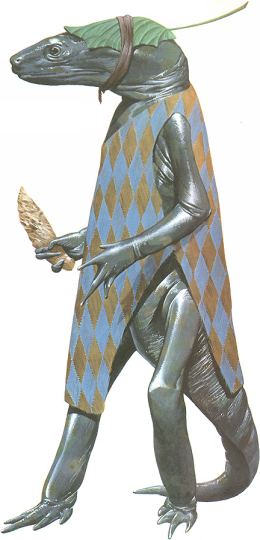
Those native lifeforms form an extremely minute part of the story, unfortunately. The description as being able to freely metamorphose between land and neotenic aquatic forms is potentially interesting, but this isn't that story. Isn't his hat cute though?
The Daedalus is a starship from Earth visiting 6 planets to which colony ships were sent over 100 years ago. Their mission is to find out the state of the colonies and help them if possible. Each novel in the series recounts the mission to one of the 6 planets. Each planet presents different problems and mysteries to the crew that need to be solved.
In book 3, Daedalus arrives at a colony on a water world listed as Poseidon. They discover the inhabitants refer to the planet as Wildeblood's Empire, apparently renamed after the colonist's chief ecologist somehow took over the colony as ruler and spent the rest of life turning the world into his personal idea of the perfect human society.
But Wildeblood is long-dead and things seem to be falling apart with a potential civil war in the offing if the Daedalus crew can't solve the mystery of how Wildeblood and his government pacified and controlled the colonists, and why their control is begin to break down. The government doesn't want to reveal its secret and the opposing faction won't talk without trading for information the crew may not be able to give them. The answers may lie with a little know indigenous species that seems to be intelligent.
The books in this series seem to improve with each volume, perhaps because the character development of the Daedalus crew is minimal in each book but the cumulative effect across the series is more interesting.