

What do you think?
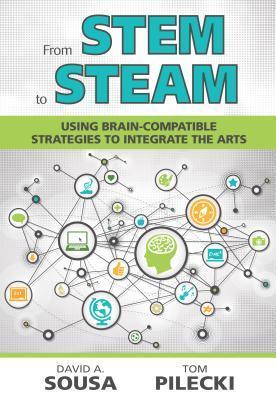
From STEM to STEAM: Using Brain-Compatible Strategies to Integrate the Arts
Build the skills mathematicians and scientists need! A is for arts―and for the advantage students gain when you integrate arts into STEM instruction. As research in neuroscience shows, arts activities enhance creativity, problem solving, memory systems, and analytical skills―all critical for achieving STEM success. Now best-selling author David Sousa teams up with veteran arts educator Tom Pilecki to bring
280 pages, Paperback
First published March 1, 2013
Ratings & Reviews
Friends & Following
Create a free account to discover what your friends think of this book!
Community Reviews
Displaying 1 - 9 of 9 reviews

November 27, 2017
I'm fine with recommending this to colleagues in STEM education. The authors, however, never quite define what an integrated STEM learning looks like and instead just argue for the inclusion of art or art-related thinking thus changing the acronym to STEAM. First, there is a misconception that STEM fields are not "artistic." Second, the integration of arts-like processes in STEM teaching is simply what many of us would call "best practices." But they are probably right in their implicit belief that in much of the teaching in science, technology, engineering and mathematics the artistic elements are minimized if not fully purged. Perhaps the best use of this book is as a guide to transform traditional education systems. That is, to create schools with more active learning and interactive teaching methods. For that purpose the book has much to offer.
July 14, 2022
Just okay. Like so many PDs I’ve attended over the years, 70% of this book is dedicated to WHY we should teach STEAM (you don’t need to convince me. That’s why I bought the book!) but only about 30% provides usable lessons that would actually help me get started. In the last chapters there are lesson plan ideas but they’re not great (some are pretty good but most lack rigor). The brain based research in the early chapters was interesting. It was a good book it just could have been a lot better.

July 25, 2022
This was the textbook for a course I took in 2021, and it was worth every penny.
Since reading this book, I've rewritten my STEM courses - Physical Geography and Lab - to be completely project based learning. I've included letting students choose really amazing projects, and they have stepped up to these tasks with incredible depth and imagination. I can't recommend this book enough if you are a teacher considering making the leap from "Skill and Drill" to Project Based Learning.
Since reading this book, I've rewritten my STEM courses - Physical Geography and Lab - to be completely project based learning. I've included letting students choose really amazing projects, and they have stepped up to these tasks with incredible depth and imagination. I can't recommend this book enough if you are a teacher considering making the leap from "Skill and Drill" to Project Based Learning.

May 27, 2017
Brilliantly written, full of wonderful resources, user-friendly, and absolutely fascinating. One of the best books for teachers I have ever read and cannot wait to use their STEM ideas and arts-integration strategies.
March 5, 2017
There really wasn't anything special or new about this. It is all just best practice.

June 28, 2017
It was ok, but nothing really new. We are getting started with our Makerspace and was hoping for something relevant.
June 2, 2014
YES!
As any good liberal arts aficionado knows, interdisciplinary learning is where it's at. The premise of this book is not necessarily to become a polymath for the sake of intellectual merit points, but rather to use creativity and the arts as a foundation for both approaching and functioning within the STEM fields. The need for "real" scientific practices of hypothesizing through trial and error is frequently highlighted in educational texts; Sousa takes it one step further by literally intertwining creative activities into this process, (posing suggestions for classroom teachers to collaborate with artists, including lesson plans for educators to use as a launching pads).
Highly recommend for all teachers, particularly those interested in innovation and the STEM fields. Lesson plans and practical applications need (lots of) work, but overall a good theoretical introduction to infusing creativity into classically empirical fields.
As any good liberal arts aficionado knows, interdisciplinary learning is where it's at. The premise of this book is not necessarily to become a polymath for the sake of intellectual merit points, but rather to use creativity and the arts as a foundation for both approaching and functioning within the STEM fields. The need for "real" scientific practices of hypothesizing through trial and error is frequently highlighted in educational texts; Sousa takes it one step further by literally intertwining creative activities into this process, (posing suggestions for classroom teachers to collaborate with artists, including lesson plans for educators to use as a launching pads).
Highly recommend for all teachers, particularly those interested in innovation and the STEM fields. Lesson plans and practical applications need (lots of) work, but overall a good theoretical introduction to infusing creativity into classically empirical fields.

July 27, 2015
Great explanations for how/why art integration in schools is beneficial for students academically and emotionally/socially.
Actual lesson plan ideas for a variety of science and math topics as well as a variety of grade levels (K-12). This is a practical guide to incorporating more art in STEM classrooms!
Actual lesson plan ideas for a variety of science and math topics as well as a variety of grade levels (K-12). This is a practical guide to incorporating more art in STEM classrooms!
Read
December 11, 2015372.5 S725 2013
Displaying 1 - 9 of 9 reviews