

What do you think?
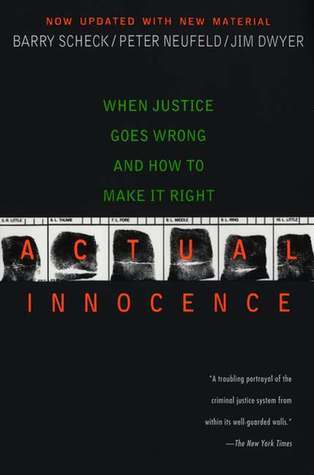
Actual Innocence: When Justice Goes Wrong and How to Make it Right
Here are the stories of innocent men and women—and the system that put them away under the guise of justice. Now updated with new information, Actual Innocence sheds light on “a system that tolerates lying prosecutors, slumbering defense attorneys and sloppy investigators” (Salt Lake Tribune)—revealing the shocking flaws that can derail the legal process and the ways that DNA testing has often shattered so-called solid evidence that condemned American citizens to death.
432 pages, Paperback
First published February 5, 2000
Ratings & Reviews
Friends & Following
Create a free account to discover what your friends think of this book!
Community Reviews
Displaying 1 - 30 of 88 reviews

October 4, 2011
I can honestly say this is one of the only books that has completely changed my life. Before reading I was a fence sitter on the subject of the death penalty, and most often I leaned towards being pro death penalty. While reading I saw so many ways that the court system could and does fail to ever support legalized death in this country again. I can not remember the case name off the top of my head, but the story about the red haired man from Missiouri who was wrongly convicted and sentenced to death haunts me to this day. I know had I been on the jury and presented with the same information I would have convicted an innocent man as well.
Anyway, not only is the book informative, it is also easy to read and divided into different types of judicial errors for easier access. I totally recommend this book to anyone.
Anyway, not only is the book informative, it is also easy to read and divided into different types of judicial errors for easier access. I totally recommend this book to anyone.

January 27, 2019
Extraordinary book by Barry Scheck detailing the cases of actual persons that were falsely convicted for crimes they did not commit. Cases involving sentences of life and death penalty. Barry Scheck relates the process that he and his team at The Innocence Project use to investigate and exonerate persons wrongfully convicted. He also covers cases where persons were put to death for crimes they did not commit. I highly recommend this book if you have any interest in legal or crime studies. If you are on the fence about where you stand regarding the death penalty I recommend this book for you to read also. The book is well thought out and the high profile cases are examined in detail to show a casual reader how the injustice took place and everything that each person lost as a result of their wrongful conviction. Regardless of where you think you stand about the death penalty, this book will illuminate areas of justice (injustice) that are not often talked about in the media. This book should be required reading for all high school and college political science and government courses. It's a life changing read.

March 30, 2012
First things first, if inspiration for righteous indignation is not what you're looking for in reading material, look elsewhere. Second, the book is fifteen years old, so the landscape on this issue has changed a bit since this was written (for one thing, 49 states now have DNA access laws, which was not the case in 1999).
That said, this book does a really fantastic job of telling the story of what it was like as DNA testing became a possibility for proving innocence in courts of law. The authors lay out the main places where our criminal justice system was (still is, I imagine) failing to locate and convict guilty parties of crime. The authors discuss the (un)reliability of eyewitness identification and prison snitches, police and prosecutorial misconduct of heinous degree and frequency, issues with ineffective counsel, and the overall attitude of society and legislators of actively burying our heads in the sand and not noticing or doing anything about these problems. They do this through case studies of wrongfully convicted folks who served various sentences, some of them more than a decade, some on death row, before being proven innocent through DNA testing that, in most cases, was unavailable during their initial trials.
The most striking part for me was that as DNA testing of evidence became more prevalent and began proving the innocence of convict after convict, no one seemed to want to talk about how that might suggest broader problems with our systems of investigating and prosecuting crime. Not all crimes involve DNA to be tested. If DNA evidence is showing we were wrong in all these cases where it existed, is it really plausible that we weren't wrong in some of the cases without DNA evidence to test? Where and how did we go wrong? How can we change police/prosecutor/jury procedure so we don't get it wrong as often?
The authors, 2 of whom started the Innocence Project in 1992, have suggestions in each chapter for how reforms can be made to the particular problem that chapter addresses. The reforms are also collected in a reference section at the back of the book. I love when non-fiction authors go beyond identifying and exploring a problem to making suggestions for how to fix it. It seems like that step gets left out too often.
The downside about the reference section is that the info is pretty out-of-date, but the good news is that some of the suggested reforms have been enacted in some states since then. There are also many state-specific innocence projects now, all with websites, and while it appears the need is still overwhelming the resources, there does seem to be more national attention on this issue now than there was fifteen years ago, and some positive legislative change since this book was written.
That said, this book does a really fantastic job of telling the story of what it was like as DNA testing became a possibility for proving innocence in courts of law. The authors lay out the main places where our criminal justice system was (still is, I imagine) failing to locate and convict guilty parties of crime. The authors discuss the (un)reliability of eyewitness identification and prison snitches, police and prosecutorial misconduct of heinous degree and frequency, issues with ineffective counsel, and the overall attitude of society and legislators of actively burying our heads in the sand and not noticing or doing anything about these problems. They do this through case studies of wrongfully convicted folks who served various sentences, some of them more than a decade, some on death row, before being proven innocent through DNA testing that, in most cases, was unavailable during their initial trials.
The most striking part for me was that as DNA testing of evidence became more prevalent and began proving the innocence of convict after convict, no one seemed to want to talk about how that might suggest broader problems with our systems of investigating and prosecuting crime. Not all crimes involve DNA to be tested. If DNA evidence is showing we were wrong in all these cases where it existed, is it really plausible that we weren't wrong in some of the cases without DNA evidence to test? Where and how did we go wrong? How can we change police/prosecutor/jury procedure so we don't get it wrong as often?
The authors, 2 of whom started the Innocence Project in 1992, have suggestions in each chapter for how reforms can be made to the particular problem that chapter addresses. The reforms are also collected in a reference section at the back of the book. I love when non-fiction authors go beyond identifying and exploring a problem to making suggestions for how to fix it. It seems like that step gets left out too often.
The downside about the reference section is that the info is pretty out-of-date, but the good news is that some of the suggested reforms have been enacted in some states since then. There are also many state-specific innocence projects now, all with websites, and while it appears the need is still overwhelming the resources, there does seem to be more national attention on this issue now than there was fifteen years ago, and some positive legislative change since this book was written.

January 7, 2016
So, obviously this book is written about a subject matter that is pretty important to me. But the great thing about this book, for me, is really that it lays out so many of the causes of wrongful convictions and it's brutally honest about how it's a whole system failure - sometimes it's more one particular cause, but it's everything from junk science and overstating evidence to eyewitness misidentification to biased/poor police investigations and overzealous prosecutors and defense attorneys sleeping on the job. There's no one fix that's going to solve this problem. And to an extent, that's always going to be true. But I think, what this book really does best, is to remind us that we're all human and that some mistakes are going to be made in the criminal system, but that we can't allow our own blinders to prevent us from looking at the whole picture. In so many of the cases discussed here, if someone had just looked at the whole story and delved a little deeper, a lot of people could have been spared a lot of unnecessary pain.
Anyway, I could go into detail about each of the cases/circumstances discussed in each chapter, but the end result is this: if criminal justice reform is something you're interested in, this is a book I would recommend.
Anyway, I could go into detail about each of the cases/circumstances discussed in each chapter, but the end result is this: if criminal justice reform is something you're interested in, this is a book I would recommend.
July 30, 2010
I agree with the death penalty in theory, in that those who willfully take the life of another do not deserve life for themselves. But ultimately, the death penalty is impractical to apply in real life. There is too much of a chance that an innocent person will be executed. So reluctantly I am against the death penalty, and this book explains why better than I could.

November 5, 2012
The cases Barry Scheck cites will make you ill. Innocent people going to jail or execution because prosecutors hid evidence, or created it.

June 24, 2020
I love this book - it is an oldie but a goodie that provides a framework for understanding how wrongful convictions happen. It is a page turner that's full of compelling stories about innocent people who are wrongly convicted while exploring the system that failed them.

May 14, 2019
As someone who has a passion for true crime and finds the criminal justice system incredibly interesting, I was so excited to read this book. It was compelling, well-written, and served to highlight just how complex our criminal justice system is. I was shocked by some of the injustices talked about in this book and was equally sickened by the way we handled it afterwards. If you're interested in learning more about DNA exonerations and the the science behind how innocent people get thrown in jail, this a non-fiction piece you won't want to pass up.
March 15, 2024
A good introduction to the work of the Innocence Project and the role of DNA testing in freeing the wrongly convicted. The narratives throughout the book felt a little repetitive, but overall, good content.

January 2, 2022
I know I am at risk of becoming cliche to say this is mandatory reading but I do feel very American should. People who think that people who believe our justice system can improve are just cop haters are clearly racist, because you are deliberately and willfully denying the truth, that the "harmless errors" the justice system makes negatively impacts more black Americans than white. We are not cop haters, we just want the actual criminal to go to prison.
Favorite passages: any text in brackets are mine
"Some people think that an error rate of one percent is acceptable for the death penalty," notes Kevin Doyle, the capital defender for the state of New York. "But if you went to the FAA and asked them to approve an airplane, and you said, oh, by the way, on every one hundredth landing, it causes or almost causes fatalities, people would say you were nuts."
On the evening of December 19, 1974, a short documentary film was shown on the local NBC newscast in New York. In it, a you7ng woman walks in a hallway. A man lurks in a doorway, wearing a hat, leather jacket, and sneakers. The man bursts from the doorway, grabs the woman's handbag, and runs straight toward the camera, full-faced. The entire incident lasts twelve seconds.
After the film was shown, the show presented a lineup of suspects. The viewers were provided with a phone number and asked to choose the culprit from among those six, or to say that he wasn't in the lineup. 'We were swamped with calls,' Robert Buckhout, a professor at Brooklyn College who organized the experiment, would later write. They unplugged the phone after receiving 2,145 calls.
The 'thief' was seated in lineup position Number 2. He received a grand total of 302 votes from the callers, or 14.1 percent of the 2,145. 'The results were the same as if the witnesses were merely guessing, since on the basis of chance (1 out of 7, including No 2,' Buckhout wrote in an article with the charming headline NEARLY 2,000 WITNESSES CAN BE WRONG.
Not surprisingly, those involved in such demonstrations often find themselves feeling deflated, and slightly put out, upon learning that they might as well have picked the culprit by throwing darts, blindfolded. When Buckhout used the same purse-snatching documentary with panels of lawyers and judges, he reported similar inaccuracy. But the members of the bar were peeved. THEY COMPLAINED THAT THE SUSPECTS IN THE LINEUP WERE NOT WEARING THE SAME CLOTHES AS THE THIEF IN THE FILM! [Capitalization is mine]
Elizabeth Loftus, illustrated the phenomenon of 'unconscious transference,' in which the mind drafts a vaguely familiar face to play a role that could not otherwise be cast.
Loftus described a case from real life in which a railroad ticket agent was held up at gunpoint. The agent was brought to the police station, where he viewed a lineup of suspects. He picked a sailor from a local naval base as the robber.
But when the police investigated the sailor, he turned out to have a solid alibi and was freed. How did the mistake happen? The ticket agent said the sailor's face looked familiar--and he was right. Because the sailor was based near the railroad station, he had bought train tickets from the very same agent three times before the robbery. But on the day of the robbery, the sailor was at sea. To the psychologists, the sailor was an obvious victim of the unconscious transference phenomenon.
[Two DNA tests excluded Peter Snyder, a man in prison for rape. But in the state of Virginia where he was convicted] "The law specifically said that a motion based on new evidence had to be made within three weeks of the conviction. By that law, the DNA evidence was approximately six years and seven months too late for it to matter. [DNA testing didn't exist when he was convicted in 1986.] That left one recourse: executive clemency.........
In theory, Snyder could have gone to federal court and asked for a writ of habeas corpus--a powerful tool that allowed the national court system to reach into the state system and correct injustice. But even that avenue was becoming cloudy. Just as Bing's laboratory [the lab that was doing the second DNA test to validate] was clearing Snyder, the chief justice of the Supreme Court, William Rehnquist, said that the federal courts did not have to entertain claims of innocence. A person convicted in state court could bring a claim to federal court that a trial had been unfair in its procedures but not its results. Nothing in the Constitution said that the federal courts were required to examine proofs of innocence. 'A claim of actual innocence is not itself a constitutional claim,' wrote Justice Rehnquist. He said prisoners who maintained their innocence should ask the governors of their states for pardons or clemency.
So the Snyder case now rested uneasily in the hands of Gov. L. Douglas Wilder, a Democrat in a conservative state. Snyder's freedom had become a political, not legal, issue. And Wilder's staff was concerned that he not be tarred as soft-on-crime liberal. By releasing Snyder, the governor would be acting against the adamancy of Faye Treatser, who continued to insist that Snyder had been her attacker.
All this was conveyed to Peter [Neufeld from Innocent Project] by the governor's public-relations aide. The case was a problem, and it was analyzed in political terms.....Peter understood that Snyder's innocence was a political liability to the governor, just as he realized that his innocence was a legal corpse that the courts had no interest in reviving.
Peter rang the leading newspaper in Richmond, the capital of Virginia....Not only was this hot news--a pardon petition from the defense and the prosecutor---but it was terrific human interest story. For seven years, Edith Snyder, a hardworking postal clear, had doggedly fought to prove her son's innocence. She and her husband had taken second mortgages and second jobs. Now Edith's journey was all but complete. She had concrete, irrefutable evidence of his innocence. Even the prosecutor agreed. How about that! Any day now, Governor Wider would be signing an order of executive clemency. The Snyder family was tying yellow ribbons around the fence on their lawn. The story got great play. The governor's public-relations man called Peter in a rage. 'What are you doing?" he screamed.
'We think it's a great story,' said Peter. 'Don't you?'
'The governor could get hurt here,' said the aide.
More stories ran in Richmond about the valiant Snyders. On April 23, Governor Wilder signed an executive order freeing Walter Snyder, grumbling that he had been dragged into the fray. The law had to be changed. 'It's to much power (for a governor) to say that an innocent person should not go free,' Wilder said. But, he acknowledged: 'I'm convinced he's not guilty.....If (DNA) can be used to convict, it must also be used to protect the innocent.'
'I just don't understand what's taking so long,' said Barry. 'The DNA shows who the real murderer is. And it's not Robert Miller.'
'All the DNA proves is that there were two killers, not just Robert Miller,' said Elliot [Ray Elliot, head of criminal prosecutions in the office of Oklahoma City district attorney] 'All we know from the DNA is that he was not the donor of the semen. We know from Robert's own statement that he was there. He knew things only the killer would have known.'
'You know he made one hundred and thirty-three wrong guesses in that videotape,' said Barry
Elliot smiled.
'His own words put him at the scene of the murder. Don't you worry about it, Barry, we're gonna needle your client.'
'I am sorry,' Barry said. 'I don't know what you mean.'
'You know, lethal injection, the needle,' explained Elliot. 'We're going to needle Robert."
[spoken like a true psychopath, and this is a person responsible for putting people in prison, a person who wants to murder]
Then PCR tests were done, and they clearly excluded Robert Miller. He had not been the rapist of either dead women.
'We'd be waiting outside a judge's chambers, and Ray Elliot would say: 'It's a damn shame they didn't kill him before this DNA testing.' [again spoken like a murderer]
In Canada, the country was shaken by a single, spectacular wrongful conviction based on phony snitch testimony. Guy Paul Morin, twenty-three, was accused of murdering and sexually assaulting his next-door neighbor in 1983. The bulk of the evidence came from two jailhouse informants. When his conviction was overturned in January 1995 because he was proven innocent by DNA tests, a commission reviewed the case and laid down new rules for the use of jailhouse snitches. Now, before a snitch can testify, a high-level screening committee of prosecutors must satisfy themselves that the tale can be corroborated, and not just by other inmates. The committee also must determine whether the snitch, like Terri Holland, is a recidivist. In court, the testimony is presumed unreliable, and the prosecutor must show the judge that it is worth hearing before it can be presented to the jury. Finally, all deals with the informant must be written, and all conversations either videotaped or audiotaped.
Not an iota of reliable evidence would be blocked if such rules were adopted in the United States.
How could such junk science [hair and bite mark] prevail in matters of life and death? Often, the horror of a violent crime will open the door to uncritical acceptance of 'novel' techniques that produce no reliable evidence. When these techniques are brought into court, typically as evidence against poor defendants, the defense simply does not have the resources or expertise to mount a difficult challenge.
More important, the legal standard for scientific evidence, the 'Frye Rule,' created a witless echo chamber: If one court allowed hair evidence, a second court would not make an independent judgment on its admissibility. And if one hair expert testified that he or she had followed the techniques practiced by other hair experts, then that usually was good enough for the courts. Indeed, deafened by the reverberations of previous Frye rulings, the courts would simply ignore new data, like the LEAA proficiency tests that showed hair experts should not be trusted.
In 1985, a Houston woman was raped in her bed. She described the intruder as a 'white male, age thirty-five.' She also described him as 'a white male, but he had an unusual color of skin. It was a honey brown color, but he was not black.' Four months later, she spotted Kevin Byrd in her neighborhood. He was the rapist, she said. Kevin Byrd, however, was black and unmistakably so. At trial, the victim and the prosecution managed to persuade the jury that her attacker was black, and that her repeated use of the word 'white' in the police reports was an error by the detectives. The same error was contained in the report she signed. The jurors believed her and convicted Byrd.
Twelve years went by, and Byrd's cause was taken on by a leading Texas defense attorney Randy Schaffer. He arranged DNA test on the rape kit that showed Kevin Byrd to be innocent. Then came the amazing performance of George W. Bush.
On July 25, 1997, the district attorney joined Schaffer in petitioning the Board of Pardons and Paroles for a gubernatorial pardon of Byrd on the grounds of actual innocence. Three days later, the judge who presided at the trial, Doug Shaver, and the sheriff, Tommy Thomas, sent similar pleas to the board. The board acted swiftly and unanimously recommended that Governor Bush pardon Byrd.
The governor denied the pardon and suggested the whole matter belonged in court. The governor's spokeswoman pointed out that the victim still believed Byrd was her attacker. The Bush political calculus was clear: Duck not only the tough calls but any that might carry the slightest risk of having a crime victim get on TV and call you an accessory to rape. A few weeks after Bush's denial of the pardon, the defense attorney got a letter in the mail from the governor. Randy Schaffer opened it eagerly, hoping for good news from Bush. He found, instead, a fund-raising pitch.
'I took his letter and sent it back, and where he says, 'I need your help,' I wrote, 'I need your help: Will you pardon Kevin Byrd?,' Said Schaffer.
Not long afterward, with the national press covering the Byrd follies, Bush reversed himself and signed the Byrd pardon. Kevin Byrd was the fifteenth person to be pardoned by Bush. He was the first African American to receive one. The governor said that mentioning race was a disgrace.
[race was everything! Bush just didn't like being called out]
During most of the twentieth century, rape was a capital offense in many states, meaning the offender could be executed. This sentencing option was rarely exercised when white men were convicted; however, it was almost universally employed when a black man was found guilty of raping a white woman. In the early decades of the century, the newspapers would report delicately that a 'Negro male was hanged for the usual crime.' [black men are just always raping] Of those executed for rape, 90 percent were black.
The number of capable public defenders is astonishingly high, but so is their burn-out rate. No wonder. Start with the overwhelming caseload. The prosecution is backed with far more resources and enjoys a base of public support for its cases. The typical indigent defendant is seen as a pariah and the defense lawyer as close kin. With an infusion of financial support that would put their salaries on a par with local prosecutors, continuing legal education, and a more flexible work plan, cynicism and pessimism could be defeated. No less than the public and prosecutors, the defense bar needs to absorb the revelations of the DNA era, especially the exclusion of 25 percent of the prime suspects in the laboratory. What was good enough for government work no longer should pass, whether in the private sector or the public defender's office.
'We cannot pretend that in three decades we have completely escaped the grip of a historical legacy spanning centuries,' declared Justice [Thurgood] Marshall. 'We remained imprisoned by the past as long as we deny its influence on the present.'
Favorite passages: any text in brackets are mine
"Some people think that an error rate of one percent is acceptable for the death penalty," notes Kevin Doyle, the capital defender for the state of New York. "But if you went to the FAA and asked them to approve an airplane, and you said, oh, by the way, on every one hundredth landing, it causes or almost causes fatalities, people would say you were nuts."
On the evening of December 19, 1974, a short documentary film was shown on the local NBC newscast in New York. In it, a you7ng woman walks in a hallway. A man lurks in a doorway, wearing a hat, leather jacket, and sneakers. The man bursts from the doorway, grabs the woman's handbag, and runs straight toward the camera, full-faced. The entire incident lasts twelve seconds.
After the film was shown, the show presented a lineup of suspects. The viewers were provided with a phone number and asked to choose the culprit from among those six, or to say that he wasn't in the lineup. 'We were swamped with calls,' Robert Buckhout, a professor at Brooklyn College who organized the experiment, would later write. They unplugged the phone after receiving 2,145 calls.
The 'thief' was seated in lineup position Number 2. He received a grand total of 302 votes from the callers, or 14.1 percent of the 2,145. 'The results were the same as if the witnesses were merely guessing, since on the basis of chance (1 out of 7, including No 2,' Buckhout wrote in an article with the charming headline NEARLY 2,000 WITNESSES CAN BE WRONG.
Not surprisingly, those involved in such demonstrations often find themselves feeling deflated, and slightly put out, upon learning that they might as well have picked the culprit by throwing darts, blindfolded. When Buckhout used the same purse-snatching documentary with panels of lawyers and judges, he reported similar inaccuracy. But the members of the bar were peeved. THEY COMPLAINED THAT THE SUSPECTS IN THE LINEUP WERE NOT WEARING THE SAME CLOTHES AS THE THIEF IN THE FILM! [Capitalization is mine]
Elizabeth Loftus, illustrated the phenomenon of 'unconscious transference,' in which the mind drafts a vaguely familiar face to play a role that could not otherwise be cast.
Loftus described a case from real life in which a railroad ticket agent was held up at gunpoint. The agent was brought to the police station, where he viewed a lineup of suspects. He picked a sailor from a local naval base as the robber.
But when the police investigated the sailor, he turned out to have a solid alibi and was freed. How did the mistake happen? The ticket agent said the sailor's face looked familiar--and he was right. Because the sailor was based near the railroad station, he had bought train tickets from the very same agent three times before the robbery. But on the day of the robbery, the sailor was at sea. To the psychologists, the sailor was an obvious victim of the unconscious transference phenomenon.
[Two DNA tests excluded Peter Snyder, a man in prison for rape. But in the state of Virginia where he was convicted] "The law specifically said that a motion based on new evidence had to be made within three weeks of the conviction. By that law, the DNA evidence was approximately six years and seven months too late for it to matter. [DNA testing didn't exist when he was convicted in 1986.] That left one recourse: executive clemency.........
In theory, Snyder could have gone to federal court and asked for a writ of habeas corpus--a powerful tool that allowed the national court system to reach into the state system and correct injustice. But even that avenue was becoming cloudy. Just as Bing's laboratory [the lab that was doing the second DNA test to validate] was clearing Snyder, the chief justice of the Supreme Court, William Rehnquist, said that the federal courts did not have to entertain claims of innocence. A person convicted in state court could bring a claim to federal court that a trial had been unfair in its procedures but not its results. Nothing in the Constitution said that the federal courts were required to examine proofs of innocence. 'A claim of actual innocence is not itself a constitutional claim,' wrote Justice Rehnquist. He said prisoners who maintained their innocence should ask the governors of their states for pardons or clemency.
So the Snyder case now rested uneasily in the hands of Gov. L. Douglas Wilder, a Democrat in a conservative state. Snyder's freedom had become a political, not legal, issue. And Wilder's staff was concerned that he not be tarred as soft-on-crime liberal. By releasing Snyder, the governor would be acting against the adamancy of Faye Treatser, who continued to insist that Snyder had been her attacker.
All this was conveyed to Peter [Neufeld from Innocent Project] by the governor's public-relations aide. The case was a problem, and it was analyzed in political terms.....Peter understood that Snyder's innocence was a political liability to the governor, just as he realized that his innocence was a legal corpse that the courts had no interest in reviving.
Peter rang the leading newspaper in Richmond, the capital of Virginia....Not only was this hot news--a pardon petition from the defense and the prosecutor---but it was terrific human interest story. For seven years, Edith Snyder, a hardworking postal clear, had doggedly fought to prove her son's innocence. She and her husband had taken second mortgages and second jobs. Now Edith's journey was all but complete. She had concrete, irrefutable evidence of his innocence. Even the prosecutor agreed. How about that! Any day now, Governor Wider would be signing an order of executive clemency. The Snyder family was tying yellow ribbons around the fence on their lawn. The story got great play. The governor's public-relations man called Peter in a rage. 'What are you doing?" he screamed.
'We think it's a great story,' said Peter. 'Don't you?'
'The governor could get hurt here,' said the aide.
More stories ran in Richmond about the valiant Snyders. On April 23, Governor Wilder signed an executive order freeing Walter Snyder, grumbling that he had been dragged into the fray. The law had to be changed. 'It's to much power (for a governor) to say that an innocent person should not go free,' Wilder said. But, he acknowledged: 'I'm convinced he's not guilty.....If (DNA) can be used to convict, it must also be used to protect the innocent.'
'I just don't understand what's taking so long,' said Barry. 'The DNA shows who the real murderer is. And it's not Robert Miller.'
'All the DNA proves is that there were two killers, not just Robert Miller,' said Elliot [Ray Elliot, head of criminal prosecutions in the office of Oklahoma City district attorney] 'All we know from the DNA is that he was not the donor of the semen. We know from Robert's own statement that he was there. He knew things only the killer would have known.'
'You know he made one hundred and thirty-three wrong guesses in that videotape,' said Barry
Elliot smiled.
'His own words put him at the scene of the murder. Don't you worry about it, Barry, we're gonna needle your client.'
'I am sorry,' Barry said. 'I don't know what you mean.'
'You know, lethal injection, the needle,' explained Elliot. 'We're going to needle Robert."
[spoken like a true psychopath, and this is a person responsible for putting people in prison, a person who wants to murder]
Then PCR tests were done, and they clearly excluded Robert Miller. He had not been the rapist of either dead women.
'We'd be waiting outside a judge's chambers, and Ray Elliot would say: 'It's a damn shame they didn't kill him before this DNA testing.' [again spoken like a murderer]
In Canada, the country was shaken by a single, spectacular wrongful conviction based on phony snitch testimony. Guy Paul Morin, twenty-three, was accused of murdering and sexually assaulting his next-door neighbor in 1983. The bulk of the evidence came from two jailhouse informants. When his conviction was overturned in January 1995 because he was proven innocent by DNA tests, a commission reviewed the case and laid down new rules for the use of jailhouse snitches. Now, before a snitch can testify, a high-level screening committee of prosecutors must satisfy themselves that the tale can be corroborated, and not just by other inmates. The committee also must determine whether the snitch, like Terri Holland, is a recidivist. In court, the testimony is presumed unreliable, and the prosecutor must show the judge that it is worth hearing before it can be presented to the jury. Finally, all deals with the informant must be written, and all conversations either videotaped or audiotaped.
Not an iota of reliable evidence would be blocked if such rules were adopted in the United States.
How could such junk science [hair and bite mark] prevail in matters of life and death? Often, the horror of a violent crime will open the door to uncritical acceptance of 'novel' techniques that produce no reliable evidence. When these techniques are brought into court, typically as evidence against poor defendants, the defense simply does not have the resources or expertise to mount a difficult challenge.
More important, the legal standard for scientific evidence, the 'Frye Rule,' created a witless echo chamber: If one court allowed hair evidence, a second court would not make an independent judgment on its admissibility. And if one hair expert testified that he or she had followed the techniques practiced by other hair experts, then that usually was good enough for the courts. Indeed, deafened by the reverberations of previous Frye rulings, the courts would simply ignore new data, like the LEAA proficiency tests that showed hair experts should not be trusted.
In 1985, a Houston woman was raped in her bed. She described the intruder as a 'white male, age thirty-five.' She also described him as 'a white male, but he had an unusual color of skin. It was a honey brown color, but he was not black.' Four months later, she spotted Kevin Byrd in her neighborhood. He was the rapist, she said. Kevin Byrd, however, was black and unmistakably so. At trial, the victim and the prosecution managed to persuade the jury that her attacker was black, and that her repeated use of the word 'white' in the police reports was an error by the detectives. The same error was contained in the report she signed. The jurors believed her and convicted Byrd.
Twelve years went by, and Byrd's cause was taken on by a leading Texas defense attorney Randy Schaffer. He arranged DNA test on the rape kit that showed Kevin Byrd to be innocent. Then came the amazing performance of George W. Bush.
On July 25, 1997, the district attorney joined Schaffer in petitioning the Board of Pardons and Paroles for a gubernatorial pardon of Byrd on the grounds of actual innocence. Three days later, the judge who presided at the trial, Doug Shaver, and the sheriff, Tommy Thomas, sent similar pleas to the board. The board acted swiftly and unanimously recommended that Governor Bush pardon Byrd.
The governor denied the pardon and suggested the whole matter belonged in court. The governor's spokeswoman pointed out that the victim still believed Byrd was her attacker. The Bush political calculus was clear: Duck not only the tough calls but any that might carry the slightest risk of having a crime victim get on TV and call you an accessory to rape. A few weeks after Bush's denial of the pardon, the defense attorney got a letter in the mail from the governor. Randy Schaffer opened it eagerly, hoping for good news from Bush. He found, instead, a fund-raising pitch.
'I took his letter and sent it back, and where he says, 'I need your help,' I wrote, 'I need your help: Will you pardon Kevin Byrd?,' Said Schaffer.
Not long afterward, with the national press covering the Byrd follies, Bush reversed himself and signed the Byrd pardon. Kevin Byrd was the fifteenth person to be pardoned by Bush. He was the first African American to receive one. The governor said that mentioning race was a disgrace.
[race was everything! Bush just didn't like being called out]
During most of the twentieth century, rape was a capital offense in many states, meaning the offender could be executed. This sentencing option was rarely exercised when white men were convicted; however, it was almost universally employed when a black man was found guilty of raping a white woman. In the early decades of the century, the newspapers would report delicately that a 'Negro male was hanged for the usual crime.' [black men are just always raping] Of those executed for rape, 90 percent were black.
The number of capable public defenders is astonishingly high, but so is their burn-out rate. No wonder. Start with the overwhelming caseload. The prosecution is backed with far more resources and enjoys a base of public support for its cases. The typical indigent defendant is seen as a pariah and the defense lawyer as close kin. With an infusion of financial support that would put their salaries on a par with local prosecutors, continuing legal education, and a more flexible work plan, cynicism and pessimism could be defeated. No less than the public and prosecutors, the defense bar needs to absorb the revelations of the DNA era, especially the exclusion of 25 percent of the prime suspects in the laboratory. What was good enough for government work no longer should pass, whether in the private sector or the public defender's office.
'We cannot pretend that in three decades we have completely escaped the grip of a historical legacy spanning centuries,' declared Justice [Thurgood] Marshall. 'We remained imprisoned by the past as long as we deny its influence on the present.'
This entire review has been hidden because of spoilers.

February 10, 2024
I am obviously in the minority on this one, but I felt like the way it was written felt too much like a textbook to be meaningful or entertaining to me.
It focuses quite a bit on wrongful convictions due to a plethora of things, one of the most common being mistaken eyewitness identification, with later exonerations thanks to advances in DNA evidence.
The Innocence Project is a wonderful organization, and it is terrifying how common wrongful convictions are, especially in death penalty cases. I had no idea how easy it was to sentence someone to death with little more evidence than randomly picking someone out of a lineup.
All of the people discussed in this book have stories that deserve to be told. I just would have preferred the storytelling to have been done a bit differently.
It focuses quite a bit on wrongful convictions due to a plethora of things, one of the most common being mistaken eyewitness identification, with later exonerations thanks to advances in DNA evidence.
The Innocence Project is a wonderful organization, and it is terrifying how common wrongful convictions are, especially in death penalty cases. I had no idea how easy it was to sentence someone to death with little more evidence than randomly picking someone out of a lineup.
All of the people discussed in this book have stories that deserve to be told. I just would have preferred the storytelling to have been done a bit differently.

December 7, 2017
I absolutely love the innocence project which is one reason I really wanted to read this book. I know without a doubt that many people are in prison and on death row who are innocent and convicted based on so many unreliable factors. I wish more had access to DNA evidence and/or other options to have their cases more thoroughly reviewed. The hard-heartedness and lack of caring about taking away years of the lives of innocent people, if not killing them or them dying in prison without ever being able to prove their innocence, is horrifying. Just to close a case, add a W to your record, or be a hero of some sort? It’s disgusting that even after these people, many within hours of the death chamber, were PROVEN NOT guilty, not just beyond reasonable doubt, but with NO doubt, that so many of the prosecutors, investigators, cops, witnesses who knew better, and others involved in the conviction had no guilt or felt no remorse. When 67 people, many on death row, are determined to be innocent within the first few years of the innocence project and only a teensy portion of the claims of innocence by criminals have been reviewed, imagine how many are in jail for no obvious reason, completely innocent, but railroaded by the prosecution and unable to afford a quality defense? And then all of their rights are completely taken away so they don’t even have a chance at proving their innocence? Then, the lack of or very low compensation when they’ve spent years of their lives in prison and the difficult challenges they face trying to readjust to society? Some never do.
Of course, mistakes will happen in letting true criminals go and convicting the innocent. I think almost everyone has been accused of something they didn’t do, as well as gotten away with something they did at some point and that’s tough enough to handle even when minor, but this is only a handful of stories of people convicted for ridiculous reasons and with no good evidence. And then, to be proven innocent, not just NOT GUILTY, but not be allowed out of jail because they didn’t prove it within a certain timeframe? The legal process is slow and it takes years and years sometimes to get anyone to even a knowledge them, much less put together an appeal within a few months or years. Once convicted, always guilty, no matter what.
Thanks to DNA and other technology and techniques, many believed to be guilty now are determined not to be before it ever gets very far, but before the 90s, and even later, there were so many convicted without that available. How many are still there? How many have we killed? Is it worse to kill or take away years of someone’s life who is totally innocent, many hard-working,normal American citizens with not even a speeding ticket in their records, or is it worse to let a guilty person go free? Why is it easier for a guilty person to go free because of legal protocols not being followed and cases getting thrown out than it is for an innocent person to prove his or her innocence after conviction because of laws taking away so many rights? In general, is it worse for an innocent person to be convicted, or a guilty person to go free, no matter what the reason? And, if we put even one innocent person to death (which has been proven to have been done, and many avoided just in time only because of new techniques), is that enough to put an end to the death penalty altogether in this country? Or do a few lives here and there not matter because it’s so important to get the ones who really deserve it? You’ll never see a rich man on death row. Why do some get death, while others who commit more blatantly obvious or more horrific murders get life or 50 years? There are so many factors. People assume there is no way the prosecution would be able to get death or send an innocent person to jail if they really were innocent. It’s just not true. The innocence project is proving that, one case at a time. By 1999, the number of freed, innocent people was 67...And they were just barely getting started. One was granted a stay of execution just two hours before execution, and later proven to be innocent. What if the state had moved forward that night? How many more are in that predicament? How many will we never know about because it’s already too late? What if it was you or a loved one?
This book wasn’t surprising because I’ve followed these stories and stats for over 20 years, but it’s still astounding at how little it takes...and how someone just like me could get home from work to find cops at my door and I’d never see freedom again. It’s something everyone needs to consider. So many cases are tried in the media. So many are guilty before proven innocent. Even once they are determined not guilty, many can never get their lives or reparation back. This book includes excellent proposals at the end to help reduce the chances of error and false convictions. Yes, innocent people confess to crimes they didn’t commit. The rate is astonishing. No one thinks they would ever do that, but the torture these people endure and the mental frame of mind they are in after hours of interrogation and the stories they are told about what “could” have happened to coerce a confession is dreadful and they give in under all the stress, pressure, hours without food, water, or sleep and promised that if they sign this form, everything will get better. Who can say they would never confess to something they didn’t do under those circumstances? And some are mentally challenged and used as scapegoats just to close a case. There are so many ways an innocent person can get convicted with virtually no good evidence of guilt. This book lays many of them out. It provides ways which are so practical that could reduce the chances of an innocent person being convicted, and pretty much eliminate it in the cases with no solid evidence.
This book is great for anyone who believes in the innocence project, and should definitely be read by anyone who doesn’t believe our system is broken by convicting innocent people, or only broken by letting guilty people go free. It will, if nothing else, make everyone think about their stand on these issues and whether it is time to re-evaluate how we handle all criminal cases, and especially capital cases and if the knowledge of having executed even one innocent person is enough to abolish the death penalty entirely. It will give doubters that we’ve never sent an innocent person to the death chamber something to seriously think about. The undeniable FACTS are right here. Again- you will never see a rich person on death row.
We can’t have a 100% perfect system either way, but we CAN have a much BETTER system both ways. It will never be “fair”, but it can be MUCH more fair, less biased, more accurate, and there’s a lot of room for change to reduce wrongful convictions AND letting true criminals free. I personally think the “double jeapordy” law can be revised so it’s not abused, but can allow people to be retried if evidence shows up later proving guilt, which has happened. That is one way to reduce the odds of wrongful convictions by taking pressure off the jury when they have serious doubts, but are afraid of releasing a truly guilty person with no chance of them ever paying for that crime. I also believe there are many things that can be changed to reduce the chances of the innocent being convicted, as well as more opportunities to prove their innocence much more quickly if they are wrongfully convicted so they can more easily and quickly resume their lives . With new techniques, the system is certainly antiquated and the justice system should be fully re-evaluated.
Of course, mistakes will happen in letting true criminals go and convicting the innocent. I think almost everyone has been accused of something they didn’t do, as well as gotten away with something they did at some point and that’s tough enough to handle even when minor, but this is only a handful of stories of people convicted for ridiculous reasons and with no good evidence. And then, to be proven innocent, not just NOT GUILTY, but not be allowed out of jail because they didn’t prove it within a certain timeframe? The legal process is slow and it takes years and years sometimes to get anyone to even a knowledge them, much less put together an appeal within a few months or years. Once convicted, always guilty, no matter what.
Thanks to DNA and other technology and techniques, many believed to be guilty now are determined not to be before it ever gets very far, but before the 90s, and even later, there were so many convicted without that available. How many are still there? How many have we killed? Is it worse to kill or take away years of someone’s life who is totally innocent, many hard-working,normal American citizens with not even a speeding ticket in their records, or is it worse to let a guilty person go free? Why is it easier for a guilty person to go free because of legal protocols not being followed and cases getting thrown out than it is for an innocent person to prove his or her innocence after conviction because of laws taking away so many rights? In general, is it worse for an innocent person to be convicted, or a guilty person to go free, no matter what the reason? And, if we put even one innocent person to death (which has been proven to have been done, and many avoided just in time only because of new techniques), is that enough to put an end to the death penalty altogether in this country? Or do a few lives here and there not matter because it’s so important to get the ones who really deserve it? You’ll never see a rich man on death row. Why do some get death, while others who commit more blatantly obvious or more horrific murders get life or 50 years? There are so many factors. People assume there is no way the prosecution would be able to get death or send an innocent person to jail if they really were innocent. It’s just not true. The innocence project is proving that, one case at a time. By 1999, the number of freed, innocent people was 67...And they were just barely getting started. One was granted a stay of execution just two hours before execution, and later proven to be innocent. What if the state had moved forward that night? How many more are in that predicament? How many will we never know about because it’s already too late? What if it was you or a loved one?
This book wasn’t surprising because I’ve followed these stories and stats for over 20 years, but it’s still astounding at how little it takes...and how someone just like me could get home from work to find cops at my door and I’d never see freedom again. It’s something everyone needs to consider. So many cases are tried in the media. So many are guilty before proven innocent. Even once they are determined not guilty, many can never get their lives or reparation back. This book includes excellent proposals at the end to help reduce the chances of error and false convictions. Yes, innocent people confess to crimes they didn’t commit. The rate is astonishing. No one thinks they would ever do that, but the torture these people endure and the mental frame of mind they are in after hours of interrogation and the stories they are told about what “could” have happened to coerce a confession is dreadful and they give in under all the stress, pressure, hours without food, water, or sleep and promised that if they sign this form, everything will get better. Who can say they would never confess to something they didn’t do under those circumstances? And some are mentally challenged and used as scapegoats just to close a case. There are so many ways an innocent person can get convicted with virtually no good evidence of guilt. This book lays many of them out. It provides ways which are so practical that could reduce the chances of an innocent person being convicted, and pretty much eliminate it in the cases with no solid evidence.
This book is great for anyone who believes in the innocence project, and should definitely be read by anyone who doesn’t believe our system is broken by convicting innocent people, or only broken by letting guilty people go free. It will, if nothing else, make everyone think about their stand on these issues and whether it is time to re-evaluate how we handle all criminal cases, and especially capital cases and if the knowledge of having executed even one innocent person is enough to abolish the death penalty entirely. It will give doubters that we’ve never sent an innocent person to the death chamber something to seriously think about. The undeniable FACTS are right here. Again- you will never see a rich person on death row.
We can’t have a 100% perfect system either way, but we CAN have a much BETTER system both ways. It will never be “fair”, but it can be MUCH more fair, less biased, more accurate, and there’s a lot of room for change to reduce wrongful convictions AND letting true criminals free. I personally think the “double jeapordy” law can be revised so it’s not abused, but can allow people to be retried if evidence shows up later proving guilt, which has happened. That is one way to reduce the odds of wrongful convictions by taking pressure off the jury when they have serious doubts, but are afraid of releasing a truly guilty person with no chance of them ever paying for that crime. I also believe there are many things that can be changed to reduce the chances of the innocent being convicted, as well as more opportunities to prove their innocence much more quickly if they are wrongfully convicted so they can more easily and quickly resume their lives . With new techniques, the system is certainly antiquated and the justice system should be fully re-evaluated.

October 15, 2019
Actual Innocence: When Justice Goes Wrong and How to Make it Right is one of the best books I have read in years. This gripping book reads better than most novels and you cannot put it down. On the surface, Actual Innocence: When Justice Goes Wrong and How to Make it Right is about the use of DNA testing to free convicted men from prison and that alone makes it worth the price of admission. Yet, this is so much more than just this small piece. The broader story is how an innocent person is convicted and sent to prison. How the virtually impossible happens more than anyone wants to admit. More importantly, how hard the system works against admitting a mistake, even when actual innocence can be proven.
Make no mistake, this book is a criticism of the larger system, but it is not wide eyed lunatic fringe zealotry. The authors make their case quite well in a calm and rational manner. They point out the faults in the system and note the damage to both the system and individuals. This is basic punditry for a better and fairer turn for the wrongfully convicted.
Actual Innocence: When Justice Goes Wrong and How to Make it Right spends a great deal of time explaining what happened with each case study and how it progressed to the end. What the reader finds out is how much is human frailty. There are certainly a few bad actors and underlying racism, but much of what happens is plain old fashion mistakes and the inability of both individuals and the court system being unable to admit to the mistakes. How once a suspect is determined, how fast everything else gets ignored due to blinders on the police trying to solve the case. How hard it becomes to free the innocent due to fears of politicians being soft on crime and worries about liability issues.
Much of the book criticizes eyewitness account and how much the victim can get wrong to the point of wrongful conviction. A very touching section lets one of the victims talk about her rape and how wrong she was once DNA excluded the convicted and how convinced she was during the suspect lineup.
As hard as the criticisms and failures of justice are catalogued, this work is ultimately hopeful. That the system has problems, but they can be fixed and science can be brought to the fore and some sensible solutions enacted to protect everyone.
Great read.
Make no mistake, this book is a criticism of the larger system, but it is not wide eyed lunatic fringe zealotry. The authors make their case quite well in a calm and rational manner. They point out the faults in the system and note the damage to both the system and individuals. This is basic punditry for a better and fairer turn for the wrongfully convicted.
Actual Innocence: When Justice Goes Wrong and How to Make it Right spends a great deal of time explaining what happened with each case study and how it progressed to the end. What the reader finds out is how much is human frailty. There are certainly a few bad actors and underlying racism, but much of what happens is plain old fashion mistakes and the inability of both individuals and the court system being unable to admit to the mistakes. How once a suspect is determined, how fast everything else gets ignored due to blinders on the police trying to solve the case. How hard it becomes to free the innocent due to fears of politicians being soft on crime and worries about liability issues.
Much of the book criticizes eyewitness account and how much the victim can get wrong to the point of wrongful conviction. A very touching section lets one of the victims talk about her rape and how wrong she was once DNA excluded the convicted and how convinced she was during the suspect lineup.
As hard as the criticisms and failures of justice are catalogued, this work is ultimately hopeful. That the system has problems, but they can be fixed and science can be brought to the fore and some sensible solutions enacted to protect everyone.
Great read.

September 29, 2022
To most readers, Barry Scheck is known for his dedication to freeing those falsely convicted and imprisoned. He and Neufeld, as public defenders in New York, created the first Innocence Project and have worked in the field for many years. Although the work has been ongoing, the same problems with false eyewitness accounts, corrupted lab results, jailhouse snitches and other issues are still issues.
'In 1999, the Innorcence Project reconstructed sixty-two cases in the United States of the sixty-seven exonerations in North America to determine what factors had been prevalent in the wrongful convictions. Mistaken eyewitnesses were a factor in 84 percent of the convictions, snitches or informants in 21 percent, false confessions in 24 percent, Defense lawyers fell down on the job in 27 percent; prosecutorial misconduct played a part in 42 percent, and police misconduct in 50 percent. A third involved tainted or fraudulent science. Among the more troubling findings is that several of these factors are more pronounced in the conviction of innocent black men.'
Although this book was disturbing to read, a more disturbing event is that I recently read a similar book by David Rudolf, another defense attorney. Although his book is recently released (2022) and this one was written in 1999, the factors and wrongs continue on. Although DNA tests can now quickly tell if an arrested person was involved, the tests have to be run in order to be used. There are thousands of rape kits, for example, gathering dust on police shelves and money must be allocated in order to test them. The system must do a better job of arresting those who truly could be guilty and convicting only those who are. This book is recommended for nonfiction readers interested in the legal system.
'In 1999, the Innorcence Project reconstructed sixty-two cases in the United States of the sixty-seven exonerations in North America to determine what factors had been prevalent in the wrongful convictions. Mistaken eyewitnesses were a factor in 84 percent of the convictions, snitches or informants in 21 percent, false confessions in 24 percent, Defense lawyers fell down on the job in 27 percent; prosecutorial misconduct played a part in 42 percent, and police misconduct in 50 percent. A third involved tainted or fraudulent science. Among the more troubling findings is that several of these factors are more pronounced in the conviction of innocent black men.'
Although this book was disturbing to read, a more disturbing event is that I recently read a similar book by David Rudolf, another defense attorney. Although his book is recently released (2022) and this one was written in 1999, the factors and wrongs continue on. Although DNA tests can now quickly tell if an arrested person was involved, the tests have to be run in order to be used. There are thousands of rape kits, for example, gathering dust on police shelves and money must be allocated in order to test them. The system must do a better job of arresting those who truly could be guilty and convicting only those who are. This book is recommended for nonfiction readers interested in the legal system.
March 3, 2019
The authors belong to the "Innocence Project", an organized attempt to determine the innocence or guilt through recently available DNA evidence of those convicted of murder/violent crimes. In over 80 cases the were able to _prove_ the innocence of the wrongly convicted, many on death row.
This book results from that project and outlines in each chapter some of the failures of the justice system in these cases including the unreliability of eyewitnesses, incompentant defense lawyers, poor laws and more. The book is straightforwardly written and very easy reading. It is also a strong indictment against our current justice system. Unlike many 'critical' books, the authors also offer suggestions for changes that would help improve our justice system and lower the number of the wrongly convicted.
This book has gotten me to think so much about our system of justice and the ramifications, that we have decided to us it as a book in our family book club and I view some experiences now through the prism of this book (recent experience with hearing two very different stories from two people of the same exact event). That a book has affected the way I percieve things is a mark of a good book.
The one criticism I have of the book is that there is not enough supporting evidence. Though I know the focus of the book is what they had learned from the Innocence Project and not a research survey, I would like to have seen more collaborative statistics and references in each chapter (perhaps an appendix with a few studies and further reading would have been welcome).
Still, it is an important and interesting book and well worth reading.
This book results from that project and outlines in each chapter some of the failures of the justice system in these cases including the unreliability of eyewitnesses, incompentant defense lawyers, poor laws and more. The book is straightforwardly written and very easy reading. It is also a strong indictment against our current justice system. Unlike many 'critical' books, the authors also offer suggestions for changes that would help improve our justice system and lower the number of the wrongly convicted.
This book has gotten me to think so much about our system of justice and the ramifications, that we have decided to us it as a book in our family book club and I view some experiences now through the prism of this book (recent experience with hearing two very different stories from two people of the same exact event). That a book has affected the way I percieve things is a mark of a good book.
The one criticism I have of the book is that there is not enough supporting evidence. Though I know the focus of the book is what they had learned from the Innocence Project and not a research survey, I would like to have seen more collaborative statistics and references in each chapter (perhaps an appendix with a few studies and further reading would have been welcome).
Still, it is an important and interesting book and well worth reading.

November 12, 2018
A great book. The co-authors talking about themselves in the third person was a little distracting to me at first, but I quickly got used to it. I think the biggest takeaway I had from this book is that most DNA exonerations are over now (they freed innocent people who had been convicted before advanced DNA testing) but there are still so many ways innocent people can be unjustly convicted. Exonerating DNA evidence doesn't exist in every case - for many if not most of the innocent people profiled in this book, if the DNA evidence hadn't existed to prove their innocence, they would have been executed or stayed in jail forever due to convictions based on things like false snitch testimony, coerced false confessions, junk forensic science, police and/or prosecutor malfeasance, and much more. The innocents freed in this book are the lucky ones, set free after years (often decades!) of unjust imprisonment. Doubtless there are many innocents still imprisoned who barring a miracle have no hope of justice. I already knew our 'justice' system is incredibly flawed, racist,and broken, but this book makes it incredibly stark.

December 6, 2018
Disclaimer: If you want to continue thinking the United States justice system is fair and just...don't read this book.
I felt this book in my soul. It infuriated me. It started a fire. It's not like I don't know that people are wrongly accused, trials are botched, testimonies scewed, evidence facked, etc, it's just not something that I'm not forced to think about very often. And the truth is painful. And ugly. After reading Actual Innocence (which by the way, is apparently not a real reason for someone to be seen as not guilty from a crime. Actual innocence, that is.) I have joined the national movement for The Innocence Project, to be kept in the know of current cases. My friend, Jen, who chose this book for bookclub, is a lawyer. I thought it was pretty cool that this was a required reading for her schooling. I feel like all people involved within the law should be made aware. Do yourself and everyone else a favor and read this book. And then let's do something about it together!
P.S. I'm sitting here laughing for catagorizing this as a dystopian, when in fact, it's truth and reality and disturbing. I'm a freaking riot.
I felt this book in my soul. It infuriated me. It started a fire. It's not like I don't know that people are wrongly accused, trials are botched, testimonies scewed, evidence facked, etc, it's just not something that I'm not forced to think about very often. And the truth is painful. And ugly. After reading Actual Innocence (which by the way, is apparently not a real reason for someone to be seen as not guilty from a crime. Actual innocence, that is.) I have joined the national movement for The Innocence Project, to be kept in the know of current cases. My friend, Jen, who chose this book for bookclub, is a lawyer. I thought it was pretty cool that this was a required reading for her schooling. I feel like all people involved within the law should be made aware. Do yourself and everyone else a favor and read this book. And then let's do something about it together!
P.S. I'm sitting here laughing for catagorizing this as a dystopian, when in fact, it's truth and reality and disturbing. I'm a freaking riot.

June 1, 2018
This book follows the development of the Innocence Project and it's efforts to free the innocent wrongfully convicted. Not all are on death row, but all have been in prison for crimes they didn't commit. The biggest development that has helped free innocent people has been the the discovery of DNA. It has been particularly effective in rape cases. The book follows many cases where people have been wrongfully convicted only to be proven innocent. The book shows the fallacies in our system that allow the innocent to be convicted. The authors also offer reforms that would help avoid such occurrences. The system works against the convicted with shorter time limits to introduce new evidence, the refusal of the courts to allow testing of DNA after conviction and the refusal to punish misdeeds by police and prosecutors. The effects of this rigged system are felt especially by minorities. This book is definitely unsettling as it shows how unfair our system can be.

September 19, 2018
“The bottom line is we’re making all these God-like decisions without God-like skills. But people don’t want to be bothered by that.” Page 222 says it all. So grateful for the Innocence Project and DNA evidence. Now all I can think about is how many people are currently on death row that are innocent. These stats make it hard to have faith in our legal system - mistaken eyewitnesses were a factor in 84% of wrongful convictions; snitches or informants in 21 percent; false confessions in 24%. Defense lawyers fell down on the job in 27%; prosecutorial misconduct played a part in 42%; and police misconduct in 50%. A third involved tainted or fraudulent science. We need to allow for DNA evidence to be tested at any time in any state (without expiration dates). If not, we become murderers as a society. If we have DNA evidence, it should always be tested as soon as possible.

August 30, 2021
This is a very good read of true cases in the USA where innocent people have gone to jail for a crime they did not commit: sometimes because of shoddy police work, sometimes because the police have made the perp fit the crime. But there are some whom will stand up and fight for the right, and even though these battles can be quite the challenge, there are many being freed from their life long jail sentence, even death. It is so hard to believe that these kinds of incidents can be happening in such high numbers. Great to see that someone is standing up for them. Definitely a very great read.
June 2, 2021
This is a wonderful piece of non-fiction from the founders of the Innocence Project. The book is a debunking of all evidentiary myths that have permeated popular culture. While it is a little outdated it is still surprisingly relevant. By exposing the holes in the legal system, it tries to rectify the problems and offer solutions to them. It is also terrifying to imagine that junk science can mean the difference between life in prison or freedom. It is an accessible look at some complex science and the inner workings of the justice system.
January 6, 2026
This was a required reading my senior year of college for all forensic science students. I firmly believe this is a must-read for anyone in the forensic or criminal justice field. It sheds a much-needed light on the importance of integrity in the field and a real-life look on what happens when that fails. This one still rings with me after a decade out of school and working in the field. If you don’t walk away from this one feeling angry and maybe a bit self-righteous, you missed the point.
September 30, 2023
This book makes you wonder how many are in prison right now maybe even on death row and they are innocent. All it takes mis-taken identity by the witness, a snitch wanting a shorter prison time or a Prosecutor wanting to close the case. This book explains them all and gives you a better understanding of what can go wrong in a criminal case. Read this before you read Journey toward Justice.
December 1, 2020
Chilling, disturbing, horrifying, terrifying reading. A powerful and compelling book that gives an indsigt in the wronfulg convictions. How fatally Wrong things can go I the American criminal Justice system.

January 21, 2022
I had to read this for a research paper I'm conducting for class. However, I sped through it, and it was quite the eye opener. I think anyone interested or involved in criminal justice should read this book.
Read
January 29, 2022Very interesting. Scary thought how many innocents get convicted because of lousy detective work, lies, etc

October 23, 2022
Foundational and inspiring in many ways but goddamn the ableist language in here
January 29, 2023
This was fantastic. So well-written and compelling. This will change your view on the legal process. It did for me. This is a classic. So glad that I heard about this. Highly recommended.

November 26, 2023
This one was great. Almost hard to believe at times the lengths that prosecutors will go to cover their errors and imprison the innocent for the sake of "solving" a crime.

January 17, 2025
4.5!!!!
Displaying 1 - 30 of 88 reviews