This book is an experiment. Inspired by the bizarre and uncanny, it is an attempt to use science and rationality to lift the veil off the irrational. Its ways are weaving along its path one finds UFOs and fairies, quantum mechanics, analytic philosophy, history, mathematics, and depth psychology. The enterprise of constructing a coherent story out of these incommensurable disciplines is exploratory. But if the experiment works, at the end these disparate threads will come together to unveil a startling scenario about the nature of reality. The payoff is a reason for hope, a boost for the imagination, and the promise of a meaningful future. Yet this book may confront some of your dearest notions about truth and reason. Its conclusions cannot be dismissed lightly, because the evidence this book compiles and the philosophy it leverages are solid in the orthodox, academic sense.
Bernardo Kastrup is the Executive Director of Essentia Foundation and Founder/CEO at AI systems company Euclyd BV. His work has set off the modern renaissance of metaphysical idealism. He has a Ph.D. in philosophy (ontology, philosophy of mind) and another in computer engineering (reconfigurable computing, artificial intelligence). As a scientist, Bernardo has worked for the European Organization for Nuclear Research (CERN) and the Philips Research Laboratories (where the 'Casimir Effect' of Quantum Field Theory was discovered). He has also been creatively active in the high-tech industry for almost 30 years, having founded parallel processor company Silicon Hive (acquired by Intel in 2011) and worked as a technology strategist for the geopolitically significant company ASML. Most recently, he has founded AI hardware company Euclyd BV. Formulated in detail in many academic papers and books, Bernardo's ideas have been featured on 'Scientific American,' the magazine of 'The Institute of Art and Ideas,' the 'Blog of the American Philosophical Association' and 'Big Think,' among others. His most defining book is 'Analytic Idealism in a Nutshell: A straightforward summary of the 21st-century's only plausible metaphysics.' For more information, visit www.bernardokastrup.com.
I always like reading for Kastrup, I find meaning in everything he says, I always believed that the calls of the absurd had always formed an intrinsic part of our world, he amuses me by the way how he tackles this idea, he lays down all the core principles that could prevent you from believing otherwise and then he challenges those principles using logic and reason then he presents you with a theory and provides what this theory could explain, I specifically in this book had no point where I disagreed with him. He is just a genius and I love him.
Kastrup’s aim in this book is to show that unconscious psychic impulse may occur together with a physical, real event consistent with the psychic impulse, even though there is no causal relationship between the two. Calls of the absurd are those stories that go beyond mere non-compliance to the known laws of physics; they defy something much more fundamental which is logic itself. Kastrup did an amazing job in explaining the introspective, psychological aspect of this phenomena.
Kastrup continues in defending his idealistic worldview by refuting realism which clearly states that brains generate minds he uses the argument that stating a thing or event exists or occurs in the absence of any observation of it is always a leap of faith. He also uses quantum mechanics to prove that.
I liked how Kastrup emphasized how if we were to reject realism we have to reject the principle of bivalence along with it (which is simply the principle that forces on us a literal reality: things and phenomena have one, and only one, correct explanation) he uses a number of paradoxes to illustrate this.
When you read this book, you’ll see how Kastrup refutes materialism/realism however I liked it when he said: ‘’Personally, I have nothing at all against it. I believe this kind of scientific open-mindedness and imagination is essential to the evolution of our understanding of reality’’ I admire his humble concession. He emphasized the importance of having a worldview, it is how we view the world, how we educate our children and how we ultimately live our life. This shows that he doesn’t just shows how passionate he is about his views and how convinced he is by them, it shows that he doesn’t have any personal aims, all his aim is to provide you with what seems to be the solution for all our problems and then leave everything for you to decide.
The first of Kastrup's books that I read, and actually ended up reading it through a second time almost as soon as I finished it. Excellent introduction for general reader to philosophical idealism, very clearly argued; this now ranks as one of my favorite non-fiction books.
For me personally, the most important concept Kastrup argues in Meaning has to do with the apparent stability of reality.
I have long tilted toward believing that idealism, rather than materialism, is the most plausible model of reality, but the question remained: if reality is "made" of consciousness, why is it so much more stable than subjective thought? Why is it so resistant to our individual whims (i.e., you can't make the chair disappear just by willing it)?
Kastrup proposes that this question perplexes us because we're asking it from the limited perspective of ego.
He proposes that, in fact, reality is not "consciousness under control of our respective egos" (much as we wish it was!); reality is being generated en mass by a vast, interconnected pool of consciousnesses, human and also maybe non-human.
This "level" of awareness is largely hidden from the perspective of normal, waking consciousness--the sliver of reality mediated by the physical brain (although we catch glimpses of it in dreams or other alternative states).
Because it's a consensus reality, generally speaking, a lone "I" can't just change it on a whim.
This insight alone was well worth the price of the book. Highly recommend to anyone who enjoys noodling these kinds of concepts.
This book helped me realize that there might be some "truth" to things that, on the surface, seem absurd. It challenges me to put aside the hard logic of expecting "facts" to be just true or false, without ambiguity. Perhaps I can remain open to possibilities, even when I'm skeptical.
Like glitches in the matrix, surreal experiences are reminders that we are living in a dream.
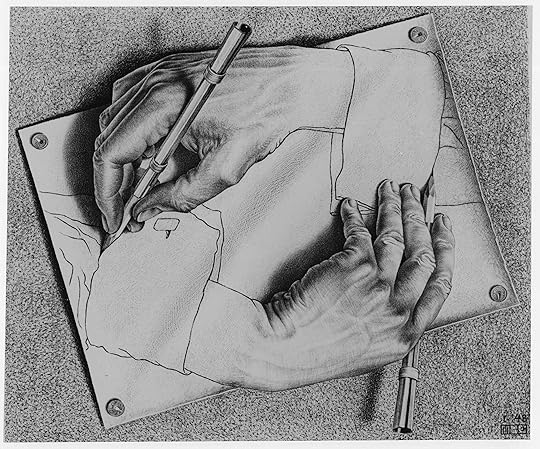
”An idealist world, as it turns out, is a world of potential paradox and contradiction; a world amenable to the absurd. It is, in fact, a world of ‘strange loops,’ perpetually cycling through self-negating metaphors of themselves, like an Escher drawing, from fantasy to seeming literalism and ultimately back to fantasy.”
“Drawing Hands” by M.C. Escher (1948)
Kastrup synthesizes depth psychology, quantum mechanics, idealism, and constructivism in this short but powerful treatise which ultimately accomplishes his goal: revealing the meaning in absurdity. His interpretation of Jung’s work, specifically the image of the “red sun” at our core, has provided me with new fuel for my own personal myth. This is not my favorite of Kastrup’s paradigm-shifting work, but I am still very grateful to have read it. For new readers of Kastrup’s philosophy, I would recommend first reading More Than Allegory or Brief Peeks Beyond. They are the path to the light for intellectual seekers.
“Your life is a patchwork of projected concepts; a thin conceptual crust around an unfathomable core of the amorphous substance of existence.”
Even if this book is conceived as a thought experiment, it goes a very long way in explaining what is wrong with our (Western) rational conception of reality. The alternative Kastrup is portraying, even as a fragile construction, sounds much more appealing than what science has to offer; the fact that he uncovers this as a scientist, makes it all the more credible. I discovered Kastrup on Youtube -well worth the time, but not easy since you need the right pace when absorbing his reflections. Reading his arguments in a book was, for me at least, a more natural way, as well as a genuine delight.
Pound for pound, one of the heaviest philosophies expressed in the fewest pages that I ever read. This book is invaluable and will take you a day to read. You will appreciate the Deus absconditus and learn not to discount the seemingly-absurd, because that may just be the sole rational interjection within an irrational or insane matrix. Enjoy....
Pulls together a lot of different disciplines to explain the way things "really are". Does a pretty convincing job of explaining why reality isn't. 8^)
The German word “unheimlich” really doesn’t translate to English. Yes, we have an approximate translation, “uncanny,” but das Unheimlich deals with a realm where approximations aren’t enough. It contains the buried cognate within, “Heim,” which means “home.” Das Unheimlich is thus “the un-homelike,” but this means not that it has nothing to do with home, but is home as we recognize it with some details askew. It’s like a creepy dream in which we walk into a familiar space—a living room, say—whose details we recognize, save for a fireplace blazing with a cat asleep in front of it. Just as we’re opening our mouths to point out that we have no fireplace or cat, the cat sits up, fixes us with its jade eyes, and speaks some words. “Son of a bitch,” we think, “it’s a dream!” “Meaning in Absurdity” is Dr. Bernardo Kastrup’s attempt to resolve the seeming disjunction between the explicable and the uncanny, or at least to explain it. To do this, he addresses everything from UFO sightings to particle physics and the phenomenon of the doppelgänger (a term that better translates from German to English than unheimlich, probably because we just gave up and accepted the loanword, in toto.) Kastrup’s ultimate conclusion is that the seeming paradoxes and absurdities we see around us have to do with what we’re not seeing, or ignoring in trying to contextualize with the logical mind. The mind, as we know it and use it intentionally, is a tool that should be used in conjunction with others. Kastrup argues that we instead—seeking certainty and order—use this mind to banish and suppress equally useful tools, whose mysterious nature offends and frightens the logical mind. There is some substrate where more ultimate truth is revealed, but to get there, we have to reexamine many of our assumptions. As with meditation, it’s a process—a sometimes frustrating one—which involves trying harder in some areas where our mental muscles are undertrained, and trying less where we’re used to exerting great effort. Tools to help us achieve this include everything from depth psychology to the aforementioned meditation to a better understanding of Jungian archetypes. If this sounds hopelessly vague and a bit like b.s., rest assured, it very much is. It hardly matters, though, as Kastrup is brilliant enough to never leave the reader bored, and has a knack for explicating his thoughts by an insane propensity for analogizing. He is, as boxing promoter Don King once said of a business foe, a master of “trickeration.” Even this, though, fits the theme and adds to the experience of reading the work, which the author himself dubs an “experiment.” For the character of “the trickster”—admired by peoples as disparate as West African Yorubas and Plains Indians—is at work in the absurd. Like das unheimlich or the surreal, it teases us with seeming illogic and disjunctions, asking us to go further in our study of the human mind and the universe around us (which may, in fact, be one in the same.) There may be no ultimate answer—Kastrup certainly doesn’t find one, though sometimes in his rhetorical flourishes he carries on as if he were on the cusp of figuring it all out But it’s a fun journey and a mindf*ck of epic proportions, to boot. And at only a little over a hundred pages, it doesn’t overstay its welcome. It’s a bit like attending a lecture given by a professor brilliant enough to fill his chalkboard with inscrutable sigils in mere minutes, but absentminded enough to get his corduroy coat’s sleeve covered in chalk in seconds flat. Recommended, though not for all dispositions, especially those who think dreams are nonsense, and that no great metaphysical revelation may lie buried within the physical sciences.
I was predisposed to like this book, as the author's perspective and philosophical ideas resonate harmoniously with the various spiritual frameworks that have become my lens for viewing the world. He even tends to use the same language as the mystics and spiritual teachers I have become quite familiar with. I was able to comfortably join him on the journey of this book without needing any convincing of the groundwork he laid. The absurdity referred to in the title is also a longtime companion in my life. So my high rating is probably informed by at least some confirmation bias, as very little discussed in this book challenged my worldview.
But even so, the ideas Kastrup explores in this book were exciting and novel to me, weaving together strands of mysticism and high strangeness with his philosophical training (a field I'm less familiar with) to form a very convincing ontological framework. He is an excellent writer who presents his ideas with impressive clarity and accessibility. I feel like I am walking way at least with the impression that I can grasp what he's offering, and it will provide food for thought for a long time to come.
Sometimes I don't have a great attention span, but even if I was making a greater effort, I'm not sure I would have been able to follow his later points on Jung.
A really interesting, brief book. Some of Kastrup's perspective dovetails with other recent books on consciousness and reality, by Donald Hoffman and Christof Koch, although I think the two would be wary of some of his conclusions, if not reject them outright. I have skepticism towards depth psychology in part from reading those books, but especially after reading Nick Chater's The Mind is Flat, which is as wondrous, in its own way, about consciousness as Kastrup is. However my sense is Chater in particular would reject Kastrup's points about the unconscious, a term which, to be fair, Kastrup uses under protest.
I'm not an expert, I'm just an aggregator of books and ideas that interest me. This one is very interesting, although I feel kind of like a buffoon wishing there were here absurdity in and of itself. Absurdity is more the penumbra hanging over the book, which is more about the possible root of reality.
Nothing original, decent simplification and distillation of the scientific realism vs idealism / collective constructivism debate, with a Jungian underpinning.
Starts with retelling a story of 7 'absurd' experiences people have had, including UFOs 🛸 and DMT elves, presumably as a sort of literary click bait, anyway there was barely any point to it and might has well been kept out.
The purely philosophical debate is good, but there was no need of including Jung nor DMT aliens, all he did was retelling it without integrating any of them philosophically.
I've been over this stuff so many times now, probably partly why it felt so stale. Likely interesting for those who are just entering that area of thought.
A great entry point into the writings of Bernardo Kastrup, the book picks away at our seemingly grounded beliefs in the nature of reality to show that this ground rests atop molten lava that spews to the surface at times. Logic and Mathematics can and do contain paradoxes and circular references that may suggest reality itself is not as rational as it seems -- as recent experiments in quantum mechanics have also suggested. Are we adhering to a materialistic paradigm that is keeping science in the dark ages?