This is the definitive history of tunneling and mining operations on the Western Front in World War I—a truly fascinating and little appreciated aspect of that terrible conflict that only now is being properly understood.
A history book from the 1960s about underground warfare in World War I. The depth of information can be a bit overwhelming, sometimes off-putting - I've been chipping away at this since June and not sure I've taken it all in. There was a lot to enjoy, too, though - quirky details and character studies, and the bravery of the men in the tunnels was immense.
"Officers were free to wear what they liked while on shift. Pryor's own standard rig was a dirty white sweater, stores-issue slacks and tennis shoes with, usually, a caged bird in his hand for gas detection. Some officers wore gardening gloves and knee-pads - and crawled through the workings with their caged canaries dangling from a string gripped in their teeth." (p.94)
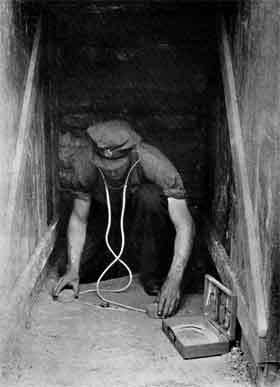
"By the autumn of 1915, 'biscuit tin' listening aids had, for the most part, been superseded. But only by devices that gave no more than marginally better results. Short sticks each with a single vibrating wire-type earphone attached - an instrument used by Water Board inspectors - had grown popular. So had an improvised arrangement using heavy French water-bottles; these were filled with water, laid flat on their sides in pairs and listened to through medical stethoscopes." (p.138)
The use of tunnels in war is always a compelling subject. The terror of descending into caves and mines (especially if you have claustrophobia) really shows the bravery and dedication of those involved. That the subject is sometimes shortchanged in favor of the war above-ground makes such studies even more welcome, when they're written.
Alexander Barrie's "War Underground" is a more than respectable (and long-overdue) examination of the lives and deaths of men who dug through soil, mud, and sometimes chalk and rock to lay explosive charges beneath their enemy. Tunnelers were perhaps the most feared soldiers in the First World War (which is saying something, considering how many other horrors were unleashed on the battlefield), and it's not hard to see why. Having bombs dropped on top of you is no fun, and neither is it pleasant to be shot at. That said, sitting in a trench and then feeling an earthquake and having the ground in front of you subside into a massive crater has to be the most unpleasant feeling in the world.
Tunnelers, in fact, were such a rare and curious breed that they sometimes sowed distrust among their own soldiers and even in the ranks of the higher-ups. The author does a good job of showing how many of the people involved in this dark aspect of the war (from generals to geologists) weren't exactly sure of what they were supposed to be doing. The work these men did was many times disorienting, exhausting, and never less than terrifying. The risk of collapse, counter-mining, and hand-to-hand fighting in the bowels of the earth was always there, and Alexander Barrie does a solid job of casting a bright light down a dark mine-shaft, seguing seamlessly from the larger campaign-level picture to the individual blood-and-sweat reality of being alone in the dark, underground. The handful of photographs and maps are welcome. Recommended.
One must be careful when reviewing a 40+ year old book, particularly one so clearly seized of an urgent desire to tell a tale it considers in danger of being forgot. Consequently, I forgive that this book requires a relatively detailed pre-existing knowledge of the strategic situation on the western front throughout 1915-1918 to fully provide context for what is a frequently thrilling, and frequently horrifying, survey of the amazingly extensive below-ground operations undertaken by British & Empire forces. Without such a context these tales of derring-do float somewhat incongruously in space, but the book nonetheless supplies interesting facts and beguiling questions - securing the story of a sapper who spent a week trapped in a blast-closed mine, using all his knowledge from civilian mining to survive until rescue as his comrades died around him, and the extraordinary resistance of a Canadian mining company cut off in their own tunnels when an attack captured the pitheads, the air gradually becoming unbreathable with their own exhalation and then noxious gases released by bullets and grenades. It also tells intriguingly of what would seem an obvious attempt to make an underground communication trench, through which soldiers could advance to a newly-captured German front line without risk - but which was undone by not being factored into the surface commanders plans.
Barrie does a great job of documenting the importance of subterranean warfare in World War I and the methods of terror that the Allies and Germans wreaked upon one another. Barrie carefully synthesizes the handful of known sources on the topic, condensing what is known into a work that is both articulate and neat but can be dry and has moments where chronology and historicity take precedence over prose. Certainly though, the reader feels the aches, agonies, and reverberations of the volatile and explosive narrative of tunnelers of the Great War.