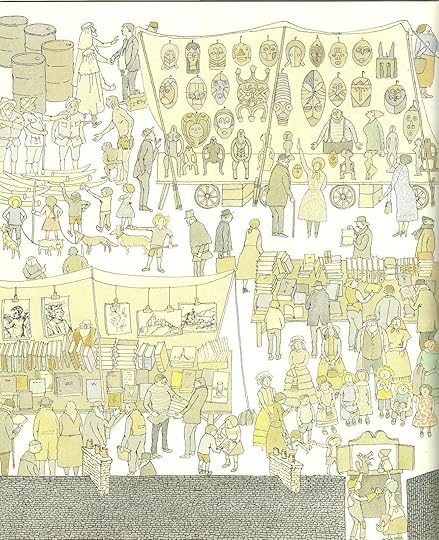
Depicts the treasures and trash of a flea market, one Saturday morning in the town square, as men, women, and children buy and sell everything imaginable.
Mitsumasa Anno (born March 20, 1926) was a Japanese illustrator and writer of children's books, known best for picture books with few or no words. He received the international Hans Christian Andersen Medal in 1984 for his "lasting contribution to children's literature".
First of all, this was super detailed. So many people, so many varied objects spread on table at the market. I used to draw things a bit like this when I was kid, so it was a surprise that I didn't love it more. I'm not sure if I grew out of this, or it is more fun to draw than to look at, or it was just the "many similar objects together" that was dull to me. Maybe mostly the last one, because I did enjoy looking at the human and animal figures.
This book has two pages of text, a prologue explaining what flea markets are, and an epilogue in which Anno writes about an old wooden bowl he bought at a flea market, and how old, handmade things are better than new, mass produced imitations. The rest is Anno's wordless illustrations, which look to be ink, watercolor, and gouache and are fabulous. They feature an enormous castle, half-timbered buildings, horsedrawn carts, old automobiles, furniture, and tables loaded with old typewriters, cameras, clothes, tools, pots and pans, vegetables, dolls, etc. The pages are cluttered (in a good way) in the manner of a Richard Scarry book.
Delightful. No words, just whimsical drawings of a weekend flea market in a sort of timeless walled city, maybe somewhere in France...? The wares for sale range from toys to tools to food (my favorites are the root vegetables). There are oddly shaped washtubs and old typewriters on display, mirrors, crockery, cutlery, butter churns, bowls, china, musical instruments. The people buying and selling are just as varied: snake oil medicine men, a fortune teller, street performers of various shapes and sizes, street vendors selling roasted corn, roasted chestnuts, coffee, crepes, cotton candy. All sorts of small dramas are being played out if you look closely. And then there are these funny bits where, when you least expect it, Mitsumasa Anno has introduced characters out of other story books and tales, like Laurel and Hardy among the rutabagas.
I didn't really follow what the story was about, except for the fact that it showed this old man and woman going through a market, and each page was a different portion of the market which seemed huge. The pictures are flat, not really showing any depth, and at times were a little confusing, but I still got a sense of movement. I lost where the old man and woman went; it was like trying to find waldo in the market, but there were other interesting things going on, like there was a whole page for weapons, or home decor. I found that we're always looking over the marketplace wall, as if it was a bird's eye view almost.
This book is based around the premise that there are plenty of interesting things to be found at Flea Markets.
It reminds me of going to those small country museums featuring what the pioneer life was like - with Mum saying "we had one of those, and those. Oh - we're still using that, much better than the new-fangled versions. Those just aren't available anymore. Do you remember those? [to Dad who always answers 'no', which Mum replies with:] Well you did grow up in the city with fancy things like cars, TV and shoes on schoolkids".
Given the march of technology over the last 25 years kids will need even more assistance in working out what many of the objects pictured were used for.
Anno's prediction - "who knows, [this book:] may well be found in a flea market one day." is I'm sure true.
Easy read, but can be used to conduct a data analysis and/or bar graph math lesson. The book is mostly a picture book and shows various items found at a flea market. Good for pre-k through second grade.
This book has very limited text but it does have lots of illustrations. This book might be used by children to make up their own stories. Teachers could use this for nearness and distance questions. I thought this was an interesting book.
A visual feast of items found at the flea market and very few "flea" type items. Lots of drawings of antique tools of all types, telephones, cameras, furniture, bath tubs, etc, etc,. Definately not the items found in the modern day flea market. I would love to be at this one.
Kind of feel weird rating this book as "read" as there are no words, just pictures, of all kinds of objects one could find in a flea market. This was like a predecessor to the "I Spy" books, except done in amazingly detailed illustrations. One of the author's interview in "Show Me a Story".