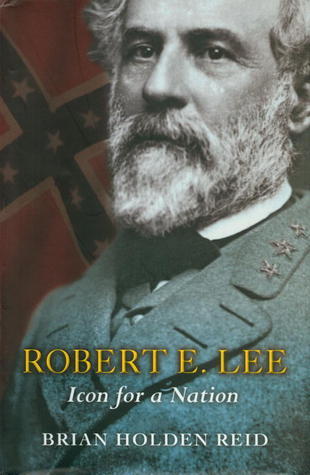
One of the most impressive monuments to an American military hero is found in Richmond, Virginia. Weighing twelve tons and standing almost sixty-two feet high, this great marble statue depicts Gen. Robert E. Lee on horseback. It projects an air of defiance as well as celebration, implying that, despite the tragic outcome of the Civil War for the South, this general was not defeated. By the time this monumental icon was unveiled in 1890, twenty years after Lee's death, the apotheosis of the great Confederate leader's life and career was well underway. He came to symbolize the great lost cause–the unfulfilled, idealized achievements that were central to the romanticized imagery that quickly enveloped the Old South after the war.In this in-depth examination of the career of Gen. Robert E. Lee, noted historian Brian Holden Reid looks beyond the legend to arrive at an objective assessment of the man and his military career. Holden Reid argues that Lee's qualities as a general do not require any exaggeration or embellishment. Tracing the military campaigns of the Civil War, he shows that Lee's short period of field command, just under three years, was marked by imagination, decisiveness, stamina, and a determination to win the war against the better-equipped union army, rather than just avoid losing it. Some historians have criticized Lee's offensive strategy as an error that became ultimately self-defeating. By contrast, Holden Reid asserts that it was the only realistic way for the Confederacy to win its independence. Nonetheless, he acknowledges that Lee exhibited occasional overconfidence, sometimes underestimated his enemy, and failed to develop his staff in any modern sense.As a British historian, Holden Reid brings a fresh, detached eye to his evaluation of Gen. Lee, and in the end he presents an authoritative and balanced assessment of a great American commander.Marked by clarity of style and filled with fascinating historical details, this new reconsideration of a legendary southern general will be a welcome addition to the bookshelves of Civil War enthusiasts as well as students and scholars of American history and military history.
Dr. Brian Holden-Reid, FRHistS, FRGS, FRSA, FKC, is Professor of American History and Military Institutions in the Department of War Studies and Academic Member of Council, Kings College London. He is a fellow of the Royal Historical Society (RHistS), the Royal Geographical Society, the Royal Society of Arts, and in 2007 was he was awarded the Fellowship of King's College (FKC), the highest honour the college can award its alumni and staff.
It is easy to overlook the many contributions that non-Americans have made to the study of the American Civil War. Brian Holden Reid's outstanding study "Robert E. Lee: Icon for a Nation" brings an informed, fresh and balanced perspective to bear upon the Confederacy's greatest general. Reid is Professor of American History and Military Institutions and Head of the Department of War Studies at Kings College, London. He has taught military strategy and tactics and written extensively about America's Civil War.
Any new study of Lee must work on two levels. First, of course, it must examine Lee himself, his life, his career, and his generalship. Second, any study must come to terms with the extensive writing and radically shifting perspectives about Lee over the years. Following the Civil War, Lee quickly became an icon to Southern partisans in the "Lost Cause" tradition. His character and success, for a time, against long military odds soon elevated Lee into a figure respected and revered by many Americans, north and south. Then, in mid-20th Century a reaction set in against Lee, questioning some of the mythology that had grown around him and challenging his aggressive conduct of the War, his focus on the Eastern theater, his alleged lack of broad strategic vision, and the high casualty rate to which he subjected the Army of Northern Virginia, among other things. The reasons underlying the reassessment were complex. They included correcting an overly iconic and uncritical account, the changing perspective with which Americans viewed the Civil War, and a general and, I think, unhappy tendency to debunk and to criticize important historical figures.
In clear, elegant prose, Reid examines Lee and Lee historiography. Although Reid avoids hero worship, he clearly admires greatly Robert E. Lee as a person and as a general. He finds that much, but not all, of the traditional picture of Lee has merit: he was an imaginative, aggressive, savvy, and gifted commander who, importantly, inspired the love and the trust of his men. He fought and won many battles against long odds and prolonged the life of the Confederacy, giving it its best chance to achieve independence. Reid is far from uncritical as he points to flaws in, among other things, the command structure of Lee's army, the commander's frequent over-confidence, his tendency to over-delegate to subordinates, his conduct of the Battle of Gettysburg, and the failure to make the most of his opportunities in battles such as Seven Days, Second Manassas, Fredricksburg, and Chancellorsville. For all these faults, Lee emerges in this study as a remarkable, charismatic commander whom Reid believes is properly regarded as one of the greatest in history.
The book opens with a chapter on Lee the icon with a summary of how historians of the "Lost Cause" school have viewed him, under the influence of the writings of Confederate General Jubal Early. The book then discusses Lee's pre-Civil War career, focusing on his service in Mexico, but gathers force in its consideration of Lee's three-year career as the commander of the Army of Northern Virginia. Lee's assumption of command in June, 1862, and the battles for which he is famous -- Seven Days, Second Manassas, Fredericksburg, Chancellorsville, Gettysburg, the Wilderness Campaign, Petersburg, and Appomattox, are discussed clearly and with sufficient detail. Reid keeps his and the reader's focus on the main themes of his study: showing Lee's greatness as a leader but his shortcomings as well.
In common with most books about Lee, his military exploits are discussed in detail but we see little of his inmost thoughts and feelings. Lee was a highly reserved individual. I would have also liked more emphasis on Lee's post-Civil War career and, particularly, a fuller discussion of Lee's life and career as President of Washington University following the Civil War. The book includes some basic maps of the key theatres of Lee's operations -- placed at the beginning of the book to avoid cluttering the text -- a good, basic bibliography, and no footnotes.
Reid has written an excellent study of a great commander which argues convincingly that Lee deserves most of the esteem that he has traditionally received. This book will appeal to serious students of the Civil War.
Former British Army Officer (and one who took many assignments with NATO, working with both German and American forces) Brian Holden Reid is the prime example of an academic military historian who is also one hell of a great writer. In his introduction to this book he outlines some of the generals in history who have come up as his favorites, and he realized that the theme of all of his chosen ones being gentlemen was a common thread. Men who were not bombastic, loud or profane or lusting after the enemy's blood, but those who were reserved in emotions, stoic, quietly brilliant, and never self serving in their own reminisces, at least to a point. In other words, the old Marcus Aurelius style of strong, silent, manly virtue. Among this list of great captains he admires so profoundly is Robert E. Lee. First of, one must acknowledge the myths surrounding Lee and the current trend of everything being distorted by the hateful, overly PC, anti-logic speak that dominates modern Western thought. Reid denounces many of the Southern Lost Cause myths surrounding Lee's generalship. In fact Lee's brilliance shines all the brighter when one realizes that he was, as is all men, flawed and made mistakes that contributed to his ultimate defeat. Also Reid points out Lee's ambivalent, very typical white 19th Century American (not just Southern) attitude towards blacks and slavery in general. While never openly condoning slavery, he neither, as some apologists proclaim, openly condemned it either. In fact he took the typical American view at the time that the black man was indeed inferior to the rest of 'civilization'. Before anyone makes too much out of that, though, the vast majority of Americans, and Europeans at the time, agreed wholeheartedly. Remember that even Lincoln did not feel that blacks were on the same level as whites. Reid also points out the one truly odious event that Lee allowed his army to conduct during the Gettysburg campaign, namely the forced enslavement of blacks in the North (as a means of psychological warfare, to destroy the will of the North and cause moral fragmentation of the popular psyche, thus eroding the will of the society as a whole to continue the fight). Reid castigates Lee for allowing this, though he never implicitly ordered it either, without falling into the typical American academic refrain of vilifying Lee falsely that showcases modern American academia's beholden to the Civil War as Northern moral crusade myth. A myth just as damaging to the truth as is the Neo-Confederate Lost Cause one. In short, Lee the man is revealed within the pages of this book. A man who, like all others, has his flaws. Reid points out, however, that in calling him an American icon, Lee should be seen as such. Unlike the vast majority of American generals, who generally make war with plenty and in fact become almost lazy and fattened on too rich a material and logistical base, Lee accomplished much while running on a shoestring budget as it were, he did more with far less and for this his generalship shines above even those like Grant and Patton. And after the war, while secretly depressed over the result and still loyal to the South above all, Lee cautioned former Confederates to be the best citizens they could and as President of Washington College, now Washington and Lee College, Lee taught young Southerners (blacks among them) to be good citizens and to let the past remain so. His attitudes and admonishments to let the war go as it were ensured that the South would not wage a prolonged guerrilla war following conquest, and that indeed peace and unity were possible. Lee, as the symbol of the South, spared the nation such horrors. If he had been executed as an example, as some then and now would like to have done, a partisan war that would have lasted for generations and eroded the US to a state similar to that of Russia, would have been a certainty. In this, Lee served both of his countries, the South and the US. This was a very good book, it focuses on the military aspect, and while it doesn't go into detail about the battles, it is because it focuses upon the strategic and operational, not the tactical. Much like Lee himself did. As such it tends to demolish many of the caveats of those like Bevin Alexander who assume flaws in Lee's leadership that doomed the South to defeat. Reid argues that Lee gave the South its best chance of victory and that he understood, far better than Davis even, the grand strategy the South had to pursue to achieve victory or at least a political settlement. All in all this is a highly recommended, if brief, book on Lee, certainly one of the greatest, if not the greatest, American general.
This book is an interesting case of what happens when someone attempts to write a generally praiseworthy account of a man without whitewashing him or seeking to promote neo-Confederate myths. The author notes that while Lee's prowess as a general has often been exaggerated by writers, the exaggerations themselves come from a basis of truth and on that basis Lee deserves both some credit as well as some criticism. In addition, and also particularly worthy of interest, the author notes that in many ways the greatness of Lee and the greatness of Grant are tied up together, so that both of these generals benefit because of their epic conflict each other over the course of 1864 and 1865, which demonstrated the importance of logistics and the way that both fought tenaciously and also honorably. Indeed, one of the reason for Lee's greatness is the fact that the Confederate cupboard was relatively bare as far as great generals went, making it very hard for them to overcome their losses of such leaders as Jackson and Stuart because of attrition, give the unappealing options they had for leaders of key western armies, yet the choice to put the best general in the most important theater may have prolonged the Civil War, which is something that one can appreciate, if one appreciates that sort of thing.
This book is about 250 pages long and it looks at Lee's career and life and how it was that Lee was a general from a favorable but non-Confederate point of view. The book begins with a list of illustrations and maps, a foreword by Julian Thompson, and a preface. After that the author discusses Lee's reputation in neo-Confederate myth as the starting point to how one appreciates him as a general, a daring choice given the author's criticism of the Confederate perspective even with an appreciation of Lee as a general (1). After that the author spends one chapter talking about the entire life of Lee from his birth to distressed Virginia aristocrats up to his resignation from the U.S. Army in 1861 (2), mainly notable for the author's discussion of Lee's acquisition of various skills and the challenges of the peacetime army. After that the author divides Lee's Civil War experience into seven chapters, showing the outsize importance of the Civil War to Lee's historical reputation, beginning with Lee's quiet emergence in seeking to save West Virginia to the Confederacy as well as overcome daunting inferiority in terms of naval forces at Port Royal (3). This leads to the transformation of Confederate fortunes once he took leadership of the Army of Northern Virginia and led it to victory in the Seven Days Campaign (4), and then reached the apogee of success during Second Bull Run and then the hard-fought draw at Antietam (5). The author then discusses his successes at Fredericksburg and Chancellorsville (6), the Gettysburg campaign (7), his defensive skill at Mine Run and the Overland campaign (8), and the slow disintegration during and after the siege of Petersburg up to Appomattox (9), after which the author gives a reckoning of Lee's skill as a general (10), and then provides a guide to further reading and an index.
It is striking and interesting that while this book deals with the iconography of Lee as a general, the author himself does not view Lee as an icon himself. Yet neither is this a revisionist history of the sort that would try to claim that Lee was himself a terrible general. The author views Lee more favorably than I would personally, yet presents a plausible case for not viewing Lee as deficient in logistics, which is the area of war that I would fault him the most for. One can see that his offensive-defensive tactics of seeking tactical victories where possible through opportunistic means was well-suited for the situation he found himself in and if he failed in both of his attempts to invade the north he remained a difficult opponent until his army's strength was sapped by the siege of Petersburg and even then he had at least a sensible strategy for escape that was failed by logistical blunders as well as the skill of Grant and Sheridan. It is no shame to fail in such circumstances, and the author's main point stands that Lee, whatever one thinks of the cause for which he fought, is certainly a general worth respecting and highly regarding.
The author is a good writer, entertaining with an obvious wealth of knowledge of the subject. I couldn't imagine how the author could get a picture of Lee into that small book when it took Freeman four volumes.
But it was well worth the purchase, I would highly recommend it. 8/10
Holden Reid, a British historian, makes for a compelling and readable biography of Robert E. Lee. He states early on he is not interested in making his book a "Lost Cause" romantic view of a mortal man, or engage in the reaction to said views and deny Lee his greatness. Instead, Holden Reid takes a path that suggests Lee was not only a great general, but contrary to a lot of popular opinion, he was an exceptional general in an army (the Confederate Army) that lacked a lot of exceptional generals, as seen in the Confederacy's inability to hold the west. The book is fair, showing where Lee made mistakes, but all the while showing him to be every bit the great general he was.
A very readable biography although like others have said, I would have liked a bit more on his life outside of the civil war. I think only the first two chapters and then the last covered the rest of his life.