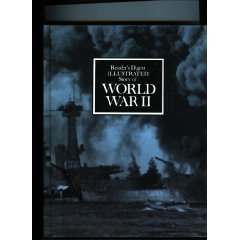
In this book the editors of the Reader's Digest present in text and photographs the story of the greatest conflict ever to engulf our globe. It ranges from the first German blitzkrieg that crushed Poland in 1939 to Japan's unconditional surrender on the U.S.S. Missouri six years later; from the prewar rise of Hitler and the Nazi Party to the dropping of the first atomic bomb on Hiroshima.
The Reader's Digest Association, Inc. is a global media and direct marketing company based in Chappaqua, New York, best known for its flagship publication founded in 1922, Reader's Digest. The company's headquarters are in New York City, where it moved from Pleasantville, New York.
The company was founded by DeWitt and Lila Wallace in 1922 with the first publication of Reader's Digest magazine, but has grown to include a diverse range of magazines, books, music, DVDs and online content.
One of my prized possesions, I have read and re-read and will continue to re-read it. Though I doubt you will ever get your hands on it.
What I liked about the book: It is the book that first got me interested in the WWII (I am kind of a WWII buff). It contains accounts of historic battles and events from the people who were in it. Supplemented by pictures.
This is a book of primary sources from World War Two. The historical context is given and then a short writing from a primary source is given. This format makes the primary sources more understandable and the impact more striking. I read this book as a high school student and it made me think of the world in a different way.
This compilation by Reader's Digest (originally published in 1969) claims one of the most stellar contributing writer lists one could hope for of that era: wonderful articles by Winston Churchill, Douglas MacArthur, Cornelius Ryan, William Shirer, John Toland, Edward R. Murrow, Bernard Law Montgomery, Ernie Pyle, H.R. Trevor-Roper, and more. My only complaint involves its focus on efforts by the USA and Great Britain, although that's probably to be expected from a book by an American magazine. The Soviet front gets little coverage, as does the Pacific/Asian theater beyond US involvement. The book also provides no afterward, ending with America's usage of the atomic bomb and Japan's capitulation. But considering the time this book came out, with the Cold War still raging, perhaps mentioning the UN's creation or the occupation of Germany and Japan would open more doors than it would close.
This is my first book about World War II, which is an eye opener, and it started my journey to understand more about this catastrophic event, its origins and legacy, and modern history in general.