What IDF military intelligence, MOSAD, and politicians failed in preparation for the October 1973 Yom Kippur War, reservists and conscripts made up through shear courage, faith, and necessity. In the initial days of war along the northern Golan Heights, an unprepared and dismally chaotic Israeli armored brigade suffered against an organized Syrian armored division eight times its size. Known for its highly skilled Air Force and air superiority, the IAF failed to support its ground forces. Unprepared for Syria's SAM batteries, some of Israel's best pilots were subsequently shot down. Their tank brigades became easy targets, and gunners blinded from direct sunlight or darkness, found it difficult and at times impossible to see their Syrian counterpart. Adding to an array of mechanical failures further slowed Israel's advance. Israeli fighters were left stranded searching for barely operational tanks to continue fighting, running to safety behind ridges or ditches. Israel's loss of men, tanks, and airplanes exceeded all expectations. Its armored brigades were on the brink of being driven behind its own lines of defense, on the verge of losing on the northern front. Yet each time events were at their worst extreme, fresh support in the form of paratroopers, air bombardments, or newly arrived armored support, arrived saving many lives.
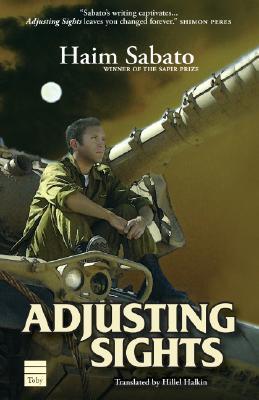
Adjusting Sights is about two orthodox yeshiva friends, who having just completed their Yom Kippur fast, were called upon to join their countrymen in battle along the Golan Heights. The year's holiest day of prayer to God had just ended. With open hearts of thankfulness for His creation and forgiveness for their sins, they are suddenly thrown into tank battle against a formidable Syrian surprise attack. From the outset of their arrival for battle, their tank platoons were in already disarray. At the army base, both boys stand amongst a crowd of soldiers in disarray. One of the commanders asks the soldiers, who of them was a loader and who was a gunner. Dov responds and is immediately taken to a tank, while Haim (the main character) is placed in another. As readers, we then see, hear, feel one of the largest tank battles unfold from inside a tank, through a telescope and Haim, the gunner.
Armed with guns and tanks, prayer books and Tefillin , inside the tank memories of Haim's childhood and teachings of local sages flashes through him while exploding mortars land nearby. Amidst the chaos, his faith and love for the promised land of Israel remains unshaken. Losses of lives mount, mechanical tank failures commonplace, and the prospect of losing the war ever so present, Haim never loses sight and faith in the Covenant made with Abraham and his Hebrew ancestors on Mount Sinai. Through selfless defense for his country and his brethrens' historically biblical identity, submitting was never an option. Faith based perspective gives him the courage and strength to overcome the chaos and an enemy armed eight times its size.
Throughout the chaos of battle, Haim prays and converses with himself. Questioning his friend Dov's whereabouts, only at the end of the story does he learn that Dov had died during the first night. This story is not about glory, but about patriotism. It is about war's chaos, and an internal peace brought on through prayer and faith, and an unconditional love for the people and the land of Israel.
Adjusting Sights is the first time I've read a fictional war story (which is based on Sabato's experience as a tank fighter in the '73 war) written in first person by an Orthodox Jewish rabbi. This novel's appeal transcended the orthodox community, and was awarded Israel's literary prize.