In the Chicago suburb of Skokie, one out of every six Jewish citizens in the late 1970s was a survivor—or was directly related to a survivor—of the Holocaust. These victims of terror had resettled in America expecting to lead peaceful lives free from persecution. But their safe haven was shattered when a neo-Nazi group announced its intention to parade there in 1977. Philippa Strum's dramatic retelling of the events in Skokie (and in the courts) shows why the case ignited such enormous controversy and challenged our understanding of and commitment to First Amendment values.
The debate was clear-cut: American Nazis claimed the right of free speech while their Jewish targets claimed the right to live without intimidation. The town, arguing that the march would assault the sensibilities of its citizens and spark violence, managed to win a court injunction against the marchers. In response, the American Civil Liberties Union took the case and successfully defended the Nazis' right to free speech.
Skokie had all the elements of a difficult case: a clash of absolutes, prior restraint of speech, and heated public sentiment. In recreating it, Strum presents a detailed account and analysis of the legal proceedings as well as finely delineated portraits of the protagonists: Frank Collin, National Socialist Party of America leader and the son of a Jewish Holocaust survivor; Skokie community leader Sol Goldstein, a Holocaust survivor who planned a counterdemonstration against the Nazis; Skokie mayor Albert Smith, who wanted only to protect his townspeople; and ACLU attorney David Goldberger, caught in the ironic position of being a Jew defending the rights of Nazis against fellow Jews. While the ACLU did win the case, it was a costly victory-30,000 of its members left the organization. And in the end, ironically, the Nazis never did march in Skokie.
Forcefully argued, Strum's book shows that freedom of speech must be defended even when the beneficiaries of that defense are far from admirable individuals. It raises both constitutional and moral issues critical to our understanding of free speech and carries important lessons for current controversies over hate speech on college campuses, inviting readers to think more carefully about what the First Amendment really means.
Philippa Strum is a Senior Scholar at the Woodrow Wilson Center. She was the Former Director of the Division of United States Studies at Woodrow Wilson Center.
In 1977 and 1978, a few dozen American Nazis, led by half-Jewish Frank Collin (born Frank Cohn) sought to demonstrate in front of a suburban city hall for half an hour or so. Their efforts to do so mushroomed into a set of court cases and a national debate on the limits of free speech. This little book gives a blow-by-blow account of this story.
The most interesting parts of this story were the parts I didn't know. I knew that Nazis had tried to march in Skokie (a heavily Jewish suburb of Chicago)- but I didn't know that most of the excitement arose by chance.
To start with, Collin did not initially target Skokie. Instead, he sent letters to numerous suburbs asking for permission; every suburb but Skokie threw away the letters without response, while Skokie's park district bothered to reply (with a letter suggesting that the Nazis post an uncomfortably large bond). The Nazis then complained about the bond's constitutionality - proof that no good deed goes unpunished!
The city could have then allowed the march to occur with as little publicity as possible. Instead, it allowed the march and informed local rabbis, with the understanding that the rabbis would inform their congregation to ignore the Nazis. Instead, local Jews became outraged, causing city politicians to flip-flop and try to ban the Nazis from demonstrating, causing a national debate on whether Nazis could march through a suburb full of Holocaust survivors. (In fact, the Nazis did not seek to "march through" Skokie but merely to demonstrate in front of City Hall, relying on free media to carry their message).
Eventually, the courts decided that the Nazis could march. But the Nazis decided not to march, perhaps because of fear of violent counterdemonstrators, or perhaps because they had gotten more publicity out of the matter than they could have gotten from a demonstration.
this book was very gory and had no trigger warning which was not fun. it was also extremely repetitive. however, i learned a lot and some of it was interesting. it explained the skokie cases very well, despite saying similar things over and over again.
You would think that this would be a fast paced and infopacked book considering the subject matter and wealth of material on it, but sadly, this one's a bit too slow and ponderous for my taste.
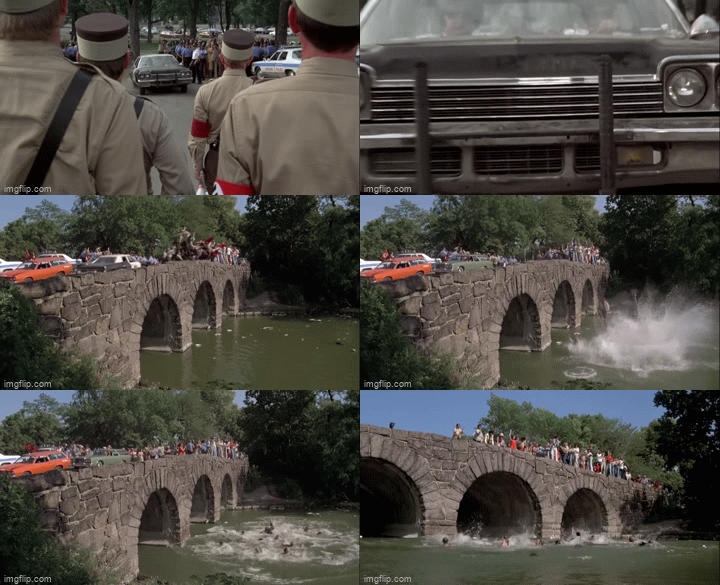
Read this in high school history. It was overall a decent chronicle of the story of a Neo Nazi group that insisted on their Constitutional Right to march through a predominantly Jewish suburban town in Illinois. At the time it was just an interesting but not particularly engaging history book to read. Years later when I finally saw The Blues Brothers though reading the book beforehand did provide some context to the film's Nazi subplot.
It took me FOREVER to read this book. As fascinating as I find the topic, the level of detail (and legal detail in particular) really put me to sleep at times. I'd recommend a more "popular nonfiction" history of the Skokie case (if such exists) for those, like me, more interested in the social and cultural implications of hate speech than the legal intricacies involved.
This book teaches you to believe in the power of the First Amendment. All that happens when people talk and are respected either people listen and realize what most people say is silly and disregardable.
Very well researched. This book takes a legal perspective in Collin v. Skokie, and discusses the effect the case had on its participants. The last chapter is especially great, covering the long-reaching ramifications of the verdict.