Walter Farley's love for horses began when he was a small boy living in Syracuse, New York, and continued as he grew up in New York City, where his family moved. Young Walter never owned a horse. But unlike most city children, he had little trouble gaining firsthand experience with horses-his uncle was a professional horseman, and Walter spent much of his time at the stables with him.
"He wasn't the most successful trainer of race horses," Mr. Farley recalled, "and in a way I profited by it. He switched from runners to jumpers to show horses to trotters and pacers, then back to runners again. Consequently, I received a good background in different kinds of horse training and the people associated with each."
Walter Farley began to write his first book, THE BLACK STALLION, while he was a student at Brooklyn's Erasmus Hall High School and Mercersburg Academy in Pennsylvania, and
finished it while he was an undergraduate at Columbia University. It was published by Random House when he was 26. He used his first advance to go traveling and after that hardly stopped longer than it took him to write another book. He traveled and lived in Mexico, Hawaii, the South Seas, most of the South American countries, the Caribbean Islands, and Europe.
The appearance of THE BLACK STALLION in 1941 was hailed by enthusiastic boys and girls all over the country. An avalanche of mail urged Mr. Farley to write more about Alec Ramsey and the Black. But World War II intervened. Mr. Farley went into the US Army, where he spent the next five years. Most of the time he was assigned to Yank, the army weekly magazine, and he was also trained in the Fourth Armored Division.
After the war Walter Farley resumed the adventures of Alec and the Black with THE BLACK STALLION RETURNS. This was followed by SON OF THE BLACK STALLION. Then Mr. Farley tried his hand at a story about a new boy, Steve Duncan, and a new horse, Flame, in THE ISLAND STALLION. Mr. Farley's readers were just as delighted with this book as his others.
Mr. Farley went on to write many more stories about the two stallions, and about other horses as well. Children of all ages have found Farley titles to enjoy, since many of the later stories were written for Mr. Farley's own children when they were too young to read his Stallion novels. And older readers and adults have been gripped by his fictionalized biography of America's greatest Thoroughbred, Man O'War. Walter Farley's titles reached a grand total of 34. The 21 Black Stallion and Island Stallion stories are still in print and selling steadily. His readers respond with passion, writing him thousands of letters and emails every year. In May 1949, the first Black Stallion Club was founded, in Kentucky. Mr. Farley designed a membership button for it; the button was in constant demand among his readers for years. The Black Stallion books were so popular in the late 1940s and '50s that they York Times annual list of best-selling children's books. Three nationwide Black Stallion contests were held. Walter Farley's books have been published abroad in more than 20 countries, including Austria, Czechoslovakia, Denmark, England, Israel, Finland, France, Germany, Holland, Iceland, India, Indonesia, Italy, Japan, Malaya, Norway, Russia, Saudi Arabia, Sweden, and Switzerland, as well as in the United States and Canada.
All his life Walter Farley remained a keen spectator of the racing scene, and he enjoyed nothing more than hobnobbing with horse trainers and other professional horsemen. It is thanks to these people that his books are so full of authentic details of raising and training horses. When not busy working or traveling, Mr. Farley liked to ride dressage and high school Lippizaner horses. He also sailed and sometimes raced his 35-foot auxiliary sloop "Circe."
Mr. Farley and his wife Rosemary, had four children: Pam, Alice, Steve, and Tim, whom they raised on a farm in Pennsylvania and in a beach house in Florida. In addit
Just add me to the pack of people who loved this book as a child, and who are now reading it to their own children.
One of the things I want to add to the accolades is that this makes a good book for children to read. It is particularly satisfying because it has a good story -- something that is sometimes lacking in beginning readers.
As far as level I would say that it is at a first grade level which is to say that the print is still fairly large, but that there are more sentences per page than the very beginning readers are used to.
Big Red got back up on the bank. I tried and tried to get there too. But I could not. My feet were cold. My hands were cold. I was cold all over. "Help! Help!" I called. But Big red could not help me.
Little Black, a Pony is a great short story picture book by Walter Farley. Although I’ve read all the Black Stallion books I can get my hands on, I hadn’t yet touched this younger reader’s book until I read it to my daughter.
Little Black is a black pony owned by a young boy. The two are best of friends, but one day the young boy decides he’d like to ride another horse – Big Red. It seems the larger horse can do so much more than Little Black. Consequently, the little pony gets neglected by his owner.
It isn’t until an accident whilst out riding that the young boy realises Big Red can’t do everything and that he should appreciate what he has with Little Black. A great moral to the story and some lovely pictures.
Re-read this book the other day. It was one of my all time favorites as a child. I would act out the story over and over again with my dad. The words and sentences are simple but the message of loyalty is profound. A must read for all parents, children, and anyone who loves a good story.
This book tells the story of a little boy and his pony. The boy loves his pony, but one day he decides to try and ride a horse named Big Red. Big Red can run faster, jump higher and is in general more exciting to ride than Little Black. But each time Big Red is chosen over Little Black, Little Black gets sadder and sadder, until he runs away one winter morning. The boy rides Big Red to try and get his pony, and ends urying to cross a frozen river. The ice breaks under Big Red and the two fall. Big Red manages to escape to the bank, but cannot save the boy. Little Black finally finds something he can do that Big Red can't, and saves the boy's life. The little boy then pledges to ride only Little Black from now on, and the book ends. Any grade level is fine for this book. Any Subject area is fine with this book. Students that may benefit is a kid that needs a boost of courage. Small group work would be fine. You can use the whole class as well. A similar book would be stellaluna. No multimedia that I am aware of.
This is the very first book I ever read by myself, which came as a great surprise to my mother, who read it to me repeatedly and was gobsmacked one day when I read it to her instead.
A charming story of a boy and his pony Little Black. The boy loves his pony but Big Red is fun to ride. Little Black is sad to be left behind until one day he is needed to save the day. The illustrations are beautiful and are reason enough to open this book. The story is good-hearted and uplifting.
When I got this book, at the library sale, the circle on the corner stating "Black Stallion Literacy Project" (not shown in the GR pic) made me think that this was part of the "Black Stallion" series, which I had read some of as a child. Imagine my surprise, when I brought it home, opened it, and saw that it was a children's book (on the level of Dr. Seuss) instead! But, I still read it right away.
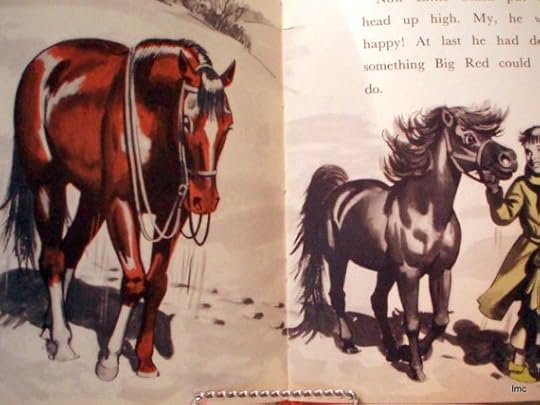
The art in this book is amazing. Only a few colors, but very nice. And, the story is touching as well. A boy (whose name is never mentioned!) owns a pony named Little Black, but is more impressed by a big horse named Big Red. He ends up abandoning the training of Little Black to ride Big Red instead. This leave Little Black feeling depressed, but the child does not seem to care, and continues to do so.
One morning, the child gets up at the crack of dawn, only to see the pony he once loved running away. Little Black is tired of his owner never paying him attention, anymore, and therefore, sees no reason to stick around. But, his owner--who wants to "rescue" him--does what he shouldn't....runs to get Big Red.
Following Little Black into the woods on Big Red, the child sees Little Black cross the ice, which is easily done, due to Little Black's small size. So, he has Big Red cross the ice. Big Red is too heavy, and cracks the ice, throwing the child in the ice-cold water. Luckily, Little Black still loves the child, and goes over to rescue him from the icy water, glad to have found something he could do that Big Red cannot do.
Later that evening, while eating, everyone discusses how helpful Little Black was in that dire situation.
This is one of the world's greatest horse stories for little kids. If you go to the following link, you can see a picture of the book as I know it. I love this story!!!
This is one of those books I used to have, lost and thought about it after seeing it here on Goodreads. I added it to my books in 2014 or so and was really annoyed that I could not remember it enough to write a review.
So I did what any logical person would do. I found it for sale on Amazon for one penny and bought it. This new copy is a much later edition than the one I had was. There wasn't an Internet when my first copy was around and there are website addresses on the back of this one.
The odd thing (for Walter Farley) is that it's written in first person. His best known books are all in third person. Gorgeously illustrated, although it's the kind of "whiter, brighter America of the 1950s" style that is all too easy to snigger at today. For example -- why aren't there any girls or women at this farm and why are the men smiling eagerly at the boy?
Another thing that bothers me now is how Big Red winds up. Now, the focus of the book is the relationship between the boy and Little Black the Arab-type pony. I get that. I identified with Little Black, the forgotten old friend who is physically unable to compete with the new horse on the block. That's all I focused on when I had my first copy. Now that I'm older and bitter and experienced, I can't help but wonder how Big Red feels about all this. He seems confused by the half-assed commitment from the boy.
Doesn't growing up suck? It's given evil shadowy meanings to a beloved children's book. Your mileage may vary.
Little Black is a happy pony with a boy who loves him. Then a tall chestnut horse called Big Red arrives and lives in the same stables. The boy goes off riding Big Red and has a great time. Little Black feels that he will never be needed again. Then something serious happens to prove that this is not the case...
The pictures are lovely and fit the words very well. "His head went up. His tail went up. Here was something he could do!"
I read this as a small girl long before I heard of Farley's Black Stallion and Island Stallion books. Little Black has another book in which he goes to the circus.
The edition of this book which shows up on Good Reads is a new one, which is translated into Navajo and comes with a CD. Interesting! Apparently, this children's classic (written in 1961 by Walter Farley, who is also the author of THE BLACK STALLION)has been very popular with Native American children for decades. I just learned something new. But I digress...
This is a simple, easy-to-read book which my older sons loved when they were just learning to read. They loved the story, and I loved the incremental repetition of words, which helped them with their reading vocabulary. It's a sweet story and great for young readers.
Georgia's review: I really like this book. I think the best part is when they boy falls through the ice and Little Black saves him. I really want a horse that is black just like Little Black.
Laura's Review: I love this book!! It is really fun to read a book to your child that they want to read again and again. This is one of those books. Now that Georgia is reading on her own she has just read it to me.
This entire review has been hidden because of spoilers.
This bi-lingual picture book is one of the most unique books I have found for Navajo and non-Navajo children. Illustrated by the well known and talented Baje Whitethorne, Sr., "Little Black" is Walter Farley's story interpreted in a Navajo landscape. I am amazed at how seamlessly the story flows. It should have great appeal for all children and especially Navajo boys.
I had completely forgotten this book when I found it on Goodreads. I didn't even know it was by Walter Farley. Of course it makes sense; I loved the book as a little girl and later adored Walter Farley's other horse books. I wanted to have a horse then.
Oh to be a child again to see it through the eyes of one so young again. Spend some time reading to someone young again, what better than to see the excitement in a kids eyes as you read them simple little stories.
The themes of loyalty, courage, and overcoming obstacles in this children's story can be just as inspiring for adults! I read this many times throughout childhood. As an adult, the conclusion can still bring me to tears. Once used as part of a devotional at a baby shower I attended.
The story of a small pony and the little boy that owns him. The boy sneaks another horse out of the stable and little black follows, the other horse breaks thru the ice on the river and Little Black saves him.