Intense attention has been paid to Detroit as a site of urban crisis. This crisis, however, has not only yielded the massive devaluation of real estate that has so often been noted; it has also yielded an explosive production of seemingly valueless urban property that has facilitated the imagination and practice of alternative urbanisms. The first sustained study of Detroit's alternative urban cultures, The Unreal Estate Guide to Detroit initiates a new focus on Detroit as a site not only of urban crisis but also of urban possibility.
The Guide documents art and curatorial practices, community and guerilla gardens, urban farming and forestry, cultural platforms, living archives, evangelical missions, temporary public spaces, intentional communities, furtive monuments, outsider architecture, and other work made possible by the ready availability of urban space in Detroit. The Guide poses these spaces as "unreal estate": urban territory that has slipped through the free- market economy and entered other regimes of value, other contexts of meaning, and other systems of use. The appropriation of this territory in Detroit, the Guide suggests, offers new perspectives on what a city is and can be, especially in a time of urban crisis.
In the summer of 2010, [Detroit] announced a plan to close 77 parks, comprising around 1,400 acres; while the implementation of this plan was deferred, park maintenance was reduced to a bare minimum.
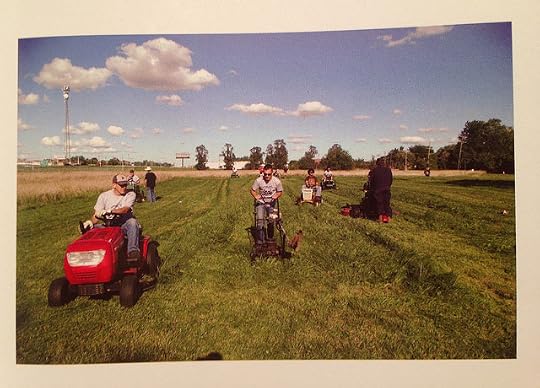
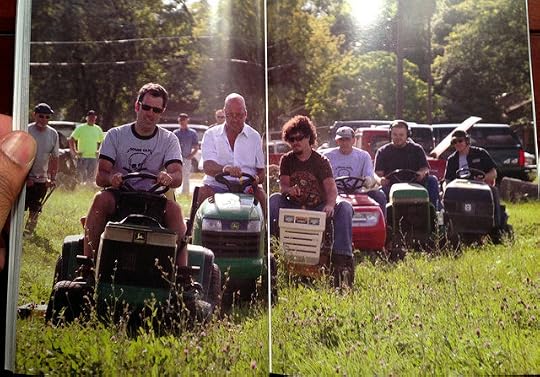
Public parks, offering space for recreation for all, are never more precious than in time of economic challenge. Recognizing this value, the Detroit Mower Gang was formed as a group of public service vigilantes, dedicated to the upkeep of the city's neglected parks. The Mower Gang describes its activities as "one part cleanup effort and one part biker rally"; the Mower Gang thus approaches lawn tractor display and riding with all the passion of motorcycle enthusiasts. In so doing, the Mower Gang transforms park maintenance from laborious drudgery to creative play.
Among the spaces that the Mower Gang has tended are O'Shea Park, Riverside Park, Roosevelt Park and the Dorais Velodrome, abandoned in the late 1980s and now used for formal and informal bicycle, moped and go-cart racing. The Mower Gang also collaborated with the Navin Field Grounds Crew to reconstruct the infield of Tiger Stadium. Through this work, the Mower Gang renders park maintenance a public right-- the right of the public to care for spaces that it cares about.
A fun read once you get past the high-flown, pretentious language -- the book is mostly photos anyway. Well worth a look. Full of encouraging examples of how people with good ideas can make something -- a school, a farm, a social-service agency, an absurdist artistic statement -- out of what appears to be nothing.
The book did a good job of summarizing and providing insight into various Detroit community efforts, non profit organizations, and guerilla group undertakings. However, the definition and concepts of "Unreal Estate" and how each effort fell into a class of it was eyes-rollingly dull.