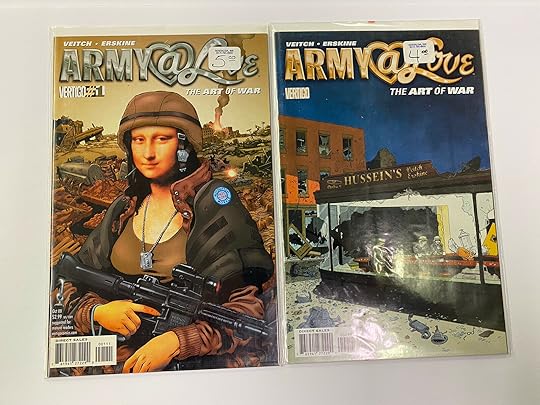
Comics iconoclast Rick Veitch, the creator of CAN'T GET NO, writes and illustrates this volume collecting the critically acclaimed first six issues of the new series that is equal parts blistering battle action, sensuous soap opera and pitch-black satire that fans of PREACHER and TRANSMETROPOLITAN will love.
Comedy collides head on with tragedy when a New Jersey National Guard unit is deployed indefinitely to a never-ending series of wars in the Middle East. These citizen soldiers range from kids fresh out of high school to middle-aged corporate managers — and the modernized military has gone into take-no-prisoners marketing mode in order to motivate them. And you won't believe what it takes to become a member of the Hot Zone Club!
Part one of Rick Veitch's outrageous for 'mature-audience' satire on a never ending war in the fictional 'Agbahnistan', being maintained by the military-industrial complex using marketing, branding, PR, corporate sponsorship etc. The tale is held together by numerous character driven sub-plots and adventures. Very good read, 8 out of 12, Four Stars. 2013 read
When my husband set this on my nightstand for me to read, I put off reading it for a while. Honestly, war stories - even funny ones - are not usually my thing. But I finished a long non-fiction book and decided to read comics for a few days to clear my mind, and I got down to this. And I couldn't put it down. This is a satire of war and the military (but not necessarily in an unkind way), of corporate influence, of high-level political corruption, of our overly-PC society - and it's side-achingly hilarious. A few years in the future, the US is still at war in the Middle East, and the military is having a hard time recruiting. So they institute the Morale and Motivation unit (MoMo for short), headed by a corporate marketing genius who turns military recruiting on its head. Suddenly joining the military is the cool thing to do, the ultimate rush. And Army@Love gives us a peek inside MoMo's tactics and true intentions through a fascinating cast of characters. I laughed out loud lots of times while reading. There's lots of sex and nakedness, though, so if you're not comfortable with that, skip this series.
A high concept, low-brow satire. The comic looks at the way our lifestyles are hypersaturated with technology (i.e. omnipresent cell phone and wi-fi service), and how that might apply to warfare. It also considers an interesting method of inspiring enlistment: advertising the army as a bacchanalia fueled adrenaline rush. Interesting concept, but bogged down by unnecessarily soapy melodrama. My major problem with the book was this: A lot of the character quirks came off as just that... quirks for the sake of being goofy or eliciting a very specific response. Really? a character who collects celebrity hair? He must be CRAAAAZY! A mentally handicapped private whose only friend is a robot? Oh, no! That's not fair! A guy that loves to wear a werewolf mask in battle. Haha, what a goof! I wanted to like the comic, really, but it just didn't quite take me where I wanted to go.
An interesting premise, the USA fighting in another "Islamic" country as part of the ongoing war on terror franchise but are running low on recruits. The military and war are rebranded with overt commercial sponsorship and hip marketing to the key demographic that will make up the enlisted."i.e. its spring break on Steriods".
Its an interesting piece of satire. A grphic Catch 22 for this age but lacks the darkest of humour to be really hard satire.
Smart, funny and over the top - I'm enjoying Veitch's new series, and I hope its hiatus is brief. The whole high concept of the army promoting war as "spring break on steroids" is terrific, and Veitch is smart enough to make it titillating and still understand the nuances of the circumstances and human behavior. I appreciate that basically every character has their price and motivations, some of which aren't entirely wrong but are easily askew.
Plus, Veitch and Erskine complement each other. Nice art, with good coloring from Jose Villarrubia and Brian Miller.
Rick Veitch has made a career out of writing satire comics. I find most of these satires are actually some of his best comics. What makes them so good is that Veitch understands and often loves his subject and that’s what enables him to write a successful comic that also serves as poignant satire. That dual relationship of love and hate is what fuels powerful criticism. I remember the first time reading Brat Pack, Veitch shattered an important part of superhero comics. He was able to do so effectively because he understood superhero comics so well. It’s with that realization, that he knows his subject; you can really understand the satire for what it is. It’s too bad that Veitch doesn’t seem to understand love and war as much as he does superheroes and Army@Love suffers because of it.
The first volume, collection issues #1-5 is actually a pretty good start to a series. The problem is that the seven remaining issues, collected in volume 2, can’t keep up with what came previously. Veitch can’t follow his own act and its damn shame because, for a while at least, he had something interesting to say about the American military, modern warfare and the media. What began as the exploration of our near future devolved into a shock and awe tactic that only left the narrative (and the reader) feeling hollow and spent.
The first volume begins with a woman fighting somewhere in the Middle East. She’s in the middle of combat talking to her husband in America on her cellphone. In the next few pages we see her join the Hot Zone Club. It’s a spin on the Mile High Club in which active soldiers have sex in the middle of combat, combining the adrenaline of combat with the pleasures of sex for the ultimate high.
The Hot Zone Club is the product of one man, Colonel Haley. Colonel Haley used to be a corporate man, working in marketing and specializing in consumer profiling. Haley ended up in the military after congress passed a corporate level draft. They began enlisting older men with job market skills and work experience in an effort to revitalize their military. People like Haley, having a specific set of skills, were able to apply them directly to certain areas of the military. After doing a deep-psyche consumer profile, Haley discovered that young Americans who indulged in movies and video games have developed an addiction to low levels of adrenaline. Based on his research and analysis, Haley has coined the phrase "peak life experience". He recruits huge numbers of young Americans by selling them peak life experience which they can find in the combat hot zone in the Middle Eastern theatre.
Colonel Haley's Motivation and Morale (or MoMo as the soldier's call it) has combined the adrenaline inducing experience of military combat with other experiences, most notably soldiers have sex while under fire. Soldiers are also allowed cell phones in combat and female recruitment has been increase to further exploit sexual tension in military settings. If that wasn't enough, MoMo organizes regular Retreats, which are essentially orgies that take place in controlled environments.
Army@Love did have some fun covers. Veitch based his covers on magazine advertisements. Army@Love outgrows its premise early on. Outgrows might be the wrong word. It's more of an issue that Veitch reveals too much too soon and it affects the potential growth of the story. In very little time the comic becomes a satire and a mockery of religion, witchcraft, romance, corporate America, magazine ads, various cultures as well as future technologies both near and far. The military satire stops developing in the third or fourth issue. The satire is still present but its repeated ad nauseum. It doesn’t change. The story doesn’t really evolve either. Veitch should have put sex somewhere in the title because we get far more of that than we get love. Quite a few issues revolve around discovering who’s sleeping with who and I stopped caring before the end of the first volume.
Army@Love could have benefitted from a shorter length and tighter focus. Like the Middle Eastern war it's commenting on, it's grown into a self-parody. I don't think Veitch pulled any punches in his commentary but he did run out of breath. Still, I enjoyed Army@Love but not in the form it was originally intended. I really liked it because of the funny melodrama and for seeing the artistic collaboration between Veitch and inner Gary Erskine. I don't think Veitch's art has ever looked better. It's too bad the story only required they draw the same small core of characters and military vehicles over and over. As much as I enjoyed it, it seems the art just like the story was destined to repeat itself without really adding anything new to the mix.
A surprisingly enjoyable read that I only happened on thanks to Res!
While it is certainly not perfect, I have decided to start with the things I really liked about Army@Love before moving on to some of my criticisms.
First off I was really hit over the head by how great Veitch's female characters really are. Not many guys I read pull off sexually and morally liberated women without coming across as judgmental in some way. And while you aren't necessarily supposed to really like any of these people, you aren't supposed to dislike Switzer any more or less than any other character. Yet not only does this woman take sexual initiative with her husband (and other guys) she almost single-handedly creates a trend to have sex under fire on the front line; Switzer won't leave her husband for a love-sick puppy of a soldier (brought on, we find out at the end, by a love charm planted by another character). Switzer's husband accepts her as his equal, even when it comes to both of their infidelities, and she's a great shot. Everyone is flawed and dirty, quirky and caught up in drama that is down right hilarious.
That's not even mentioning some of the other really interesting and exciting characters in the series. None of the characters are particularly forgettable, but I think Switzer, Gest and Mors are surely my favorite. There's a lot of switching back and forth, but I never felt like I got lost either in plot or in keeping track of who was who or where was where. The plot unfolds in a pretty satiric way and there's more than a few red haring thrown in to throw you off the scent of truth.
The art was also another high point for me. Having read a lot of vertigo comics at this point, some of them with barely any line and some of them that I thought (initially at least) had way too much line, I felt like Army@Love really hit the happy medium. With enough hatching and cross hatching to make things feel three dimensional and expressive, but not distractingly so. Each page layout is a little different than the one that comes before and, again, helps to progress the plot in a way that is interesting but not distracting. Overall, very solid.
All that gushing aside, I do feel like there are some issues to be addressed. For starters, I felt like the minimal use of torture was a bit unrealistic. Especially when you take into considering how power, adrenaline and the forbidden all play as much into the army's use of torture as anything else that is covered by the plot thus far. Perhaps it would have been too serious, but I do think it's an issue that needed to be dealt with - and not in the sanitary and gadget dependent "torture of the future" that does get used once in a truth test that one of the commanding officers is subjected to.
The next issue I did feel was representation of Islam, for both good and perhaps ill. Not that you should be taking my opinion of this at all seriously, I haven't been able to locate any real opinion from practicing Muslims (feel free to let me know if you do know of any) so this is purely abstract conjecture. I will try and keep this part brief and to the point:
1. The focus of this story is on the secular American side of things. We need more stories from pretty much any opinion besides this (and the Christian American perspective) on pretty much anything. But of course the solution to this is not to have Veitch tell the perspective of people he's even further removed from, but rather that other people get to tell stories. So not really a critique of Veitch (since I've only read one interview) but more of the system.
2. Since he is focusing on the American army it does make sense that a lot of the enemies in this book end up being a faceless mass or hoard. And, considering how he could have tried to justify the army's actions by making the enemy look really bad. Making them faceless and rather characterless means they actually seem more sympathetic in this particular instance (for me anyway) so in this story I do think the lack of development ends up being a good thing. Although I have a brain prone to sympathy at this point in time.
3. The few times that the people of Afbaghistan are characterized as individuals with dialog and even a name or two, they are perhaps the ones with the cleanest hands. I want to think this is good. I don't think it's enough characterization to place any of them on a pedestal but perhaps I am wrong.
A hard M read for sex, nudity, violence and language. The subtle nuance, and ways that Veitch plays with you, make for a mature, rather than just an adult read.
I think some of the satiric elements have potential. The fetishization of technology and the sexualization of warfare; the corruption; the infiltration of corporate culture and marketing into just about everything; and the absurdity of it all--it works. However, it never quite came together for me. It was all a bit too broad, too easy, and it hit the same notes a few too many times. It didn't make me think all that much. Or rather, it made me think that I would have responded to it better as a novella. What ultimately put me off was the art style. I couldn't see it as effective satire because it seemed to fall too far into a place that makes me think of icky exploitative juvenile fantasy. It makes the book complicit in a way that makes it less able to point out the cracks in the system. It is a kind of grotesque that is uncomfortable not because it exaggerates, distorts, and makes us confront the ugliness in us and around us, but because it seems to revel in it. And that isn't offensive as much as it is disappointingly boring.
In Army @ Love, Rick Veitch and Gary Erskine take a look at a very possible future where the U.S. military has begun hiring corporate professionals as officers and advertising agents to snare new recruits. It’s good satire that works well, both because Veitch is a pretty solid writer (his work on Swamp Thing was cool) and because, let’s face it, there’s no end of things to satirize when it comes to military, business, politics, government, etc. What didn’t interest me so much was the soap opera quality. A lot of people are touting this book as a great blend of war and romance but… this is more war and f*cking. Who’s sleeping with who soap opera stuff. I borrowed this and the second volume of this series from a friend and I will read volume two but this isn’t something I would pick up of my own accord.
The US is at war with a country much like Iraq. Combat troops have little reason to stay at the end of their tours, unless the government and corporations running the war make R&R too much fun to go home. It is a good premise for a story, especially if part of the incentive is sexual with all the repercussions that has for the characters in the military and their families at home. At least in the first several issues, reprinted here, that is not enough to make compelling reading. While mildly interesting, the story does not seem to be on its way to a satisfying conclusion:, and stories set in the world created by the writer and the artist are not enoug. Add some weaknesses in the rendering of the art, and this graphic novel disappoints. Remove the titillation and this story has even less to offer.
Veitch is not a horrible writer, but the concept is better than the execution. The writing is a bit bland, pretty predictable, and not nearly clever enough to be considered "good" satire. Sorry Rick, but I've seen better.
Erskine's not much better - a good artist, but not terribly imaginative. Tends to stick with the conventional framing & angles, and doesn't stray far from telling the narrative-as-written.
As I said, the concept is interesting - in the hands of better authors and/or artists, it could have been a mind-blower.
A bizarre commentary on - well, something? THe direction modern war is taking? The insane influence the media has on how war is fought these days? The sheer ridiculousness of modern politics and society? Yup, sure, all the above, and more, and if you can get over quite how daft the whole thing is this is a hilarious poke in the eye at the way the modern world behaves itself, and how the really big decisions are often made by people who should never be making them, and indeed don't realise that they are making them in the first place. An absurdist classic.
Got this the same time as 100 Bullets. Another brilliant graphic novel. I've been seeing Rick Veitch's work for years now. First came across him in Epic Magazine (in the 80's?). This mash-up of romance and war stories really mixed well. War stories are always open to intrigue (both political and moral) which compliments the intrigue of romance (both political and moral). Can't wait to get my hands on another volume.
you know, i didn't want to like this as much as i did. but it is well written, fast paced, and above all, an excellent satire. i was a bit worried about it being overtly disrespectful of the wrong people, but though it does strp on some toes, i think its overall point is loud and clear. recommended.
A cheeky satirical painting of a possible future in a capitalist, post-industrial nation's military service. The socio-political commentary in ARMY@LOVE is very interesting, however it does seem to play second fiddle to the dramatic main storyline which is focused on the relationships of the main characters.
There were numerous clever elements in this tale of the US Army of the future. It's really not hard to imagine military equipment emblazoned with corporate sponsor logos, soldiers chatting on cell phones in the middle of firefights, or pushy, overprotective moms chewing out military brass for being too harsh on their sons and daughters.
Good premise, but none of the characters really grabbed me. Still, I'll read onto the next one-sometimes I can still be undecided about a series judging just from the first volume.