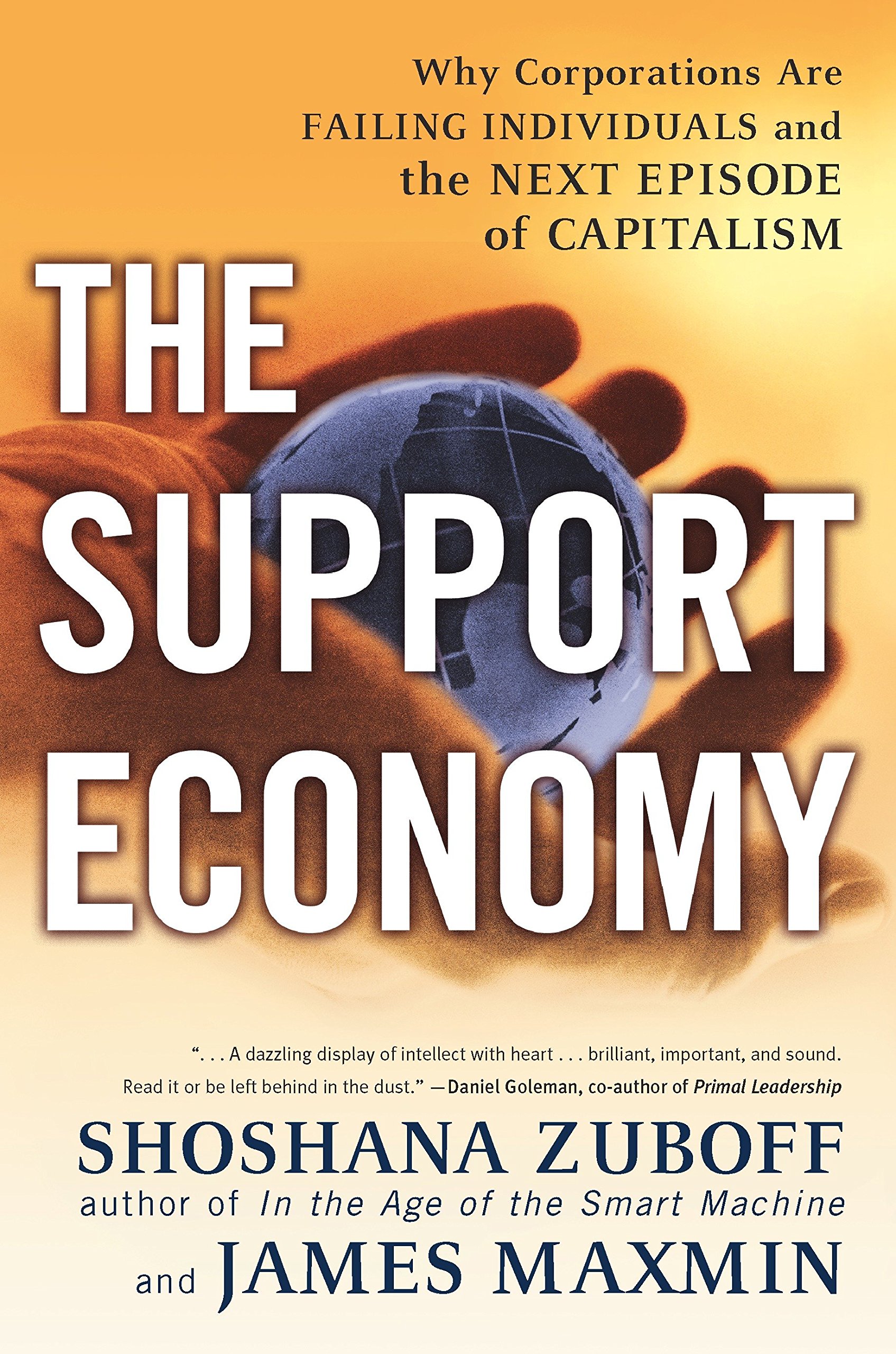
Today’s “managerial” capitalism has grown hopelessly out of touch with the people it should be serving. The Support Economy explores the chasm between people and corporations and reveals a new society of individuals who seek relationships of advocacy and trust that provide support for their complex lives. Unlocking the wealth of these new markets can unleash the next great wave of wealth creation, but it requires a radically new approach—“distributed” capitalism. The Support Economy is a call to action for every citizen who cares about the future.
Shoshana Zuboff is the Charles Edward Wilson Professor emerita, Harvard Business School. She is the author of In The Age of the Smart Machine: the Future of Work and Power and The Support Economy: Why Corporations Are Failing Individuals and the Next Episode of Capitalism. She received her Ph.D. from Harvard University and her BA from the University of Chicago.
This was the book that inspired my sabbatical. Shoshana Zuboff's work helped me understand a lot of the nonsense I was seeing and experiencing in my professional and personal life.
Since reading this book which gave a detailed and fascinating history of capitalism, I have continued to research what this new economy looks like. I do appreciate her ideas around advocacy and confederacy, and there are some examples of that appearing now. But she doesn't really take into consideration at this time emergent technologies like digital fabrication into her new economic model. Highly recommend this as a gateway drug into learning about the new economy.
To top it off, she wrote this very kind note to me regarding my sabbatical: " I hope you find what you are looking for, Jasmin. There are so many ways to live life with joy, and love, and passion. One doesn’t have to be contained by the savage struggle."
Interesting reed for it's time. Too much of what they suggest has already come to pass for it to be truly unique, but a good place to start for those that are trying to see the macro big picture changes in society.
One of the best business books I've read. They truly have a fine analysis of how our society developed and what are the problems with Economics. Plus, I'm glad to see that I'm not the only one who has realised that it's the Accountants who stop companies truly building relationships with customers. I liked the acknowledgement that sexism has played a large role in the producer/consumer disconnect too!
The solutions I'm less sure of. It sounds good but I struggle to see how the money people in organisations will give up their power. Plus how will people come together to make capital goods etc., it is one thing to do that with IT support or travel planning but quite another with a car plant. Also, in this scenario, it would seem that everyone will be employed providing support for everyone else. The logic of which would be, why not support yourself. Furthermore, this economic model rather supposes that everyone is both able and capable of making informed choices. I do wonder how the old, infirm and disabled would fair under this system? Or indeed, the undereducated or simply those not familiar with a particular area they were negotiating? I can see much potential for being ripped off by the unscrupulous as the problem of bad people doing bad things is not really addressed. Rating poor service somehow doesn't seem enough and is open to abuse where others extort money from you with the threat of bad ratings. I understand this already happens with many small travel providers.
So, all-in-all, do read and it will help produce a better economy and society because of their excellent analysis. I'm less sure that the solution will work but this could be an example of one set of people having the analysis and the other the solution. I'm reminded of Marx who's analysis is excellent but solution fraught with problems.
The Support Economy: Why Corporations Are Failing Individuals and the Next Episode of Capitalism, co-authored with James Maxmin, was the product of multi-disciplinary research integrating history, sociology, management and economics. It argued that the new structure of demand associated with the 'individuation of consumption' had produced widespread institutional failures in every domain, including a growing divide between the individuals and the commercial organizations upon which they depend.
Written before the introduction of the iPod or the widespread penetration of the Internet, Zuboff and Maxmin argued that wealth creation in an individualized society would require leveraging new digital capabilities to enable a 'distributed capitalism'.
This entails a shift away from a primary focus on economies of scale, asset intensification, concentration, central control, and anonymous transactions in 'organization-space' towards support-oriented relationships in 'individual-space' with products and services configured and distributed to meet individualized wants and needs.
The title says it all: "Why corporations are failing individuals." Whether Zuboff's network-enabled "agents" are the answer to the 21st century's discontent and the failure of conventional corporations remains to be seen. But her analysis of the problems we face is on-target.
Read particularly her definition of "the transaction crisis" (that sinking feeling we all have in our stomachs, when our flight is canceled; our hotel reservation is lost; or, the product fails to perform as advertised).
This original work by Harvard professor and intellectual Shoshana Zuboff, and philosopher and former CEO James Maxmin may seem utopian. And, to an extent, perhaps it is. The book presents a fantastic future world of commerce, and does so within the strictures of an academic tone, including extensive footnotes. The authors’ ideas seem shy of practicality but quite worthwhile. Surely some businesses already serve their customers more than their shareholders or executives; of course, some companies already provide superior customer service. But even among those stars, few create commercial transactions that not only satisfy customers, but also fulfill and energize them – that’s the authors’ utopian vision. Spreading this attitude throughout the realm of business may be a fantasy, but it sure sounds good. getAbstract thinks this insightful book conveys an imaginative, fresh corporate vision. Will this consumer-based new world unfold precisely as the authors suggest? Probably not. But at least they show what could be, as well as what should be averted: capitalism in its business-as-usual, perverse, anticonsumer mode. If you’ve ever become aggravated trying to make a simple purchase, you’ll understand.
It's both fascinating and depressing to see how much the old and modern corporations have changed the lives of people/consumers, for better or for worse. The corporate employee was, is and always will be a simple 'peasant' in the eyes of the bloody corporations they work for. These companies are more than happy to hire them and 'fulfil' their dreams and desires in exchange for their private lives and indefinite membership of the 'rat race'. It's very sad to read that people have worked and lived in such a corporate dominated world that they thought would really 'support' them in some way, but the ugly truth is that these companies had only bad intentions and corporate greed that would only benefit the top management of the company and its executives. The ugly truth is that the sad reality of the past has managed to blatantly infiltrate our modern times and continues to bring sorrow and depression into our lives more than it so called 'wants' to bring joy and happiness.
Zuboff is a smart guy. Corporations are there to support the people. Because the Government is there to pump up the wages and the pensions for the preachers like himself. Only the US Government, besides killing brown people all over the World, doesn't offer anything. So the money has to come from somewhere. And this is the ugly truth. While you are upset about the corporation more and more taxes are there to make life better for the Zuboffs of the US: solar panel credits, money for the new hybrid car, scholarships for the offspring, and, best of all, more Federal Funding so Zuboff could hire more servants.