Jump to ratings and reviews
Rate this book

A Kosher Christmas: 'Tis the Season to Be Jewish

Rate this book
Christmas is not everybody’s favorite holiday. Historically, Jews in America, whether participating in or refraining from recognizing Christmas, have devised a multitude of unique strategies to respond to the holiday season. Their response is a mixed one: do we participate, try to ignore the holiday entirely, or create our own traditions and make the season an enjoyable time? This book, the first on the subject of Jews and Christmas in the United States, portrays how Jews are shaping the public and private character of Christmas by transforming December into a joyous holiday season belonging to all Americans.

Creative and innovative in approaching the holiday season, these responses range from composing America’s most beloved Christmas songs, transforming Hanukkah into the Jewish Christmas, creating a national Jewish tradition of patronizing Chinese restaurants and comedy shows on Christmas Eve, volunteering at shelters and soup kitchens on Christmas Day, dressing up as Santa Claus to spread good cheer, campaigning to institute Hanukkah postal stamps, and blending holiday traditions into an interfaith hybrid celebration called “Chrismukkah” or creating a secularized holiday such as Festivus.

Through these venerated traditions and alternative Christmastime rituals, Jews publicly assert and proudly proclaim their Jewish and American identities to fashion a universally shared message of joy and hope for the holiday season.

See also: http://www.akosherchristmas.org

232 pages, Paperback

First published October 1, 2012

9 people are currently reading
103 people want to read

About the author

Ratings & Reviews

What do you think?
Rate this book

Friends & Following

Create a free account to discover what your friends think of this book!

Community Reviews

5 stars
7 (15%)
4 stars
10 (22%)
3 stars
23 (51%)
2 stars
2 (4%)
1 star
3 (6%)
Displaying 1 - 10 of 10 reviews
Profile Image for Jan Rice.
586 reviews519 followers
November 29, 2013
I thought this book, billed as the first U.S. book about Jews and Christmas, would be a good bet to deal with issues such as the "war on Christmas" and Garrison Keillor's 2009 Baltimore Sun non-word-mincing opinion piece:

Unitarians listen to the Inner Voice and so they have no creed that they all stand up and recite in unison, and that's their perfect right, but it is wrong, wrong, wrong to rewrite "Silent Night." If you don't believe Jesus was God, OK, go write your own damn "Silent Night" and leave ours alone. This is spiritual piracy and cultural elitism, and we Christians have stood for it long enough. And all those lousy holiday songs by Jewish guys that trash up the malls every year, Rudolph and the chestnuts and the rest of that dreck. Did one of our guys write "Grab your loafers, come along if you wanna, and we'll blow that shofar for Rosh Hashanah"? No, we didn't.

Christmas is a Christian holiday - if you're not in the club, then buzz off. Celebrate Yule instead or dance around in druid robes for the solstice.


That's an article that had left me feeling kicked in the teeth. I knew that White Christmas had become the most popular Christmas song ever, and, ironically, that a (Christian) Republican senator had indeed written a Hanukkah song that very same year (2009), but it still rankled. Did A Kosher Christmas deal with such issues? Yes and no.

The first part of the book usefully deals with history. Christmas was not originally a big American holiday. The radical Protestant settlers thought it was pagan. In fact, in medieval Europe the celebration of Christmas had been associated with gambling and rowdiness. A reformation, so to speak, that turned Christmas into a family holiday began in the early 19th century, with credit going to literary figures and artists. Think Twas the Night Before Christmas and The Christmas Carol. From the start that evolution represented a secularization of the holiday, and in America it also coincided with the need to bind and unify a number of disparate groups, so customs from the various European countries were gradually adopted.

As Christmas became American, celebrating it became patriotic. The Christmas spirit came to represent the American spirit at its best, a celebration of well-being and generosity and a time of peace. The buying of gifts was a celebration, not of commercialism, but of financial generosity. According to Wikipedia, by 1861, even the Presbyterians accepted Christmas celebrations, and by 1864, the First Congregational Church of Illinois ("although of genuine Puritan stock"); by 1860 it was a legal holiday in 14 states, and in 1870 was made a national holiday--the only religious holiday to have such a designation.

With all those factors working, not celebrating Christmas became difficult. In fact it's reminiscent of being in a church where the invitation to the open communion is "to all those who love God and hate sin," in other words, designed to make it hard to refuse! For the German Jews who made up the bulk of the American Jewish population up to the later 1800s, that wasn't a problem. Many were used to participating in Christmas celebrations in the country they came from and simply continued. Prominent Jewish families announced their Christmas celebrations in the paper, and some Reform synagogues even had trees.

At the end of the 19th century the eastern European Jewish immigrants began arriving in America. For them, Christmas in Europe had been a different experience. Christmas, Easter, and sometimes the whole period in between, had been occasions for their persecution, as the preaching of Christian clergy incited their congregants against Jews. I gained an entirely alien picture of caroling as an occasion for Christians to go door-to-door and stone or beat up Jews. Certainly Jews stayed home and out of harm's way as much as possible. There were various medieval superstitions, such as not studying Torah on Christmas eve to avoid giving Jesus more power for evil. Instead Jews played games--cards and chess. Incidentally Christians played games, too! Christmas eve apparently was a time for games that were usually associated with gambling and rowdiness. For everybody! But the two different cultural groups had different stories about the practice of playing games on Christmas eve.

At any rate, Eastern European Jews came to America with an entirely different picture of Christmas than their central European brethren, one that led them to shun it. But, as is usually the case, for their children--the next generation--it was another story. For the children, the images of Santa Claus and gifts were just as seductive as you might expect.

In the 1880s, with antisemitism on the rise, even the American Jews of German descent had occasion to question their adoption of the holiday. There could be a whipsaw of "damned if you do, damned if you don't." From a 1904 New York Tribune piece quoted by Plaut:

In the homes of the poor Hebrews, as well as of the well to do, Christmas is being celebrated with never a thought that it is the birthday of Him whom their forbears crucified more than nineteen centuries ago.

The other end of the spectrum comes from the editor of Christian Century in 1939, urging "release (of the) spirit of Jewry from bondage to a tradition which denies it the right to participate in a free and gladsome celebration of the birthday of Jesus" and further arguing that "...it is not fair to democracy to cherish a religious faith which provides a sanction for racial and cultural or any other form of separatism."

Whammo--whiplash!

Gradually, Jews found a way to co-opt celebrating the spirit of the season without celebrating Christmas, and this, indeed, is the author's main point--to show how that was done and even to assert that Jews showed subsequent immigrant groups the way in that regard. By the 1960s it was no longer popular for Jews to celebrate Christmas, but by then alternatives had arisen.

Hanukkah had been gradually elevated, achieving some degree of parity in the public sphere, at least. Reading this book, I no longer think the expansion of Hanukkah to take the place of Christmas for Jews is as odd as it is sometimes made out to be, given that Christmas itself was created, only earlier.

Twas the Night before Christmas must be one of the most often satirized poems; I recently rediscovered one in which my fifth-grade class gloried, that I'd neatly printed out and treasured. Here's Erev Christmas (Christmas Eve) , a Jewish version preserved in this book and which I also found online.

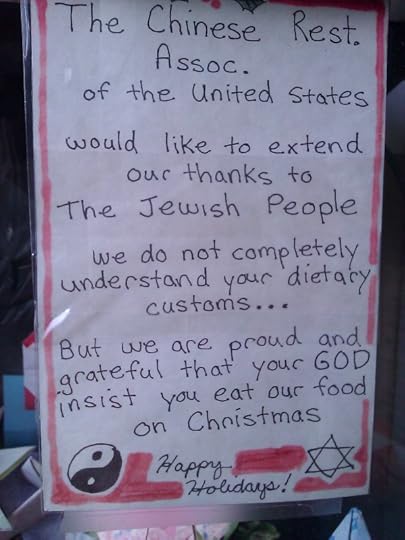
As can be seen in the rendition of Erev Christmas, Chinese food had become a tradition for Jews on Christmas, that and movies, because those where what was open, and also because the Chinese had no tradition of antisemitism. This is a cute reflection of the Chinese food tradition, one that's easy to find online; I got this one at HappyPlace Pics & Posts.

Plaut also has a chapter on the Christmas Mitzvah (good deeds), such as volunteering at the jobs of Christians so they can take Christmas off or providing charity that helps Christians celebrate their holiday. And there's a chapter on joint celebrations for intermarried families.

From parity to satire--all the comedy about the holidays and how they're celebrated. This is where one might sometimes look askance at satire. As in politics, where it flattens your own party as well as the other party, satire flattens all before it.

In his "Acknowledgements" section, Plaut tells us he strove in this first book on his subject to identify and retrieve "every single document pertaining to Jews and Chrismas in America," and it's on those shoals he runs aground in the last two-thirds of the book. He violates this dictum attributed to Voltaire: "If you want to bore the reader, tell him everything." My goodness!

But I read it all, or at least skimmed, because I thought something was missing and wanted to find out. In line with his thesis that Jews have neutralized Christmas and made the holiday time a more inclusive one, Plaut gives the impression that those efforts have been uniformly lauded and uniformly successful. That's not completely the case. I think there has been a move away from "Happy Holidays." The "war on Christmas" initiative has not been without some success. Although his book was released just a year ago in the fall of 2012, he never deals specifically with the "war on Christmas." In the service of his thesis that Jews have made a positive contribution as regards handling Christmas he implies that everyone in America, or, at least, all good people, applaud such changes. Where he does look at the counter-message, he makes conservative Christians his whipping boy. His alleged inclusion of every single relevant document broke down when it came to Garrison Keillor's piece with which I began. It is missing--even though it garnered wide attention at the time, with thousands of comments on its Baltimore Sun website.

I guess the ambivalence from American Christendom toward Jews celebrating Christmas--whether pro or con--represents the discomfiture about Jews not having melted into the general population.

This book gave me some consolation when it comes to Christmas songs written by Jews. Not only did White Christmas become the favorite Christmas song, it represented home and comfort to WWII soldiers. Also, there was this story to counter Keillor's mean-spirited Rudolph bashing:

Of particular interest is the song "Rudolph the Red Nose Reindeer," whose lyrics were originally composed in 1938 by Robert L. May in the form of a narrative poem. May, who was an advertising copywriter for Montgomery Ward and who was facing a number of personal and financial challenges, wrote the song to give hope to his four-year-old daughter while her mother, his wife, lay dying of cancer: "May described in story form not only the pain felt by those who were different but also the joy that can be found when someone discovers his special place in the world" (from Ace Collins, Stories Behind the Best Loved Songs of Christmas).... It became the second-best-selling Christmas song of all time. May's biography indicates that he identified with the shunned Rudolph because he was teased as a child for his small stature and thinness. His adult life had also been difficult as the family faced financial ruin under the burden of his wife's medical expenses....



For that, I wanted to give the book four stars. The first part is worth four stars but the rest just bogs down in too many facts, despite the occasional stand-out nugget.

One last tidbit: Woody Guthrie, whose wife was Jewish, wrote a batch of Hanukkah songs circa 1950. His daughter recently discovered the lyrics in his archives, and they have been set to music.

Addendum, Nov. 28, 2013:
Last Sunday Parade Magazine carried a blurb that it was 150 years ago this year that Abraham Lincoln designated the American Thanksgiving holiday as the last Thursday in November. But in 1939 FDR moved it up from the 30th to the 23rd "to goose holiday shopping during the Depression" (Parade)--his version of a stimulus plan. Some states resisted, and people called it "Franksgiving." So that is why Thanksgiving is now on the fourth Thursday in November instead of the last Thursday. In other words, more shopping days before Christmas.

I was curious in what spirit Christmas had been designated a federal holiday back in 1870, but A Kosher Christmas didn't answer that question. Neither do my cursory online searches, other than that it was simply designated, along with several other days. I don't think it was for overt economic reasons.

The simplistic idea crossed my mind that if some people think only Christians should participate in Christmas, then they should try to get its holiday status revoked, since, certainly, if it's a national holiday, then any citizen who wants to participate in it can, if they want to, whether or not anybody approves. When I said that out loud--the part about revoking Christmas' holiday status, my husband laughed at me, since now some huge percentage of the economy depends on Christmas. Even as I write, the appallingly-named "Black Friday" is upon us, having crept up to Thanksgiving evening.

If the dominant social group expected Christmas to facilitate the "melting pot," but the prospective "meltees" found ways to avoid that fate, then it's reasonable for those whose expectations were thwarted to be disgruntled. Well, this is one of those issues about which everybody on every side will have a different opinion, it seems.

I was speaking earlier of parodies of Twas the Night before Christmas, and now I leave you with a Thanksgiving version that came my way via a chain email. No, I didn't write this one; it is not by me.

TWAS THE NIGHT OF THANKSGIVING,
BUT I JUST COULDN'T SLEEP.
I TRIED COUNTING BACKWARDS,
I TRIED COUNTING SHEEP.

THE LEFTOVERS BECKONED -
THE DARK MEAT AND WHITE,
BUT I FOUGHT THE TEMPTATION
WITH ALL OF MY MIGHT.

TOSSING AND TURNING WITH ANTICIPATION,
THE THOUGHT OF A SNACK BECAME INFATUATION.
SO, I RACED TO THE KITCHEN, FLUNG OPEN THE DOOR,
AND GAZED AT THE FRIDGE, FULL OF GOODIES GALORE.
GOBBLED UP TURKEY AND BUTTERED POTATOES,
PICKLES AND CARROTS, BEANS AND TOMATOES.

I FELT MYSELF SWELLING SO PLUMP AND SO ROUND,
'TIL ALL OF A SUDDEN, I ROSE OFF THE GROUND.
I CRASHED THROUGH THE CEILING, FLOATING INTO THE SKY,
WITH A MOUTHFUL OF PUDDING AND A HANDFUL OF PIE.
BUT, I MANAGED TO YELL AS I SOARED PAST THE TREES....
HAPPY EATING TO ALL - PASS THE CRANBERRIES, PLEASE.

MAY YOUR STUFFING BE TASTY,
MAY YOUR TURKEY BE PLUMP.
MAY YOUR POTATOES 'N GRAVY HAVE NARY A LUMP.
MAY YOUR YAMS BE DELICIOUS.
MAY YOUR PIES TAKE THE PRIZE,
MAY YOUR THANKSGIVING DINNER STAY OFF OF YOUR THIGHS!!

HAPPY THANKSGIVING TO ALL PUMPKIN PIE
Profile Image for A.J. Jr..
Author 4 books17 followers
December 28, 2018
Imagine people disliking Christ and Christmas so much that they would consciously devise ways and means to undermine and redefine the meaning of it in order to feel better about themselves. As opposed to simply allowing Christians to happily celebrate their Savior's birth.
Profile Image for Sara.
1,559 reviews97 followers
January 10, 2015
I enjoyed this and learned a lot both about the history of the Jews in America, and the history of Jews and Christmas. It is fairly easy to read for a work for a work of research and if you are having thoughts about how to celebrate Hannukah and Christmas in your home or even outside of it, this gives a good perspective that would probably help you to solidify your own holiday celebrations.

Chinese food, anyone?
Profile Image for Jacqueline.
246 reviews6 followers
Read
May 18, 2016
Not an easy read, but provides perspective on the origins & progression of interfaith Christmas celebration in Europe and the U.S. I like how today's shared evolution of December dilemma is to try to make life easier for each other (Jews spelling Christians so they can have some time off on Christmas) and for the world around us (getting together to pool goods, services, time and care to make life easier for those who don't have it so).
Profile Image for Steve.
739 reviews2 followers
December 31, 2012
As a fan of American religious history, and as a Presbyterian with a Jewish wife and children, I was drawn to this book. Much useful information and analysis, but unfortunately, like many non-fiction books these days, what would have been a good, long magazine article, gets booged down in repetition and unneeded detail when turned into a "book."
Profile Image for Todd.
49 reviews12 followers
January 2, 2013
I really enjoyed this book. A great examination of the impact of exogenous forces on cultural integrity and the cultural work both to belong to a larger society and to maintain one's cultural difference. A fun, smart, accessible work of cultural history and religious studies.
Profile Image for Florence.
11 reviews2 followers
Read
February 20, 2013
interesting history of Hanukah in America. I liked the first half. The rest was too much of a move to assimilate for me.
Displaying 1 - 10 of 10 reviews

Can't find what you're looking for?

Get help and learn more about the design.