
Jump to ratings and reviews
Rate this book

A Cara o Cruz : El Sorprendente Mundo de las Probabilidades (Metatemas)

Rate this book
A basic understanding of the probability theory, applied to real-life circumstances, help us to make sense of situations, avoid unnecessary fear, seize the opportunities that randomness presents to us, and actually enjoy the uncertainties we face. The reality is that when it comes to randomness, you can run, but you cant hide. So many aspects of our lives are governed by events that are simply not in our control.

336 pages, Paperback

First published January 1, 2005

26 people are currently reading
854 people want to read

About the author

Jeffrey S. Rosenthal

18 books8 followers

Ratings & Reviews

What do you think?
Rate this book

Friends & Following

Create a free account to discover what your friends think of this book!

Community Reviews

5 stars
95 (18%)
4 stars
202 (39%)
3 stars
168 (32%)
2 stars
36 (7%)
1 star
9 (1%)
Displaying 1 - 30 of 66 reviews
Profile Image for Remo.
2,553 reviews182 followers
March 4, 2012

Había visto este libro hacía un tiempo, y por fin me he hecho con él. Este libro tiene de todo, estimados lectores. El autor le da un repaso a muchos, muchísimos aspectos de la teoría de probabilidades que están, de una u otra manera, relacionados con la vida cotidiana. En 264 cortas páginas hay un montonazo de información.


Comenzamos leyendo sobre la Ley de los grandes números, que nos dice que, a medida que vayamos haciendo “experimentos” (es decir, tirando un dado, jugando a la ruleta, lanzando monedas…), los resultados que obtengamos se irán pareciendo más y más a los resultados esperados. Si tiramos una moneda una vez, sólo puede salir cara o cruz, es decir, o cara el 100% de las veces o cruz el 100% de las veces, números que se alejan de la probabilidad que conocemos de 50% cara y 50% cruz. Pero si tiramos muchas monedas, podemos estar seguros de que los resultados se acercarán a la mitad caras y la mitad cruces. Los casinos conocen este hecho perfectamente y por eso, aunque algún cliente acierte un pleno y gane dinero, es el casino quien a la larga obtiene unos beneficios bastante predecibles.


A continuación, un clásico: las coincidencias. “Increíble, anoche soñé que algo malo le pasaba a mi amigo Pepe y hoy ha tenido un tortazo con el coche”. El autor desmitifica estos hechos aparentemente sobrenaturales (en CPI dijimos algo muy parecido hace un tiempo), por el simple método de formularse la pregunta adecuada: ¿cuántos casos afirmativos entre cuántos casos posibles? Si empezamos a contar cuánta gente sueña que un amigo tiene un accidente y cuántos accidentes hay al día siguiente, veremos que tarde o temprano puede haber una intersección entre ambos grupos de personas. Sin milagros.


Luego nos habla de las distribuciones aleatorias, y de cómo el cerebro humano no está bien cableado para el azar. El dicho de “las desgracias nunca vienen solas” tiene bastante que ver con la probabilidad. Si un suceso aleatorio (pongamos, una desgracia) ocurre en media una vez cada tres meses, es más que probable que de vez en cuando nos sucedan tres desgracias en el mismo mes, por pura ley de probabilidades. El autor da unos cuantos ejemplos, uno de los cuales es bastante claro:
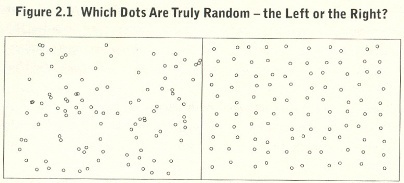


Si le pidiéramos a una persona que distribuyera aleatoriamente puntos sobre una hoja de papel, probablemente todos estarían bastante espaciados e intentarían rellenar todo el folio (a la derecha). Pero el verdadero azar hace que siempre aparezcan conglomerados de puntos (a la izquierda) que llaman la atención y hacen que parezca que “algo” concentra los puntos en una zona concreta. No es así. Es el azar.


Cuando habla de los casinos el autor repasa las probabilidades de victoria en muchos juegos, e incluso hallamos tablas de probabilidades de ganar al Black Jack dependiendo de la primera carta que le haya salido a la banca. Este capítulo está lleno de datos numéricos, realmente interesantes.


Paseamos después por el mundo de las probabilidades pequeñas, y de cómo en general se perciben algunas como mayores de lo que son (ganar la lotería) y otras como menores (morir en accidente de tráfico). Nuestro paseo sigue por la utilidad del azar y los números aleatorios para muchas cosas, desde el cifrado de mensajes hasta las estrategias para ganar o, al menos, no perder, en algunos juegos. Imaginemos que jugamos a “piedra, papel o tijera” con el campeón mundial. Probablemente él haya desarrollado un montón de formas de adivinar cuál va a ser nuestra siguiente elección. Con una psicología propia de un buen jugador de póker, él se dará cuenta enseguida de nuestra tendencia a sacar siempre dos tijeras seguidas, o sacar papel cuando nos acaban de ganar con papel. Si nos dedicamos a jugar a nuestro antojo, probablemente perderemos. La mejor manera de minimizar nuestras probabilidades de perder es hacer nuestras jugadas completamente al azar. Tiramos un dado y si sale 1 o 2 sacamos piedra, 3 o 4 papel y 5 o 6 tijera. Así nuestro oponente nunca podrá anticipársenos. Hemos garantizado que a la larga ganaremos tantas partidas como perdamos. No se puede conseguir esto en cualquier juego en el que nos enfrentamos al campeón del mundo en algo.


El autor habla del significado de los márgenes de confianza de las encuestas, de todos los motivos por los que éstas pueden fallar. También habla de los falsos positivos y negativos en pruebas médicas (como ejemplo, curiosamente, pone el lupus). Habla del problema de Monty Hall y asegura de varias maneras que “correlación no implica causación”: Si tanto el precio del chocolate como el precio de los automóviles han subido este año un 8%, ¿debemos empezar a preocuparnos por la posible relación entre estos dos bienes de consumo? No, probablemente ambos aumentos se deban a la inflación y no tengan relación entre sí.


Por último, nos hablan del desconocimiento en relación con la probabilidad. No es lo mismo el azar de un sistema caótico, que depende de nuestro grado de conocimiento del sistema, que el azar cuántico, que es así por la propia construcción del mundo. Este último capítulo también me encantó.


Hay un montón de temas interesantes en este libro. En los agradecimientos, además, hay alguna perla: “Doy gracias a toda la comunidad Open Source por haber creado GNU/Linux y TeX”. :)


Mi nota: Muy bueno y muy recomendable.

320 reviews17 followers
July 26, 2020
Look, you're probably laughing at me for giving a 5/5 star rating to a book about probabilities and statistics. But, I've read a good number of these volumes - both looking for books/excerpts to assign to my students, and because of curiosity about how people perceive risk - and this one is among the best.

In "Struck by Lightning," Dr. Jeffrey Rosenthal provides an incredibly accessible introduction to many of the key concepts involved in statistics and, specifically, the study of probabilities. He gives us a rundown of normal distributions, of confidence intervals and p-values, of the Monty Hall problem... all sorts of good stuff. And, yet, he manages to do all this in a way that is almost dangerously engaging - and without ever dumbing things down or being patronizing.

The book certainly isn't a substitute for a stats textbook and it only goes into so much detail on the actual math involved. And, if you were paying attention throughout high school math (e.g., Monty Hall problem) and have a clear understanding of statistics, not much in the book will be new or radically surprising.

But, if you're looking for a primer that explains why public opinion polls always talk about their results applying "19 times out of 20" or how casinos can manage to guarantee turning a profit without putting off their customers, this is it. The examples are great, the writing is engaging, and I can see those who haven't encountered all the essential principles within really benefiting from it. I'll be recommending this to students looking to learn a bit more about statistics and probabilities, all in the form of a book that's a real joy to read in its entirety.
Profile Image for Steve.
279 reviews7 followers
February 19, 2021
If you like math, you'll probably like this book.

Based on that probability, I gave it an appropriately rated 4 stars (aside from the qualitative value of "really liked it") based on utility adjustments.

(Note: I did read this book in less than a week's time, so it was a page-turner.)
11 reviews1 follower
May 10, 2017
An entertaining read, but I didn't find any new insight or much new information. I expect to learn a lot when picking up a book like this, so I was slightly disappointed to discover that majority of the topics discussed are taught in high school math courses.
Profile Image for Jeroen.
295 reviews1 follower
June 21, 2020
A good and clear easily accessible introduction into probability for the non-technical reader. Because my work involves probability and statistics it is always interesting to see how someone else makes this subject understandable for a non-technical audience.
As the text is easy enough to understand, probably even for a novice, the examples provided do not provide new explanation or insight just a repeat of what was already explained. Quite often there was no need for this.Perhaps the most annoying thing is the fact that some text and the majority (maybe all) of the examples are phrased in a way that it feels like they are being addressed to women, as if they need this book more than men. The need to better understand probability is something that is not gender specific, and injecting a bias like this detracts from what is otherwise a well written book.

Whether this book is for you depends on what you try to get out of it.
If you know next to nothing on this subject then perhaps this is the book for you; or as background reading to high school math.
If you know the subject, then likely this book is not technical enough for you, unless - like me- you are interested in seeing how someone explains these concepts in an easy way.

For what the book is supposed to be, an easy accessible intro to probability, I would have rated it 4 stars as it handles the matter well in a simple and well organised way.
For the way it is written, especially the unneccessary tone and examples, I have deducted a star.
If you are well versed in this topic, you might want to deduct another star as you've likely have read other and perhaps better intro books on the subject
Profile Image for Bruce Butler.
Author 3 books3 followers
August 31, 2021
If you want to know why it's very likely that in a room of 23 random people there's slightly more than a 50% chance that two people will have the same birthday, then this book is for you.

If you're dying to know why you should always pick the other door when Monty Hall offers you the option in the Let's Make a Deal "new car behind one of three doors" contest, then this book is also for you.

This book is a great dive into the world of probabilities. The explanations are written in a clear manner that a layperson can understand.

I'd have given the book 5/5 except for one error in the author's analysis of the CN Tower "falling glass" scenario. Yes, the probability getting struck by falling glass is incredibly small. But he assumes that the probability function for glass failure is time-independant. It isn't. Glass is a material that wears out the more it is walked on, which means the probability of failure increases the longer it is in use. In his scenario, he should also be asking, "How long has it been since the glass was installed?"
218 reviews14 followers
April 29, 2022
Randomness and uncertainty are fundamental parts of our existence. When making decisions, we usually can’t be certain of the long-term outcome, so we regularly assess the odds or probability of success with one option over another. Knowing the rules of probability theory helps us understand events around us, and to make more accurate assessments.

One part of the theory is that random events tend to occur in bunches. This is called Poisson clumping. What seems like improbable coincidence is just the result of chance when dealing with large numbers. Some people get assurance, however, by attributing such coincidence to supernatural causes.

Why do casinos always win in the longrun? Rosenthal provides the clearest explanation I’ve seen about how probabilities favor the house. “In every casino, every single betting game is weighted ever so slightly in the house’s favor. The Law of Large Numbers says that if a gambling game is even slightly to your advantage on average, and you play it long enough, you are sure to come out ahead.”

Casinos get the largest share of revenues from slot machines, where customers recover between 85% and 95% of their bet on average. “No matter the game, the odds are always against you.” The longer you play, the less likely luck will be a factor, and the more likely the house will win.
Rosenthal explains the lure of false causations, and how fear of violence rose after 1990 even though the murder rate was declining. He also explains the margin of error so one can evaluate the reliability of opinion polls.

Struck by Lightning looks at the probability of being struck by lightning. This reviewer lives in the country with the world’s second highest lightning fatality rate. Panama ranks second only to Cuba.

The best Monty Hall choice on Let’s Make a Deal isn’t what many believe. Contestants are allowed to choose one of three doors, only one of which has a car behind it. After contestants make the choice, Monty Hall would open a different door without the car. Contestants were then asked if they wanted to stand pat or to choose the remaining door instead. Rosenthal shows why there is a two-thirds chance of winning the car by choosing the remaining door.

Though we may prefer certainty, randomness has benefits. When determining who gets drafted, for example, a random draw by lottery is fairer than handing out exemptions to certain groups. Randomness also provides security for Internet transactions.

This book is more readable and interesting, and less like an advanced algebra class, than another book on probability I reviewed, The Improbability Principle. Struck by Lightning helps readers living in a random universe better understand and apply the probability principle. -30-
Profile Image for Rolf Kirby.
188 reviews3 followers
June 29, 2025
I saw this book upon my mathematician father's table when visiting and finished it in three days. It is an engagingly written book on statistics aimed at the non specialist. The author weaves in many examples from everyday life, and from games of chance in particular. He concludes with a nice explanation of a famous puzzle that stumped even some mathematicians.
Profile Image for Tuğba Özb.
34 reviews2 followers
July 7, 2018
Türkçe çevirisini olasılık konusunda uzman sayılabilecek birisi olmama rağmen sıkılmadan okudum. Temel matematik bilgisine sahip ve olasılıkların hayatımıza nasıl etkisi olduğunu merak eden herkesin okuyabileceği bir kitap.
Profile Image for Faye.
54 reviews12 followers
March 31, 2021
An enjoyable, engaging read on statistics and probabilities. The author writes clearly with good anecdotes. I learned a few things and find myself thinking in probabilities since I read the book. Which is reassuring if/when I feel anxious about something that is really not likely to happen.
18 reviews1 follower
November 24, 2017
Should be sugested as a supplementary literature for mathematics in high schools. :)
196 reviews
April 16, 2019
Entertaining and insightful! The example and explanation in those short stories are just funny! The author has made numbers fun and easier to remember. Highly recommended to read!
Profile Image for Mesha.
193 reviews1 follower
October 5, 2020
Should have been mandatory reading for my master's quantitative methods course...
Profile Image for Ninja Notion.
63 reviews3 followers
October 31, 2020
Worth a read if you want to know what your actual chances are of winning the lottery, catching COVID, or choosing the car if you are ever on Let's Make a Deal.

117 reviews1 follower
January 7, 2021
The layman that I am found this to be an informative and entertaining first look at probability theory.
Profile Image for Duncan.
180 reviews1 follower
December 21, 2021
Not a bad book and a tough subject to make interesting for most, but I just didn't vibe with the author. It was cool understanding more about the Monty Hall Problem.
Profile Image for Kathryn.
1,013 reviews47 followers
July 26, 2015
This was a very fun non-fiction book to read; I love statistics and probabilities (possibly from first being an accountant, then a table games dealer in a casino), so I know how important the subject is. This was a very easy read, and one that anyone who is interested in probability could read.


After an introductory chapter, the author dives into probabilities, especially as applied to real life. He has information as to why the casino always wins (every game in the house is very slightly weighted in the house’s favor), why your random music shuffle of your huge music library has repeats, how to measure trends, utility functions in making decisions, the true meaning of polls, the classic Monty Hall Problem (one door has a car behind it; you pick Door #1. You are shown Door #3, which has a goat behind it. Should you stay with Door #1, or switch to Door #2?), and how email programs keep so much spam out of your mailbox. The second-to-last chapter is on Quantum Mechanics, which holds that a system will always have a certain amount of uncertainty (the Heisenberg Uncertainty Principle). The final chapter is set up as a quiz, which summarizes the information presented in the book. Throughout the book he gives examples of the application of probabilities to real-life situations (and why you remember the time the weatherman said Partly Cloudy on the car radio, which you can’t hear because of the pouring rain on the car roof).

I loved reading this book, as we all live in a world of probabilities; alas, I will continue to purchase my Powerball tickets, under the theory that my chances of winning are 5o%, because I will either win or I won’t.
Profile Image for Ben Thurley.
493 reviews31 followers
April 24, 2014
Subtitled, "The Curious World of Probabilities" this book on probability and statistics should probably have been written to arouse more curiosity and less, say, boredom or déja vu.

It's not terrible by any means, and there are certainly some helpful lessons for the mathematical layperson here. But rather than enlivening statistics it tends towards the repetitious, and the author's real-world examples and applications are either too cursory or lacking in drama to grab the imagination.

There are fairly regular 'humorous' second-person scenarios that attempt to put you in the position of evaluating probability, biases and the like, but for the most part these just feel like reworkings of points already made. The book's final exam, testing whether the reader has the "probability perspective" is a helpful reminder of the topics covered, but it certainly ain't no quiz. You don't really need a probability perspective to pick the correct answers in this multiple-choice quiz, just basic literacy.

I suppose I shouldn't have been surprised that a book about statistics wasn't particularly exciting. But I guess when you are popularising a topic, it's not unreasonable to expect it to be – at least to some degree – popular.
11 reviews
March 28, 2019
Not enough depth to be interesting. By page 10 the author is describing a particular large number as 1 followed by 22 zeros... why? Maybe his editor insisted the target audience will be people who have never been through 8th grade math. The author intersperses superfluous stories to illustrate concepts which are neither thought-provoking nor easy to read. This book could've been half the length and conveyed the same ideas with the same level of depth. Was the author trying to hit a page target of 250? Yikes. We get it, you got your Ph.D at age 24 from Harvard, but...stick to your specialty of Markov Chain Monte Carlo methods...not introductory books on probability.

I would not recommend this book for anyone interested in probability. For an introduction to these topics, I've heard good things about this book but have yet to read it: An Introduction to Statistical Learning: With Applications in R
18 reviews
January 11, 2014
As an IT Professional I am often working with mathematical, statistical and logical problems; I chose this book to discover some of the fun and interesting parts of statistics.

The very core concept of the book is to empower the reader to question and interpret statistics that they are exposed to in daily life. Well written stories and anecdotes back up the famous phrase "lies, damned lies, and statistics".

By the end of the book you will have picked up a number of interesting facts to regurgitate at parties, an eye opening look at how statistics affects everyone and hopefully a significantly more cynical eye on news reports and fantastical claims - if something is apparently 50% better, what was the sample size, how was it tested, how were the conclusions reached, what was the potential error rate, how have the results been interpreted?
Profile Image for Andrew.
1 review
April 12, 2012
Started off with some interesting scenarios and then explored the odds behind them. Makes coincidences and random events seem less random and more predictable. Too much time was spent on gambling and the odds behind different games. Obviously casinos make money so they are going to stack the odds in their favor. Best part was the explanation of scientific studies and how they determine if a study shows a correlation. What they are looking for is a p-value of less than .05, meaning there is only a 1 in 20 chance that the results are a fluke. Not exactly comforting knowing that a company could commission 20 studies, not publish the 19 that show no correlation, and then advertise the one that does.
Profile Image for Franz.
167 reviews2 followers
March 4, 2016
It was okay - a bit too "conversational" for my liking. But what really bothered me were Mr. Rosenthal's inserts, his fictitious stories that were to illuminate a particular point. They interrupted the flow, and were a bit over the top. And I could have done without the Final Exam - I would have scored 100% even without reading the book, which begs the question if I learned anything new.

Maybe okay for somebody who has absolutely no idea how to define and work with probabilities, but I was disappointed. Two stars (which is as low as I will go - no time and interest to finish reading and evaluating a book that I would give one star only). Too bad really, as I think that Mr. Rosenthal really knows his subject matter

11 reviews
December 31, 2008
An interesting look at the world of probabilities. I am a little biased since I have heard him speak and find him a fascinating guy, but the problem with this book is that it isn't the other books on the same subject that came out at the same time. This book is neither Freakonomics or either of Taleb's books, and shouldn't be compared as such, but it is inevitable that it will be.

He writes very well and simplifies a complicated subject. A very good lay-man's look into how probabilities affect your life. Again, it's not as entertaining as the other books on the subject, but a very good introduction to the subject
Profile Image for Chelsey Cosh.
Author 5 books11 followers
May 30, 2015
You're not going to become an economist or probability expert by reading this book, but at least you can see how probability, statistics, game theory, and other such math applies to everyday life. You understand the different types of biases, how probability works, the concepts of p-values and Gaussian distribution, utility functions, and more. I think it would be good reading in high school curricula. Best of all, it's nice to read a great book like Struck by Lightning, a Malcolm-Gladwell-read-alike, that comes from Canada! Truly enjoyed it. I highly recommend to anyone who is interested in math (and even a little bit to those who aren't)!
15 reviews
July 8, 2013
Excellent book - made me want to dig out my high school mathematics books and read the chapters on probability again. Wish I had this perspective in high school - would have made me look at school in a different light.

Poisson clumping and the law of large average numbers were very interesting as were utility functions.

On the flip side, the author's political bias became a bit obvious a couple of times and a little more mathematical perspective about how to repeat the calculations done by the author would have been useful.
Displaying 1 - 30 of 66 reviews

Can't find what you're looking for?

Get help and learn more about the design.