

What do you think?
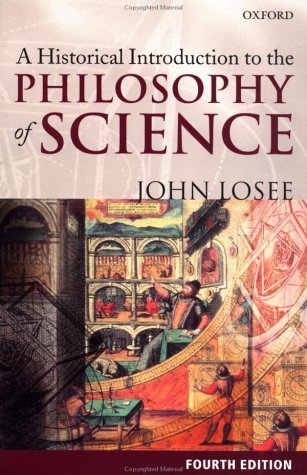
A Historical Introduction to the Philosophy of Science, 4th Edition
Designed for first-time readers of the subject, this stimulating introduction offers a historical exposition of differing views on the philosophy of science. With concise profiles presenting the major philosophers whose contributions are discussed in this book, Losee explores the long-argued questions raised by philosophers and scientists about the proper evaluation of science. This new edition incorporates contemporary developments in the discipline, including recent work on theory-appraisal, experimental practice, the debate over scientific realism, and the philosophy of biology. Taking a balanced and informative approach, this work is the ideal introductory volume.
328 pages, Paperback
First published October 5, 1972
About the author
John Losee
18 books5 followersAfter many years of teaching at Lafayette College and establishing myself as an author of nine thought-provoking philosophy books. I decided to try my hand at creative writing. I embraced a new role as a storyteller. Inspired by the rhythms of modern life, I set out to craft engaging, humorous short stories that can be devoured in the time it takes to sip a cup of coffee. The Adventures of Max and Maude is my first work of fiction.
In Millwood Stories, I continue to create bite-sized tales that reflect the humor and complexity of life, offering quick escapes into a world where ordinary moments unfold into extraordinary adventures. This format, I believe, resonates with the fast pace of today’s world – perfect for readers seeking an enjoyable and satisfying break.
In The Sabbatical Sleuth, I invite readers to follow the exploits of a professor who joins a detective agency on a leave of absence from his university. He turns out to be rather good at this new job. This collection of short stories is another window into the happenings of Millwood. Readers will be surprised by the turn of events.
With a keen eye for human emotion and a playful sense of adventure, my stories aim to bring a spark of joy to readers from all walks of life.
In Millwood Stories, I continue to create bite-sized tales that reflect the humor and complexity of life, offering quick escapes into a world where ordinary moments unfold into extraordinary adventures. This format, I believe, resonates with the fast pace of today’s world – perfect for readers seeking an enjoyable and satisfying break.
In The Sabbatical Sleuth, I invite readers to follow the exploits of a professor who joins a detective agency on a leave of absence from his university. He turns out to be rather good at this new job. This collection of short stories is another window into the happenings of Millwood. Readers will be surprised by the turn of events.
With a keen eye for human emotion and a playful sense of adventure, my stories aim to bring a spark of joy to readers from all walks of life.
Ratings & Reviews
Friends & Following
Create a free account to discover what your friends think of this book!
Community Reviews
Displaying 1 - 21 of 21 reviews

January 18, 2016
Εξαιρετικά προσιτό για το ευρύ κοινό βιβλίο με θέμα την εξέλιξη των ιδεών για την επιστημονική μέθοδο, ειδικά πριν από το 1940 . Ιδανικό για εκείνους που δεν έχουν ασχοληθεί καθόλου με το θέμα και χρειάζονται μια εισαγωγή κατανοητή είτε είναι προπτυχιακοί φοιτητές είτε απλά θα ήθελαν να αποκτήσουν γνώσεις και δεν ξέρουν από που να ξεκινήσουν. Με βοήθησε πολύ.

October 11, 2016
از قرن 20 یکم در هم میپیچه ولی تا کانت خیلی جاها بصیرت افزایی داره.خاصیتش هم همینه دیگه.خودشونم پیچیده شدن.

August 7, 2013
This book is as advertised; an historical introduction to the philosophy of science. I have heard it paraphrased that "History of Science without Philosophy of Science is Blind; Philosophy of Science without the History of Science is Empty." This is a very easy read to get you started on your way to understanding science as an evolving set of methods and views. I can see layman and students in undergraduate sciences with no prior knowledge of the history or philosophy and reap great rewards from this work. It fashioned as a collection short essays on topics through history. If you are looking for a hardcore introduction with all kinds of depth, this is not it. For advanced HPS students, look elsewhere. If you know a bit about the history and philosophy of science, you can pick and choose your way through the sections of this book. For this reason, I have found it immensely useful.

April 10, 2014
I read the 3rd edition in graduate school. This edition is significantly better. It reads more fluidly than the earlier version and the content is updated including new research in theory appraisal. This is a sound primer for those interested in the historical and philosophical development of what became known as "scientific method." But this is not a popular book and the reader will benefit by re-reading sections. The last third of the book focuses on the last 60 years during which research in these fields vastly expanded.
January 28, 2008
a good overview of philosophical thought over the ages governing the various approaches to scientific investigation.
essays by and analysis of socrates, kuhn, bacon, pythagoras, newton, aquinas and many others.
great book if you're into science, philosophy or just trying to understand the logic behind scientific thinking
essays by and analysis of socrates, kuhn, bacon, pythagoras, newton, aquinas and many others.
great book if you're into science, philosophy or just trying to understand the logic behind scientific thinking

March 30, 2011
A good survey of the subject, with topics grouped so as to provide counterposing arguments in context.

December 10, 2023
queria traduzir esse livro

April 19, 2013
The trouble of philosophy of science is that the thinker is trying to explain on what principles the scientist should think, but is himself bound by certain principles on how he should think. So, for example, when Popper says that all scientific theories must be in principle falsifiable, he is in fact making a non-falsifiable statement, and so it is my his own definition pseudo-scientific. Of course, he would say that he is not claiming his philosophy to be scientific as such, but defining whether other theories are. But then one must ask, why listen to Popper's ideas? Moreover, can or should one apply this to historical theories? It is all very well applying it to contemporary (for Popper) pseudoscience like Marxism and Freudianism, but what about geocentrism, phlogistons and the four elements? One can certainly make an argument for and against any of these being falsifiable, but that would be beside the point, because these theories, when they were overturned, were not discussed in such terms, but in the terms common to scholarly argument at the time.
To analyse this in Kuhnian terms, it turns out that philosophy of science, as well as science itself, runs in dominant paradigms for a while before being replaced by new paradigms.
It is to this end that all philosophers of science need to be deeply acquainted with the history of science, and especially the history of the philosophy of science. (What a wonderfully interdisciplinary area of research!) The only book I have managed to find on the subject is this one, which is surely the definitive treatment, and Dr Losee rises to the challenge admirably with a detailed and polymathic overview of a wide range of thinkers and scientists across multiple millennia. One cannot help but admire his understanding of defunct thought patterns; each section deserves to be read multiple times in order to grasp the content. It is only a pity that more philosophers will not engage with history at such a high level.
To analyse this in Kuhnian terms, it turns out that philosophy of science, as well as science itself, runs in dominant paradigms for a while before being replaced by new paradigms.
It is to this end that all philosophers of science need to be deeply acquainted with the history of science, and especially the history of the philosophy of science. (What a wonderfully interdisciplinary area of research!) The only book I have managed to find on the subject is this one, which is surely the definitive treatment, and Dr Losee rises to the challenge admirably with a detailed and polymathic overview of a wide range of thinkers and scientists across multiple millennia. One cannot help but admire his understanding of defunct thought patterns; each section deserves to be read multiple times in order to grasp the content. It is only a pity that more philosophers will not engage with history at such a high level.

June 9, 2009
This book was read for a course entitle Topics in Philosophy & Science taken at Loyola University Chicago during the first semester of 1983/84. Just before beginning it in September I had obtained a job in Loyola's University College, the part-time undergraduate division, as an academic advisor, my assistantship in the philosophy department having reached its limit. This job began as part-time and wasn't enough to handle my amassed school loans, so I also obtained a full-time position at Evanston Hospital's ER, working nights. It was terrible: the load, the timing of everything and Evanston Hospital. Although I had completed the master's portion of the the MA/PhD program at Loyola and had 24 semester hours towards the PhD (all but one course I think), landing this peachy job at the university contrasted to the dismal prospects for teachers of philosophy, led me to discontinue coursework within the year.

December 18, 2022
Why Bother with the Philosophy of Science?
Is the history of science dependent on the philosophy of science or is the philosophy of science derived from the history of science? Any discussion concerning the philosophy of science must first overcome Gilbert Ryle’s objection that it is pretentious to think that scientists need philosophers of science to explain to them the meaning of science. The physicist Paul Feyerabend concurred and said that there is no reason for a practicing scientist to consult the philosophy of science. That is, the philosophy of science bears little resemblance to the way science is actually done. I think this objection can be overcome be recognizing that there is a difference between doing science and thinking about science. The former should be left exclusively to trained scientists, the latter is something in which both scientists and philosophers should engage together. Thinking about science necessarily engages with the history of science and is not a transhistorical or metaphysical project making claims to universal understanding.
Though thinking about science is as old as science itself, it was not until after the second world war that the philosophy of science emerged as a distinct and formal academic discipline for the purpose of clarifying what is meant by science. Can we ask, what are the aims of science? Or is this the same as asking the meaningless question, what is the meaning of life? What qualifies as science? What constitutes scientific theories? What makes something a scientific law? What is the role of formal deduction, mathematics, observation, and inference in the building of scientific knowledge? What is the language of science? How close does science get us to the ‘truth’ or the ‘real’ nature of reality? What does scientific progress look like? Does predictive success equal progress, does progress equal truth? For example, Francis Bacon saw progress as a succession of inductive generalizations expanding from an established factual base. Karl Popper saw progress as a sequence of conjectures which survive attempts at repudiation. Thomas Kuhn famously saw the normal course of scientific development as a serious of ongoing revolutions of thought and paradigm shifts.
Just as a theory of science can be superseded, e.g., the theory of relativity superseded classical mechanics so it is with the methods employed to understand science itself. A methodology judged best today may be archaic in the future. Evaluative principles change and so does the rational for this change. Economic and political considerations also play an important role in the understanding science as well as the development of science itself. The most fundamental and basic science is not independent of human social influences. The way in which we purse science, even independent of social, economic, and political influences, is still biased by our psychology, our way of perceiving the world and the very structure and capability of our physical brains. Our beliefs about reason guide our beliefs about what is or can be reasonable and the way we do science down to the experiments we design.
The universe is independent of human theorizing about it, but our theories have provided an increasingly more accurate picture of the universe. To the extent our theories explain the observed regularities recorded in the empirical record, we call this progress. Standards of reason and rationality also change (perhaps even progress) over time. These historical developments, philosophical issues and thinking is covered in this book by reviewing the contributions of specific thinkers to this continuing project.
Is the history of science dependent on the philosophy of science or is the philosophy of science derived from the history of science? Any discussion concerning the philosophy of science must first overcome Gilbert Ryle’s objection that it is pretentious to think that scientists need philosophers of science to explain to them the meaning of science. The physicist Paul Feyerabend concurred and said that there is no reason for a practicing scientist to consult the philosophy of science. That is, the philosophy of science bears little resemblance to the way science is actually done. I think this objection can be overcome be recognizing that there is a difference between doing science and thinking about science. The former should be left exclusively to trained scientists, the latter is something in which both scientists and philosophers should engage together. Thinking about science necessarily engages with the history of science and is not a transhistorical or metaphysical project making claims to universal understanding.
Though thinking about science is as old as science itself, it was not until after the second world war that the philosophy of science emerged as a distinct and formal academic discipline for the purpose of clarifying what is meant by science. Can we ask, what are the aims of science? Or is this the same as asking the meaningless question, what is the meaning of life? What qualifies as science? What constitutes scientific theories? What makes something a scientific law? What is the role of formal deduction, mathematics, observation, and inference in the building of scientific knowledge? What is the language of science? How close does science get us to the ‘truth’ or the ‘real’ nature of reality? What does scientific progress look like? Does predictive success equal progress, does progress equal truth? For example, Francis Bacon saw progress as a succession of inductive generalizations expanding from an established factual base. Karl Popper saw progress as a sequence of conjectures which survive attempts at repudiation. Thomas Kuhn famously saw the normal course of scientific development as a serious of ongoing revolutions of thought and paradigm shifts.
Just as a theory of science can be superseded, e.g., the theory of relativity superseded classical mechanics so it is with the methods employed to understand science itself. A methodology judged best today may be archaic in the future. Evaluative principles change and so does the rational for this change. Economic and political considerations also play an important role in the understanding science as well as the development of science itself. The most fundamental and basic science is not independent of human social influences. The way in which we purse science, even independent of social, economic, and political influences, is still biased by our psychology, our way of perceiving the world and the very structure and capability of our physical brains. Our beliefs about reason guide our beliefs about what is or can be reasonable and the way we do science down to the experiments we design.
The universe is independent of human theorizing about it, but our theories have provided an increasingly more accurate picture of the universe. To the extent our theories explain the observed regularities recorded in the empirical record, we call this progress. Standards of reason and rationality also change (perhaps even progress) over time. These historical developments, philosophical issues and thinking is covered in this book by reviewing the contributions of specific thinkers to this continuing project.

December 22, 2022
Trata-se de uma introdução ao tema que vale sobretudo pelo resumo histórico que contém sobre o desenvolvimento das ciências. No que à filosofia diz respeito faz-lhe pouca justiça, se é que existe alguma a fazer... De facto, ficamos com aquela ideia de Feyerabend de que a Filosofia das Ciências tem apenas em comum o nome com o assunto de que é suposto tratar e há uma sensação omnipresente de um discurso sem sentido, inconcreto, sem rumo, de um ramo da filosofia sem vislumbre de noção sobre o que está a tratar. Além disso, a escrita não é brilhante, é repetitiva e enfadonha e, globalmente, o autor, não obstante os seus esforços, faz um trabalho sofrível ao lidar com os assuntos da matemática e da ciência.

January 5, 2025
Aproximación muy breve a la historia de la filosofía de la ciencia. Los capítulos se sienten algo desordenados, yendo y viniendo de autores y épocas a partir de la mitad del libro. Con 100-200 páginas más habría ganado mucho, se hace demasiado corto. Al final tiene una selección de textos recomendados para profundizar en cualquier autor que se menciona.

July 8, 2026
An overview of various schools of thought in the Philosophy of Science over the millennia.
Not that good. It presents a wide variety of ideas but not in enough depth, which left me unsatisfied and unclear about what a particular school of thought was trying to achieve. If I hadn't read a few other books about this topic, I would've been much more lost.
Not that good. It presents a wide variety of ideas but not in enough depth, which left me unsatisfied and unclear about what a particular school of thought was trying to achieve. If I hadn't read a few other books about this topic, I would've been much more lost.

January 5, 2022
Libro molto interessante, che tratta l'argomento dal punto di vista di molti filosofi del passato.

February 22, 2022
The book sucks. It was boring to read and without deap research about authors or their books. It was also full of unnecessary informations.

December 21, 2022
Bilimsel yöntemi detaylıca irdeleyen güzel bir kitap.
This entire review has been hidden because of spoilers.

Read
February 17, 2023so incredibly dry; would recommend if you hate yourself like i do
November 23, 2024
Cool content, bad organization.

Read
December 21, 2015τον Losee μου μέσα..
June 1, 2020
Libro introduttivo di livello universitario alla storia della filosofia della scienza.
L'enfasi è posta essenzialmente sul lato espositivo invece che sul lato critico.
L'enfasi è posta essenzialmente sul lato espositivo invece che sul lato critico.

February 18, 2023
É um bom livro, porém a versão brasileira tem muitos cortes e a revisão é péssima. Me disseram que a versão portuguesa é bem melhor
Displaying 1 - 21 of 21 reviews