

What do you think?
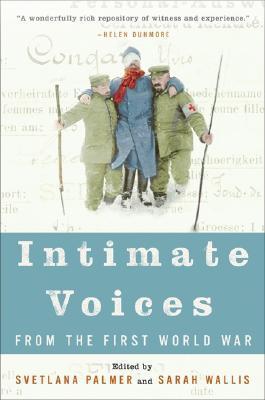
Intimate Voices from the First World War: The Gripping Eyewitness History of WWI from All Sides of the Conflict
The story of World War I is brought to life through the gripping personal narratives of those at the center of the storm.World War I was waged by young people from twenty-eight countries in an era without the advantages of military "embeds," satellite phones, and streaming media coverage. Intimate Voices from the First World War fills in the gaps in the history of the world's first global confrontation with excerpts from recently uncovered letters and diaries of those on the front lines and their friends at home. In their reflections on the vastness of the enterprise of war, these combatants, victims, and eyewitnesses re-create the scope of the conflict with immediacy and tenderness. Written with the frankness and intimacy of words not intended for public eyes -- full of private passions, prejudices, humor, and vivid insights -- these communiqués speak to us directly from within the war itself and from all sides of the conflict. These marvelous historical narratives not only immerse readers in an ongoing dialogue about the meaning of human conflict but also serve as reminders of the individual perspectives and beliefs that sometimes get overlooked during times of global strife.
400 pages, Paperback
First published December 31, 2003
Ratings & Reviews
Friends & Following
Create a free account to discover what your friends think of this book!
Community Reviews
Displaying 1 - 27 of 27 reviews

March 13, 2023
"All I'd achieve in a war is to kill a couple of innocent soldiers, while these gentlemen who were responsible for it would never come anywhere near the war itself."
-Vaso Čubrilović
My Papaw, one of the kindest men I have ever known, served in WWII. I always thought it was fascinating to ask him about this mysterious event (to me) that he had experienced, not understanding at the time how painful it was for him. He suffered from PTSD, and I would learn later that the times when he did answer my questions were because he was feeling calm from medication.
One of the battles he would talk about filled my dad and me with questions later: Where was he? Which battle was he talking about? After attempting to track down exactly where his unit was and the timing, we think it might have been the Battle of the Bulge. This was before he was wounded.
The letters in this volume convey exactly that sense of bewilderment. In the editor's introduction, they echo Vaso's sentiment with, "But in the intergenerational frictions of 1914-18 it was a war caused by the old people and then sustained by, and at the expense of, the young." Troops had often never been away from home and had no sense of where they were or what they were doing (it's easy to forget this when reading war narratives, kind of tied into neat packages with battle titles, the moves of battle commanders, etc.) Palmer and Wallis pieced the letters together into a narrative with very little commentary and included voices from every side of the war from Turks and Germans to British and Serbs.
To their credit, they also included letters from those whose experience was different, such as a soldier who had a relatively plush experience as a POW. This was definitely an exception, but it did the service of widening comprehension. In some respects, it was kind of terrible to read for curious people like me because there were questions I wanted to ask every single of one the letter-writers. To the Russian soldier who recorded the joyful singing of troops, but that they were under orders to quit as soon as they reached Warsaw: Why couldn't you sing in Warsaw??? They also included letters that were quite hilarious, making this a volume that captured the gamut of humanity. It was a fantastic supplement to my WWI reading.
-Vaso Čubrilović
My Papaw, one of the kindest men I have ever known, served in WWII. I always thought it was fascinating to ask him about this mysterious event (to me) that he had experienced, not understanding at the time how painful it was for him. He suffered from PTSD, and I would learn later that the times when he did answer my questions were because he was feeling calm from medication.
One of the battles he would talk about filled my dad and me with questions later: Where was he? Which battle was he talking about? After attempting to track down exactly where his unit was and the timing, we think it might have been the Battle of the Bulge. This was before he was wounded.
The letters in this volume convey exactly that sense of bewilderment. In the editor's introduction, they echo Vaso's sentiment with, "But in the intergenerational frictions of 1914-18 it was a war caused by the old people and then sustained by, and at the expense of, the young." Troops had often never been away from home and had no sense of where they were or what they were doing (it's easy to forget this when reading war narratives, kind of tied into neat packages with battle titles, the moves of battle commanders, etc.) Palmer and Wallis pieced the letters together into a narrative with very little commentary and included voices from every side of the war from Turks and Germans to British and Serbs.
To their credit, they also included letters from those whose experience was different, such as a soldier who had a relatively plush experience as a POW. This was definitely an exception, but it did the service of widening comprehension. In some respects, it was kind of terrible to read for curious people like me because there were questions I wanted to ask every single of one the letter-writers. To the Russian soldier who recorded the joyful singing of troops, but that they were under orders to quit as soon as they reached Warsaw: Why couldn't you sing in Warsaw??? They also included letters that were quite hilarious, making this a volume that captured the gamut of humanity. It was a fantastic supplement to my WWI reading.

June 6, 2014
This book is nothing short of AMAZING. It truly needs to be read with Strahan's The First World War. You have the personal with the historical and they coincide perfectly. I don't know how many times I cried reading this book, finding out that people I had made a connection with through their personal diaries did not survive a particular battle. The best aspect of this collection of personal stories is that the editors did an astounding job at finding multiple diary entries from soldiers of every front in WWI. I cannot imagine the time it took to work on a collection of this magnitude. They did a wonderful job and anyone interested in personal narratives of WWI should read this book.

April 9, 2012
This is a tremendous book, one of the first I've read which encapsulated the First World War experience for military personel and civilians (inclusive of children, such as Yves Congar, a young boy who kept a pictorial diary of his experiences of living under German occupation in the town of Sedan, France) alike.
I recommend this book to anyone with an interest in how people under the pressures and chaos of wartime endure and get on with living.
I recommend this book to anyone with an interest in how people under the pressures and chaos of wartime endure and get on with living.
May 21, 2020
An incredible book. The most unique and engaging WWI book I have read.

June 19, 2013
This is a history of the First World War made up entirely of selections of personal accounts: letters, diaries and memoirs. Editors Svetlana Palmer and Sarah Wallis became acquainted with these sources (some of which had not previous been published or had not previously been available in English) while working on a BBC documentary, but the book is a stand-alone item. In some ways, the format is similar to the also readable The Beauty and the Sorrow by Peter Englund. However, while Englund follows a fixed number of narrators all the way through the war, Palmer and Wallis follow a larger number of people, some of them only for very short periods. Some of these fragmentary accounts are deeply memorable, as with the diary of an Italian alpine soldier which breaks off in mid sentence, and concludes with a note from another soldier who found the diary next to the body of a man killed by a shell fragment while he was in the act of writing.
Some of the selections from non-combatants are also deeply compelling, such as the diary of Yves Congar, the future theologian who was an eleven-year-old French school boy living in Sedan when the war began, and thus experienced four and a half years of German occupation.
The book is divided into thematic chapters dealing with different aspects and periods of the war. One chapter deals with Gallipoli. Another deals with war in the middle east. One deals with the experience of children in Germany and France. Another with the war and sea. One fascinating chapter deals with the war in Africa, including one of the few accounts I have read by an African soldier who served in the French army in Europe, as over 100,000 did during the war.
Unlike The Beauty and the Sorrow, the editors of Intimate Voices provide very little narrative of their own. Since the authorial narrative was a serious weakness in Englund's work, I thought was generally for the good. The book will not, on its own, provide you with an in-depth understanding of the war's causes or strategy, but it does provide a very good window on the experiences of individual people who lived through the war, and others who did not survive.
Some of the selections from non-combatants are also deeply compelling, such as the diary of Yves Congar, the future theologian who was an eleven-year-old French school boy living in Sedan when the war began, and thus experienced four and a half years of German occupation.
The book is divided into thematic chapters dealing with different aspects and periods of the war. One chapter deals with Gallipoli. Another deals with war in the middle east. One deals with the experience of children in Germany and France. Another with the war and sea. One fascinating chapter deals with the war in Africa, including one of the few accounts I have read by an African soldier who served in the French army in Europe, as over 100,000 did during the war.
Unlike The Beauty and the Sorrow, the editors of Intimate Voices provide very little narrative of their own. Since the authorial narrative was a serious weakness in Englund's work, I thought was generally for the good. The book will not, on its own, provide you with an in-depth understanding of the war's causes or strategy, but it does provide a very good window on the experiences of individual people who lived through the war, and others who did not survive.

December 26, 2020
Because I love history I wanted to read this book. I especially love historical love letters and diaries of those on the front lines of war and their friends at home. These letters were written with frankness and intimacy . I felt guilty reading them. Kind of. The people come to life, full of private passions, prejudices, humour, and vivid insights I loved this book

January 20, 2016
It's astonishing to me how good and essential this book is.

May 20, 2018
Intimate Voices from the First World War is one of the definitive first-hand accounts of The Great War. It follows a handful of individuals from different nations and backgrounds throughout the war, of differing ages and roles. What makes it so special though is that you hear it from the individuals themselves. This book contains the diaries and letters of people who experienced the war first hand, not a second or third-hand account.
Hearing the war progress through their eyes as it's happening is more powerful than any retelling or biography well after the fact. For example, one of the soldiers represented in this book died midway through writing in his diary, and you get to read his final words, mid-sentence. We also get the perspective of a German schoolgirl, full of patriotism at the start of the war, and seeing her grow over time from a naive girl into a woman bitter with her nation and that of the enemy is an emotional journey.
That's what's so great about this book - it's less a book and more a collection of stories told by the people who were there. But the editors did a fantastic job not only translating the text into English, but also selecting engaging, interesting stories that give you the full scope of the war. It doesn't play sides, making one nation look better or worse than any other. This book deals with the reality of World War I in an honest way, one that would impossible to fully recreate if it weren't for the writings of those who experienced it.
Hearing the war progress through their eyes as it's happening is more powerful than any retelling or biography well after the fact. For example, one of the soldiers represented in this book died midway through writing in his diary, and you get to read his final words, mid-sentence. We also get the perspective of a German schoolgirl, full of patriotism at the start of the war, and seeing her grow over time from a naive girl into a woman bitter with her nation and that of the enemy is an emotional journey.
That's what's so great about this book - it's less a book and more a collection of stories told by the people who were there. But the editors did a fantastic job not only translating the text into English, but also selecting engaging, interesting stories that give you the full scope of the war. It doesn't play sides, making one nation look better or worse than any other. This book deals with the reality of World War I in an honest way, one that would impossible to fully recreate if it weren't for the writings of those who experienced it.

November 11, 2016
I was assigned to read this for one of my college courses, and like other readings for school, I wasn't expecting to love it. But I thoroughly enjoyed my time reading this book, and would highly recommend it to anyone else interested in world war 1 at all. I don't have much to say, given that this book was a collection of true diaries, but the pieces that were chosen were extremely well placed and well put together. The stories in them were startlingly honest and just in general well written for a time of such darkness. Overall, a wonderful read that I would recommend to anyone who is interested in this time period.

May 9, 2019
An excellent collection of letters and diaries that captured first-hand experiences from the First World War, and not just soldiers but also civilians, including children. The editors did a great job of finding sources from both sides of each time frame and theater of the war (from Eastern Front to Western Front, from the Italian Alps to Africa, from the trenches to grade school). It's a valuable read.

July 22, 2017
Traces the progress of World War I via letters and diaries from 28 men, women, and children from 13 countries. Lots of insight on how things seemed at home as well as from combatants. The primary sources are very nicely woven together with commentaries.
March 10, 2020
Best collection of journal entries from World War 1 I have yet to find, with wonderful contextualization by two seasoned scholars.

July 9, 2021
As I always say, I gain so much more from first-person accounts as opposed to conventional textbook learning. With that said, there were definitely chunks where my brain felt a little numb from all the statistics, names, locations, etc., but it was outweighed by the understanding that these were REAL people! In their own words! It can feel impossible for me to emotionally or even theoretically attach to content like this but these purposefully hand-picked selections will not keep me from trying.

February 17, 2015
I would give this book a 4.5 rating, but rounded that up as I feel this book is extremely important and should be required reading in life.
The book covers the First World War in a series of letters and journals. They even included two young adult accounts. There were many accounts that I found myself getting attached to, but then.. well you will have to read it. The overall impact this book gave me is that war does not make sense, the majority of the accounts did not even discuss reasons or why they were fighting. It was more of longing for home or for the war to disappear.
The children's accounts of the war were very interesting - and the depth in which they wrote their journals was eye opening. I appreciated their very innocent perspective on the war.
The only thing that really bugged me was the maps - I found them hard to follow and towards the end of the book it seemed the authors abandoned the maps altogether.
What I finally realized - the United States got involved and participated towards the end of the war - and actually may have prolonged the war a bit. Many of the journals were mentioning that the war was ending and it would all be over, soldiers were tired of fighting, the civilians had very little to survive on.. then the Americans showed up.
Overall, this is an important account of history and should be emphasized more than it is -- I think WWII takes away from the actual importance from this war.
The book covers the First World War in a series of letters and journals. They even included two young adult accounts. There were many accounts that I found myself getting attached to, but then.. well you will have to read it. The overall impact this book gave me is that war does not make sense, the majority of the accounts did not even discuss reasons or why they were fighting. It was more of longing for home or for the war to disappear.
The children's accounts of the war were very interesting - and the depth in which they wrote their journals was eye opening. I appreciated their very innocent perspective on the war.
The only thing that really bugged me was the maps - I found them hard to follow and towards the end of the book it seemed the authors abandoned the maps altogether.
What I finally realized - the United States got involved and participated towards the end of the war - and actually may have prolonged the war a bit. Many of the journals were mentioning that the war was ending and it would all be over, soldiers were tired of fighting, the civilians had very little to survive on.. then the Americans showed up.
Overall, this is an important account of history and should be emphasized more than it is -- I think WWII takes away from the actual importance from this war.

January 15, 2008
I loved this book! My dad gave this book to me several years ago, and now I'm totally kicking myself for not reading it earlier. It's a collection of diary entries and letters home from soldiers, doctors, and even a few children (who are civilians, not soldiers). It follows about thirty people, some I could've done without and others I would've loved to hear more about, but in the end, the mix is a very interesting and compelling one. The diaries are from all sides--Austrian, French, German, Russian, British, Australian, Turkish, Scottish, Canadian, American, Serb, Guinean--almost every nationality involved. I'm sure it will stay with me for a very long time.

June 11, 2015
Very moving, a wonderful book. This is one of the greatest WWI books anyone could read. By taking letters and diaries of both soldiers and civilians and putting them together into one book, Intimate Voices of the First World War brings the Great War all together for the first time, allowing readers to see it from the perspective of every country, each gender, and every living situation. Many of the entries included are very moving, and speak a truth of the war that is often overlooked. Definitely worth reading.

August 2, 2015
Each section of the book describes the action from opposing sides. The book opens with one of the assassination team of the Archduke Ferdinand and closes with minibios of those whose diaries, letters, and accounts were used (if available). Some, mostly the children Yves Congar and Piete Kuhr, appear in many books covering civilian lives during the war. Others were not in print before. This is an excellent resource of how the war was experienced from all sides and backgrounds with plenty of resources for those who wish to explore further.
February 18, 2008
This was a great read and while I have read frequently on WWI this gave me a totally new perspective as it was a collection of first person accounts from many different people both military and civilian. It introduced me to nationalities that I had no direct contact with previously. Highly recommended to students of WWI for the human perspective of the war.
June 9, 2009
Not a page turner, but fascinating in it's own way. I just never knew that much about WWI and I found out it was a pretty horrible war that started over something so stupid. Sooo many lives lost and crazy how all these countries entered the war based on alliances or protecting interests. It also was interesting to see how some of the prejudices against the Jews started in this war.
February 15, 2010
I loved this book. True diary excerpts from many people, from many backgrounds, ages, sexes, during WWI. To learn what people experienced, survived (or didn't) was fascinating. And it also made me feel much more connected to my grandmother and great aunt and uncle, whose lives were impacted by this war.

September 20, 2007
I so deeply cherish and enjoy reading these diary entries from soldiers and people effected by WWI. It a really awesome collection of entries from young boys in their teens to soldiers fighting on opposite ends. Its nice to finally read a book about war thats not so bloody and argumentative.
December 11, 2008
Insightful and heart-breaking.
July 28, 2011
An amazing book

March 29, 2013
Diary excerpts from participants in WWI. Moving, terrible, graphic.
October 18, 2013
Gory and NOT FOR KIDS under twelve with loose stomachs. (figure of speech!)

August 11, 2016
I loved this book! These voices from the past were so vivid and real! I highly recommend this book!
Currently Reading
August 5, 2007Stealing this from David to read.
Displaying 1 - 27 of 27 reviews