G.A. Miller's Psychology is a gambol around the field of psychology circa 1962. He takes as his guiding principle William James's definition of psychology as the science of Mental life. This is a strength and a weakness. A strength in so far as it is positive to try and include as much as possible, a weakness in that the idea doesn't imply any particular organising principle. I feel we get a pile of ingredients lumped into chapters and since they date to 1962 at the most recent, a few of them smell a bit now.
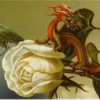
Perhaps a better way to begin though is to unfairly refer to the cover of this edition, its unfair but it seems apt, the act of observation the illustration suggests necessarily includes distortion, and it helps to be aware that the reflection isn't reality.
Miller admits that the historical background isn't his strength and that shows, there is no sense of how the different elements he discusses in his chapters relate to one another or indeed how as a whole it adds up to a science of mental life, except in the sense of 'behold the all the fun of of the fair'. Of a sudden people are chopping bits out of animals brains and then watching them navigate mazes and we don't get a sense of narrative - why did people think this was a good or useful idea , what were they hoping to learn, we might sit back from the book and assume that sadism is the principal driving factor in science, which I presume wasn't the author's intention.
There's no sense of a story of people attempting to find out how, or if the brain functions, nor does Miller approach from a clinical direction and see a search for better mental health. On the clinical side he points out late in the book that about 2/3s of cases of mental illness get better, and one assumes this despite the treatments provided I wonder if that 2/3s figure has shifted much if at all over time despite some changes in treatment - I assume removal of parts of the brain and then being pushed round a maze to find some cheese or a saccharine drink is no longer a current medical intervention.
He does put in six biographical chapters on Wundt, William James, Galton, Freud, Pavlov and Binet , but these lives all over lap, and several seemed to work in ignorance of the others so there is no sense of a scientific dialogue or a developing science, just there were these odd people. And a sense of wonder, in particular wondering who Heimholtz was and if he was so important to several of these figures why Miller didn't tell us something about him. Not that I am curious or nuthin'.
Binet and the whole business of measuring people's intelligence and mental capacities I found the most interesting (or possibly it was just that I was getting close to the end), Binet was the Frenchman who devised the I.Q. test this he did at the request of the French ministry of Education who sought a means of identifying the retarded children so they could be removed to special schools and helped , Binet didn't think much of his tests and they made no great impact apparently, but they got taken up with great enthusiasm in the USA and from there were reintroduced back into Europe, from her there was a smooth transition to discussing testing in the USA, in the army and then broadly by many employers, the author's attitude to these test is to cheat and to present yourself as hyper-normative This will win you promotions and a salary so big that you will need help to carry the cheque to the bank, and since in reality you are not hyper-normative, but typically neurotic, you will perform well enough in the new job that nobody will lose out.. What struck me about the Binet series of tests was an obvious point - how subjective they were, Binet and his collaborators were happy and confident about which children they thought were moronic and which in their view sufficiently normal, their purpose was to devise a set of tests so that anyone else conducting the test would reach the same conclusion that Binet and co would have done had they met the child. If a purely objective test of intelligence could be devised is itself I suppose a test of intelligence. Miller acknowledges that this was a problem with animal testing - the things animals were made to do in the laboratory are not much like their behaviour in nature and are not necessarily interesting or worthwhile predictors of what an animal will do and how it may do it to achieve a result that is meaningful to it, the same I suppose is true of children (and even adults) and standardised I.Q testing.
Miller is unequivocal that psychology is a science, it is just he at every opportunity shows that he prefers the intuitive, instinctual and creative sides to it that anything which can be demonstrated in a laboratory and reproduced independently in an applied setting. However, and this I have paid insufficient respect to in my updates. He has a nice turn of phrase to the half sentence, which makes for pleasant enough reading.
George Miller is a professor in psychology, behavior analysis scientist, president of the APA, chairman of the American Association of the Advancement of Science, multiple award recipient, a very apparent Sigmund Freud fan, and simply the author of this book. Basically, I can sum him up as a pretty smart guy who published this work in 1962, dedicating it to a fellow professor.
Let’s put it this way: this is a textbook for mind geeks, crazies, curious students, writers, actors, artists, etc. Since it is a pretty old one, by now we have much more accurate insights on lots of the topics discussed here, but as someone who was reading it with regard to its age and a certain historical interest, all I can say is that I loved the book! All of the topics mentioned are pretty standard psychology, so I’d say you should pick it up if you need a great introduction to the field, but if you’re an advanced nerd, this might be a bit boring for you (on the other hand, you can always read this for the purpose of arguing with the author’s opinions).
The writing style is quite easy, and the narrative is entertaining, I bet if we put ourselves in the shoes of a soul-searcher from the 60s we’d fall in love with the book (cuz at the time this stuff was pretty fresh and mind-blowing), but we are modern people with excessive confidence and internet availability, aren’t we? «Viva la wikipedia!», let’s say in unison.
«Each thing we think so desirable is desirable because we have learned to desire it.»
Introducción a la psicología que empieza por la parte hardcore, hablando de voltajes y potenciales en el cerebro, tiempos de reacción y un montón más de medidas experimentales que para el lego resultan bastante abrumadoras (aparte de no muy útiles). Luego sigue atacando el tema desde otras perspectivas y por el camino nos acaba contando biografías de célebres investigadores en el campo. Es un libro un tanto ecléctico y el orden que elige el autor para contarnos las cosas me confundió más de lo que me iluminó. No fue un libro que me enamorara. Es de principios de los 60, el consenso es que hay libros mejores ahora para nivel introductorio.
This is actually a very good book, for those interested in the clinical and/or empirical aspects of psychology. It also provides interesting short bios on key figures in the discipline. I gave it a low rating only because it did not serve my purpose that much. I am sure others would have a lot to learn from it.
Buen libro para aproximarse a la ciencia de la psicología.
No conozco en profundidad si el contenido del libro es realmente comprensivo con el desarrollo del campo de la psicología. Aun así, parece que sí recoge los puntos fundamentales del desarrollo de la psicología desde sus inicios hasta los 60, que es cuando se publicó este libro. Tiene sus partes más aburridas, como los capítulos sobre fisiología, pero son pasos necesarios para entender el desarrollo histórico de la psicología, por supuesto de manera comprimida.
Evidentemente, al haber pasado 60 años, habrán habido reinterpretaciones de hechos pasados y faltan los últimos desarrollos, especialmente los vinculados a la neurociencia. Por ejemplo, el libro Why We Sleep demuestra los enormes avances especializados en la ciencia del dormir, lo que en todo caso está en línea con la predicción del autor de que la psicología se especializaría en los siguientes años.
Finalmente, apuntar que no acabo de congeniar con la traducción del título, de "Psicology. The science of mental life" a "Introducción a la Psicología". Me recuerda a la traducción de "Die hard" por "La jungla de cristal".
Debería llamarse "Introducción a la historia de la psicología" y aún con ese título se quedaría corto, bueno para entender algunos términos muy básicos de la psicología, malo como inteoductor a la psicología. Completamente desfasado + blanqueamiento del psicoanálisis, meh.
If insanity is a sickness, it would seem to be a sickness of the brain. In order to cure it, therefore, one must understand how the brain works. This line of reasoning, as old as Hippocrates, but especially appealing to positivistic thinkers in the nineteenth century, led to many important discoveries about the psychological effects of organic injuries and diseases in the nervous system.Psychiatrists who worked in this tradition found their major ally was the neurologist, and their favourite theories of insanity were theories of neural damage. In spite of noteworthy successes, however, not all mental disorders could be traced directly to organic causes. The difficulties with a purely organic theory first became obvious, not in the study of psychosis, but in the study of neurosis. (As a rough and ready rule: If cognitive disorders pre-dominate, it is usually psychosis; if emotional disorders predominate, it is usually neurosis; if moral disorders predominate, it is usually psychopathy.) Once again a Frenchman led the way. The particular kind of neurosis that was to prove so very instructive was called hysteria. A patient with hysterical symptoms seems to have a great and senseless variety of bodily ailments. Parts of his body may be paralysed so that he cannot move them or cannot feel anything in them, his vision and hearing may be impaired, his memory may be faulty, and the like. - Alfred Binet, The Psychologist (Psychology : The Science of Mental Life by George A. Miller) . . This book is attempting to briefly explain what these scientists has done or contributed in their respective fields and researches. For someone who’ve almost zero to none knowledge in psychology, the introductory part is what prompted me wanting to read the book in the first place. Unfortunately, there was no way this book is for beginner or layman that simply wanted to learn about psychology or in the book context, the science of mental life. Is it the arrangement, is it the way it was written or is the subject is too dry that i felt wanting to DNF this few times, i can’t just pinpoint it. Aside from putting chapters of some prominent scientists (Ivan Petrovich , Pavlov Wilhelm Wundt, William James, Alfred Binet, Francis Gallon and Sigmund Freud) on this fields, the author also integrated many diagrams, summary of experiments and even theoretical approach that i am sure those who’ve psychology background will appreciate it. I enjoyed Freud chapter because i knew about him but the rest went above my head. This is definitely ‘its not you, its me’ situation whereby my inadequacy of the field / area caused me to not to enjoy what i am reading. I am pretty sure this will be a different story if i am a psychology student or at least possessed sufficient amount of psychology knowledge. That being said, this might be a treat for those who would like to revise and revisit the past conception of psychology and how it has changed over the years.