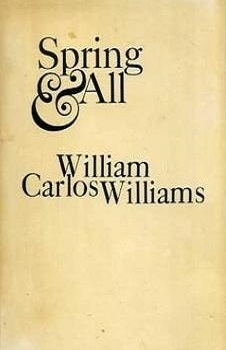
Spring is a time of rebirth and renewal; and in an intriguing little book titled Spring and All (1923), poet William Carlos Williams issues a quirky, radically original call for a sort of artistic renewal and rebirth – one predicated upon the absolute primacy of the imagination. Mixing as it does passages of prose and poetry, in a sometimes wildly unpredictable manner, Spring and All constitutes a kind of manifesto on behalf of true and total imaginative freedom. It is about 100 pages long, and it is one of the most challenging books that I have ever read.
William Carlos Williams’s career gives the lie to the old romantic conceit that, to be a “writer,” one must cut oneself off from everyday life and work, writing feverishly in one’s garret with only an occasional pause to look up with contempt at the meanderings of the “common” herd. Williams lived in and participated in the real world of human life and human endeavor. Born in Rutherford, New Jersey, Williams pursued a career as a physician, and achieved great success at it. As chief of pediatrics at Passaic General Hospital, he provided comfort and care to sick children for decades.
And while he was about it, he also became one of the pre-eminent American poets of the 20th century. Williams’s poetry, on some levels, certainly reflects the modernist idea that high art can provide some sense of order and meaning in an otherwise chaotic universe (both T.S. Eliot’s The Waste Land and James Joyce’s Ulysses were published in 1922, one year before Spring and All). Yet Williams’s work also has strong associations with Imagism, a movement that encouraged the artist to focus intensely on something very simple, in the hope that doing so will help the artist to arrive at some higher truth.
“The Red Wheelbarrow,” which appears in Spring and All, is worth focusing upon – both as, arguably, Williams’s most famous poem, and as a characteristic example of how his poetry brought together elements of modernism and imagism:
so much depends
upon
a red wheel
barrow
glazed with rain
water
beside the white
chickens (p. 74)
Here, one sees Williams’s characteristic, extremely close focus upon ordinary objects, his description of those objects in deceptively simple language – and an unstated, but unmistakable, suggestion that behind that seeming simplicity, one can find complex and profound higher truths. Rarely has a poet accomplished so much in a 4-stanza poem that is only 16 words long.
At the same time, “The Red Wheelbarrow” is not the only thing that Spring and All is about – far from it. As a manifesto, it argues for the primacy of the imagination over all other ways of trying to perceive reality. Near the beginning of the book, there is the following statement: “To whom then am I addressed? To the imagination” (p. 3). Shortly after, this statement receives the following elaboration:
And if when I pompously announce that I am addressed – To the imagination – you believe that I thus divorce myself from life and so defeat my own end, I reply : To refine, to clarify, to intensify that eternal moment in which we alone live there is but a single force – the imagination. This is its book. I myself invite you to come and see. (p. 3)
I like how the speaker could be Williams himself, saying that he is addressing himself to the subject of the imagination – or could be the book itself, saying, in effect, “Take a look at me. I am a book that is addressed, dedicated, to the power of the imagination” – even if the book is formally dedicated to the modernist painter Charles Demuth, a friend of Williams.
The very organization of the prose passages of Spring and All involves a kind of rejection of the attempt to achieve “realism” through an accretion of prosaic detail. The prose part of the book begins with Chapter 19, and then moves on to Chapter XIII (with the chapter title printed upside down!), Chapter VI, Chapter 2, Chapter XIX, and so on. Williams’s playfulness is on full display here. He wants the reader to be aware that any attempt to organize reality along “rational” lines is to some extent arbitrary.
By contrast, the passages of poetry in Spring and All proceed in an orderly manner, starting with the Roman numeral I and moving forward through II, III, IV, and so on – as if to suggest that the imagination, as embodied in and expressed through poetry, can convey reality in a way that the “prosaic” mind cannot. People who have composed in the old-fashioned vein are, to Williams’s mind, “THE TRADITIONALISTS OF PLAGIARISM.” They cannot capture life; they can only plagiarize it, in a kind of artistic cheating.
Williams insists that “Only through the imagination is the advance of intelligence possible, to keep beside growing understanding” (p. 28). For him, it is vital that art be nourished by imagination:
Truly men feel an enlargement before great or good work, an expansion but this is not, as so many believe today a “lie”, a stupefaction, a kind of mesmerism, a thing to block out “life”, bitter to the individual, by a “vision of beauty”. It is a work of the imagination. It gives the feeling of completion by revealing the oneness of experience; it rouses rather than stupefies the intelligence by demonstrating the importance of personality, by showing the individual, depressed before it, that his life is valuable – when completed by the imagination… (pp. 29-30).
He claims that the imagination’s “unique power is to give created forms reality, actual existence” (p. 49). Citing the career of William Shakespeare, who achieved such supreme feats of imagination in spite of coming from a thoroughly ordinary background in the English Midlands, Williams writes that Shakespeare’s “very lack of scientific training loosened his power. He was unencumbered” (p. 52). And, as if to put one final mike-drop stamp on this aspect of his anti-rationalist discussion, he concludes his disquisition on Shakespeare’s work by writing that the imagination “is a step over from the profitless engagements of the arithmetical” (p. 54).
As an example of the limitations of the rationalist approach to life, Williams at one point invokes the pioneering German psychologist Wilhelm Wundt: “I remember so distinctly the young Pole in Leipzig going with hushed breath to hear Wundt lecture – In this mass of intricate philosophic data what one of the listeners was able to maintain himself for the blinking of an eyelash. Not one. The inundation of the intelligence by masses of complicated fact is not knowledge” (p. 76). Anyone whose attention has wandered during a college or university lecture will no doubt relate to these ideas.
In contrast with the data-driven, analytical view of life represented by Wundt, Williams advocates “the imagination on which reality rides – It is the imagination – It is a cleavage through everything by a force that does not exist in the mass and therefore can never be discovered by its anatomitization” (pp. 76-77). And no, that last word is not a typo. Irregularities of orthography and punctuation abound in Spring and All – so much so that the book’s original publisher felt obliged to include a list of errata, as if to say, “This is how the author wrote it. I know better.”
Or does the publisher know better? My sense was that Williams was saying, subtly and mischievously, that too much focus on minutiae like grammar and mechanics can fetter the imagination; and for Williams, it’s all about the imagination. One hears in Williams’s work echoes of a fellow New Jerseyan, Walt Whitman. Do I contradict myself? Very well, I contradict myself. I am large, I contain multitudes.
Spring and All does contain some references to Spring the season; for instance, the volume’s well-known Poem I, with its famous first line “By the road to the contagious hospital” (a reference, perhaps, to Williams’s long and illustrious medical career), suggests that
Lifeless in appearance, sluggish
dazed spring approaches – (p. 12)
That passage of poetry is then followed by prose passages in which the reader is told that “At any rate, now at last spring is here!” (p. 14), and, shortly afterward, that “Meanwhile, SPRING, which has been approaching for several pages, is at last here” (p. 16). Yet the season of renewal to which Williams commits this book is metaphorical rather than literal – he calls for a springtime of the mind and heart, a time of restoration centered around the power of the imagination.
It was a challenge to the industrial, mechanical, big-money mindset of Williams’s time – and it is just as profound a challenge to our tech-oriented world as well. Williams would no doubt say that all our smartphones and laptops and tablets and other devices signify precious little, when compared with the power of the creative human imagination.