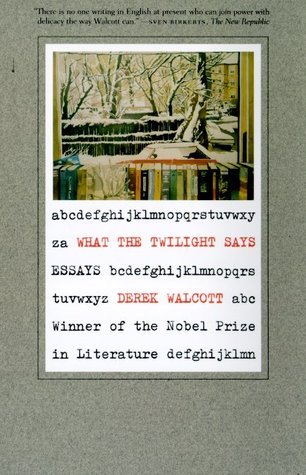
The first collection of essays by the Nobel laureate Derek Walcott, What the Twilight Says, drawn from pieces originally published in The New York Review of Books, The New Republic , and elsewhere.
This collection forms a volume of remarkable elegance, concision, and brilliance. It includes Walcott's moving and insightful examinations of the paradoxes of Caribbean culture, his Nobel lecture, and his reckoning of the work and significance of such poets as Robert Lowell, Joseph Brodsky, Robert Frost, Les Murray, and Ted Hughes, and of prose writers such as V. S. Naipaul and Patrick Chamoiseau.
On every subject he takes up, Walcott the essayist brings to bear the lyric power and syncretic intelligence that made him one of the major poetic voices of our time.
Derek Walcott was a Caribbean poet, playwright, writer and visual artist. Born in Castries, St. Lucia, he won the Nobel Prize for Literature in 1992 "for a poetic oeuvre of great luminosity, sustained by a historical vision, the outcome of a multicultural commitment."
His work, which developed independently of the schools of magic realism emerging in both South America and Europe at around the time of his birth, is intensely related to the symbolism of myth and its relationship to culture. He was best known for his epic poem Omeros, a reworking of Homeric story and tradition into a journey around the Caribbean and beyond to the American West and London.
Walcott founded the Trinidad Theatre Workshop in 1959, which has produced his plays (and others) since that time, and remained active with its Board of Directors until his death. He also founded Boston Playwrights' Theatre at Boston University in 1981. In 2004, Walcott was awarded the Anisfield-Wolf Lifetime Achievement Award, and had retired from teaching poetry and drama in the Creative Writing Department at Boston University by 2007. He continued to give readings and lectures throughout the world after retiring. He divided his time between his home in the Caribbean and New York City.
"Our bodies think in one language and move in another."
From WHAT THE TWILIGHT SAYS: Essays by Derek Walcott, collated in 1992.
#ReadCaribbean #ReadtheWorld21 📍Saint Lucia
For each month of Read the World 21, I am trying to read a Nobel Laureate. For the Caribbean, I read 1992 Nobel Prize for Literature winner, Derek Walcott.
Best known for his poetry, I went the non-traditional route and chose his selected essays. Of course, the poetic voice remains strong when writing about events, beliefs, personal history.
The collection pulls from the late 1970s through his 1992 Nobel Lecture, "The Antilles: Fragments or Epic Memory".
Walcott's early essays focused on the cleaved mind of post-colonial creators in the Caribbean, historical constructs, and how things are remembered. He paints a beautiful vision of the diversity of the "Antilles" in the Nobel Lecture after watching a South Asian diaspora drama, a retelling of the Ramayana, at an outdoor theatre in Trinidad.
Of his literary criticism essays, I most enjoyed his discussion of poetry and translation in "Magic Industry: Joseph Brodsky", lauding the work of fellow Nobel recipient, Russian poet Brodsky. Also, in "A Letter to Chamoiseau", his tribute to Martinquan writer Patrick Chamoiseau on his novel Texaco. This essay also delves into the Creole language differences between islands, and comparisons to real life events mentioned in Chamoiseau's novel. This underlined the fact that I need to get Texaco and read more Chamoiseau after so enjoying his Slave Old Man last year. . He delves into CLR James, Ted Hughes, Ernest Hemingway, and other (primarily male) authors and contemporaries. Among them, his fellow Caribbean Laureate, Trinidadian V.S. Naipaul. This early essay on Naipaul is conciliatory, praising some work, and criticizing only a bit. Written in 1987, this essay well pre-dates what became quite a literary feud. Interviews, op-eds, and then openly sniping each other...
I learned a bit of literary drama circa 2008 surrounding the battle of words between the two Caribbean Nobel Laureates, Walcott and V.S. Naipaul (who won the Nobel Lit Prize in 2001). Apparently much of this 'feud' came to a head at the Calabash Literary Festival in Jamaica in 2008, when Walcott wrote a poem calling out Naipaul's anti-Black racism and mocking his writing and press photos. Naipaul fired back with some words of his own too... Journalists reported it "got nasty".
Break a vase, and the love that reassembles the fragments is stronger than that love which took its symmetry for granted when it was whole.
I really need to read more Walcott. His thoughts on poetry, West Indian identity, racism, and history made for an absorbing book. Sometimes I was leafing backwards so I could re-read his thoughts again but really I just admired his love of the English language. He was a New World poet and I feel somewhat guilty for having neglected him up to this point.
My style had been, perhaps still is, that of the magpie. A bit here, a bit there, hopping from one poet to another, but it wasn't that of the buzzard.
This is also an excellent introduction to some of the authors he highlights. Hemingway, of course, but also Philip Larkin and Robert Lowell and Les Murray and Ted Hughes and Robert Frost...there are more but these alone kept me as happy as a June bug. He made me want to live in a secondhand bookshop.
Robert Lowell The windshield runs with tears as well as stars. AND Waves wash and batter him, and he never falls overboard. This was the New Englander in him.
Joseph Brodsky ...what one hears in his pages is the rough sound of a coniferous forest...
Philip Larkin The average face, the average voice, the average life had never been defined so precisely in English poetry until Philip Larkin.
Ted Hughes His poetry is lonely and remote. It sometimes snarls back at us like a hounded, embayed beast, cornered and bleeding.
Les Murray A man who has known deserts believes in wells.
Walcott's reason for this book's title is because he felt that every poet has a particular twilight in his soul. Butterflies can indeed survive rainstorms, can't they?
Really glad I’ve been digging into Walcott this summer — incredible writer, and in these essays he demonstrates himself to be an even more thoughtful reader. Could quibble with a bit of what happens in the first two essays re: language / art / colonial history and inheritance, but he writes so forcefully that even when I think I disagree I am nevertheless compelled. One of my favourite essays on Robert Lowell in here as well.
Brilliantly written essays — the ones on poets Philip Larkin, Robert Lowell, and Ted Hughes were highly illuminating. Walcott has a dazzling prose style that shimmers like his poetry, and he gets to the core of how these poets brought forth their themes and interests.
The original language dissolves from the exhaustion of distance like fog trying to cross an ocean, but this process of renaming, of finding new metaphors, is the same process that the poet faces every morning of his working day, making his own tools like Crusoe, assembling nouns from necessity, from Felicity, even renaming himself. The stripped man is driven back to that self-astonishing, elemental force, his mind. That is the basis of the Antillean experience, this shipwreck of fragments, these echoes, these shards of a huge tribal vocabulary, these partially remembered customs, and they are not decayed but strong. They survived the Middle Passage and the Fatel Rozack, the ship that carried the first indentured Indians from the port of Madras to the cane fields of Felicity, that carried the chained Cromwellian convict and the Sephardic Jew, the Chinese grocer and the Lebanese merchant selling cloth samples on his bicycle. And here they are, all in a single Caribbean city. Port of Spain, the sum of history. Trollope's "non-people." A downtown babel of shop signs and streets, mongrelized, polyglot, a ferment without a history, like heaven. Because that is what such a city is, in the New World, a writer's heaven.
We must read as far as the white whale draws us, beyond the tight, calendar hamlets and harbors of New England and its chapels with their harpoon spires, to a wider and more terrifying space, the elemental ocean, beyond provinciality, history, race, beyond America, beyond the sick anti-Semitic provincialities of Pound or the patriotic regionalism of Frost to a realm that only genius can depict. We must follow Moby Dick, the huge ribbed metaphor of the white whale carrying the freight of the republic's sins as the republic perishes in the whirlpool with a sole survivor, Melville-Ishmael, who is, despite Melville's convictions of racial superiority, a poet. Now that other races and other causes in the babel of the republic have been given permission to speak in the very language that ruled and defined them, must everything be revised by the new order? Does Frost's ironic, jocular accent not apply to them? But it does, because the new order would be repeating the old order if it made a policy of exclusion and an aesthetics of revenge.
The collection of essays covers musings on history and colonialism, literary influences and a story. The title essay was the most helpful for me in understanding Derek Walcott's poetry, as it shows his thoughts and preoccupations, if you will forgive the cliche, 'where he is coming from' and his search for a truly West Indian identity, separate from both that of the European colonial powers and an idealised tribal Africa. It is also the most finely nuanced, the furthest from my own experience and thus the most difficult. I wanted the author present, so I could ask him questions. His book of collected poems, Selected Poems of Derek Walcott, answers some of them, while raising a lot more. The poems themselves are good, haunting and memorable, and they cover a lifetime of writing. https://www.goodreads.com/review/show...
I read this having read some of Walcott's poetry for my postcolonialism class. There was something so enchanting and beautiful about his poetry that I wanted to explore more. And because of reading this I now want to read all of the poetry ever... It's just one big circle of always wanting to read more!
This book is a complex collection of postcolonial and modern culture. There is no doubt that the author's voice is distinct but empathetic as he diverges from poetry to prose. His references to known writers like Hemingway, Hughes, Naipaul offer a beautiful introduction to authors I enjoyed in school. His brilliance is displayed in a remarkable manner like he was performing an elegant dance as he does his groceries in the typical West Indian shop. He absorbs the smells and notes the surroundings and sounds thus producing a vivid image to one who has never visited this side of the world which is otherwise nostalgia for those who have been there. In short a descriptive historical fiction is what best sums up 'What The Twilight Says.' His poetic voice remains strong. His lyrics, fragments of epic memory. His poetic thoughts arrest me although I felt loneliness. And I think that is the Twilight he speaks about. Sometimes a little gruff: snarling at, backing me into a corner like a wounded animal.
Clearly the author adores the forest. I heard the rough sound of a coniferous forest within his pages. They took me back to The Botanical Gardens in Dominica even to Cabritts National Park.
Walcott's book's title made me ponder about the twilight in my own soul. It seems like he felt that every poet has a particular twilight in his soul. Butterflies can indeed survive rainstorms, can't they? The book took me back to days after Hurricane Maria devastated the island of Dominica and the deafening silence spoken about after the gnawing rage of the wind. It was heartwarming to see such familiar words like Fond St. Jacques, Mabonya, Forestièr, Roseau, Mahaut pronounced not in French—but in patois. How easily a cold and hard heart can be ignited. Love is seen in the leaves though they are illiterate, they create their own literature. Beautiful words. I encourage you to read this book. Find out what exactly The Twilight is trying to say to you.
Context is really important when reading these essays. Though they are beautifully written, I found them hard to follow until I oriented myself to the proper context. I don't have much of a background in Caribbean literature, and the first two essays were at times impossible for me to follow because of that. The third, Walcott's Nobel lecture, addressed to a more general audience, was much easier for me to grasp. The essays in the second section, which are reviews of specific works of specific writers, were delightful once I figured out that they were reviews (mostly, anyway). They were each a kind of conversation between two great poetic minds--it was almost magical. It would have helped to have the framing that would have accompanied the essays when originally published--for instance: "A review of To Urania, by Joseph Brodsky." Even something that simple would have helped a great deal. But the essays in the second section are gorgeous and thought-provoking, and they made me excited to explore poetry further.
The essays in Section I, a sort of theoretical exploration of the identity of Caribbean literature, are for me rhetorically dense, critically puzzling, and at times utterly incomprehensible.
Nonetheless, the radiant essays in Section II—especially those on Hughes, Frost, and Lowell—carried the book and provided ample personal anecdote and insightful lessons on the art of poetry.
The brilliant Cafe Martinique: A Story, a 10-page long short story that is the sole contents of Section III, perfectly embodies the many poetic truths and cultural observations made earlier in Section II, while more concretely depicting the Caribbean ethos abstractly described in Section I. Walcott masterfully spins a snapshot of nobility, folly, and artistic ambition out of a typical St. Lucian scene he would have encountered countless times.
The essays point out to breaking stereotypes of Carribean literature and instead of the usual post colonial rants, Walcott instead embraces his love for American and British poets like Phillip Larkin, Robert Lowell and Robert Frost to name a few. He is not a black writer or a Creole or Caribbean writer. He is a writer . His narrative gets me lost but somehow, I like where the perspective is driven also by the elegant and expressive essay writing
A rich collection of essays by a very accomplished writer. I had a hard time accessing a lot of this because I'm so unfamiliar with Walcott's context, his poetry, and most of the writers/poets he was writing about. And yet, it made me want to read more of his work and find some of the texts/poets he's referencing.
I very much liked Walcott's reflections on fellow poets and writers, particularly the essays on Robert Lowell, Robert Frost, and Joseph Brodsky. The rest of the book held less interest for me.